
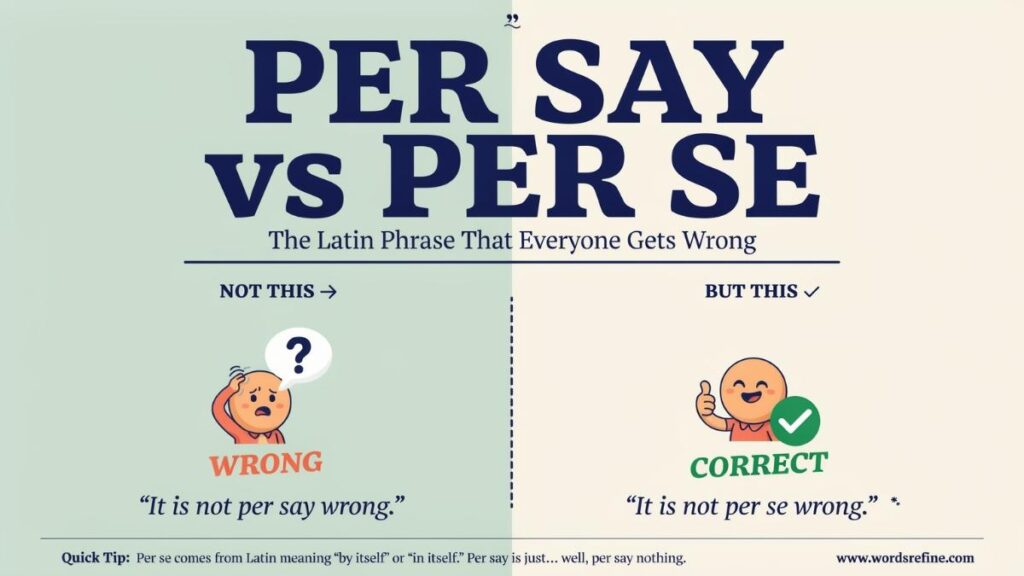
A tiny spelling difference per say vs per se can create a surprisingly big grammar headache, and per say vs per se is a perfect example. Since both forms sound almost identical, it’s easy to see why writers mix them up. However, there’s no need to let this little phrase cause a writing crisis. Per se is the correct expression, meaning “by itself” or “in itself,” while per say is a common misspelling. You’ll encounter per se in everyday conversations, academic writing, and professional discussions. But what makes this expression confusing, and how can you use it correctly? Let’s explore its meaning, pronunciation, and examples to put this spelling puzzle to rest.
Quick Answer Per Say vs Per Se
per say vs per se is the correct spelling. and Per say is a common spelling mistake that occurs when people write the expression according to how they pronounce it.
The confusion is understandable. When English speakers say per se aloud, the final syllable sounds like the familiar word “say.” Consequently, someone who hasn’t seen the expression in writing might naturally assume that it contains the English word “say.”
However, pronunciation doesn’t determine the established spelling.
Consider these examples:
Correct: The proposal isn’t expensive per se, but the additional fees make it costly.
Incorrect: The proposal isn’t expensive per say, but the additional fees make it costly.
The first sentence uses per se correctly because it distinguishes the proposal’s basic price from the additional expenses. The second sentence contains a spelling mistake.
Therefore, if you’re wondering whether to write per say vs per se remember that per se is the only accepted spelling of this expression.
Learn the difference between confusing more English words
Stripes vs Strips Meaning Differences and Correct Usage ?
Per Se Meaning Definition and Usage
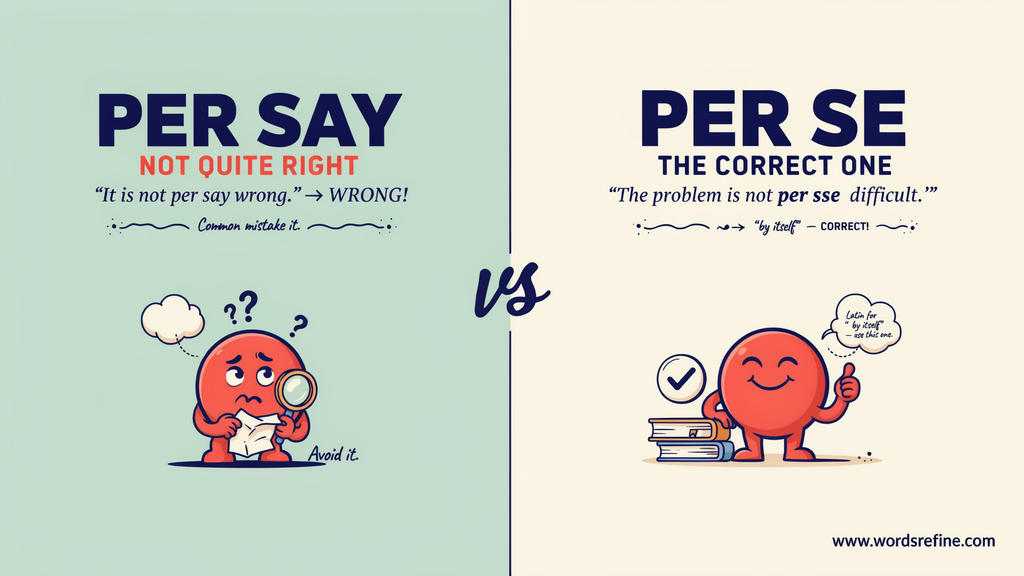
What does per se mean when someone uses it in a conversation or written statement?
Per se means “by itself,” “in itself,” or “considered independently of other factors.” It describes something according to its own qualities rather than the circumstances surrounding it.
In other words, the expression helps you separate an object’s inherent characteristics from the additional details that might influence how people understand or evaluate it.
For example:
“The job isn’t difficult per se, but the long working hours make it exhausting.”
Here, the speaker isn’t saying that the job itself is difficult. Instead, the demanding schedule creates the problem.
Similarly:
“Social media isn’t harmful per se, but excessive use can affect your well-being.”
This sentence doesn’t suggest that social media is inherently harmful. Rather, it distinguishes the platform itself from the possible consequences of using it excessively.
Per Se Definition in Simple English
The easiest way to understand per se is to think of it as an expression that asks you to consider something on its own.
It directs attention toward an object, action, quality, or situation without automatically including outside influences.
Depending on the context, you can understand it as meaning “by itself,” “in itself,” “on its own,” or “inherently.”
However, these expressions don’t always work as exact replacements. Although their meanings overlap, the surrounding sentence determines which alternative sounds most natural.
Understanding the Meaning of Per Se in English
Imagine visiting a restaurant that serves excellent food but provides terrible customer service.
Someone might say:
“The restaurant isn’t bad per se, but the service needs improvement.”
The speaker separates the restaurant’s overall quality from one particular problem. The food might be excellent even though the customer service disappoints visitors.
This distinction captures the central meaning of per se.
The expression doesn’t automatically describe something as good or bad. Instead, it helps you clarify what you’re judging and which surrounding circumstances you’re considering separately.
Consequently, it becomes particularly useful when you want to qualify a statement rather than make an absolute judgment.
Learn the difference between commonly mixed-up more words
Taylored vs Tailored Which One Is Correct?
Why Does This Spelling Mistake Happen?
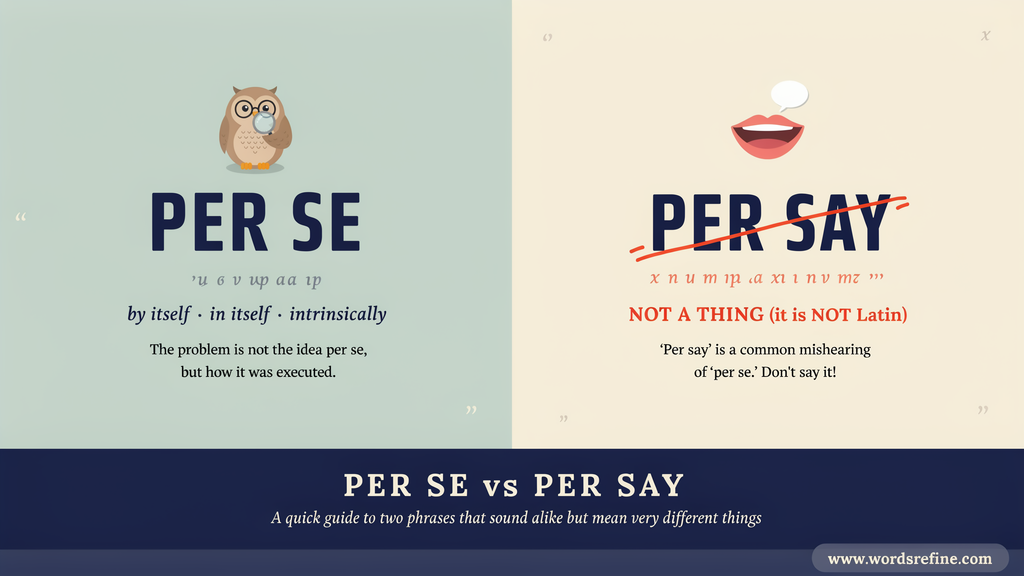
If per se is the correct spelling, why do so many people write per say?
The answer largely comes down to pronunciation and familiarity.
English contains many words that don’t follow predictable spelling patterns. It also borrows expressions from other languages, including Latin and French. As a result, people sometimes hear an unfamiliar expression and spell it using familiar English words.
That’s exactly what happens with per se.
Pronunciation Creates the Confusion
In English, per se is commonly pronounced with two syllables. The final syllable sounds similar to the word “say.”
When someone hears the expression without seeing it written, they might assume that the final word uses the familiar English spelling.
For example, someone might hear:
“That isn’t a problem per se.”
Later, when writing the sentence, they type:
“That isn’t a problem per say.”
The mistake happens because they remember the sound but not the original spelling.
Familiar English Words Influence Spelling
The word “say” appears frequently in everyday English. People recognize it immediately and know how to spell it.
By comparison, “se” looks unfamiliar when used outside its Latin expression. That unfamiliarity can make writers second-guess the correct form.
However, spelling depends on the expression’s established written form rather than simply how its final syllable sounds.
Is Per Say a Word?
The answer requires a small distinction.
Say is certainly an English word. However, per say isn’t the accepted spelling of the Latin expression meaning “by itself” or “in itself.”
You might encounter per say in online comments, informal messages, social media posts, and everyday writing mistakes. Nevertheless, seeing an incorrect expression repeatedly doesn’t make it a standard alternative.
Whenever you intend to express the meaning of “in itself,” use per se.
The Origin of Per Se Latin Meaning and History
The spelling of per se makes much more sense when you understand where it comes from. Unlike ordinary English expressions, this phrase has its roots in Latin, a language that has contributed thousands of words and expressions to modern English.
The expression comes from the Latin words per and se.
Per is a Latin preposition that can mean “through,” “by,” or “by means of,” depending on the context. Meanwhile, se is a reflexive pronoun meaning “himself,” “herself,” “itself,” or “themselves.”
Together, per se means “by itself” or “in itself.”
The expression entered English during the 16th century and retained its original spelling. Over time, English speakers adopted it as a convenient way to describe something independently of other circumstances.
Learn the difference between tricky grammar more words
Siked vs Psyched Which One Is Correct?
How Did Per Se Become Part of the English Language?
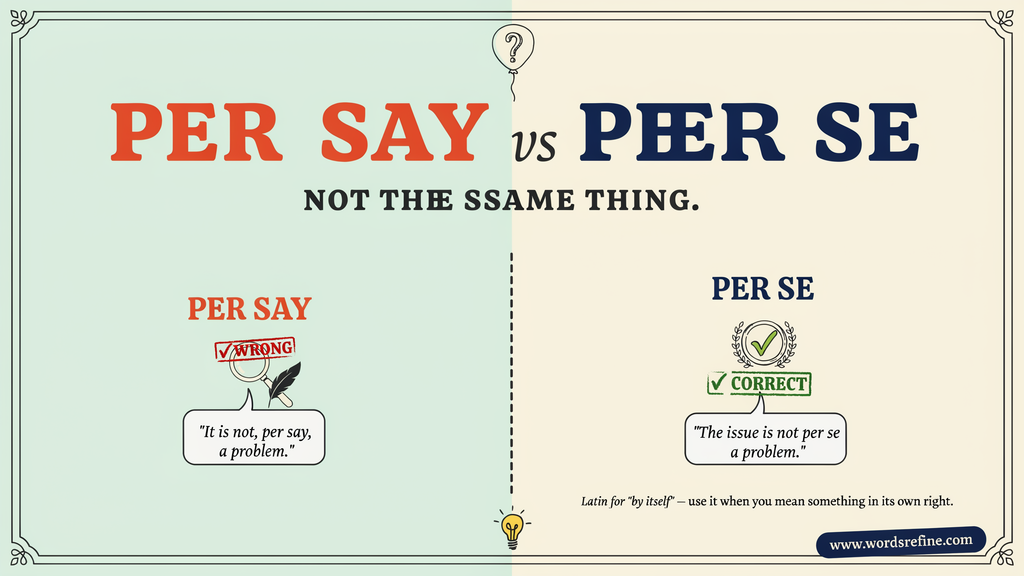
Latin influenced English for centuries, particularly through education, religion, philosophy, science, and law.
Scholars frequently used Latin expressions to communicate precise ideas. Eventually, several of those expressions became established parts of everyday English.
Per se followed a similar path.
English speakers adopted it because it offered a concise way to describe something according to its own nature. Rather than writing a lengthy explanation such as “when considered separately from everything else,” a writer could simply use per se.
The expression also appears in philosophical discussions, where distinguishing an object’s inherent nature from its external relationships can be important.
Today, you don’t need to study Latin to understand or use it. You only need to remember its meaning and established spelling.
Why Does Per Se Keep Its Latin Spelling?
Some borrowed expressions change their spelling as they become familiar in English. Others retain their original forms.
Per se belongs to the second group.
Its spelling remains unchanged even though English speakers pronounce it according to English sound patterns. That’s why the written form doesn’t always look the way people expect it to sound.
The same situation occurs with other Latin expressions, including ad hoc, meaning “for a particular purpose”; et cetera, meaning “and other similar things”; de facto, meaning “existing in practice”; and vice versa, meaning “with the order or relationship reversed.”
These expressions have established spellings that writers should learn rather than recreate from pronunciation.
Per Se Pronunciation How Do You Say It?
One reason people confuse per se with per say is that the correct pronunciation actually sounds like the incorrect spelling.
In American English, the expression is commonly pronounced with two syllables, with the main stress on the second syllable. The final sound rhymes with “day.”
The first syllable sounds like the beginning of “person,” while the second sounds like the familiar English word “say.”
Some pronunciation variations also exist, but they don’t change the spelling.
Whether you pronounce the final syllable like “say” or use the less common “see” pronunciation, the correct written expression remains per se.
Learn the difference between confusing word pairs
Ambassador vs Embassador Which Spelling Is Correct?
Does Per Se Have More Than One Pronunciation?
Yes. Some English pronunciation references recognize a variation in which the final syllable sounds like “see.”
However, the pronunciation that rhymes with “day” is widely recognized in American and British English.
The important point is that pronunciation and spelling serve different purposes. You can pronounce the expression correctly while still spelling it incorrectly if you write per say.
Therefore, learn the written form alongside its meaning rather than relying entirely on how it sounds.
How to Use Per Se Correctly in a Sentence
Knowing the definition is one thing. Using the expression naturally is another.
The best way to understand how to use per se is to look at what it does within a sentence. It usually qualifies a statement by separating something’s inherent qualities from other circumstances that might influence the situation.
In simple terms, it helps readers understand exactly what you’re referring to when you make a particular judgment.
Consider this example:
“Working from home isn’t difficult per se, but staying productive without a routine can be challenging.”
The sentence doesn’t suggest that working from home is inherently difficult. Instead, it identifies the lack of a routine as the real challenge.
Per Se Grammar Rules
Although per se has Latin origins, English grammar treats it as an adverbial expression.
There are several practical guidelines to remember when using it.
First, use it to qualify a statement. The expression works well when you want to distinguish something from its surrounding circumstances.
For example:
“The software isn’t complicated per se, but its installation process is confusing.”
Second, place it near the idea it qualifies. Writers commonly position per se after the noun, phrase, or concept they’re discussing.
For example:
“The issue isn’t the price per se; it’s the lack of quality.”
Third, use it when the distinction matters. Don’t add the expression merely to make a sentence sound sophisticated. It should clarify the relationship between an idea and its context.
For example:
“The policy isn’t unfair per se, but its implementation creates problems.”
Finally, avoid using it as a substitute for every adverb. Per se doesn’t automatically mean “exactly,” “particularly,” “generally,” or “specifically.” Choose the expression that communicates your intended meaning.
Learn the difference between often confused words
Simular vs Similar Which One Is Correct?
per say vs per se in a Sentence Practical Examples
The following examples demonstrate how per se works in different per say vs per se situations.
| Sentence | Meaning |
|---|---|
| I’m not against online shopping per se. | Online shopping itself isn’t the problem. |
| The assignment isn’t difficult per se. | The assignment isn’t inherently difficult. |
| Money isn’t the problem per se. | Money itself isn’t the main issue. |
| The movie wasn’t boring per se, but the ending disappointed me. | The movie wasn’t inherently boring, although one part was disappointing. |
| Exercise isn’t painful per se, but starting after a long break can be uncomfortable. | Exercise itself isn’t necessarily painful. |
| The company doesn’t oppose remote work per se. | Remote work itself isn’t what the company objects to. |
| His argument wasn’t unreasonable per se. | The argument wasn’t unreasonable when considered independently. |
| The change isn’t harmful per se, but it may create unexpected complications. | The change itself isn’t necessarily harmful. |
Notice how the expression often appears after the subject or idea being qualified.
It allows the speaker to make a more precise statement without rejecting an entire concept.
Can You Put per say vs per se at the Beginning of a Sentence?
Yes, but this construction is less common.
For example:
“Per se, the decision wasn’t unreasonable, but the timing was questionable.”
The sentence is understandable, but it sounds less natural than:
“The decision wasn’t unreasonable per se, but the timing was questionable.”
Most writers place per se after the word or phrase they want to qualify. This position makes the relationship between the expression and its intended meaning easier to understand.
Can You Use Per Se at the End of a Sentence?
Absolutely. The expression can appear at the end when it clearly qualifies the preceding statement.
For example:
“There’s nothing wrong with asking questions per se.”
Another example:
“She isn’t opposed to competition per se.”
Both constructions are natural because the expression refers directly to the ideas being discussed.
The important point isn’t whether per se appears in the middle or at the end. What matters is whether readers can easily identify the idea it qualifies.
Learn the difference between basic English word mistakes
Loosing vs Losing Which Is Correct? Meaning, Spelling, and Usage
Per Se Synonyms and Alternatives What Can You Use Instead?
Sometimes per se fits a sentence perfectly. Other times, a simpler expression sounds more natural.
Understanding its alternatives helps you choose the right words for different situations. However, remember that synonyms often have slightly different meanings. A replacement that works in one sentence might sound awkward in another.
| Alternative | Meaning | Example |
|---|---|---|
| By itself | Considered alone | The idea isn’t harmful by itself. |
| In itself | According to its own nature | The change isn’t problematic in itself. |
| On its own | Independently | The evidence doesn’t prove anything on its own. |
| Intrinsically | Naturally or inherently | The activity isn’t intrinsically dangerous. |
| Inherently | As a basic or essential quality | The material isn’t inherently unsafe. |
| Essentially | In its basic nature | The problem is essentially about communication. |
| Fundamentally | At the most basic level | The disagreement is fundamentally about priorities. |
| In and of itself | Considered independently | The decision isn’t wrong in and of itself. |
| In its own right | Having value or importance independently | The book is interesting in its own right. |
| As such | In the stated capacity or sense | The document doesn’t function as a contract as such. |
By Itself
By itself is one of the simplest alternatives to per se.
It describes something considered independently of other things.
For example:
“The rule isn’t unfair by itself, but the way people enforce it creates problems.”
This alternative works particularly well in everyday conversation because it sounds natural and requires no knowledge of Latin expressions.
In Itself
In itself is another close alternative.
It emphasizes the inherent nature or qualities of something.
For example:
“Technology isn’t dangerous in itself; irresponsible use creates risks.”
This construction often works interchangeably with per se.
Intrinsically
Intrinsically means that something possesses a particular quality as part of its essential nature.
For example:
“Competition isn’t intrinsically harmful.”
This word is useful in academic and professional writing. However, it sounds more formal than everyday alternatives.
Essentially
Essentially means fundamentally or in its basic nature.
For example:
“The disagreement is essentially about how the company should allocate its resources.”
Although it sometimes works as a replacement for per se, it doesn’t always express the same distinction. Use it when you mean “fundamentally” rather than simply “considered on its own.”
As Such
As such can mean “in that capacity” or “as the thing just described.”
For example:
“The building isn’t a museum as such, but it contains a collection of historical objects.”
This expression overlaps with per se in some contexts, but the meanings aren’t identical.
The best approach is to choose per se when you want to separate something’s inherent qualities from external circumstances. However, when a simpler alternative communicates the same idea more clearly, there’s no reason to make your sentence unnecessarily complicated.
Learn the difference between commonly misused words
Inclusivity vs Inclusiveness Which One Is Correct?
Common Mistakes to Avoid When Using per say vs per se
Even after learning the correct spelling, writers sometimes per say vs per se misuse the expression. The problem isn’t always spelling. Sometimes the sentence simply doesn’t communicate what the writer intends.
Here are some common mistakes worth avoiding.
Writing Per Say Instead of Per Se
This is the most obvious mistake.
Incorrect: The idea isn’t bad per say.
Correct: The idea isn’t bad per se.
The correction is simple. Replace per say with per se.
Using Per Se to Mean Exactly
Per se doesn’t mean “exactly.”
Incorrect: That’s per se what I wanted to say.
Better: That’s exactly what I wanted to say.
The first sentence uses the expression incorrectly because it doesn’t establish a distinction between something and its surrounding circumstances.
Confusing Per Se With Particularly
The words particularly and per se serve different purposes.
Incorrect: I particularly don’t dislike the idea per se.
Better: I don’t dislike the idea per se.
The revised sentence communicates the intended distinction without unnecessary wording.
Adding Per Se Without a Clear Purpose
Some writers use Latin expressions because they believe these phrases make their writing sound more sophisticated.
Unfortunately, unnecessary expressions can make a sentence harder to understand.
Wordy: The proposed arrangement isn’t problematic per se in its own inherent nature.
Better: The arrangement isn’t inherently problematic.
The second version communicates the same basic idea more efficiently.
Treating per say vs per As Such as Exact Synonyms
Although these expressions sometimes per say vs per se overlap, they aren’t interchangeable in every situation.
For example:
“The manager isn’t a lawyer per se.”
This means the manager isn’t a lawyer in the strict or inherent sense being discussed.
Now consider:
“The manager isn’t a lawyer as such.”
Depending on the context, this may mean the manager doesn’t hold that role or function in the relevant capacity.
Always consider the intended meaning before replacing one expression with another.
per say vs per se in Different Contexts Everyday Academic, Legal, and Professional Usage
Although per say vs per se has a formal Latin origin, English speakers use it in several settings. Its meaning per say vs per se stays consistent, but the context determines how naturally it fits.
Per Se in Everyday Conversation
People frequently use per se when they want to explain that something isn’t necessarily the problem.
For example:
“I’m not tired per se; I just need a break.”
“I don’t hate cooking per se, but I don’t enjoy washing dishes afterward.”
“The neighborhood isn’t dangerous per se, but some streets are poorly lit.”
“I’m not against spending money per se. I just prefer saving for important things.”
“The meeting wasn’t pointless per se, but we could have finished it much sooner.”
In everyday conversation, the expression often appears in sentences that begin with a qualification or clarification.
It helps people avoid making overly broad statements. Instead of saying that something is entirely good or bad, they can identify the specific circumstances that influence their opinion.
Per Se in Academic Writing
Academic writing often requires precise distinctions. Researchers need to separate a subject’s inherent characteristics from the conditions surrounding it.
That’s where per se becomes useful.
Consider these examples:
“The study does not suggest that technology per se improves student performance.”
“Economic growth per se does not guarantee equal opportunities.”
“The research examines the effects of social interaction rather than communication per se.”
“The treatment isn’t harmful per se, although certain combinations may create adverse effects.”
In these examples, per se helps writers identify exactly what their arguments address.
However, academic writing doesn’t benefit from Latin expressions simply because they sound sophisticated. If “by itself” communicates the same idea more clearly, there’s no reason to avoid it.
Per Se in Legal Writing
The expression also has a specific role in legal language.
Lawyers and legal scholars use per se when discussing something that is inherently unlawful or legally significant under a particular rule or doctrine.
For example, negligence per se refers to a legal doctrine under which violating a relevant statute may establish the breach-of-duty element of a negligence claim when the applicable legal requirements are satisfied.
Similarly, legal discussions sometimes use expressions such as illegal per se, negligence per se, nuisance per se, and conflict of interest per se.
Consider this example:
“Under the applicable statute, the conduct may be unlawful per se.”
Here, the phrase indicates that the conduct is unlawful under the relevant legal rule rather than requiring a separate assessment of every surrounding circumstance.
However, legal meanings depend on jurisdiction, statutes, and case law. The expression doesn’t automatically make every action unlawful or establish liability.
Per Se in Business and Professional Writing
Business communication often involves distinguishing a problem from the circumstances that create it.
For example:
“The project isn’t expensive per se, but the maintenance costs are substantial.”
“The employee isn’t underperforming per se; the expectations were never clearly communicated.”
“The company isn’t opposed to automation per se, but it wants to evaluate the long-term costs.”
“The new policy isn’t restrictive per se, although it introduces additional approval requirements.”
These sentences demonstrate how per se can help professionals discuss problems without making unnecessarily broad judgments.
It can be particularly useful in reports, evaluations, proposals, and discussions where precise wording matters.
Is Per Se Formal or Informal?
Per se is generally considered a formal or somewhat sophisticated expression. However, English speakers also use it in everyday conversations.
You can use it in professional writing and ordinary discussions, but the expression may sound unnecessarily formal when a simpler alternative would work.
Compare these examples:
More formal: The proposed strategy isn’t ineffective per se, but it requires additional resources.
More conversational: The strategy isn’t ineffective by itself, but it needs more resources.
Both sentences communicate a similar idea.
The first may fit a business report or professional discussion. The second sounds more natural in casual conversation.
When Should You Use Per Se?
Use the expression when you need to distinguish an inherent quality from external circumstances, qualify a statement to avoid an overly broad judgment, or clarify that something isn’t necessarily good or bad on its own.
It also works well when discussing concepts in academic, legal, and professional writing.
When Should You Avoid It?
Consider a simpler alternative when the sentence already communicates your meaning clearly, when you’re using the expression merely to sound sophisticated, or when your audience may not understand Latin expressions.
For example, by itself and in itself often communicate the same idea without making the sentence sound overly formal.
Good writing isn’t about using the most complicated expression available. It’s about choosing words that communicate your meaning accurately.
Learn the difference between everyday English mistakes
Labelled vs Labeled Which one Is Correct?
Per Say vs Per Se Correct and Incorrect Sentence Examples
Sometimes, seeing the wrong spelling next to the correct one is the easiest way to remember the difference per say vs per
The following per say vs per se examples cover several everyday situations.
| Incorrect Sentence | Correct Sentence |
|---|---|
| The idea isn’t bad per say. | The idea isn’t bad per se. |
| I’m not against technology per say. | I’m not against technology per se. |
| The job isn’t difficult per say vs per. | The job isn’t difficult per say vs per. |
| Money isn’t the problem per say. | Money isn’t the problem per se. |
| The movie wasn’t boring per say. | The movie wasn’t boring per se. |
| The policy isn’t unfair per say. | The policy isn’t unfair per se. |
| The business isn’t failing per say. | The business isn’t failing per se. |
| Exercise isn’t painful per say. | Exercise isn’t painful per se. |
| The subject isn’t complicated per say. | The subject isn’t complicated per se. |
| The decision wasn’t unreasonable per say. | The decision wasn’t unreasonable per se. |
Notice that every correction involves the same spelling change.
You don’t need to rewrite the entire sentence. Simply replace the incorrect expression with per se.
A Practical Example How One Phrase Changes a Statement
Imagine a manager reviewing an employee’s performance.
The manager says:
“The employee isn’t inexperienced per se, but the company hasn’t provided enough training.”
What does this mean?
The manager isn’t claiming that the employee lacks experience. Instead, the manager distinguishes the employee’s existing abilities from the training opportunities available at the company.
Now consider a slightly different statement:
“The employee is inexperienced.”
This sentence makes a much broader judgment. It doesn’t distinguish between the employee’s existing knowledge and the company’s training process.
That’s the practical value of per se. It allows writers and speakers to make careful distinctions without changing the central subject of their discussion.
Quick Tips to Remember the Correct Per Se Spelling
If you frequently confuse per say with per se, a few simple reminders can help.
First, remember its Latin origin. The expression comes from Latin, so its spelling isn’t based on the English word say.
Next, associate it with its meaning. Think “by itself” whenever you see per se.
Also, learn the complete expression rather than trying to spell it from sound. This makes it easier to recognize in both reading and writing.
Finally, check your work when proofreading documents. A grammar checker can help identify the incorrect spelling, but understanding the expression will help you avoid the mistake in the first place.
The easiest memory trick is this: The expression means “by itself,” and its correct spelling is always per se.
Learn the difference between more words people mix up
Flyer vs Flier Which one Is Correct?
Practice Session Per Say vs Per Se
- The correct spelling is ______, not per say.
- The expression ______ comes from Latin.
- Per se means “by itself” or “in ______.”
- The idea isn’t unreasonable ______, but it needs more explanation.
- Working from home isn’t a problem ______, although distractions can make it difficult.
- The movie wasn’t boring ______, but its ending felt unnecessarily long.
- Being quiet isn’t a weakness ______; it can also show thoughtfulness.
- The restaurant isn’t expensive ______, but its location increases the cost.
- The phrase is commonly pronounced like “per ______.”
- The spelling “per say” is a common ______.
- In the expression per se, the word “per” comes from ______.
- The phrase describes something considered on its ______.
- “In itself” is a possible alternative to ______.
- The decision wasn’t wrong ______, but the timing could have been better.
- You don’t automatically need ______ around per se.
- In legal writing, negligence ______ refers to a specific legal doctrine.
- The company didn’t break any rules ______, but its actions raised concerns.
- The expression can help distinguish an idea from other ______.
- The plan isn’t difficult ______, but it requires careful preparation.
- “By itself” is another way to express the meaning of ______.
- The word “per” can mean “for each,” as in five dollars ______ person.
- Per se usually appears after the word or idea it ______.
- The weather wasn’t unpleasant ______, but the strong wind made the trip uncomfortable.
- The expression retains its original ______ spelling.
- Remember to write per se, not per ______.
Answers
- Per se
- Per se
- Itself
- Per se
- Per se
- Per se
- Per se
- Per se
- Say
- Misspelling
- Latin
- Own
- Per se
- Per se
- Commas
- Per se
- Per se
- Factors
- Per se
- Per se
- Per
- Describes
- Per se
- Latin
- Say
Here’s a trusted source for clear more words Comparison:
FAQs
Why is it called per se?
Per se comes from Latin, where it means “by itself” or “in itself.” English adopted the expression to describe something considered independently, without including other factors or circumstances. That original meaning remains the same in modern English.
Do you say per say vs per se?
The correct expression is per say vs per se. Although it sounds like “per say,” the accepted spelling is per se. The word “say” is a common spelling mistake caused by the phrase’s pronunciation.
What is another word for per se?
Depending on the sentence, you can replace per se with “by itself,” “in itself,” “on its own,” “intrinsically,” or “inherently.” For example, “The idea isn’t bad per se” could become “The idea isn’t bad in itself.” Choose an alternative that preserves your intended meaning.
How do you put per se in a sentence?
Use per se when you want to discuss something on its own rather than considering its surrounding circumstances. It usually appears after the word or idea it describes.
Example: “The job isn’t difficult per se, but the long hours make it exhausting.”
What are five examples of sentences using per se?
Here are five examples that show how the expression works in different situations.
- The movie wasn’t boring per se, but its slow beginning tested my patience.
- Working from home isn’t a problem per se; managing distractions can be challenging.
- The restaurant isn’t expensive per se, although some dishes cost more than expected.
- Being quiet isn’t a weakness per se; sometimes listening is more valuable than speaking.
- The decision wasn’t wrong per se, but the timing could have been better.
How do you say per se in English?
Per se is commonly pronounced “per say” in English. The final syllable sounds like the English word “say.” Although the pronunciation resembles two familiar English words, the expression retains its Latin spelling.
Does per se need commas?
No, per se does not automatically require commas. You can usually place it directly in a sentence without additional punctuation.
For example: “The plan isn’t unreasonable per se, but it needs more preparation.”
However, use commas when the sentence’s structure or an inserted phrase requires them. The expression itself does not create a comma rule.
What does per se mean legally?
In legal language, per se means that something is considered unlawful or legally significant by its nature under a particular rule, rather than requiring separate proof of every related circumstance.
For example, negligence per se is a legal doctrine that may apply when someone violates a statute designed to protect a particular group from a specific type of harm. Whether the doctrine applies depends on the law, jurisdiction, and facts of the case.
What does per mean?
Per generally means “for each,” “by,” or “according to,” depending on the context. For example, “$10 per person” means each person pays $10, while “miles per hour” describes distance traveled in one hour.
In the Latin expression per se, however, per works with se to create the meaning “by itself” or “in itself.”
Learn the difference between often confused words
Reoccurrence vs Recurrence Which One Is Correct ?
Conclusion
A phrase can sound perfectly English while keeping its Latin roots, and per say vs per proves it. Although many people write per say because that matches its pronunciation, per se is the only correct spelling for the expression. It means “by itself,” “in itself,” or “considered on its own.”
The good news is that you don’t need to memorize complicated grammar rules to use it correctly. Simply remember its meaning, place it naturally in your sentence, and add commas only when the sentence structure calls for them.
So, don’t let a familiar sound fool you into making an avoidable spelling mistake. Per say may sound right, but per se is the expression that gets your writing right!

Diora AJS she is an experienced blogger and passionate English language enthusiast at Words Refine. With a keen eye for language and a love for clear communication, she writes practical content about grammar, word meanings, usage, and commonly confused terms. Her goal is to make English easier to understand through clear explanations and relatable examples, helping readers write accurately and communicate with confidence.