
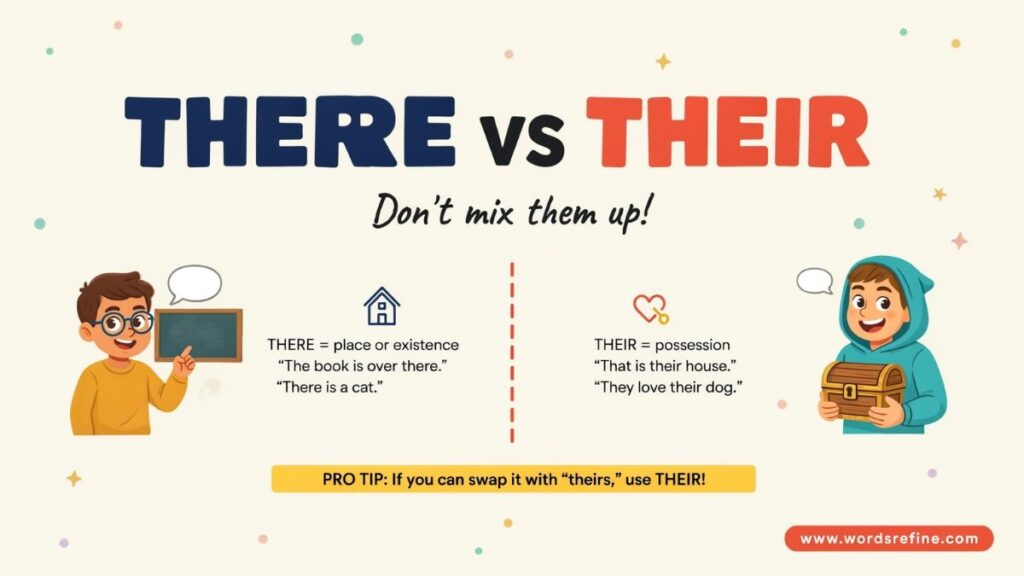
There vs their may seem like a small spelling mix up, but choosing the wrong word can completely change your sentence. One refers to a place or introduces something that exists, while the other shows ownership. Confuse them, and someone else’s money might suddenly end up in the wrong place! Although these words sound identical, they serve very different grammatical purposes. So, how can you tell when to use there or their? Fortunately, the difference is easier to understand than it looks. With simple explanations, practical examples, and a few helpful tricks, you’ll learn to use both words correctly and avoid these common grammar mistakes.
Quick Answer There vs their
The difference between There vs their comes down to location and possession.
There refers to a place, position, or the existence of something. You can use it to identify where something is or introduce something that exists.
Their shows that something belongs to or is associated with a person, group, or thing. It usually appears before a noun.
They’re is a contraction of they are. It describes what people are doing or what they are like.
Here’s a simple comparison:
| Word | Meaning | Example |
|---|---|---|
| There | A place or existence | There is a book on the table. |
| Their | Ownership or association | Their book is on the table. |
| They’re | They are | They’re reading a book. |
An easy way to remember these words is to connect each one with its purpose. Think of there as a location, their as possession, and they’re as they are.
Once you recognize what your sentence is trying to express, the correct choice becomes much clearer.
Learn the difference between confusing more English words
Drily vs Dryly Which One Is Correct?
What Does There Mean?
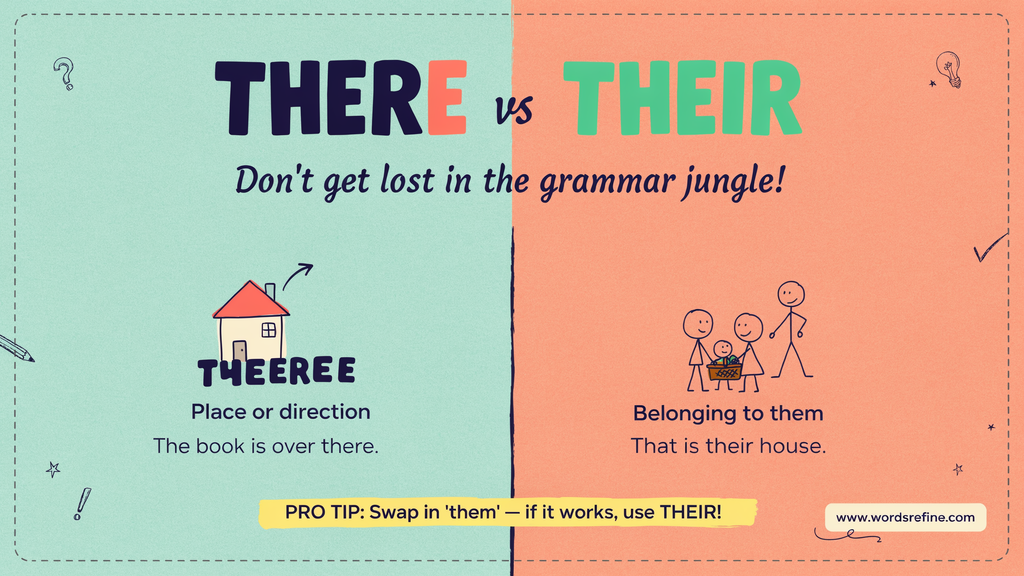
The word there has several grammatical uses. Most commonly, it identifies a location or introduces the existence of something. Its exact meaning depends on how you use it in a sentence.
For example, when someone asks where your keys are, you might answer, “They’re over there.” In this case, there identifies the location of the keys.
However, you can also use there to introduce something that exists. Consider the sentence, “There is a problem with the computer.” Here, the word doesn’t point to a particular place. Instead, it introduces the existence of a problem.
Understanding these two uses will help you recognize when there is the correct choice.
There as an Adverb of Place
The most familiar meaning of there relates to location. It tells readers or listeners where someone or something is.
Think of there as the opposite of here in many everyday situations. Here refers to the place where someone is, while there generally points to another location.
For example, consider these sentences:
Your backpack is over there.
We visited the museum, and several paintings were displayed there.
Please put the groceries there.
My friends are waiting there.
The restaurant is just around the corner from there.
In each example, there answers the question “Where?”
However, the word doesn’t always refer to a physical location. You can also use it to describe an abstract place or situation.
For instance, consider this sentence:
After several difficult months, she finally reached a better place emotionally. She’s much happier there.
Here, there refers to an emotional state rather than a physical location.
Similarly, someone might say, “I’ve been there before,” when referring to an experience rather than an actual place.
There as an Introductory or Existential Pronoun
There also appears at the beginning of sentences to introduce the existence or presence of something. Grammarians call this use existential there.
For example:
1There is a problem with the computer.
2There are three messages in your inbox.
3There was a strange noise outside.
4There were several people waiting in line.
5There will be a meeting tomorrow.
In these examples, there introduces information about something that exists, happened, or will happen. It doesn’t identify a particular location.
However, there’s an important grammar rule to remember. The verb must agree with the noun that follows it.
Consider the following examples:
| Singular | Plural |
|---|---|
| There is a problem. | There are two problems. |
| There was a student. | There were several students. |
| There is an opportunity. | There are many opportunities. |
The difference is simple. Use is or was with a singular noun and are or were with a plural noun in these constructions.
For example, “There is five students in the classroom” is incorrect in standard written English. The correct sentence is “There are five students in the classroom.”
Although people sometimes use singular forms informally in conversation, standard writing generally follows subject-verb agreement.
There in Common Expressions
You’ll also find there in several everyday expressions. Some of these phrases don’t refer to a specific location in the usual sense, but they still use the same word.
For example, “There you go” is something people often say when handing someone an item or confirming that something works.
Similarly, “There you are” can express satisfaction when you find someone or bring something to someone’s attention.
Other familiar expressions include “There it is,” “There goes the bus,” and “So there!”
Consider this example:
“There you go! You’ve finally fixed the printer.”
Here, there forms part of a common expression. It doesn’t indicate ownership, so their wouldn’t make sense in this context.
Learn the difference between commonly mixed-up more words
Annual vs Anual Which one Is Correct?
What Does Their Mean?
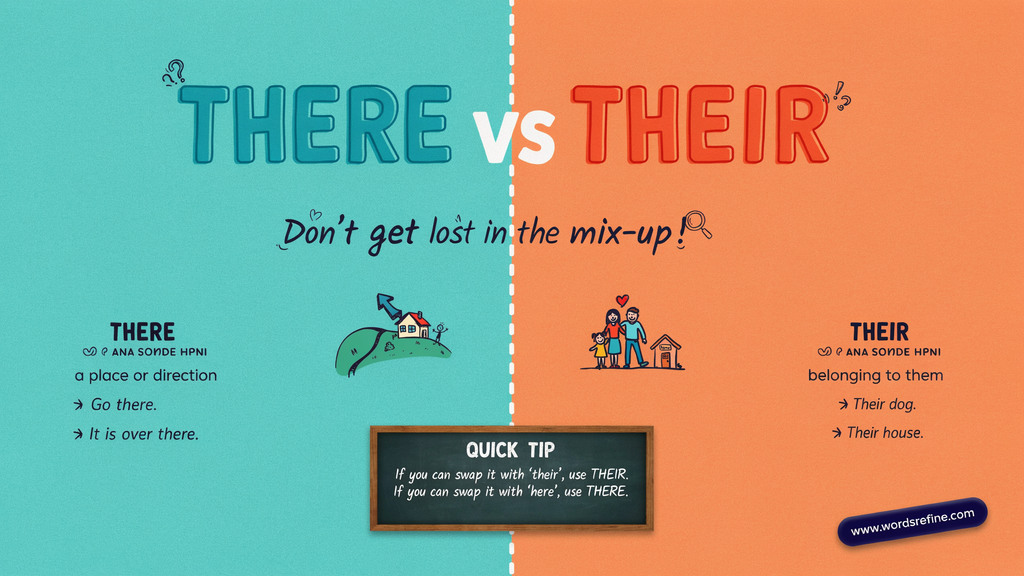
Unlike there, their has one central purpose: it shows possession or association.
Their is a possessive determiner. It appears before a noun to indicate that something belongs to or is connected with the people, animals, or things represented by they.
For example:
Their house is beautiful.
The students submitted their assignments.
The children forgot their lunchboxes.
My neighbors are painting their garage.
The company announced their new policy.
In each sentence, their identifies who owns or is associated with something.
For instance, in “Their house is beautiful,” the word their tells you that the house belongs to or is associated with a particular group of people.
Their as a Possessive Determiner
A possessive determiner identifies ownership and appears before a noun. Their works in the same way as my, your, his, her, and our.
Consider these examples:
| Personal Pronoun | Possessive Determiner | Example |
|---|---|---|
| I | My | My phone is ringing. |
| You | Your | Your jacket looks nice. |
| He | His | His car needs repairs. |
| She | Her | Her bag is missing. |
| We | Our | Our team won. |
| They | Their | Their team won. |
Notice how each possessive determiner connects someone with something that belongs to or is associated with them.
However, don’t confuse their with theirs. Although both words express possession, they work differently in a sentence.
Their comes before a noun, while theirs can stand alone.
For example:
Their house has a swimming pool.
That house is theirs.
The first sentence uses their because it comes directly before the noun house. The second uses theirs because the word replaces the noun phrase.
This distinction is useful when learning possessive forms in English.
Their for Singular and Plural Possession
A common misconception is that their can only refer to multiple people. However, modern English also uses their to refer to one person.
This usage is known as singular they.
You can use singular they when you don’t know someone’s gender, when gender isn’t relevant, or when an individual uses they/them pronouns.
For example:
Someone left their umbrella in the classroom.
Every student should bring their notebook.
The customer said their order hadn’t arrived.
Alex brought their laptop to the meeting.
In the first three examples, their refers to one person whose identity or gender isn’t specified. In the last example, it refers to Alex, an individual who uses they/them pronouns.
Singular they has a long history in English and is widely accepted in modern standard usage.
Therefore, their doesn’t always mean that something belongs to several people. Context determines whether it refers to one person or a group.
Their in Everyday Sentences
Their appears in conversations about families, workplaces, schools, relationships, and everyday responsibilities.
For example, at school, you might say, “The students finished their science projects before the deadline.”
At work, someone might write, “The employees discussed their new schedules with the manager.”
At home, you could say, “My parents are decorating their living room.”
Similarly, in sports, you might hear, “The players celebrated their victory after the final whistle.”
Another common example is, “Everyone should check their email before leaving.”
In each case, their connects a person or group with something they own, use, or are associated with.
Learn the difference between tricky grammar more words
Instinctually vs Instinctively Which One Is Correct ?
What Is the Difference Between There vs their

The difference between there and their becomes clear when you look at their meanings and grammatical functions.
There usually refers to a location or introduces the existence of something. Their, however, identifies ownership or association.
Although both words sound alike, they cannot replace one another without changing the meaning of a sentence.
Consider these examples.
There is a new restaurant downtown.
Their restaurant is downtown.
The first sentence tells you that a restaurant exists in a particular location. The second identifies a restaurant associated with a particular group of people.
Here’s another comparison:
The children are playing over there.
The children brought their toys.
The first sentence identifies where the children are playing. The second tells you who owns the toys.
Similarly:
There are several books on the shelf.
Their books are on the shelf.
In the first sentence, there introduces the existence of several books. In the second, their shows that the books belong to someone.
The main point is that the correct word depends on what you want to communicate. If you’re talking about a location or existence, choose there. If you’re showing possession, choose their.
There vs their Which Is Correct?
Neither spelling is inherently wrong. Both are standard English words, but each serves a different purpose.
For example, consider this sentence:
_____ house is near the park.
The correct choice is their because the sentence refers to a house belonging to or associated with someone.
Now consider:
The children are playing over _____.
Here, there is correct because the word identifies a location.
Finally:
_____ going to the park.
Neither there nor their fits. The correct choice is they’re because the sentence means they are going to the park.
Therefore, whenever you’re unsure which spelling to use, consider the meaning of the entire sentence rather than relying on pronunciation.
There vs Their vs They’re Understanding All Three
Just when you think you’ve solved the confusion, they’re joins the conversation.
The words there, their, and they’re are homophones. They sound alike but have different spellings, meanings, and grammatical functions.
This similarity makes them easy to confuse, particularly when writing quickly. However, understanding what each word does will help you avoid most mistakes.
Learn the difference between confusing word pairs
Cadaver vs Corpse Which One Is Correct ?
What Does They’re Mean?
They’re is a contraction of they are.
A contraction combines two words and replaces one or more letters with an apostrophe. In this case, the apostrophe replaces the missing letter in are.
They + are = They’re
For example:
1They’re going to the movies.
2They’re excited about their vacation.
3They’re waiting outside.
4They’re learning English grammar.
5They’re planning to renovate their kitchen.
A simple way to check whether they’re is correct involves replacing it with they are.
Consider this sentence:
They’re waiting outside.
Now expand the contraction:
They are waiting outside.
The sentence still makes sense, so they’re is correct.
However, try the same test with their:
Their waiting outside.
The result doesn’t work as a standard equivalent of the intended sentence. This tells you that they’re is the appropriate choice.
There Their vs They’re in the Same Sentence
One of the easiest ways to understand these three words is to use them together.
Consider this example:
They’re leaving their bags over there.
Each word has a different purpose. They’re means they are and describes what the people are doing. Their shows that the bags belong to them. There identifies the location where they’re leaving the bags.
Here are a few more examples:
They’re taking their children there after school.
The students said they’re keeping their books over there.
They’re bringing their friends to the restaurant over there.
Once you understand the function of each word, sentences like these become much easier to read and write.
There Their vs They’re Grammar Rules
Although the three words share the same pronunciation, their grammar rules are different.
| Word | Main Rule | Example |
|---|---|---|
| There | Use for a location or existence. | There is a meeting today. |
| Their | Use before a noun to show possession. | Their meeting starts at noon. |
| They’re | Use when you mean they are. | They’re attending the meeting. |
Remember that they’re contains an apostrophe because it combines two words. Their doesn’t need an apostrophe because it isn’t a contraction.
Understanding this distinction also helps you avoid confusing possessive words with contractions elsewhere in English.
Learn the difference between basic English word mistakes
Ironic vs Unironic Meaning, Differences, and Correct Usage
How to Remember the Difference Between There vs Their
Memorizing grammar rules can sometimes feel like studying a phone book. Fortunately, you don’t need complicated definitions to distinguish these words.
A few simple memory tricks can make the process much easier.
Connect There With Here
The word there contains the word here with an additional letter at the beginning.
This connection can help you remember that there relates to location.
For example:
Put the box here.
Put the box there.
Both words identify places, although they refer to different positions.
Whenever you’re talking about where someone or something is, think about the relationship between here and there.
Connect Their With Ownership
Think of their as a word that answers the question “Whose?”
For example:
Whose car is parked outside?
Their car is parked outside.
You can also compare their with other possessive determiners, such as my, your, his, her, and our.
My house, your house, our house, and their house all follow the same basic pattern.
If your sentence shows ownership or association, their is likely the correct choice.
Use the They Are Substitution Test
This trick works specifically for they’re.
Whenever you’re unsure whether to use they’re, replace it with they are.
For example:
_____ happy with the results.
Try the substitution:
They are happy with the results.
The sentence makes sense, so they’re is correct.
However, if replacing the word with they are creates an incorrect sentence, you probably need there or their instead.
Ask Three Simple Questions
When choosing between these words, take a moment to consider what your sentence means.
1If you’re talking about a place or introducing something that exists, use there.
2If you’re showing ownership or association, use their.
3If you mean they are, use they’re.
These three questions provide a quick and reliable way to distinguish the words in emails, essays, text messages, and everyday writing.
Learn the difference between often confused words
Enflamed vs Inflamed Which One Is Correct ?
Common Mistakes When Using There vs Their
Even though the difference between there and their is straightforward, these words frequently appear in the wrong places.
The problem often occurs because people rely on pronunciation rather than meaning. Since the words sound identical, spelling mistakes can easily slip into writing.
However, recognizing a few common errors can help you avoid them.
Using Their When Referring to a Location
Incorrect: Their is a beautiful park near my house.
Correct: There is a beautiful park near my house.
The sentence introduces the existence of a park. It doesn’t show ownership, so there is the correct choice.
Consider another example:
Incorrect: Put your shoes over their.
Correct: Put your shoes over there.
Here, the word identifies a location. Therefore, their doesn’t belong in the sentence.
Using There to Show Possession
Incorrect: There dog is barking loudly.
Correct: Their dog is barking loudly.
The sentence refers to a dog belonging to someone. Since it shows possession, their is necessary.
Here’s another example:
Incorrect: The employees submitted there reports.
Correct: The employees submitted their reports.
The reports belong to the employees, so their is the appropriate word.
Confusing Their With They’re
Incorrect: Their going to the concert tonight.
Correct: They’re going to the concert tonight.
The intended meaning is they are going to the concert. Therefore, they’re is correct.
Now consider the opposite mistake:
Incorrect: They’re house looks beautiful.
Correct: Their house looks beautiful.
The sentence identifies a house belonging to someone. It doesn’t describe an action, so their is the correct choice.
Confusing There Is vs There Are
Another common mistake involves subject-verb agreement.
Incorrect: There is five students in the classroom.
Correct: There are five students in the classroom.
The noun students is plural, so are is appropriate.
Compare these sentences:
1There is one apple in the basket.
2There are six apples in the basket.
3There was a problem with the order.
4There were several problems with the order.
Always check whether the noun following the verb is singular or plural. This small habit can improve the accuracy of your writing.
There vs Their in Different Writing Situations
These words appear in everyday conversations, but choosing the correct spelling becomes particularly important in writing.
A small mistake might not prevent readers from understanding your message. However, repeated errors can make your writing harder to follow and may give the impression that you haven’t checked your work carefully.
There vs Their in Academic Writing
Students frequently encounter these words in essays, research assignments, examinations, and classroom discussions.
For example:
Incorrect: Their are several reasons for climate change.
Correct: There are several reasons for climate change.
Another example:
Incorrect: The researchers explained there findings.
Correct: The researchers explained their findings.
Academic writing depends on clear sentence structure and accurate word usage. Choosing the correct word helps readers understand whether you’re discussing the existence of something or identifying its owner.
There vs Their in Professional Emails and Business Writing
Professional communication leaves little room for unnecessary confusion.
Imagine receiving this email:
“Hi, their are three documents attached for your review.”
The intended message is understandable, but the spelling mistake makes the email look careless.
A better version would be:
“Hi, there are three documents attached for your review.”
Similarly, consider this sentence:
Incorrect: The managers shared there recommendations.
Correct: The managers shared their recommendations.
Before sending an important email, check these words along with names, dates, and other details. A quick review can prevent small mistakes from distracting readers from your message.
There vs Their in Text Messages and Social Media
Fast typing makes homophone mistakes especially common in informal digital communication.
For example:
“Your friends are over their.”
The correct version is:
“Your friends are over there.”
In casual conversations, readers can often understand what someone means from the surrounding context. However, that doesn’t make the spelling correct.
Even a quick proofreading check can prevent these mistakes without slowing down your communication.
There vs Their Practical Sentence Examples
Sometimes, the best way to understand a grammar rule is to see it working in real sentences.
The following examples demonstrate how there, their, and they’re function in different situations.
Examples of There in a Sentence
There is a beautiful garden behind the house.
My keys are somewhere over there.
There are several restaurants near the station.
We stayed there for three nights.
There was a loud noise coming from the kitchen.
Is there enough food for everyone?
There will be an important announcement tomorrow.
I left my jacket there yesterday.
There seems to be a problem with the internet.
There are many ways to improve your writing.
Examples of Their in a Sentence
Their house has a beautiful garden.
The students forgot their homework.
My neighbors are renovating their kitchen.
The children packed their bags before leaving.
The employees discussed their responsibilities.
Everyone should bring their own water bottle.
The players celebrated their victory.
My friends invited me to their wedding.
The company announced their latest project.
Alex said their presentation was ready.
Examples of They’re in a Sentence
1They’re going to the supermarket.
2They’re excited about the new project.
3They’re waiting for their friends.
4They’re planning a family vacation.
5They’re learning how to write better sentences.
6They’re working on their assignments.
7They’re leaving for the airport tomorrow.
8They’re happy with the final results.
9They’re bringing their children to the party.
10They’re staying at a hotel near the beach.
There Their vs They’re Side by Side
Comparing the three words in similar sentences makes their differences easier to recognize.
| There | Their | They’re |
|---|---|---|
| There is a new teacher. | Their teacher is friendly. | They’re meeting their teacher. |
| There are two dogs. | Their dogs are playful. | They’re walking their dogs. |
| There is a problem. | Their problem needs attention. | They’re discussing the problem. |
| The books are over there. | Their books are missing. | They’re looking for their books. |
| There is a party tonight. | Their party starts at eight. | They’re organizing their party. |
Notice how each word changes the meaning of the sentence. Although the pronunciation remains the same, the spelling tells readers exactly what you intend to say.
A Practical Editing Example
Imagine that a student writes the following paragraph:
“The students arrived at school early. There teacher welcomed them, and their was a meeting in the classroom. They’re books were on the desks, and the students said there excited about the lesson.”
The paragraph is understandable, but several words are incorrect.
Here’s the corrected version:
“The students arrived at school early. Their teacher welcomed them, and there was a meeting in the classroom. Their books were on the desks, and the students said they’re excited about the lesson.”
The corrections become easier to understand when you look at the purpose of each word.
| Incorrect | Correct | Explanation |
|---|---|---|
| There teacher | Their teacher | Shows possession. |
| Their was | There was | Introduces existence. |
| They’re books | Their books | Shows ownership. |
| There excited | They’re excited | Means they are excited. |
This example highlights an important lesson: the correct spelling depends on grammatical function, not pronunciation.
Learn the difference between commonly misused words
Suffix vs Postfix Which One Is Correct?
Practice Session There vs Their
- The children forgot to bring _____ lunch boxes.
- _____ are several books on the table.
- My friends invited me to _____ wedding.
- Please put the keys over _____.
- The students submitted _____ assignments on time.
- _____ is something strange about this room.
- The birds returned to _____ nests before sunset.
- We visited the museum, and _____ were many interesting exhibits.
- The workers parked _____ cars outside the building.
- I left my notebook _____ yesterday.
- The parents packed _____ children’s clothes.
- _____ are two ways to solve this problem.
- The neighbors decorated _____ house for the holidays.
- Look over _____! A beautiful rainbow has appeared.
- The players celebrated _____ victory after the match.
- _____ is no reason to panic.
- The students gathered with _____ teachers in the hallway.
- My cousins live _____, near the river.
- Everyone should bring _____ own water bottle.
- _____ are plenty of opportunities to learn something new.
- The company announced _____ plans for next year.
- We couldn’t find the restaurant because _____ were no signs nearby.
- The children placed _____ shoes beside the door.
- Is _____ anyone who can help me with this task?
- The tourists took pictures of _____ favorite landmarks.
Answers
- Their
- There
- Their
- There
- Their
- There
- Their
- There
- Their
- There
- Their
- There
- Their
- There
- Their
- There
- Their
- There
- Their
- There
- Their
- There
- Their
- There
- Their
Here’s a trusted source for clear more words Comparison:
FAQs
Where Should You Use Their in a Sentence?
Use their before a noun to show that something belongs to or is associated with someone. For example, “The students left their books in the classroom.” Here, their indicates ownership.
Which Is Correct: Their vs There?
Both words are correct, but they serve different purposes. Their shows possession, while there refers to a location or introduces the existence of something. The correct choice depends on the meaning of your sentence.
Which Is Correct: Their Eyes vs There Eyes?
Their eyes is correct when referring to eyes belonging to someone. For example, “Their eyes sparkled with excitement.” The word their shows possession, while there cannot express ownership.
Which Is Correct There Money or Their Money?
Their money is correct because it refers to money that belongs to someone. For example, “They saved their money for a family vacation.” Using there in this sentence would be grammatically incorrect.
What Are Five Sentences Using Their?
Here are five examples that show how their works in everyday writing:
- The children packed their schoolbags.
- My neighbors painted their front door.
- The players celebrated their victory.
- Everyone should bring their identification.
- The employees discussed their new responsibilities.
What Is Another Word for Their?
There isn’t one exact replacement for their in every situation. Depending on the context, you can use phrases such as belonging to them, owned by them, or associated with them. For example, “Their house” can also mean “the house belonging to them.”
Which Is Correct Their Country or There Country?
Their country is correct when referring to a country associated with a particular person or group. For example, “They returned to their country after several years abroad.” The word their indicates possession or association.
How Do You Use There Correctly?
Use there to identify a location or introduce the existence of something. For example, “The library is over there” points to a place, while “There are several books on the desk” indicates that the books exist.
Where Can You Place There in a Sentence?
You can use there at the beginning, middle, or end of a sentence, depending on its meaning. For example, “There is a problem,” “I left my bag there,” and “The children are playing over there” all demonstrate correct usage.
Learn the difference between more words people mix up
Instalments vs Installments Which one Is Correct?
conclusion
There vs their may sound identical, but they serve very different purposes. Once you understand the distinction, choosing the correct word becomes second nature. Remember, their shows ownership, while there refers to a place or introduces something that exists. Whenever you’re unsure, take a moment to consider the meaning of your sentence. After all, you wouldn’t want someone searching for their money when you simply meant to tell them where it is! Paying attention to small grammar details makes your writing clearer, more accurate, and more professional. Master the difference, and you’ll have one less common writing mistake standing between you and confident communication.

Diora AJS she is an experienced blogger and passionate English language enthusiast at Words Refine. With a keen eye for language and a love for clear communication, she writes practical content about grammar, word meanings, usage, and commonly confused terms. Her goal is to make English easier to understand through clear explanations and relatable examples, helping readers write accurately and communicate with confidence.