
A tiny apostrophe can create surprisingly big grammar confusion, especially when you are writing Don’ts vs Donts Should you include it, leave it out, or let your spell checker decide? Before a simple phrase turns into a punctuation puzzle, let’s clear things up. The difference between “dos,” “do’s,” and “don’ts” depends on spelling conventions, contractions, and plural forms. Although these words look alike, each follows its own rules. Once you understand those differences, you’ll avoid common apostrophe mistakes and write with greater confidence. After all, punctuation should make your writing clearer, not leave readers wondering where the apostrophe belongs.
Don’ts vs Donts Quick Answer
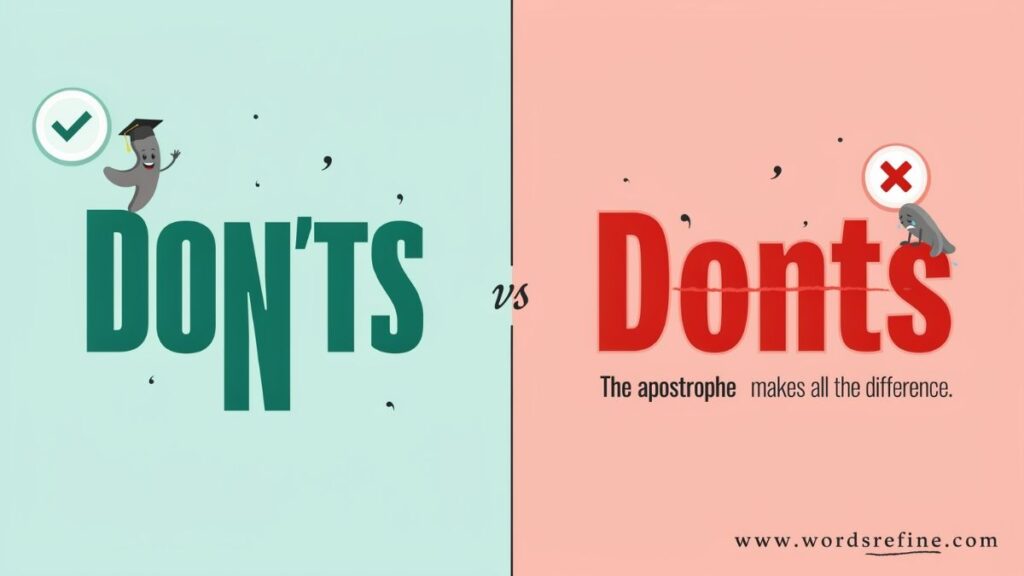
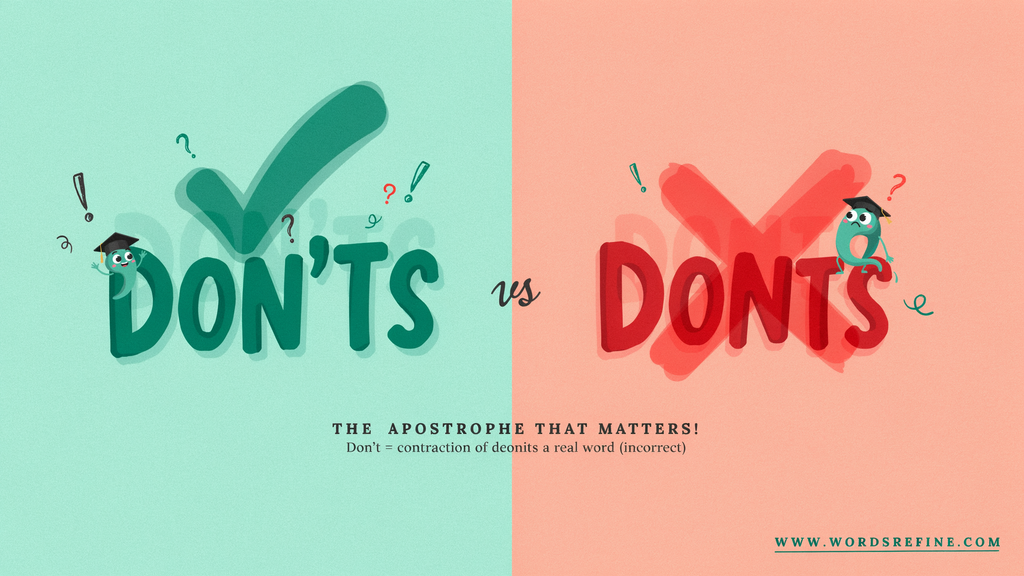
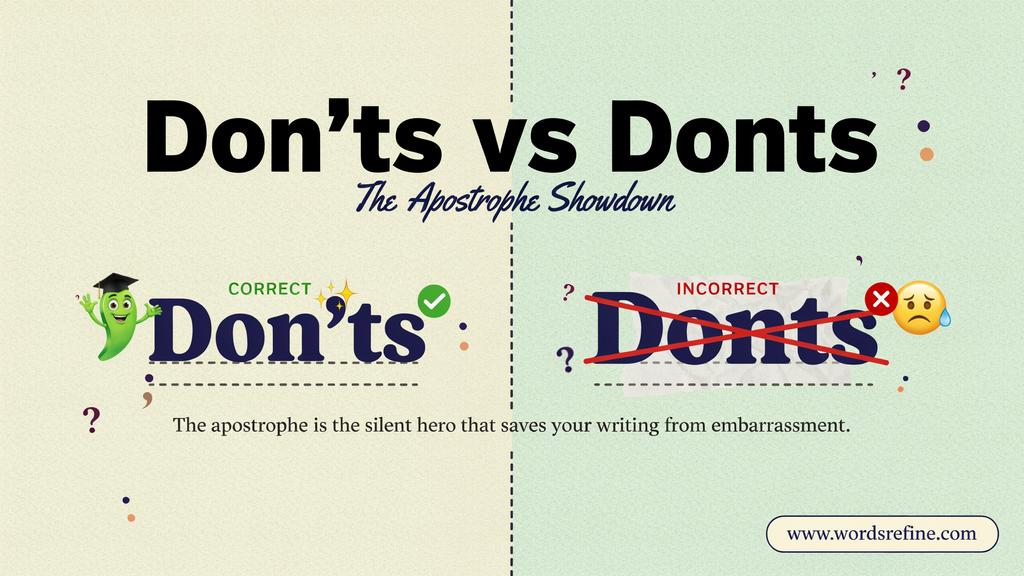
Don’ts vs Donts is the correct standard spelling, while “donts” is generally considered incorrect.
The apostrophe in “don’ts” comes from the contraction “don’t,” which means “do not.” It represents the omitted letter in the original expression. When you add an “s” to make the noun plural, the apostrophe stays in its original position.
For example, consider this sentence:
The employee handbook explains the dos and don’ts of workplace communication.
Here, “dos” refers to recommended actions, while “don’ts” identifies behaviors employees should avoid.
Writing “donts” removes the apostrophe and changes the standard spelling. Although readers might understand what you mean, the missing punctuation remains a spelling mistake.
The distinction is straightforward. Use “don’ts” when referring to multiple things people should avoid. Don’t remove the apostrophe simply because you’re making the word plural.
There is another detail worth understanding, though. The spelling of “dos” can vary depending on the writing style you follow. Chicago style prefers “dos and don’ts,” while AP style uses “do’s and don’ts.” Both forms communicate the same meaning.
Learn the difference between confusing more English words
Sited vs Cited Meaning Differences Examples and Correct Usage
What Does Don’ts Mean?
The word “don’ts” refers to actions, behaviors, or activities that people should avoid. It describes things that someone shouldn’t do in a particular situation.
For example, a workplace handbook might explain how employees should protect confidential information. It could also identify behaviors that violate company policies. The recommended actions are the dos, while the prohibited or discouraged actions are the don’ts.
Grammatically, “don’ts” functions as a plural noun. It comes from the contraction “don’t,” which represents “do not.”
Consider these sentences:
One important don’t is sharing your password with strangers.
The instructor explained the don’ts of laboratory safety.
Ignoring workplace safety procedures is one of the biggest don’ts in a manufacturing environment.
The travel guide includes several don’ts for visitors.
In each example, the word identifies something people should avoid. Notice that the apostrophe remains even when the sentence refers to several actions.
Understanding Don’ts in Everyday English
The meaning of “don’ts” depends on the situation, but it generally identifies discouraged, inappropriate, or prohibited behavior.
For instance, a workplace might tell employees not to share confidential documents with unauthorized people. A travel guide might advise visitors against ignoring local customs. Similarly, a teacher might explain why students shouldn’t copy another person’s work.
These situations all involve actions that people should avoid.
The word is particularly useful in instructional materials because it introduces restrictions without requiring a lengthy explanation. Instead of using a heading such as “Things You Should Avoid During Your Visit,” a writer can simply use “Important Don’ts.”
That simplicity makes the word common in everyday conversations, workplace documents, educational materials, and practical guides.
Learn the difference between commonly mixed-up more words
T- Shirt vs Tee Shirt Which One Is Correct and Why?
What Does Donts Mean?
Unlike “don’ts,” the spelling “donts” without an apostrophe isn’t the standard written form.
The missing punctuation matters because the original contraction is “don’t,” not “dont.” The apostrophe represents the omitted letter in “do not.” Removing it creates a spelling error rather than an accepted alternative.
Consider this example:
Incorrect: The employee handbook includes a list of donts for new staff members.
Correct: The employee handbook includes a list of don’ts for new staff members.
Readers will probably understand the incorrect version because the surrounding sentence provides enough context. However, understanding a word doesn’t automatically make its spelling correct.
This distinction becomes especially important in professional documents, academic assignments, articles, and published material. A missing apostrophe might seem like a minor issue, but careful punctuation helps make writing look polished and reliable.
Why Do People Confuse Don’ts vs Donts?
Several habits contribute to this mistake.
First, writers sometimes assume that adding an “s” automatically creates the plural form. That works for many ordinary nouns. For example, “book” becomes “books,” and “rule” becomes “rules.” However, “don’t” already contains an apostrophe because it is a contraction.
Another reason involves confusion between contractions and ordinary nouns. The two forms follow different Don’ts vs Donts spelling conventions. Someone who remembers that regular plurals don’t need apostrophes might mistakenly remove the apostrophe from “don’ts” as well.
Digital communication can also contribute to the problem. People often skip punctuation in text messages, search queries, and quick online conversations. Unfortunately, those shortcuts sometimes carry over into formal writing.
Finally, spell-checking tools don’t always recognize every error. Their suggestions depend on dictionaries, language settings, and context. Therefore, a missing apostrophe might occasionally escape notice.
The safest approach is to remember that “don’ts” retains the apostrophe from “don’t.”
Why Does Don’ts Have an Apostrophe?
The apostrophe in “don’ts” serves a specific grammatical purpose. It shows that the word contains omitted letters.
The original expression is “do not.” When speakers shorten it, they combine the two words into “don’t.” The apostrophe marks the omitted letter.
The same principle appears in other familiar contractions. For example, “cannot” becomes “can’t,” “will not” becomes “won’t,” and “is not” becomes “isn’t.”
When these contractions function as nouns, their apostrophes remain in their plural forms. That’s why writers use “can’ts” and “won’ts” in appropriate contexts.
The plural “don’ts” follows the same pattern.
Consider this sentence:
One of the company’s don’ts is discussing confidential information outside the office.
Here, “don’ts” identifies prohibited behavior. The apostrophe still marks the omitted letter from “do not,” while the final “s” indicates the plural form.
It’s important to understand that the apostrophe isn’t showing possession. Instead, it belongs to the original contraction.
Apostrophes generally serve several purposes in English. They indicate contractions, show possession, and occasionally help clarify unusual plural forms. However, ordinary plural nouns usually don’t need them.
For example, you write “employees,” not “employee’s,” when referring to several employees. Similarly, Chicago style uses “dos” rather than “do’s” because the word is an ordinary plural noun.
The difference becomes easier to recognize when you examine how each word is formed.
Learn the difference between tricky grammar more words
Envisage vs Envision Meaning Differences Examples ?
Don’ts vs Donts Understanding the Expression
The expression Don’ts vs Donts refers to recommended actions and behaviors people should avoid. It brings together two contrasting ideas in a short, familiar phrase.
“Dos” identifies things people should do, while “don’ts” identifies things they shouldn’t do.
For example, a travel guide might explain the dos and don’ts of visiting another country. Its recommendations could include respecting local traditions, following public transportation rules, and dressing appropriately at religious sites.
The expression works because it communicates both positive recommendations and restrictions without requiring a lengthy explanation.
You’ll often encounter it in instruction manuals, workplace policies, travel guides, educational materials, health and safety information, and everyday conversations.
Should Dos Have an Apostrophe?
This is where the spelling becomes slightly more complicated.
Under Chicago style, the plural of “do,” when used as a noun, is “dos.” The word refers to actions or things people should do. Since it is an ordinary noun, its plural generally takes an “s” without an apostrophe.
For example:
The instructor listed three dos for successful presentations.
Following these dos can improve your writing.
The article explains the dos of professional networking.
In each sentence, “dos” refers to recommended actions. The plural simply adds an “s.”
However, the Associated Press style convention uses “do’s” in the expression “do’s and don’ts.”
The reason is readability. Without an apostrophe, “dos” can resemble the Spanish word “dos,” meaning two. Adding an apostrophe helps readers recognize the intended English noun.
Therefore, both “dos and don’ts” and “do’s and don’ts” appear in established edited English. The difference comes from editorial preferences rather than a change in meaning.
Why Is Do’s Sometimes Written With an Apostrophe?
The spelling “do’s” may look unusual because ordinary plural nouns don’t usually take apostrophes. However, some style guides preserve this form in the familiar expression.
The Associated Press uses “do’s and don’ts,” while the Chicago Manual of Style prefers “dos and don’ts.”
This doesn’t mean that writers can add apostrophes to every ordinary plural. The preference applies to this particular expression.
For example, writing “book’s” when you mean several books is still incorrect. The same applies to ordinary plurals such as “rule’s,” “employee’s,” and “student’s.”
The important distinction is that an accepted editorial convention doesn’t create a general grammatical rule.
Don’ts vs Donts Which Is Correct?
Both spellings are used in published English, but major style guides don’t treat them identically.
The Chicago Manual of Style recommends “dos and don’ts.” The Associated Press convention uses “do’s and don’ts.”
The difference concerns the apostrophe in the first word. Both forms retain the apostrophe in “don’ts” because it belongs to the contraction.
Chicago style follows ordinary plural formation. Since “do” functions as a noun, its plural becomes “dos.”
AP style takes a slightly different editorial approach by adding an apostrophe to make the first word easier to recognize.
Neither form changes the meaning of the expression.
For example:
The website explains the dos and don’ts of online privacy.
The website explains the do’s and don’ts of online privacy.
Both sentences describe recommended and discouraged actions. The difference is simply a matter of punctuation.
What Does the Chicago Manual of Style Recommend?
The Chicago Manual of Style recommends “dos and don’ts.”
Its approach follows the general principle that ordinary plural nouns don’t need apostrophes. The first word is an ordinary noun, while the second retains the punctuation from its contraction.
This makes the expression consistent with the usual rules for forming plurals.
Chicago style is widely used in book publishing, academic editing, and professional writing. Therefore, writers working with publishers or institutions that follow this guide should use “dos and don’ts.”
What Does AP Style Recommend?
The Associated Press style convention uses “do’s and don’ts.”
This spelling is common in journalism and news writing. The apostrophe helps distinguish the noun “do” from other possible interpretations of the spelling.
However, AP’s preference doesn’t mean that “dos” is universally incorrect. It simply reflects a different editorial convention.
When writing for a newspaper, magazine, or news website, follow the publication’s preferred style. If no particular guide applies, choose one accepted form and use it consistently.
Learn the difference between confusing word pairs
Apprised vs Appraised Which One Is Correct and Why It Matters ?
Does the Difference Change the Meaning?
No. Both expressions communicate the same idea.
Whether you write “dos and don’ts” or “do’s and don’ts,” you’re referring to recommended actions and things people should avoid.
This is an important distinction because not every difference between published spellings represents a disagreement about grammar. Sometimes, editors simply choose different conventions to maintain consistency within their publications.
Don’ts vs Donts Understanding the Difference
Another common question involves “dont’s” and “don’ts.”
The correct standard spelling is “don’ts.”
The form “dont’s” places the apostrophe after the “t” rather than between the “n” and “t.” That position is incorrect because the original contraction is “don’t.”
The apostrophe must remain where it originally appeared.
Similarly, “don’t’s” isn’t the preferred standard plural form. Adding another apostrophe is unnecessary because the contraction already contains one.
Compare these examples:
“Don’t” is the contraction of “do not.”
“Don’ts” is the plural noun referring to actions people should avoid.
“Dont” is missing the required apostrophe.
“Donts” is also missing the required apostrophe.
“Dont’s” places the apostrophe incorrectly.
“Don’t’s” adds an unnecessary second apostrophe.
Once you understand the original contraction, these forms become much easier to distinguish.
Learn the difference between often confused words
Remediated vs Remedied Which One Is Correct ?
Common Mistakes With Dos vs Don’ts Grammar
Even experienced writers sometimes hesitate over this expression. The problem usually comes from applying one apostrophe rule to two different grammatical forms.
One common mistake is writing “donts” instead of “don’ts.” This removes the apostrophe that represents the omitted letter in “do not.”
Another mistake is writing “do’s and don’t’s.” Some writers assume that both words should follow the same punctuation pattern. However, the preferred forms are “dos and don’ts” under Chicago style and “do’s and don’ts” under AP style.
Confusing contractions with ordinary plural nouns can also cause problems. An apostrophe doesn’t automatically mean that a word is plural.
For example, “the student’s book” refers to a book belonging to one student, while “the students’ books” refers to books belonging to multiple students.
The apostrophe in “don’ts” has an entirely different purpose. It marks omitted letters rather than ownership.
Writers also sometimes add apostrophes to ordinary plurals. Writing “rule’s” when you mean several rules is incorrect. The correct form is simply “rules.”
Understanding these differences helps prevent punctuation mistakes in everyday and professional writing.
How to Use Don’ts vs Donts a Sentence
The expression works particularly well when you want to introduce positive recommendations alongside restrictions.
However, the wording should always fit the situation. A casual guide might use “dos and don’ts,” while a formal policy may benefit from more precise terms such as “permitted and prohibited actions.”
In everyday English, you might write:
The parents discussed the dos and don’ts of internet safety with their children.
Before visiting the museum, read the dos and don’ts for visitors.
The cooking guide explains the dos and don’ts of handling raw meat.
The instructor explained the dos and don’ts of driving in heavy traffic.
These examples show how the expression introduces practical advice without making the sentences complicated.
Don’ts in Workplace Rules and Professional Writing
Workplace documents often include recommendations and restrictions to help employees understand professional expectations.
For example:
The employee handbook outlines the dos and don’ts of workplace communication.
Managers should understand the dos and don’ts of giving constructive feedback.
The training session covered the dos and don’ts of handling confidential information.
The company published a guide to the dos and don’ts of remote collaboration.
In formal policies, however, a more precise heading may sometimes work better. For example, “Permitted and Prohibited Actions” can communicate legal or regulatory requirements more clearly than “Dos and Don’ts.”
Choose wording that matches the purpose and seriousness of the document.
Don’ts in Educational Guidelines
Students and researchers also encounter the expression in academic instructions.
For example:
The professor explained the dos and don’ts of academic citations.
The writing guide includes the dos and don’ts of using quotations.
Students should understand the dos and don’ts of responsible research.
The workshop covered the dos and don’ts of preparing a research proposal.
Academic writing often favors precise language. Therefore, use the expression when it suits the tone, but explain specific requirements whenever readers need more detail.
Don’ts in Online Writing
Websites, blogs, and digital publications frequently use this expression in headings because it is short and familiar.
For example:
The article covers the dos and don’ts of writing effective headlines.
Learn the dos and don’ts of sharing content on social media.
The guide explains the dos and don’ts of email marketing.
Follow these dos and don’ts when publishing images online.
When preparing digital content, consistency matters. Choose an accepted spelling convention and maintain it throughout the article.
Learn the difference between basic English word mistakes
Vaccum Vs Vacuum Which One Is Correct and Why It Matters ?
American English vs British English Is the Spelling Different?
American and British English generally use the same spelling for “don’ts.”
Neither variety treats “donts” as the standard form. The apostrophe remains because the word comes from the contraction “don’t.”
The difference you’re more likely to encounter comes from editorial style guides rather than regional spelling conventions.
You may also notice two different apostrophe characters. A straight apostrophe appears in “don’ts,” while a curly apostrophe appears in “don’ts.”
These are typographical variations. They don’t change the spelling or meaning of the word.
Straight apostrophes are common in plain-text documents, basic keyboard input, and digital environments. Curly apostrophes often appear in professionally typeset books, magazines, and published articles.
Both represent the same punctuation mark in this context.
The important thing is to place the apostrophe correctly and maintain consistent typography throughout your writing.
What Do Grammar Checkers and Style Guides Recommend?
Grammar checkers can help identify missing apostrophes, inconsistent punctuation, and common spelling mistakes. However, they don’t always recognize the editorial conventions behind every expression.
For example, one writing tool might suggest “do’s and don’ts” because it recognizes the AP convention. Another might prefer “dos and don’ts” because it follows Chicago style.
Neither suggestion automatically makes the alternative incorrect.
Dictionaries and style guides also serve different purposes. Dictionaries record words, meanings, spellings, and accepted usage. Style guides establish editorial preferences for particular types of writing.
A dictionary can help you understand whether a word exists and how people use it. A style guide tells you which spelling a newspaper, publisher, or academic institution expects.
The Chicago Manual of Style recommends “dos and don’ts,” while AP style uses “do’s and don’ts.” Other editorial resources may also have their own preferences.
This is why checking the requirements of your publication or organization is important.
Consistency matters just as much as choosing the correct form. A document that switches between different spellings without a clear reason can look poorly edited.
Before publishing an article, report, handbook, or academic assignment, check whether your organization follows a particular style guide. Then apply that convention throughout the document.
How to Remember the Correct Spelling
Apostrophe rules become easier when you understand why each mark appears.
For “don’ts,” start with “do not.” Shorten it to “don’t,” then keep the apostrophe when adding the plural ending.
For “dos,” remember that “do” functions as an ordinary noun meaning an action someone should take. Under Chicago style, its plural is “dos.”
If you’re following AP style, use “do’s and don’ts” instead.
The easiest way to remember the distinction is to focus on the original words rather than trying to make both forms look identical.
“Don’ts” retains its apostrophe because it comes from a contraction. “Dos” doesn’t need one under the standard Chicago convention because it is an ordinary plural noun.
Once you recognize that difference, the spelling becomes much easier to manage.
Learn the difference between commonly misused words
Octopus vs Octopi Which Plural Is Correct and Why?
Practice Session Don’ts vs Donts
- The guide explains the dos and ______ of online safety.
- “Don’t” is a contraction of “do ______.”
- The correct spelling is “don’t,” not “______.”
- An apostrophe can show ______.
- The plural of “book” is “______.”
- AP style uses “______ and don’ts.”
- My teacher explained the dos and ______ of writing essays.
- The students ______ understand the instructions.
- I added five ______ to my daily task list.
- The correct plural of “CD” is “______.”
- The word “don’ts” refers to things you should ______.
- The apostrophe in “don’t” replaces the missing letter ______.
- “The girl’s notebook” uses an apostrophe to show ______.
- The correct plural is “to-dos,” not “______.”
- We ______ need to follow every rule blindly.
- The handbook lists the do’s and ______ of workplace behavior.
- “Children” is already a ______ noun.
- The correct plural is “teachers,” not “______.”
- “Yours” is a possessive ______ that does not need an apostrophe.
- The phrase “dos and don’ts” describes things you should do and things you should ______.
- She wrote down three ______ before starting work.
- “Donts” is considered ______ in standard English.
- Use “don’t” when you mean “do ______.”
- The correct plural of “student” is “______.”
- Apostrophes are generally unnecessary when forming ordinary ______ nouns.
Answers
- don’ts
- not
- dont
- possession
- books
- do’s
- don’ts
- don’t
- to-dos
- CDs
- avoid
- o
- ownership
- to-do’s
- don’t
- don’ts
- plural
- teacher’s
- pronoun
- avoid
- to-dos
- incorrect
- not
- students
- plural
Here’s a trusted source for clear more words Comparison:
FAQs
When should I use an apostrophe, “s,” or “s” without an apostrophe?
Use an apostrophe with s to show possession or form certain contractions. Add s without an apostrophe to make most nouns plural. For example, “the teacher’s desk” shows ownership, while “three teachers” indicates more than one teacher.
Is there an apostrophe in “don’t”?
Yes. “Don’t” is a contraction of “do not.” The apostrophe replaces the missing letter o. Writing “dont” without an apostrophe is incorrect in standard English.
How do you write “Don’ts vs Donts” in AP style?
The Associated Press (AP) style uses “Don’ts vs Donts The apostrophe in “do’s” makes the plural easier to read, while “don’ts” retains the apostrophe from the contraction. If you’re writing for a publication, follow its preferred style guide.
How do you say “dos and don’ts”?
Pronounce “dos and don’ts” as “dooz and donts.” The expression refers to the things you should do and the things you should avoid in a particular situation.
How do you write “don’ts” correctly?
Write “don’ts” with an apostrophe between the n and t. It refers to several things people should avoid. For example, “The handbook explains the dos and don’ts of workplace communication.”
What does “Don’ts vs Donts” mean?
Don’ts vs Donts” refers to recommended actions and behaviors to avoid. For example, a travel guide might explain the do’s and don’ts of visiting another country.
Is “don’t” used for plural?
“Don’t” is a contraction, not a plural noun. However, you can use it with plural subjects such as we, they, and plural nouns. For example, “They don’t understand the instructions.” In the phrase “dos and don’ts,” the word “don’ts” refers to multiple things people should avoid.
Is it “to-dos” vs “to-do’s”?
Use “to-dos” when referring to tasks or items on a list. For example, “I added three to-dos to my planner.” The apostrophe isn’t necessary because to-do forms its plural by adding s.
What words don’t need an apostrophe?
Most regular plural nouns and possessive pronouns don’t need apostrophes. For example, write “books,” “students,” “yours,” “hers,” and “theirs.” Similarly, use “CDs” rather than “CD’s” when making an acronym plural. Remember, apostrophes show possession or mark omitted letters; they don’t usually make ordinary words plural.
Learn the difference between everyday English mistakes
Sublet vs Sublease Which One Is Correct ?
conclusion
Apostrophes might be tiny punctuation marks, but they can create some surprisingly big spelling headaches. Fortunately, choosing between “dos,” “do’s,” vs “don’ts” doesn’t have to be complicated. Remember that “don’t” is short for “do not,” while “don’ts” refers to actions or behaviors you should avoid. Meanwhile, both “dos” and “do’s” appear in English usage, depending on the style guide you follow. The key is to understand the difference and stay consistent throughout your writing. Whether you’re preparing a checklist, sharing advice, or writing instructions, getting these forms right will help you avoid common grammar mistakes. Keep apostrophes in their proper place, and let your words do the talking!

Diora AJS she is an experienced blogger and passionate English language enthusiast at Words Refine. With a keen eye for language and a love for clear communication, she writes practical content about grammar, word meanings, usage, and commonly confused terms. Her goal is to make English easier to understand through clear explanations and relatable examples, helping readers write accurately and communicate with confidence.