
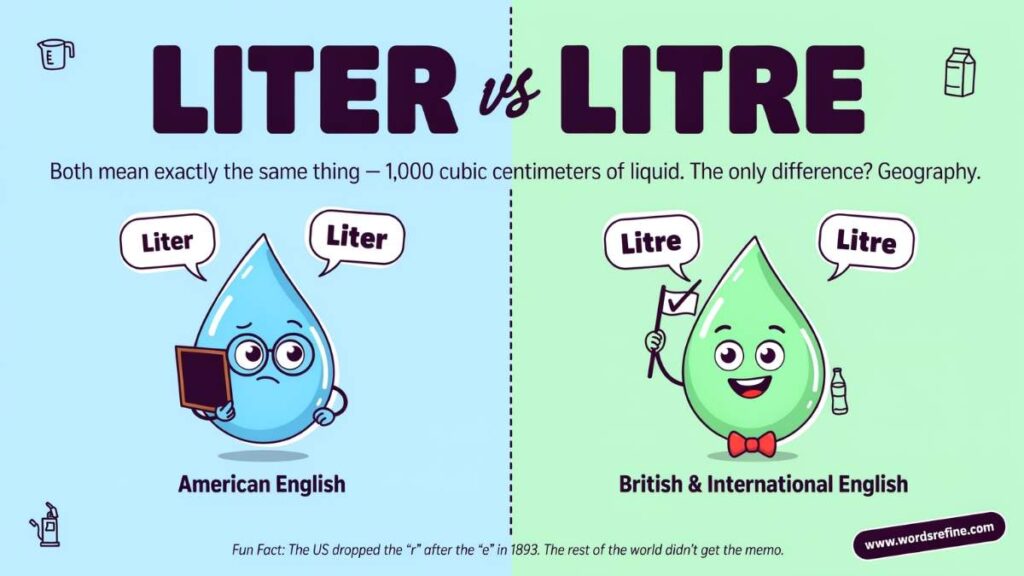
Have you ever stopped mid sentence wondering whether to write liter vs litre? You are not alone. This small spelling difference causes plenty of confusion, even among careful writers. Fortunately, both spellings are correct, so there’s no need to let one extra letter ruin your day. The choice simply depends on your audience. American English uses liter, while British English generally prefers litre. Although the spelling changes, the measurement remains exactly the same. Let’s explore the difference, clear up common grammar mistakes, and help you choose the right spelling with confidence. After all, good grammar shouldn’t leave you drowning in confusion!
Quick Answer Liter vs Litre
Liter is the standard American English spelling, whereas litre is the standard spelling in British English and several other English-speaking countries.
Both words describe a metric unit used to measure liquids and other substances by volume. For example, a bottle of water can contain one liter or one litre. The quantity remains the same regardless of which spelling appears on the label.
Here’s a simple comparison:
| Word | Where It Is Commonly Used | Example |
|---|---|---|
| Liter | United States | I bought two liters of milk. |
| Litre | United Kingdom | I bought two litres of milk. |
| Litre | Australia and New Zealand | The container holds three litres. |
| Litre | Canada, generally | The bottle contains one litre of water. |
Although these spellings look different, they have the same meaning. Therefore, you don’t need to memorize two definitions. You only need to remember which spelling suits your audience.
Learn the difference between confusing more English words
Choose vs Chose Difference and which one is Correct?
What Does Liter vs Litre Mean?
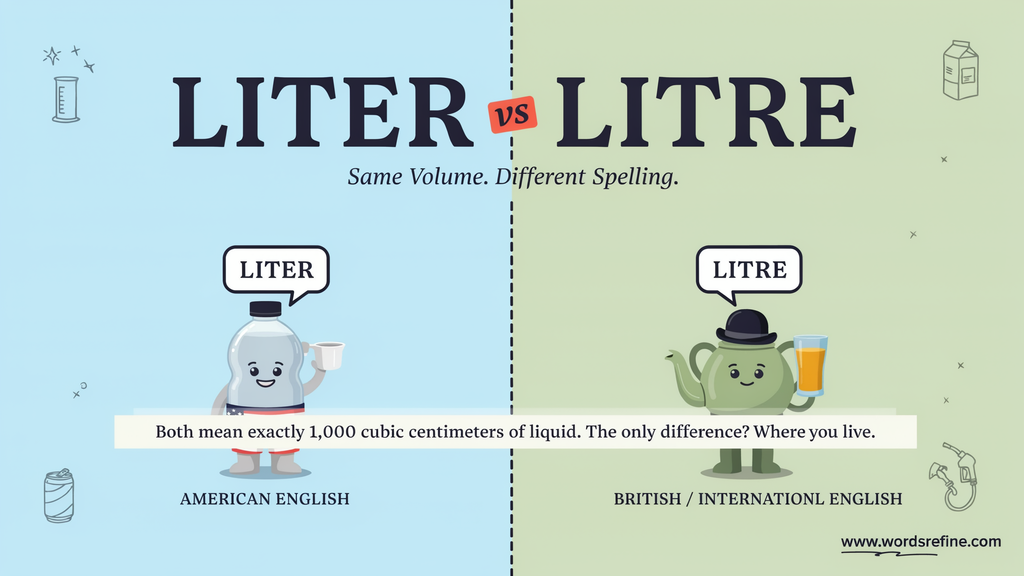
A liter or litre is a metric unit of volume. People commonly use it to measure liquids such as water, milk, juice, gasoline, and cooking oil. It can also describe the capacity of containers and the volume of certain substances.
One liter equals 1,000 milliliters. It is also equal to one cubic decimeter.
For example, imagine filling a one-liter bottle with water. If you pour that water into a container marked in milliliters, it will fill the container to the 1,000-milliliter mark.
The spelling doesn’t affect the measurement. A liter in the United States is exactly the same amount as a litre in the United Kingdom.
Liter vs Litre in Milliliters
Milliliters and liters are both metric units of volume. The main difference is their size.
A milliliter is one-thousandth of a liter. Consequently, you need 1,000 milliliters to make one liter.
Here are some useful conversions:
| Liters or Litres | Milliliters |
|---|---|
| 0.25 liter | 250 mL |
| 0.5 liter | 500 mL |
| 1 liter | 1,000 mL |
| 1.5 liters | 1,500 mL |
| 2 liters | 2,000 mL |
| 5 liters | 5,000 mL |
These measurements work the same way whether you use American or British spelling. For instance, a two-liter bottle in the United States contains the same volume as a two-litre bottle in Britain.
What Is the Symbol for Liter vs Litre?
The standard symbol for liter or litre is L. The symbol remains the same in both American and British English.
You may also encounter the lowercase symbol l. However, the uppercase L is often preferred because the lowercase letter can look like the number 1, especially in certain fonts.
For example, you might see the following measurements on a container:
- 1 L
- 500 mL
- 2 L
- 3.5 L
Notice that the symbols do not change according to the spelling used in the surrounding text. Even if a British label spells the word litre, it can still use L as its symbol.
Also, unit symbols generally do not take a plural ending or a period when used in standard scientific notation. Write 5 L rather than 5 Ls or 5 L.
Learn the difference between commonly mixed-up more words
Further vs Farther The Simple Difference and Each Correctly?
What Is the Difference?
The difference between liter and litre is regional spelling, not meaning, pronunciation, or measurement.
American English generally favors the spelling liter. British English traditionally uses litre. Other countries often follow British spelling conventions, although local practices and institutional guidelines can vary.
Consider these examples:
American English: The car has a 2.0-liter engine.
British English: The car has a 2.0-litre engine.
Both sentences describe an engine with the same capacity. The only difference is the letter arrangement in the unit’s name.
Similarly, a recipe might call for two liters of water in the United States and two litres of water in the United Kingdom. Either way, the cook needs the same amount of water.
Therefore, neither spelling is universally better. The appropriate choice depends on the variety of English you’re using.
Is Liter vs Litre the Correct Spelling?
Both liter and litre are correct spellings. However, they are not equally common in every country.
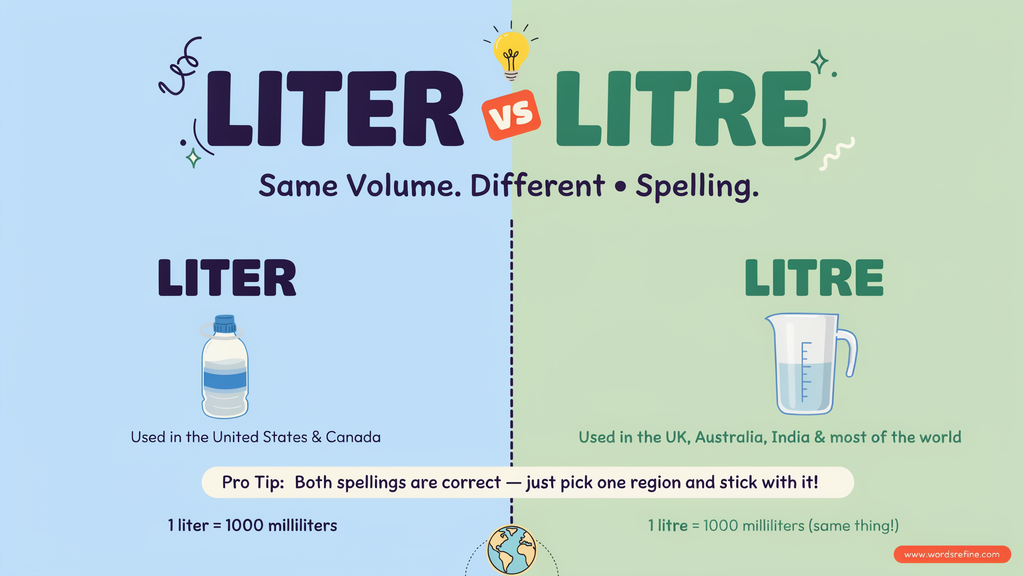
If you’re writing for an American audience, choose liter. If you’re writing for a British audience, choose litre. In Australia and New Zealand, litre is also the usual spelling.
Canada generally uses litre, although American spelling influences some writing and commercial material. When writing for a particular organization, it’s best to follow its style guide.
For example, an American student might write, “The bottle holds three liters of juice.” Meanwhile, a British student would normally write, “The bottle holds three litres of juice.”
Neither student has made a spelling mistake. Each has followed the spelling convention commonly used in their region.
The important thing is consistency. Avoid switching between liter and litre in the same piece of writing unless you’re discussing the differences between the two forms.
Why Does Litre Have an Extra E?
The difference between liter and litre comes from the development of regional English spelling conventions.
American English often uses simplified spellings that differ from traditional British forms. Examples include color and colour, center and centre, and theater and theatre. Liter and litre follow a similar pattern.
American spelling uses the ending -er, while British spelling generally uses -re. As a result, Americans write liter, whereas British writers use litre.
However, the difference doesn’t mean that one spelling is more logical or more accurate. Both forms have become established in their respective varieties of English.
You may notice similar spelling patterns in other words, but remember that English has exceptions. It’s better to learn the common spelling of each word than to assume every word follows the same rule.
Learn the difference between tricky grammar more words
Capital vs Capitol Which One Is Correct?
Liter vs Litre Pronunciation
Although liter and litre have different spellings, their pronunciation is generally the same or very similar in standard American and British English.
In American English, liter is commonly pronounced “LEE-ter,” with regional variations in the vowel sounds.
In British English, litre is often pronounced “LEE-tuh,” although pronunciation varies by accent.
The final sound may differ depending on the speaker’s accent. Nevertheless, both words refer to the same unit of volume.
For everyday conversation, you don’t need to worry about pronouncing one spelling differently simply because it contains an extra letter. The spelling changes, but the meaning stays the same.
American English vs British English Spelling
American and British English share most of their vocabulary, but some words have different spellings. These differences can appear in everyday writing, academic work, product packaging, and professional documents.
Liter and litre are a straightforward example of this distinction.
Liter in American English
In the United States, liter is the standard spelling. You’ll commonly see it on beverage containers, fuel-related information, cooking instructions, and scientific materials.
For example:
- The recipe requires one liter of water.
- She purchased two liters of orange juice.
- The tank holds 40 liters of fuel.
- The laboratory measured five liters of liquid.
In each example, liter follows American English spelling conventions.
If you’re writing a school assignment, business report, or article for American readers, use liter and its plural form, liters. Doing so keeps your spelling consistent with the audience’s expectations.
Litre in British English
In the United Kingdom, litre is the standard spelling. It appears in recipes, educational materials, scientific writing, and everyday descriptions of volume.
For example:
- The jug holds one litre of water.
- We bought two litres of milk.
- The vehicle has a 1.6-litre engine.
- Add three litres of stock to the pot.
These examples follow British English conventions. The measurements themselves remain identical to those expressed with the American spelling.
Canadian Spelling of Litre
Canadian English generally favors litre rather than liter. This spelling aligns with many Canadian English conventions, although American influence can sometimes appear in commercial and informal writing.
For example, a Canadian writer would typically write, “The bottle contains two litres of water.”
However, if you’re preparing a document for a Canadian company, school, or publication, check its preferred style guide. Consistency matters more than trying to apply a regional rule without considering the specific context.
Australian and New Zealand Spelling of Litre
Australian and New Zealand English generally use litre and litres.
For example:
- The container holds five litres of water.
- She bought a two-litre bottle of juice.
- The engine has a 2.0-litre capacity.
These spellings follow the conventions commonly used in both countries.
Nevertheless, the same principle applies everywhere: use the spelling that fits your intended audience and keep it consistent throughout your writing.
Learn the difference between confusing word pairs
Loose vs Lose Difference and which is Correctly?
Which Spelling Is Used in Pakistan and India?
English spelling conventions in Pakistan and India can vary by institution, publication, and context. However, British-style spelling is common in many formal and educational settings, so litre is widely used.
For example, you might see a school textbook describe a container as holding two litres of water.
Similarly, a science lesson might explain that one litre equals 1,000 millilitres.
Still, local preferences can differ, especially in international business, software, and American publications. If you’re writing for a particular school, employer, or publication, follow its established spelling conventions.
The key is to choose one form and use it consistently. Mixing liter and litre in the same document can distract readers, even though both spellings are correct.
Is Litre the Internationally Accepted Spelling?
The liter is a recognized metric unit of volume, and both liter and litre are accepted spellings in English. However, the spelling convention depends on the language or regional variety being used.
In international scientific and technical writing, the symbol L can help avoid confusion. For example, 2 L communicates the measurement clearly without requiring the writer to choose between liter and litre.
The liter is not an SI base unit, but it is accepted for use with the International System of Units. One liter equals one cubic decimeter, or 0.001 cubic meter.
When accuracy matters, focus on the measurement and its unit symbol. When writing ordinary prose, choose the regional spelling appropriate for your readers.
Liter vs Litre Singular, Plural, and Grammar Rules
The spelling difference also affects plural forms.
In American English, the singular form is liter, and the plural form is liters. In British English, the singular form is litre, and the plural form is litres.
For example:
- One liter of milk.
- Two liters of milk.
- One litre of milk.
- Two litres of milk.
The number determines whether you need the singular or plural form. Use the singular with one and the plural with quantities greater than one in ordinary contexts.
However, the word can remain singular when it functions as a modifier before another noun.
For instance, you would write “a two-liter bottle” in American English and “a two-litre bottle” in British English.
This construction describes the bottle’s capacity. It doesn’t mean the bottle contains two separate units that require a plural noun in the modifier.
Is It 5 Liter vs 5 Liters?
In standard American English, write “5 liters” when the measurement follows the number as a noun phrase.
For example: “The container holds 5 liters of water.”
When the measurement modifies another noun, use the singular form in a compound modifier.
For example: “We bought a 5-liter container.”
The same distinction appears in many other measurements. You would write “a 10-mile walk,” not “a 10-miles walk.”
Is It 5 Litre vs 5 Litres?
In standard British English, write “5 litres” when the measurement functions as a noun phrase.
For example: “The tank contains 5 litres of fuel.”
However, use the singular form when the measurement appears as a compound modifier before a noun.
For example: “The vehicle has a 5-litre tank.”
The difference is grammatical rather than mathematical. The amount stays the same, but the form of the word changes according to its role in the sentence.
Is It 100 Liter vs 100 Liters?
In American English, the standard form is “100 liters.”
For example: “The storage tank holds 100 liters of water.”
In British English, write “100 litres.”
For example: “The storage tank holds 100 litres of water.”
If the measurement modifies a noun, the singular form is normally appropriate: “a 100-liter tank” in American English or “a 100-litre tank” in British English.
Liter vs Litre Usage in Everyday Writing
You’ll encounter liter and litre in many everyday situations. The correct choice depends on the audience, but the basic meaning never changes.
Liter vs Litre in Recipes and Cooking
Recipes frequently use liters and milliliters to measure liquids such as water, milk, broth, and cooking oil.
An American recipe might say, “Add one liter of water to the pot.”
A British recipe might say, “Add one litre of water to the pot.”
Both instructions call for the same quantity.
When following a recipe from another country, pay attention to the units as well as the spelling. A recipe may use cups, fluid ounces, milliliters, or liters. These units are not interchangeable without conversion, even though liter and litre are simply alternative spellings of the same word.
Liter vs Litre on Product Labels
Product labels often show the volume of a liquid in liters or litres. You may see these words on bottled water, milk cartons, cleaning products, cooking oil, and fuel containers.
For example, a bottle may be labeled 1 L or described as containing one liter of water.
A British product may use the same symbol while spelling the word litre in its description.
The unit symbol makes the measurement easy to recognize across regional spelling differences. Therefore, if you’re comparing product sizes, focus on the stated quantity rather than the extra letter.
Liter vs Litre in Science and Education
In science classes, students often use liters and milliliters when measuring liquid volume. These units are useful in chemistry experiments, laboratory work, and practical demonstrations.
For example, a student might measure 250 milliliters of water and add it to a container holding another 750 milliliters. Together, the quantities equal one liter.
The spelling depends on the educational setting. American textbooks generally use liter, while British textbooks generally use litre.
Regardless of the spelling, students should understand the conversion between liters and milliliters and record measurements accurately.
Learn the difference between basic English word mistakes
Lay vs Lie Difference and which is correct?
Liter vs Litre in Technical and Professional Writing
Technical documents may use liter or litre when describing tank capacity, engine displacement, storage volume, or liquid consumption.
For example, a report might state that a machine uses 12 liters of liquid per hour. A British report could express the same information using litres.
In technical writing, clarity and consistency are especially important. If a document uses American English, maintain that spelling throughout. If it follows British English, use the British form instead.
Where space is limited or international readers need a clear measurement, the symbol L can be a practical choice.
Common Liter vs Litre Mistakes to Avoid
Although the difference between liter and litre is simple, writers sometimes make avoidable mistakes. Fortunately, a few basic rules can help you keep your writing accurate.
Mixing American and British Spellings
One common mistake is switching between liter and litre without a reason.
For example, an American article might begin with “one liter of water” and later refer to “five litres of milk.” Both spellings are valid, but using them together without explanation can make the writing look inconsistent.
Choose the spelling that matches your audience, then use it throughout the document.
Using the Wrong Plural Form
Another mistake is forgetting to add the plural ending when the word functions as a noun.
In American English, write “three liters,” not “three liter.” In British English, write “three litres,” not “three litre.”
However, remember that compound modifiers usually take the singular form. For example, “a three-liter bottle” is correct in American English, while “a three-litre bottle” is standard in British English.
Confusing Unit Symbols With Abbreviations
The symbol L represents both liter and litre. You don’t need to change it according to the regional spelling.
For example, write 2 L for two liters or two litres. The uppercase L is generally preferred because it is easier to distinguish from the number 1.
Also, avoid adding an ordinary plural ending to the symbol. Write 5 L, not 5 Ls.
Assuming Liter and Litre Have Different Meanings
The extra letter in litre doesn’t indicate a different quantity or a special type of liquid.
A liter and a litre are the same unit. One liter equals one litre, and both equal 1,000 milliliters.
If you see the two spellings on products from different countries, there is no need to worry about a measurement difference. Check the actual quantity and unit instead.
Confusing Liter With Litter
Liter and litter look similar, but they have different meanings.
Liter refers to a unit of volume. Litter usually refers to waste left in a public or outdoor place, such as empty bottles and wrappers. It can also refer to a group of animals born to the same mother at one time.
For example:
- The bottle contains one liter of water.
- Please don’t leave litter in the park.
- The dog gave birth to a litter of puppies.
Although the words sound similar, their meanings are unrelated. Choosing the right word makes a significant difference to your sentence.
Learn the difference between commonly misused words
Whoever vs Whomever How to Use Each Word Correctly?
Liter vs Litre Examples A Practical Comparison
Sometimes, the easiest way to understand a spelling difference is to compare the words in complete sentences.
| American English | British English |
|---|---|
| I bought two liters of milk. | I bought two litres of milk. |
| The tank holds 50 liters of water. | The tank holds 50 litres of water. |
| Add one liter of broth. | Add one litre of broth. |
| She filled a 2-liter bottle. | She filled a 2-litre bottle. |
| The engine has a 1.5-liter capacity. | The engine has a 1.5-litre capacity. |
As you can see, the sentences express the same information. Only the spelling changes.
When writing your own examples, think about your audience first. If your readers primarily use American English, choose liter. If they generally use British English, choose litre.
The Origin of Liter vs Litre
The word liter comes from French, where the metric unit was called a litre. The unit became part of the metric system, which was developed in France during the late eighteenth century.
As the metric system spread, the word entered English. Over time, American and British spelling conventions developed different preferences for certain words.
American English generally adopted liter, while British English retained litre. This pattern resembles other spelling differences, including meter and metre.
Despite the different spellings, the unit itself has not changed. A liter and a litre represent the same volume, and both spellings remain established in English.
Understanding this history can make the difference easier to remember. Still, you don’t need to know the word’s full history to use it correctly. Just match the spelling to your audience.
Learn the difference between everyday English mistakes
Don’ts vs Donts Which One Is Correct?
Liter vs Litre Practice Session
- American English uses the spelling ______.
- British English generally uses the spelling ______.
- Liter and litre refer to the same unit of ______.
- One liter equals ______ milliliters.
- The plural of liter in American English is ______.
- The plural of litre in British English is ______.
- A bottle containing two ______ of water follows American spelling.
- A British recipe calls for three ______ of milk.
- The standard symbol for liter or litre is ______.
- One liter equals one cubic ______.
- In American English, a container holds five ______ of water.
- In British English, the phrase “a two-______ bottle” uses the singular form.
- Canadians generally prefer the spelling ______.
- Four liters equal ______ milliliters.
- Two liters equal approximately ______ US fluid ounces.
- One US gallon contains approximately 3.785 ______.
- Five US cups equal approximately ______ liters.
- Thirty-two US fluid ounces equal approximately ______ liters.
- The correct American spelling is ten ______ of juice.
- The correct British spelling is ten ______ of juice.
- When writing for an American audience, use ______ instead of litre.
- When writing for a British audience, use ______ instead of liter.
- The spelling difference between liter and litre does not change the ______.
- In the phrase “a five-liter tank,” the word liter remains ______.
- To maintain consistency, choose your spelling based on your ______.
Answers
- Liter
- Litre
- Volume
- 1,000
- Liters
- Litres
- Liters
- Litres
- L
- Decimeter
- Liters
- Litre
- Litre
- 4,000
- Approximately 67.6
- Liters
- Approximately 1.18
- Approximately 0.95
- Liters
- Litres
- Liter
- Litre
- Meaning
- Singular
- Audience
Here’s a trusted source for clear more words Comparison:
FAQs
Is it 1 litre vs 1 liter?
Both spellings are correct. American English uses 1 liter, while British English uses 1 litre. The spelling differs, but the measurement remains the same.
Is 5 litres the same as 1 gallon?
No. Five litres is approximately 1.32 US gallons. A US gallon contains about 3.785 litres, so five litres is slightly more than one gallon.
How much is 4 litres of water?
Four litres of water equals 4,000 milliliters, approximately 1.06 US gallons, or about 16.9 US cups. It is also roughly the amount in two large 2-liter bottles.
Is 32 oz the same as 1 litre?
Not exactly. Thirty-two US fluid ounces equal approximately 0.95 liters. One liter contains about 33.8 US fluid ounces, so the difference is small but worth remembering when measuring liquids.
Do Canadians say litre vs liter?
Canadians generally use litre in writing, following British-style spelling conventions. However, pronunciation does not usually change based on the spelling.
Does 5 cups equal 1 liter?
Not quite. Five US cups equal approximately 1.18 liters. One liter is about 4.23 US cups, so five cups provide slightly more than a liter.
How do Americans spell litre?
Americans spell it liter, without the extra letter e. For example, an American writer would use 2 liters of water rather than 2 litres of water.
Is 2 liters equal to 1 gallon?
No. Two liters equal approximately 0.53 US gallons. A US gallon contains about 3.785 liters, so you need almost two 2-liter bottles to fill one gallon.
Is 2 liters the same as 64 ounces?
No. Two liters equal approximately 67.6 US fluid ounces. Sixty-four US fluid ounces equal about 1.89 liters, which is slightly less than two liters.
Is this conversation helpful so far?
Learn the difference between more words people mix up
There vs Their the Difference and Using Each Word Correctly?
Final Thoughts
So, should you write liter vs litre? It all comes down to your audience. American English prefers liter, while British English generally uses litre. Both spellings are correct, and neither holds more water than the other! Whether you’re measuring milk for breakfast, water for a recipe, or fuel for your car, the amount stays exactly the same.
However, don’t let that extra letter trip you up. Use liters in American English and litres in British English when referring to multiple units. Also, be careful not to confuse liter with litter unless you want your grammar lesson to turn into a cleanup job!
Ultimately, choose the spelling that fits your audience and stick with it. Once you understand this simple difference, you can stop second-guessing every letter and focus on getting your measurements right. After all, good grammar should make your writing clearer, not leave you drowning in spelling confusion!

Diora AJS she is an experienced blogger and passionate English language enthusiast at Words Refine. With a keen eye for language and a love for clear communication, she writes practical content about grammar, word meanings, usage, and commonly confused terms. Her goal is to make English easier to understand through clear explanations and relatable examples, helping readers write accurately and communicate with confidence.