
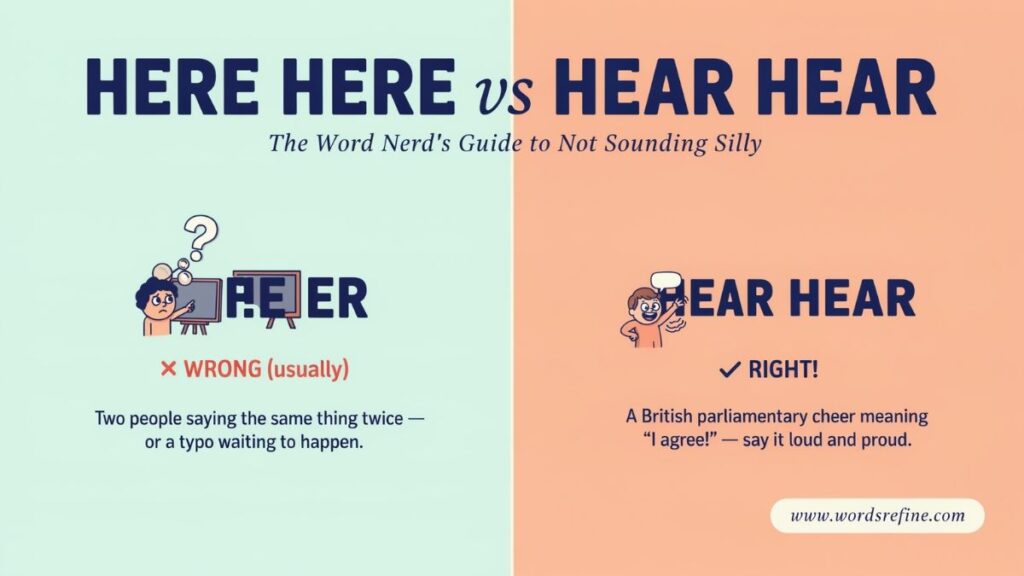
Have you ever wanted to show your agreement with someone but ended up questioning the spelling instead? The confusion between Here Here vs Hear Hear catches many writers off guard because both expressions sound exactly alike. However, only “Hear, hear!” is correct when you want to express approval, support, or agreement. “Here, here” is a common spelling mistake in this context. The difference comes down to two simple words with very different meanings. Let’s explore why “hear, hear” is the right choice, where the expression comes from, and how to use it confidently without letting a tiny spelling slip steal the show!
Quick Answer Here Here vs Hear Hear
If you’re wondering whether to write here here or hear hear, the correct expression is “Hear, hear!” when you want to express agreement, approval, or support. People use it to show that they strongly agree with something another person has said.
For example:
“Hear, hear! That’s exactly what I was thinking.”
“Hear, hear! Everyone deserves an equal opportunity.”
“Hear, hear! We need to spend less time arguing and more time solving problems.”
In each example, the speaker uses the expression to support someone else’s statement. It communicates something similar to “I completely agree,” “Well said,” or “That’s exactly right.”
But why does the expression use hear instead of here?
The answer comes down to meaning. Hear relates to listening and paying attention, whereas here refers to a place or position. Although both words sound alike, their meanings and spellings are different.
Therefore, “Here, here!” is generally incorrect when you intend to express agreement. It isn’t an accepted American or British alternative.
Learn the difference between commonly mixed-up more words
Stary vs Starry Meaning Differences Examples and Correct ?
What Does Hear Hear Mean?
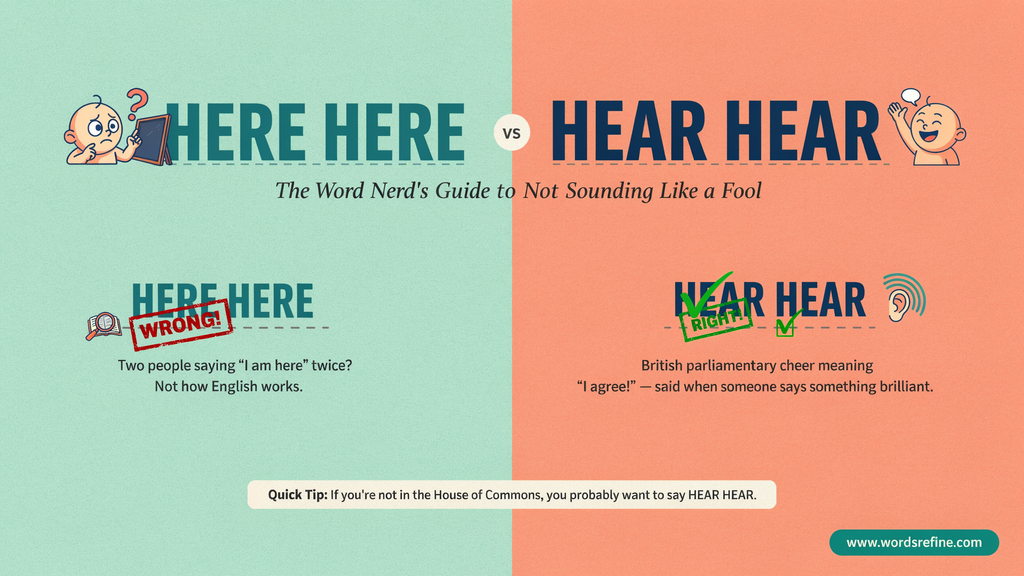
The expression “Hear, hear!” means that you agree with, approve of, or support something someone has said. When you use it, you’re acknowledging that another person has made a good point and deserves recognition.
For example:
“Everyone deserves access to a good education.”
“Hear, hear! Every child should have that opportunity.”
The second speaker uses the expression to support the first person’s opinion. Rather than giving a lengthy response, they communicate their agreement in two simple words.
The expression has several similar meanings:
“I agree!”
“Well said!”
“Absolutely!”
“That’s exactly right!”
“Couldn’t agree more!”
However, these alternatives don’t always carry the same tone. “Hear, hear!” often sounds enthusiastic and approving. It can also feel slightly formal or traditional, particularly during speeches and public discussions.
Grammatically, “Hear, hear!” functions as an interjection. An interjection expresses a reaction, emotion, or response without necessarily forming a complete sentence. Other familiar examples include “Wow!”, “Excellent!”, and “Bravo!”
When Should You Use Hear, Hear?
Use “Hear, hear!” when someone makes a statement that deserves agreement or support. Although people often associate it with formal discussions, it also fits naturally into everyday conversations.
During a discussion or debate, someone might suggest that every employee deserves equal opportunities for professional growth. If you agree, you could respond:
“Hear, hear! Everyone should have a fair chance to succeed.”
Similarly, during a speech, a speaker might say:
“Education should open doors rather than create barriers.”
An audience member could respond:
“Hear, hear!”
The expression shows approval and encourages the speaker.
It also works in casual conversations. For example:
Friend: “We should stop making plans that nobody follows through on.”
You: “Hear, hear! Let’s actually stick to the next one.”
You can even use it during a celebration or toast. Imagine someone raising a glass and saying:
“Here’s to good health, wonderful friendships, and many more happy memories!”
Another guest might respond:
“Hear, hear!”
In this situation, the expression shows agreement with the toast and support for its message.
Is Hear, Hear Formal or Informal?
“Hear, hear!” works in both formal and informal situations. However, its tone depends on the conversation.
In formal settings, such as parliamentary debates, public meetings, and speeches, it often sounds traditional and respectful. People use it to acknowledge a speaker’s argument or express support for a particular opinion.
In everyday conversations, it can sound friendly, enthusiastic, or humorous.
For example:
“Nobody should schedule a meeting that could have been an email.”
“Hear, hear!”
The response adds a little humor while showing agreement.
Nevertheless, context matters. If someone makes a controversial statement, responding with “Hear, hear!” signals that you support their opinion. Therefore, use the expression thoughtfully rather than treating it as an automatic reaction.
Learn the difference between confusing more English words
Scrapped vs Scraped Differences Examples and Correct Usage?
Here vs Hear Understanding the Difference
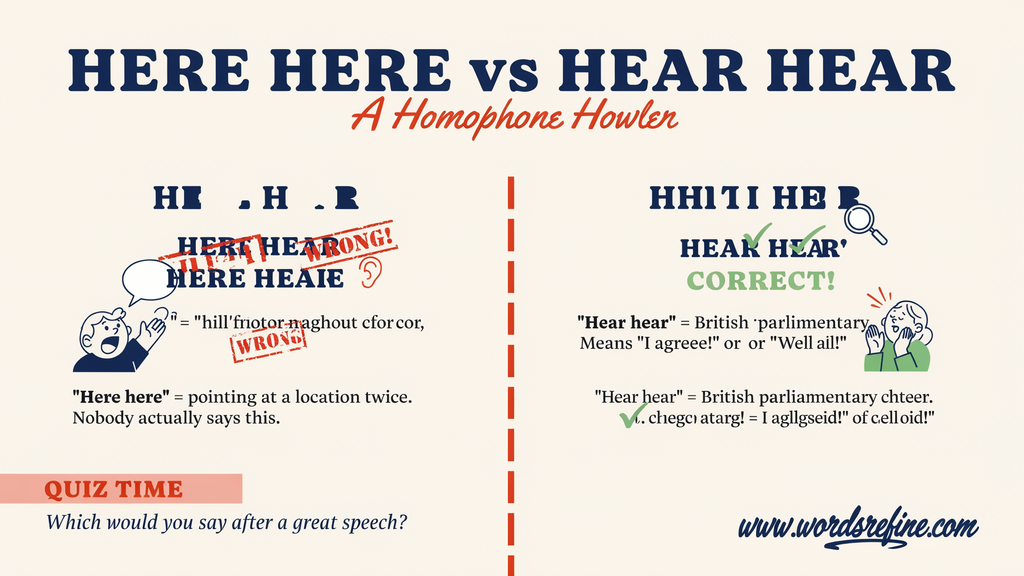
The confusion between here here and hear hear comes from two words that sound alike but have different meanings and grammatical functions.
Here and hear are homophones. Homophones are words that share the same pronunciation but have different spellings and meanings. English has plenty of these pairs, including there and their, right and write, and sea and see.
Fortunately, understanding the difference between here and hear makes the correct expression much easier to remember.
Here Meaning and Examples
The word here is an adverb of place. It refers to a particular location, position, or place where someone or something exists.
When you use here, you’re talking about where something is rather than what someone hears.
For example:
“Please come here for a moment.”
“I left my notebook here yesterday.”
“Your keys are right here on the table.”
“We have everything we need here.”
“Stay here until I return.”
In each sentence, here identifies a location.
The word can also appear in expressions that introduce or present something.
For example:
“Here is the report you requested.”
In this sentence, here introduces something being presented. It doesn’t express agreement or approval.
Remember this simple distinction: when you’re referring to a place, position, or something being presented, use here.
Hear Meaning and Examples
The word hear is a verb. It means to perceive sound through your ears. It can also refer to receiving information or becoming aware of something.
Unlike here, which identifies a location, hear relates to sound, listening, and communication.
Consider these examples:
“Can you hear the music from outside?”
“I didn’t hear what the teacher said.”
“Did you hear about the new restaurant?”
“She could hear the rain hitting the windows.”
“We need to hear everyone’s opinion before making a decision.”
Notice that hear doesn’t always involve a physical sound. In “Did you hear about the new restaurant?” it means receiving information.
The word also appears in several everyday expressions:
“Hear me out.”
“I hear you.”
1″Hear from someone.”
2″Hear of something.”
3″Hear a noise.”
Most importantly, hear appears twice in “Hear, hear!” where it communicates agreement and approval.
Why Here vs Hear Are Easily Confused
The main reason people confuse these words is their pronunciation. In standard American English, here vs hear are homophones. They sound alike even though their spellings and meanings differ.
Consequently, someone who hears the expression rather than reads it might naturally assume that it uses here. After all, the phrase can sound like someone repeating the same word.
However, pronunciation alone cannot tell you which spelling belongs in a sentence. You need to understand the meaning.
| Word or expression | Meaning | Example |
|---|---|---|
| Here | A place or position | “Come here, please.” |
| Hear | To perceive sound | “Can you hear me?” |
| Hear, hear! | To express agreement | “Hear, hear! That’s a great idea.” |
| Here, here! | Usually an incorrect spelling of the expression | “Here, here! I agree.” |
The trick is to connect hear with listening and approval. When someone makes a good point, you’re essentially acknowledging their words and showing that you agree.
That small connection can help you avoid one of the most common homophone mistakes in English.
Learn the difference between tricky grammar more words
Tinder vs Tender Differences Examples and Correct Usage?
Why Is Hear Hear the Correct Spelling?
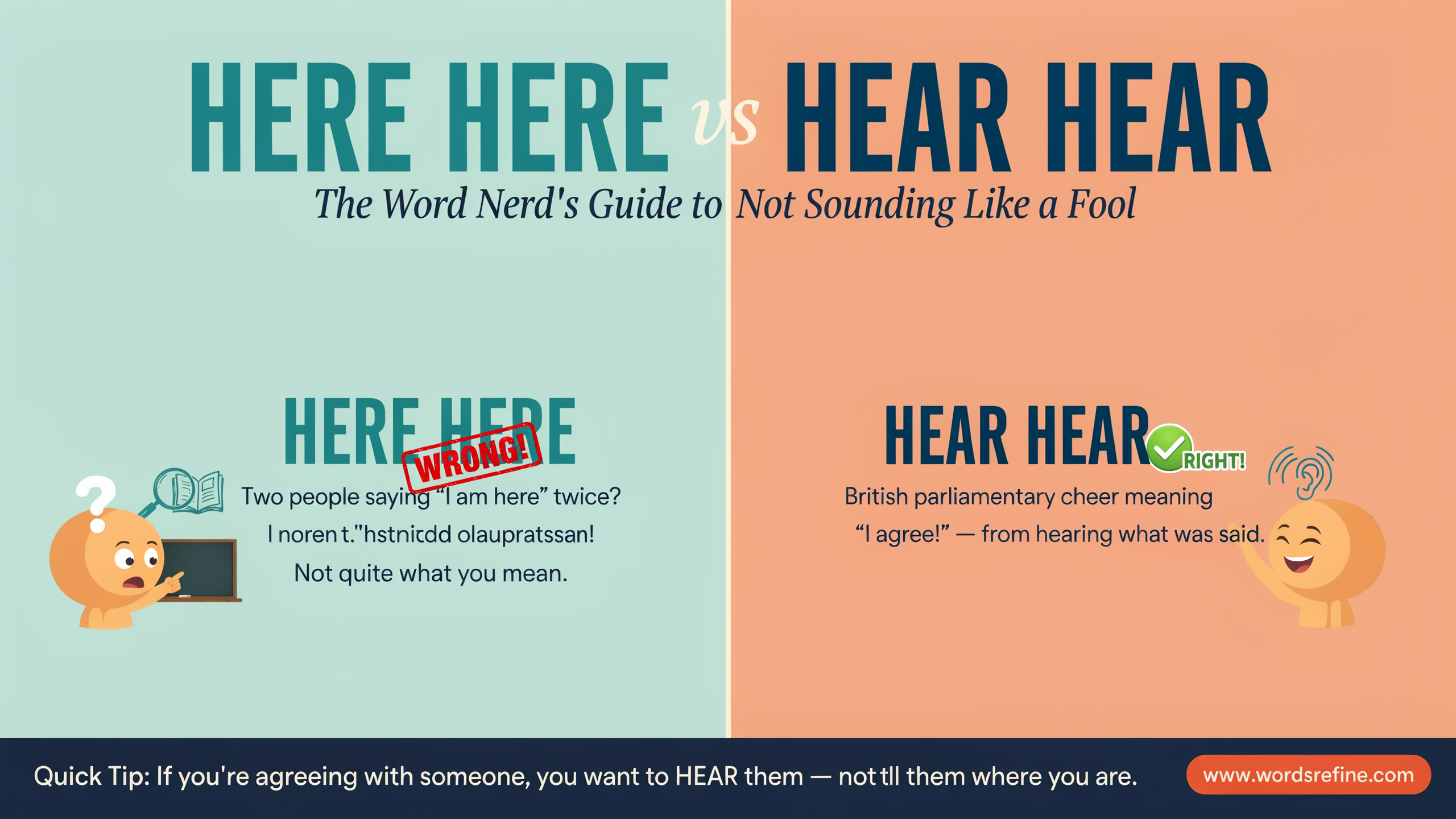
The correct spelling becomes easier to understand when you explore the expression’s history. It wasn’t created by randomly repeating a word. Instead, its spelling reflects an older call that encouraged listeners to pay attention to a speaker.
The Historical Origin of Hear, Hear
The expression “Hear, hear!” dates back to the late 17th century. Historical references connect it with the longer phrase “Hear him, hear him!” People used this expression to encourage others to listen to someone speaking.
In parliamentary discussions, members sometimes called out “Hear him!” to draw attention to a speaker. Over time, the longer expression became shorter and developed into the familiar “Hear, hear!” used to communicate agreement and approval.
This history is important because the original expression focused on listening. People weren’t asking an audience to look at a particular place. Instead, they wanted everyone to pay attention to what someone was saying.
The expression’s development can be understood through three stages:
| Historical form | Purpose |
|---|---|
| Hear him! | Encouraged listeners to pay attention to a speaker. |
| Hear him, hear him! | Repeated the call for attention and emphasis. |
| Hear, hear! | Expressed agreement, approval, or support. |
As the expression evolved, its meaning shifted from simply calling attention to a speaker to openly supporting that person’s words.
That’s why hear belongs in the expression. Its historical connection to listening explains the spelling far better than simply memorizing two repeated words.
How Hear, Hear Became a Sign of Agreement
Originally, the expression served as a call for attention. However, its use gradually expanded. People began using it not only to encourage others to listen but also to show approval of what a speaker had said.
This development made the phrase especially useful during public discussions.
Imagine a parliamentary member making a strong argument about education, public services, or government policy. Other members might call out “Hear, hear!” to express their support.
Eventually, the expression became a familiar form of audience participation. Rather than interrupting with a complete sentence, listeners could show approval with two short words.
Today, people use it to praise a persuasive argument, support someone’s opinion, acknowledge an important statement, respond positively to a toast, or express approval during a speech.
Interestingly, the phrase can also carry a sarcastic tone. Someone might say “Hear, hear!” after a friend makes an exaggerated complaint about Monday mornings. The words remain the same, but the speaker’s tone changes their effect.
Learn the difference between confusing word pairs
Jibe vs Jive What’s the Difference?
Is It Hear, Hear vs Here, Here in British and American English?
English spelling often changes between the United States and the United Kingdom. For example, Americans generally write color, while British writers prefer colour. Similarly, organize and organise reflect different spelling conventions.
However, “Hear, hear!” is the correct expression in both American and British English.
There is no standard regional spelling difference that makes “Here, here!” correct when someone wants to express agreement.
Hear, Hear in British English
The expression has strong historical connections with British parliamentary discussions. It remains familiar in political debates, public speeches, and formal gatherings.
Members of Parliament may use it to express approval when another member makes a statement they support.
Its traditional association with Parliament also gives it a slightly ceremonial sound. Even outside politics, the phrase can make an ordinary expression of agreement feel more emphatic.
Hear, Hear in American English
American English uses the same spelling and meaning.
People may say “Hear, hear!” during speeches, discussions, celebrations, and everyday conversations. Although “I agree!” and “Absolutely!” often sound more conversational in American settings, “Hear, hear!” remains a recognizable expression.
For example:
“The community deserves a cleaner and safer park.”
“Hear, hear! Everyone should be able to enjoy the neighborhood.”
The spelling doesn’t change just because the conversation takes place in the United States.
Is Hear Hear a British Expression?
The expression has historical roots in British parliamentary usage, but it isn’t exclusive to British English. American speakers also understand and use it.
The distinction is between its historical background and its modern reach. A phrase can originate in one variety of English and become familiar in others.
Therefore, whether you’re writing for an American audience or a British one, use “Hear, hear!” to express approval.
How to Use Hear Hear in a Sentence
Knowing the correct spelling is only half the job. You also need to understand how the phrase fits naturally into a conversation or piece of writing.
Because “Hear, hear!” is an interjection, it usually appears as a standalone response. It can also follow a speaker’s statement in written dialogue.
Hear, Hear in Speeches and Public Discussions
Public speaking provides one of the most familiar settings for the expression. An audience member might use it to show approval without interrupting the speaker with a lengthy response.
Consider these examples.
Example: A speech about education
Speaker: “Every child deserves access to a quality education, regardless of family income.”
Audience member: “Hear, hear!”
Example: A community meeting
Speaker: “We need to protect our local parks for future generations.”
Audience member: “Hear, hear! Our children deserve green spaces.”
Example: A workplace discussion
Manager: “Good teamwork means listening to every employee, not just the loudest person in the room.”
Employee: “Hear, hear!”
In each situation, the expression communicates approval. It also reinforces the original speaker’s message.
Hear, Hear in Everyday Conversations
You don’t need to stand in front of a crowd to use this expression. It can work naturally whenever someone makes a statement you strongly support.
For example:
“People should get credit for their hard work.” “Hear, hear!”
“A little kindness can make someone’s entire day.” “Hear, hear!”
“We should spend more time enjoying life and less time worrying about things we can’t control.” “Hear, hear!”
“Nobody needs a meeting that could have been a two-line email.” “Hear, hear!”
The last example adds a touch of humor. That’s perfectly fine. The expression doesn’t always need a serious political or social message.
Learn the difference between often confused words
Foward vs Forward Meaning Spelling and Correct Usage
Hear Hear in Written Communication
In writing, “Hear, hear!” often appears in dialogue, online discussions, comments, and informal messages.
For example:
“Taking breaks makes you more productive, not less.”
“Hear, hear! Everyone needs time to recharge.”
You might also see it in a social media comment responding to a public statement or an opinion.
In formal writing, however, consider your audience. The phrase works well when you’re reproducing spoken reactions or writing conversational dialogue. In a formal report or academic essay, a direct statement such as “I agree with this conclusion” may be more suitable.
The goal is to match the expression to the tone of your writing.
Hear Hear Punctuation How Do You Write the Expression Correctly?
Punctuation can make a short expression look more complicated than it really is. Fortunately, the basic rule is straightforward.
The most common form is:
“Hear, hear!”
The comma separates the repeated words, while the exclamation point conveys enthusiasm or approval.
You may also encounter these variations:
1″Hear, hear!”
2″Hear! Hear!”
3″Hear, hear,” she replied.
The audience responded with cries of “Hear, hear!”
All these forms can appear in writing, depending on sentence structure and editorial style.
Should You Put a Comma Between Hear, Hear?
Yes. The conventional written form uses a comma between the two instances of hear.
The comma reflects the expression’s established punctuation and makes the repeated words easier to read.
However, writers sometimes use two exclamation marks to emphasize the reaction:
“Hear! Hear!”
This form is also recognizable. For ordinary writing, though, “Hear, hear!” is the simplest and most familiar choice.
Is Hear, Hear One Word or Two?
“Hear, hear!” is written as two separate words, not one.
The expression contains two repetitions of the verb hear. The comma separates them, and the exclamation point completes the expression.
Avoid writing it as:
Hearhear
Hear-hear
Herehere
Here, hear
The standard form remains “Hear, hear!”
Common Mistakes When Using Here Here vs Hear Hear
Even experienced writers occasionally confuse homophones. Since here and hear sound identical, the wrong spelling can slip into emails, comments, and social media posts.
However, a few simple distinctions can prevent most mistakes.
Writing Here, Here Instead of Hear, Hear
This is the most common mistake.
People sometimes write “Here, here!” when they want to agree with someone. The spelling seems reasonable because the expression sounds like the word here. Unfortunately, pronunciation doesn’t determine the correct spelling.
Incorrect: “Here, here! That’s exactly what I was thinking.”
Correct: “Hear, hear! That’s exactly what I was thinking.”
Assuming Here vs Hear Are Interchangeable
Although these words sound alike, they perform different grammatical jobs.
Here identifies a place, while hear describes the act of perceiving sound. Replacing one with the other can change a sentence’s meaning or create a spelling error.
For example:
Incorrect: “Can you here the announcement?”
Correct: “Can you hear the announcement?”
The first sentence uses the wrong word because the speaker is asking whether someone can perceive a sound.
Treating Here, Here as a Regional Variation
Another misconception is that “Here, here!” might be acceptable in one English variety but incorrect in another.
That’s not how this expression works. American and British English both use “Hear, hear!” to express approval.
Using Hear, Hear When Referring to a Location
The opposite mistake can also happen.
For example:
Incorrect: “Please come hear and sit beside me.”
Correct: “Please come here and sit beside me.”
In this situation, the speaker is directing someone toward a physical location. The word here is the correct choice.
Forgetting the Meaning of the Expression
Some people memorize “Hear, hear!” without understanding why it uses hear. That makes the spelling harder to remember.
Instead, connect the expression with listening to a speaker. When someone makes an excellent point, you’re acknowledging their words and showing that you agree.
This small mental connection makes the correct spelling much easier to recall.
Here Here vs Hear Hear Sentence Examples
Sometimes “Here Here vs Hear Hear” a few contrasting sentences explain a grammar rule better than several paragraphs. These examples show how context determines the correct spelling.
| Sentence | Correct or incorrect? | Explanation |
|---|---|---|
| “Hear, hear! That’s an excellent suggestion.” | Correct | Expresses agreement. |
| “Here, here! That’s an excellent suggestion.” | Incorrect | Uses the wrong spelling for the expression. |
| “Come here and look at this picture.” | Correct | Refers to a location. |
| “Can you hear the birds singing?” | Correct | Refers to perceiving sound. |
| “Hear, hear! We need more honest leaders.” | Correct | Expresses support for an opinion. |
| “Your phone is right hear.” | Incorrect | The sentence needs here to identify a location. |
| “I can’t here what you’re saying.” | Incorrect | The sentence needs hear to describe listening. |
| “Hear, hear! That’s worth celebrating.” | Correct | Shows approval. |
Hear, Hear in Real-Life Conversations
Let’s look at a few more examples to understand how the expression works naturally.
At work:
Manager: “Everyone on this team deserves recognition for their contributions.”
Employee: “Hear, hear! We couldn’t have completed the project without everyone’s effort.”
Among friends:
Friend 1: “We should stop buying things we don’t need.”
Friend 2: “Hear, hear! My bank account would appreciate that.”
During a public speech:
Speaker: “A strong community begins when neighbors support one another.”
Audience member: “Hear, hear!”
During a family celebration:
Uncle: “Here’s to good health, happy memories, and more family gatherings!”
Everyone: “Hear, hear!”
These examples demonstrate that the expression can communicate agreement in different settings. Its meaning stays consistent even when the conversation changes.
Learn the difference between basic English word mistakes
Teams vs Teams Meaning Differences Accounts and Features ?
What Are Other Ways to Say Hear, Hear?
Although “Hear, hear!” is a useful expression, you don’t have to repeat it every time you agree with someone. English offers several alternatives that communicate approval, support, or enthusiasm.
The best choice depends on the situation and the tone you want to convey.
| Alternative expression | Meaning | Best use |
|---|---|---|
| Well said! | Someone has expressed an idea effectively. | Speeches and discussions |
| Absolutely! | You strongly agree. | Everyday conversations |
| I agree! | You share someone’s opinion. | Formal and informal settings |
| Exactly! | Someone has expressed your thoughts accurately. | Casual discussions |
| Couldn’t agree more! | You completely support an opinion. | Strong agreement |
| That’s right! | You confirm that a statement is correct. | Everyday conversations |
| Bravo! | You admire someone’s achievement or performance. | Celebrations and performances |
Choosing the Right Alternative
Consider these examples:
“We should always treat people with respect.” “Absolutely!”
“Your explanation makes perfect sense.” “Exactly!”
“Everyone deserves a fair opportunity.” “I couldn’t agree more!”
“That was an excellent presentation.” “Well said!”
Each response expresses approval, but the tone differs slightly.
For example, “Well said!” focuses on the quality of someone’s words, while “Absolutely!” emphasizes strong agreement.
“Hear, hear!” can do both. It acknowledges the speaker’s statement and shows that you support it.
One important distinction: “Here, here!” should not be treated as an accepted alternative to “Hear, hear!” It is generally a misspelling when used to express agreement.
Quick Tips to Remember Hear, Hear
Still worried that you’ll accidentally type the wrong version? These simple memory tricks can help.
Connect hear with your ears. You use your ears to hear sounds. Similarly, “Hear, hear!” acknowledges someone’s words and expresses approval.
Remember that here refers to a place. If you’re telling someone where to go, use here.
For example: “Come here and listen.”
Think about the original expression. The phrase developed from “Hear him, hear him!” This historical connection makes the correct spelling easier to remember.
Finally, read the sentence for meaning. Ask yourself whether you’re expressing agreement or referring to a location. Your answer will point you toward the correct word.
A simple reminder makes the distinction clear:
Hear = listening and agreement.
Here = location and position.
Once you remember this difference, the confusion becomes much less likely.
Practice Session: Here, Here vs. Hear, Hear
Think you know the difference between “here” and “hear”? Put your knowledge to the test with these 25 fill-in-the-blank questions. Choose the correct word or expression for each sentence.
Learn the difference between commonly misused words
Broke vs Broken Meaning Differences and Correct Usage ?
Practice Session Here Here vs Hear Hear
1. The audience shouted “________!” after the speaker made an excellent point.
2. Please sit ________ while I get your paperwork.
3. I couldn’t ________ the announcement because the music was too loud.
4. Several members of the audience called out “________!” to show their support.
5. Can you ________ the thunder in the distance?
6. Leave your keys ________ on the kitchen counter.
7. When the speaker finished her argument, everyone responded with “________!”
8. I can barely ________ what you’re saying over this noise.
9. Come ________ and take a closer look at this document.
10. The correct expression of agreement is “________!”
11. Did you ________ the phone ring last night?
12. Your jacket is right ________ on the chair.
13. The audience shouted “________!” to show that they agreed with the speaker.
14. I’m glad you’re ________ to help us with the project.
15. Please speak clearly so everyone can ________ your instructions.
16. When someone makes a convincing argument, you can respond with “________!”
17. Put the books ________ before you leave the room.
18. I couldn’t ________ the speaker from the back of the hall.
19. The crowd responded with an enthusiastic “________!”
20. Is everyone ________ for the meeting?
21. During the debate, several members used “________!” to express approval.
22. Can you ________ me clearly, or should I speak louder?
23. Your phone is ________ beside the computer.
24. “________!” is a traditional expression used to show agreement or approval.
25. Please come ________ when you’re ready to begin.
Answers
- Hear, hear
- Here
- Hear
- Hear, hear
- Hear
- Here
- Hear, hear
- Hear
- Here
- Hear, hear
- Hear
- Here
- Hear, hear
- Here
- Hear
- Hear, hear
- Here
- Hear
- Hear, hear
- Here
- Hear, hear
- Hear
- Here
- Hear, hear
- Here
Here’s a trusted source for clear more words Comparison:
FAQS
Does the Oxford Dictionary recognize “hear, hear” as the correct expression?
Yes. The Oxford English Dictionary recognizes “hear, hear” as an interjection used to express agreement or approval. “Here, here” is generally considered a misspelling when used with this meaning.
What does “hear, hear” mean?
“Hear, hear” expresses agreement, approval, or support for something someone has said. It carries the same general meaning as “Well said!” or “I couldn’t agree more!” People often use it during speeches, debates, and everyday conversations.
Why is clapping traditionally discouraged in the British Parliament?
In the British House of Commons, parliamentary tradition favors verbal expressions of approval, such as “Hear, hear!” rather than applause. Members use the phrase to show support for a speaker’s point without interrupting proceedings with clapping. However, parliamentary customs and practices can vary between settings.
Do British people say “here, here” or “hear, hear”?
The correct expression is “Hear, hear!” in both British and American English. Although some people mistakenly write “here, here,” the phrase has nothing to do with location. It uses “hear” to call attention to a speaker’s words.
Why do people say “hear ye”?
“Hear ye” is an old-fashioned expression that means “listen” or “pay attention.” It was traditionally used by town criers and public officials to announce important news or make public proclamations. Today, you may encounter it in historical settings, formal announcements, or humorous imitations of old-fashioned speech.
Is “I am hearing you” grammatically correct?
Yes, “I am hearing you” is grammatically correct, but its meaning depends on the situation. It can mean that you can hear someone’s voice or that you’re gradually understanding their message. However, if you simply want to show agreement or acknowledge someone’s point, “I hear you” sounds more natural.
Is this conversation helpful so far?
Learn the difference between everyday English mistakes
Cloth vs Clothe Differences Examples and Correct Usage ?
Conclusion
The difference between “here, here vs hear, hear” may seem small, but one letter changes the entire meaning. When you want to show agreement, approval, or support, “Hear, hear!” is the correct expression. On the other hand, “here” points to a place, while “hear” relates to listening. Although both words sound identical, they don’t share the same job. So, the next time someone makes an excellent point, don’t accidentally direct them somewhere. Give them the approval they deserve with a confident “Hear, hear!” Your spelling will be correct, and your agreement will be crystal clear.

Diora AJS she is an experienced blogger and passionate English language enthusiast at Words Refine. With a keen eye for language and a love for clear communication, she writes practical content about grammar, word meanings, usage, and commonly confused terms. Her goal is to make English easier to understand through clear explanations and relatable examples, helping readers write accurately and communicate with confidence.