English spelling can be surprisingly tricky and the confusion between fead vs feed is a perfect example. One small letter can turn a perfectly clear sentence into a spelling mistake. So, is “fead” ever correct, or should you always write “feed”? The answer is simple: “feed” is the standard English spelling, while “fead” is not an accepted alternative. However, knowing the correct spelling is just the first step. Let’s look at the word’s meaning, pronunciation, verb forms, and common uses so you can write with confidence and avoid this unnecessary spelling mix up.
Quick Answer Fead vs Feed
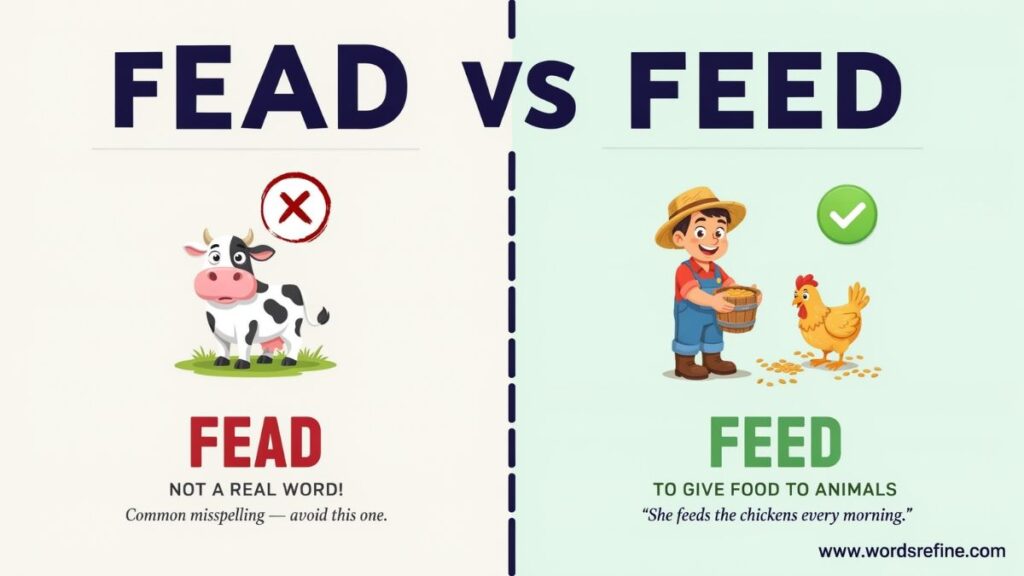
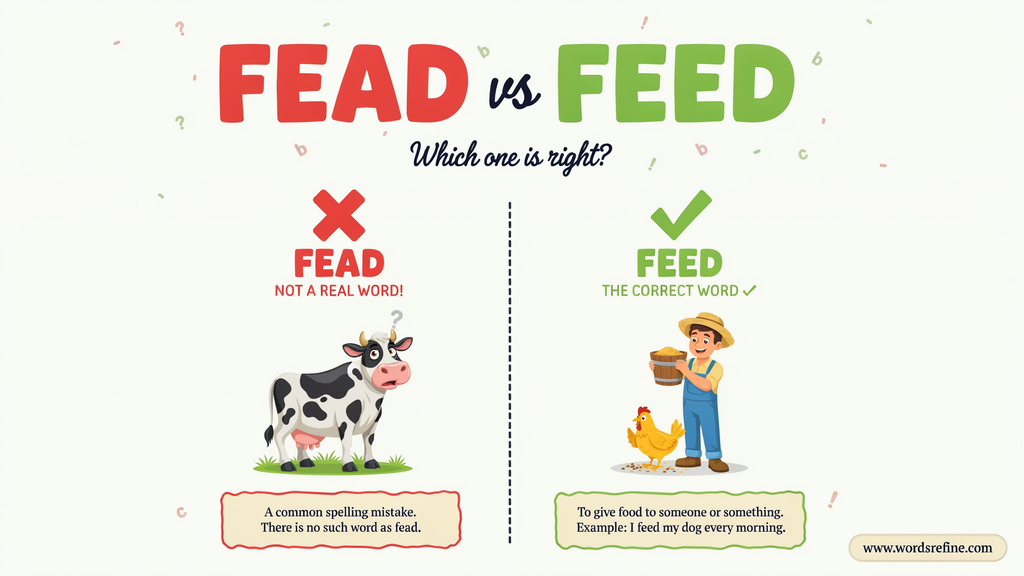
Feed is the correct spelling in standard English. You should use it whenever you mean to give food to someone or something, provide nourishment, or supply information to a system.
Fead is not a standard alternative spelling of feed. When someone uses it in an ordinary sentence about food, animals, or information, they most likely intend to write feed.
Consider these examples:
| Incorrect | Correct |
|---|---|
| I need to fead the dog. | I need to feed the dog. |
| She feads her chickens every morning. | She feeds her chickens every morning. |
| They fead the livestock before sunset. | They fed the livestock before sunset. |
| Please fead the information into the system. | Please feed the information into the system. |
The correct spelling contains two E’s. This spelling stays the same in both American and British English.
Which Is Correct in Everyday Writing?
Whenever you mean to provide food or supply something, choose feed. The spelling doesn’t change based on the situation.
For example, you might write:
- I feed my pets twice a day.
- The farmer feeds the cattle fresh hay.
- Please feed the information into the computer.
- My social media feed displays cooking videos.
In each example, feed is the correct choice. However, remember that the past-tense form changes to fed. That small grammatical detail matters just as much as the spelling itself.
Learn the difference between confusing more English words
It vs Its Meaning Differences Examples and Correct ?
What Does Feed Mean?
The word feed has several meanings in English. Most commonly, it describes giving food to a person or animal. However, its meaning extends beyond meals and animal care.
Feed can function as both a verb and a noun. Its meaning depends on how you use it in a sentence.
Feed as a Verb
As a verb, feed means to give food to a person, animal, or living thing. It can also describe supplying something that another person, organism, or system needs.
One common use involves giving food to people or animals. For example, parents feed their children, pet owners feed their dogs, and farmers feed their livestock.
Consider these sentences:
- Parents feed their children nutritious meals.
- I feed my cat before leaving for work.
- The zookeeper feeds the lions fresh meat.
- Farmers feed their livestock hay and grain.
In each sentence, feed describes the action of providing food.
Another use involves supplying nutrients to plants. Gardeners and farmers often use the word when discussing fertilizers and plant nutrition.
For example, you might feed tomato plants with suitable fertilizer during their growing season. Similarly, a gardener may feed flowers to support healthy growth.
Feed also appears in technology. When someone supplies information or data to a computer, machine, or software application, they can describe that action as feeding information into the system.
For example, the technician feeds the data into the computer, or the researcher feeds new information into the software.
The meaning remains connected to the idea of supplying something. Instead of food, however, the object is information.
Feed as a Noun
Although many people first learn feed as a verb, it also works as a noun. In this form, it can refer to food supplied to animals, a continuous supply of material, or a stream of information.
Animal feed refers to food given to livestock and other animals. It may include hay, grass, grains, pellets, and specially prepared nutritional mixtures.
For example, the farmer purchased enough animal feed to last through the winter.
The word also appears frequently in digital communication. A social media feed is a stream of content displayed on a digital platform. It may contain posts, photographs, videos, advertisements, and updates from accounts you follow.
Similarly, a news feed displays news stories and updates in one place.
For example, she checked her news feed for the latest headlines.
In manufacturing, feed can describe the material supplied to a machine or production process. A machine may require a continuous feed of raw materials to operate properly.
Feed Meaning at a Glance
| Usage | Meaning | Example |
|---|---|---|
| Verb | Give food to someone or something | I feed my dog every morning. |
| Verb | Supply nutrients to plants | We feed the plants fertilizer. |
| Verb | Provide information to a system | Feed the data into the computer. |
| Noun | Food for animals | The cattle need fresh feed. |
| Noun | A stream of digital content | I checked my news feed. |
| Noun | Material supplied to machinery | The machine needs a steady feed. |
As you can see, feed has a much wider meaning than simply providing food. Its use in technology, agriculture, and digital communication makes it an important part of everyday English.
What Does Fead Mean?
If you’re looking for the meaning of fead, the important distinction is that it isn’t the standard English spelling of the common word feed.
When someone writes fead in a sentence about feeding a pet, supplying livestock with food, or displaying online content, they most likely intend to write feed.
For example:
Incorrect: Please fead the puppy before bedtime.
Correct: Please feed the puppy before bedtime.
This spelling mistake can happen for several reasons. Someone might type too quickly, confuse English vowel patterns, or simply remember the pronunciation without remembering the correct spelling.
However, it’s worth making one distinction. A spelling that isn’t a standard English vocabulary word may still appear as a personal name, surname, acronym, brand, or specialized term. Its meaning would depend on that particular context.
Therefore, when someone asks whether fead is a word, the most accurate answer is that it isn’t an accepted alternative spelling of the ordinary English word feed.
Learn the difference between commonly mixed-up more words
Bicep vs Biceps Meaning Grammar Spelling and Correct Usage?
Feed Pronunciation, Spelling, and Word Forms
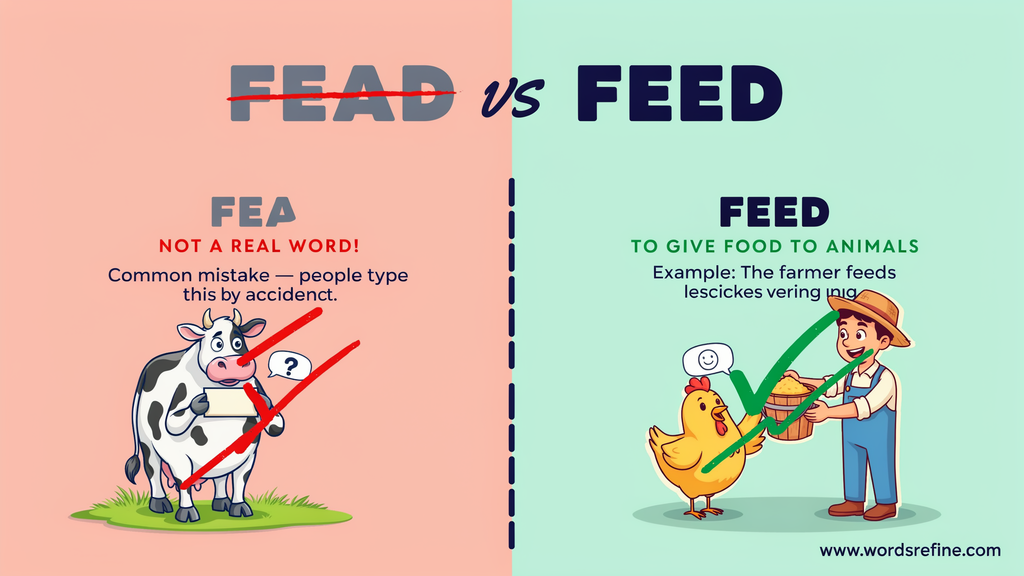
Correct spelling becomes easier when you understand how a word sounds and how it changes in different grammatical situations.
The word feed has a long E sound followed by a D sound. Its pronunciation is /fiːd/.
The pronunciation remains the same in standard American and British English. Likewise, the spelling doesn’t change between the two varieties.
How to Spell Feed Correctly
If you’re unsure how to spell feed, remember its three-letter pattern:
F comes first, two E’s appear in the middle, and D finishes the word.
A useful way to remember it is to connect feed with need. Both words contain the same ending and share the long E sound.
For example:
I need to feed the dog.
The animals need fresh feed.
We need to feed the children before leaving.
This simple connection can help you avoid writing fead by mistake.
Feed Verb Forms
Feed is an irregular verb in English. Unlike regular verbs that usually form their past tense by adding -ed, this verb changes its spelling.
| Verb form | Correct spelling | Example |
|---|---|---|
| Base form | Feed | I feed my rabbits daily. |
| Third-person singular | Feeds | She feeds the birds. |
| Present participle | Feeding | He is feeding the chickens. |
| Simple past | Fed | We fed the horses yesterday. |
| Past participle | Fed | They have fed the animals. |
Notice that feed doesn’t become feeded or feaded in standard English.
Instead, it changes to fed when you describe a completed action or use it with helping verbs such as has, have, and had.
Feed vs Fed Understanding the Difference
The confusion between fead vs feed sometimes leads to another question: should you write fead or fed when describing something that happened in the past?
The correct answer is fed.
Although feed and fed belong to the same verb family, they serve different grammatical purposes. Feed is the base form, while fed is the simple past tense and past participle.
Use feed when discussing the present, a regular routine, or an action that hasn’t happened yet.
Use fed when describing an action that already happened.
For example:
| Feed | Fed |
|---|---|
| I feed my dog every morning. | I fed my dog yesterday. |
| She feeds the chickens daily. | She fed the chickens last night. |
| They feed their cattle fresh grass. | They fed their cattle before sunset. |
| We feed the children at noon. | We fed the children an hour ago. |
The difference becomes clearer when you look at the sentence structure.
Present tense examples:
I feed my cat before work.
She feeds her baby every three hours.
Farmers feed their livestock during the winter.
Past tense examples:
I fed my cat before work yesterday.
She fed her baby an hour ago.
Farmers fed their livestock before the storm arrived.
Learn the difference between tricky grammar more words
Discard vs Disgard Meaning Differences Examples and Correct ?
What Is the Past Tense of Feed?
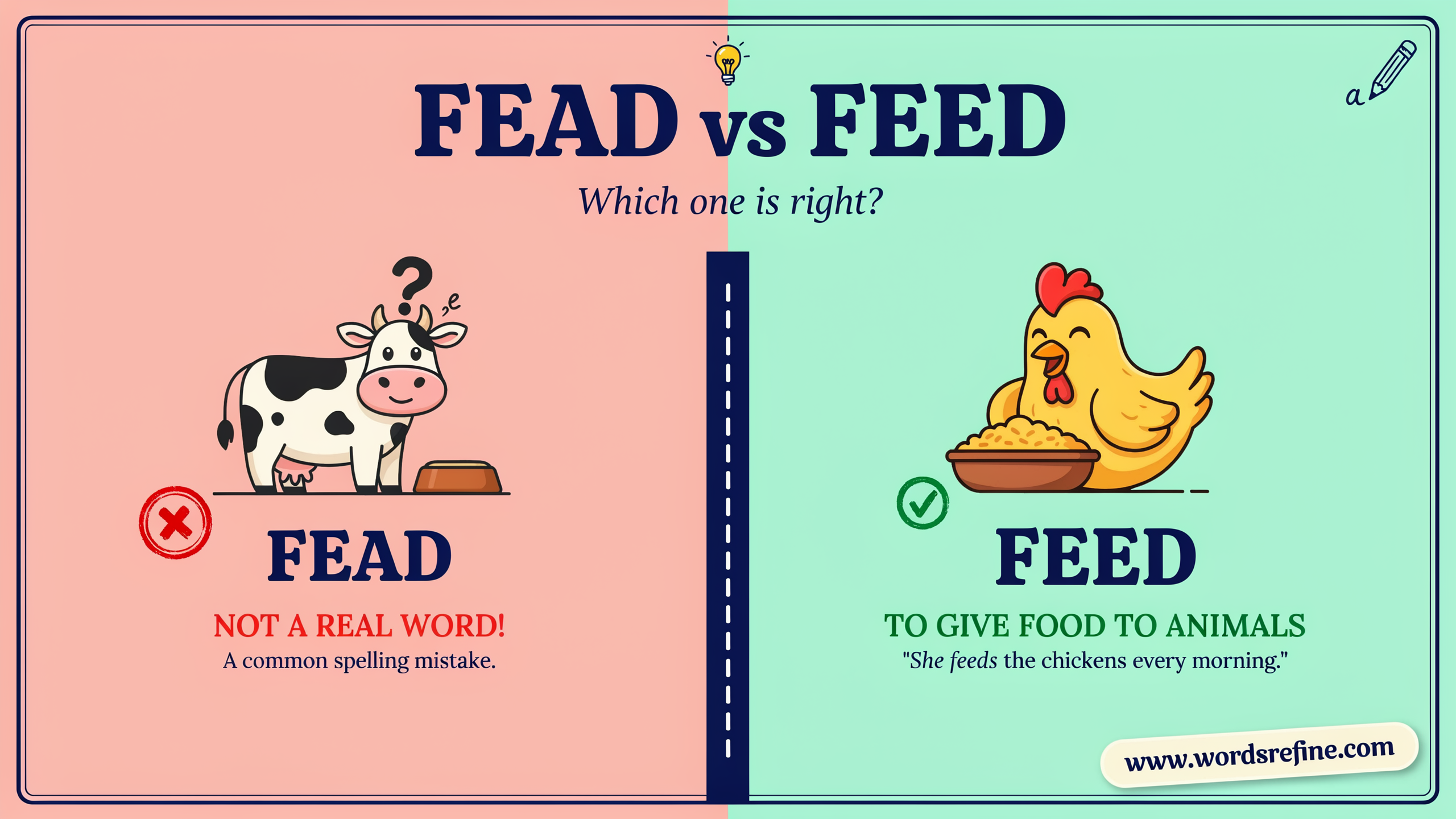
The past tense of feed is fed.
English contains many irregular verbs that change their internal spelling rather than following the usual -ed pattern.
For example:
| Base form | Past tense | Past participle |
|---|---|---|
| Feed | Fed | Fed |
| Keep | Kept | Kept |
| Sleep | Slept | Slept |
| Meet | Met | Met |
| Feel | Felt | Felt |
| Leave | Left | Left |
These irregular forms require practice because you can’t always predict them by applying one spelling rule.
For feed, remember this simple pattern:
Feed → Fed → Fed
What Is the Past Participle of Feed?
The past participle of feed is also fed.
You generally use this form with helping verbs such as has, have, and had.
For example:
I have fed the dog already.
She has fed the chickens.
They had fed the animals before the guests arrived.
We have fed everyone at the shelter.
You can also use fed in passive constructions:
The animals were fed twice a day.
The children were fed before the journey.
The important point is that the simple past tense and past participle share the same spelling.
Is It Fead, Feed vs Feeded?
Here’s the easiest way to separate these forms.
Feed is the correct base form.
Fed is the correct past tense and past participle.
Feeded is incorrect in standard English.
Fead is incorrect when intended as the standard spelling of feed.
For example:
Incorrect: I have feeded my puppy.
Correct: I have fed my puppy.
Incorrect: She fead the birds yesterday.
Correct: She fed the birds yesterday.
Once you understand the irregular pattern, these mistakes become much easier to catch.
Why Do People Confuse Fead vs Feed?
At first glance, fead vs feed look almost identical. Only one letter changes. That tiny difference can create unnecessary confusion, especially when you’re typing quickly or spelling a word from memory.
Several factors contribute to this mistake.
Similar-Looking Vowel Patterns
English uses different vowel combinations to represent different sounds. The letters E and A can create confusion because their pronunciation changes across words.
For example, compare feed, read, head, bread, and lead.
These words don’t all follow the same pronunciation pattern. In fact, read and lead can have different pronunciations depending on their grammatical role or meaning.
However, the standard spelling of feed remains consistent. You cannot replace its double E with EA simply because another English word uses those letters.
Spelling Words the Way They Sound
People sometimes write words according to their pronunciation rather than their established spelling.
This approach can cause English spelling mistakes because pronunciation doesn’t always provide enough information to determine the correct letters.
For example, someone who remembers the sound of feed but not its spelling might accidentally type fead.
However, familiar expressions provide a useful reminder. You regularly see phrases such as feed the dog, animal feed, and news feed.
Typing Errors and Autocorrect
Fast typing can produce unexpected spelling mistakes. Someone might press the wrong key or fail to notice an incorrect letter before sending a message.
Autocorrect doesn’t always catch every problem either. Some systems focus on recognizing familiar words, but their suggestions depend on context and software settings.
That’s why proofreading still matters, especially when preparing professional documents.
Confusion About Irregular Verbs
Another source of confusion involves the past tense.
Someone who knows that regular verbs often take an -ed ending might assume that feed follows the same pattern.
This assumption can produce forms such as feeded or feaded.
However, English irregular verbs don’t always follow predictable spelling patterns. The correct past form is simply fed.
Learn the difference between confusing word pairs
Expense vs Expenditure Meaning Differences and Correct Usage?
How to Use Feed Correctly in Different Contexts
The word feed appears in everyday conversations, agriculture, technology, and digital communication. Understanding these contexts helps you recognize its meaning without confusing it with similar-looking spellings.
Feed in Everyday Conversations
In daily conversation, feed usually refers to giving food to someone or something.
For example:
I feed my dog before going to work.
Parents feed their children healthy meals.
She feeds the birds in her backyard.
We need enough groceries to feed the entire family.
The word can also describe an animal eating independently.
For example:
The cows feed on fresh grass.
Rabbits feed on vegetables and leafy plants.
The birds feed on seeds and insects.
Notice the difference between giving food and eating food. In the first group of examples, someone provides food. In the second, the animal consumes it.
Feed in Farming and Agriculture
In agriculture, feed plays an important role in discussions about livestock nutrition and food production.
Farmers use the word when describing the food they provide to cattle, chickens, sheep, goats, and other animals.
Common types of animal feed include hay, grass, corn, grain mixtures, silage, and commercially prepared feed pellets.
For example:
The farmer stores enough feed to maintain the cattle throughout the winter.
Here, feed functions as a noun because it refers to the food supply.
However, consider another sentence:
The farmer feeds the cattle every morning.
In this example, feeds is a verb because it describes an action.
This distinction is useful when writing agricultural reports, animal-care instructions, and everyday conversations.
Feed in Technology and Computer Systems
Technology has expanded the meaning of feed beyond food and nutrition.
In computing, the verb describes supplying data or information to a system. A computer may receive information from a database, an external source, or another application.
For example:
The analyst feeds the information into the software.
The system receives a continuous feed of data.
The machine processes the information supplied through its input feed.
A data feed can provide structured information from one system to another. Businesses use these feeds to update product catalogs, synchronize records, and exchange information between applications.
The meaning remains connected to the original idea of supplying something. Instead of food, however, the object is information or data.
What Does Feed Mean on Social Media?
A social media feed is a stream of content that appears on a user’s screen.
Depending on the platform, it may display posts from people you follow, photographs, videos, news, suggested content, advertisements, and updates from businesses and organizations.
For example:
I checked my social media feed during lunch and found several updates from my friends.
A news feed works similarly. It presents recent stories and updates from different sources.
Therefore, when discussing the meaning of news feed, remember that it refers to an organized stream of news content, not a supply of food.
Fead vs Feed Side-by-Side Comparison
A comparison makes the difference fead vs feed easier to remember.
| Feature | Feed | Fead |
|---|---|---|
| Standard English spelling | Yes | No, not as an alternative to feed |
| Common grammatical role | Verb and noun | No standard role in this usage |
| Meaning | Give food or supply something | No standard meaning as a substitute for feed |
| Past tense | Fed | Not applicable |
| Past participle | Fed | Not applicable |
| Present participle | Feeding | Not applicable |
| Third-person singular | Feeds | Not applicable |
| British English | Correct | Incorrect as a substitute |
| American English | Correct | Incorrect as a substitute |
The difference is a spelling distinction, not a choice between two accepted English words with separate meanings.
When you mean to provide food, nourishment, or information, choose feed.
British English vs American English Does the Spelling Change?
Some English words have different spellings depending on whether you use American or British English. For example, Americans write color, while British writers generally use colour. Similarly, organize and organise reflect different spelling conventions.
However, feed is spelled the same way in both varieties of English.
| American English | British English |
|---|---|
| Feed | Feed |
| Fed | Fed |
| Feeding | Feeding |
| Feeds | Feeds |
You don’t need to change the spelling when writing for an American or British audience.
For example:
American English: I feed my dog every morning.
British English: I feed my dog every morning.
Both sentences are correct.
The same rule applies to expressions such as animal feed, news feed, and social media feed. None requires a regional spelling adjustment.
Therefore, don’t assume that fead is a British spelling simply because it looks different. It isn’t the standard British alternative to feed.
Feed Synonyms and Alternatives
The best synonym for feed depends on the context. You wouldn’t normally replace feed the dog with supply nourishment to the dog in casual conversation. Likewise, nourish may sound more appropriate than feed in a discussion about health or development.
Feed Synonyms for Giving Food
Nourish means providing the food or nutrients needed for growth and health.
Sustain means providing what someone or something needs to continue living or functioning.
Provide means making something available.
Serve means presenting food to someone.
Supply means providing something in sufficient quantity.
For example:
Parents nourish their children with balanced meals.
The farmer supplies the cattle with fresh hay.
The restaurant serves breakfast to its customers.
Volunteers provide meals to families in need.
Feed Synonyms for Supplying Information
When feed refers to providing information or material to a system, other words may fit better.
Input, enter, supply, transfer, submit, and provide can express similar ideas.
For example:
Original: The technician feeds the data into the computer.
Alternative: The technician enters the data into the computer.
Although these words can express similar ideas, they aren’t interchangeable in every situation. Choose the alternative that preserves your intended meaning.
Common Mistakes to Avoid When Using Feed
Even though feed looks like a simple word, several grammatical mistakes can appear in everyday writing. Understanding these errors will help you use it correctly.
Writing Fead Instead of Feed
This is the main spelling mistake discussed in this article.
Incorrect: I fead the dog before leaving.
Correct: I fed the dog before leaving.
The past-tense sentence requires fed, not fead vs feed.
Using Feeded Instead of Fed
Regular verbs usually form their past tense by adding -ed. However, feed is irregular.
Incorrect: She feeded the chickens yesterday.
Correct: She fed the chickens yesterday.
Don’t apply the regular verb pattern to this word.
Confusing Feed With Fed
Both words are correct, but they serve different grammatical purposes.
Incorrect: I fed my cat every morning. (when describing a current daily routine)
Correct: I feed my cat every morning.
However, the original sentence would be correct if you were describing a routine in the past.
Using the Wrong Form With Helping Verbs
The past participle fed works with helping verbs such as has, have, and had.
Incorrect: He has feed the animals.
Correct: He has fed the animals.
Incorrect: They had feed the cattle.
Correct: They had fed the cattle.
Confusing the Noun and Verb
The same spelling can serve different grammatical roles.
Consider these examples:
Verb: The farmer feeds the chickens.
Noun: The chickens need fresh feed.
In the first sentence, feeds describes an action. In the second, feed identifies food for animals.
Understanding the sentence structure helps you choose the correct form.
Fead vs Feed in a Sentence Correct Examples
Examples make spelling rules easier to remember because they show how a word works in real situations.
The following sentences demonstrate the correct use of feed as a verb and noun.
Feed as a Verb
Parents feed their children nutritious meals.
I feed my dog twice a day.
The farmer feeds the cows fresh grass.
She feeds the birds in her garden.
We feed the guests before the meeting begins.
The machine feeds paper into the printer.
The software feeds information into the database.
Volunteers feed homeless people at the shelter.
The mother is feeding her baby.
These plants need nutrients to grow properly.
Feed as a Noun
The farmer bought animal feed from the local supplier.
The chickens need fresh feed every morning.
My social media feed displays cooking videos.
The news feed provides updates throughout the day.
The machine requires a steady feed of raw material.
Feed in Past-Tense Sentences
Remember that fed replaces feed when you describe a completed action.
I fed my puppy before going to bed.
She fed the horses early yesterday.
The farmer fed his livestock before sunset.
They have fed the entire family.
We had fed the animals before the storm started.
These examples also demonstrate why fead vs. fed is not a choice between two accepted past-tense forms. Fed is the correct past tense of feed.
Learn the difference between often confused words
Onstage vs On Stage Meaning Differences and Correct Usage ?
What Do Dictionaries and Grammar Checkers Say About Fead vs Feed?
When you’re unsure about a spelling, reliable dictionaries provide a better answer than guessing from pronunciation or relying on random online examples.
Merriam-Webster and Cambridge Dictionary recognize feed as a standard English word. Their entries explain its meanings and grammatical forms.
Cambridge Dictionary identifies feed as both a verb and a noun. It also lists fed as its past tense and past participle.
Grammar checkers can also help identify spelling and grammatical problems. For example, if you type “I need to fead my dog,” a spelling checker may suggest replacing fead with feed.
However, automated tools aren’t perfect. They may overlook errors when a misspelled form resembles a name or another recognizable expression. They also rely on context to identify grammatical problems.
For that reason, use grammar checkers as helpful editing tools rather than treating them as final authorities.
A good proofreading routine should include checking unfamiliar spellings in a trusted dictionary, reviewing verb tense and sentence structure, reading sentences aloud, and making sure your chosen words communicate the intended meaning.
Fead vs Feed in Professional and Academic Writing
Correct spelling matters in professional communication because small errors can distract readers from important information.
Imagine preparing an agricultural report that repeatedly uses fead instead of feed. Even if readers understand the intended meaning, the mistake can make the document appear poorly edited.
The same issue applies to academic papers, technical instructions, business reports, and educational materials.
Consider these examples.
Agricultural report:
Incorrect: Farmers should provide nutritious fead to their livestock.
Correct: Farmers should provide nutritious feed to their livestock.
Technical instructions:
Incorrect: Fead the information into the computer system before running the program.
Correct: Feed the information into the computer system before running the program.
Business communication:
Incorrect: Our website displays a live fead of industry updates.
Correct: Our website displays a live feed of industry updates.
In each example, the corrected spelling makes the intended meaning clear.
Professional writing doesn’t require complicated vocabulary. It requires accurate language, clear sentences, and careful proofreading.
A Practical Example Choosing Between Feed, Fed, and Fead
Consider a small farm where an employee looks after chickens, cows, and goats.
The employee writes the following note:
“Every morning, I fead the chickens and give the cows fresh grass. Yesterday, I feeded the goats before breakfast. I also updated the farm’s online news fead.”
Although readers can understand the message, it contains three spelling or grammatical mistakes.
Let’s correct them.
| Original wording | Correct wording | Reason |
|---|---|---|
| I fead the chickens. | I feed the chickens. | Feed is the correct present-tense form. |
| I feeded the goats. | I fed the goats. | Fed is the irregular past tense. |
| Online news fead | Online news feed | Feed is the standard noun spelling. |
The revised note reads:
“Every morning, I feed the chickens and give the cows fresh grass. Yesterday, I fed the goats before breakfast. I also updated the farm’s online news feed.”
Notice how three small corrections improve the entire paragraph.
The lesson is simple: choose feed for the base form and present-tense use, fed for the past tense and past participle, and avoid fead when you intend to use either standard form.
Learn the difference between basic English word mistakes
Temporary vs Temporarily Meaning Difference and Correct Usage?
Practice Exercise Fead vs Feed
- Please ______ the cat before you leave.
- The farmer ______ the horses early this morning.
- I need to ______ my plants with the right nutrients.
- Have you ______ the baby yet?
- The chickens are waiting for someone to ______ them.
- She ______ her dog twice a day.
- We ______ the guests before starting the meeting.
- The simple past tense of “feed” is ______.
- My social media ______ keeps showing me interesting videos.
- They are ______ the animals in the barn.
- He forgot to ______ his fish yesterday.
- Have you ______ the information into the computer?
- Fresh grass helps ______ the cattle.
- My phone’s news ______ updates throughout the day.
- The volunteers ______ hundreds of people during the event.
- She has ______ the stray kittens every evening this week.
- You should ______ your body with healthy food.
- The machine is designed to ______ paper into the printer.
- The correct spelling is ______, not “fead.”
- We need to ______ the birds before sunset.
- The children ______ the ducks at the pond yesterday.
- Who has ______ the dog while I was away?
- This website provides a personalized news ______.
- The farmer is ______ the cows in the field.
- “Feed,” “fed,” and “fed” are the three forms of the verb ______.
Answers
- Feed
- Fed
- Feed
- Fed
- Feed
- Feeds
- Fed
- Fed
- Feed
- Feeding
- Feed
- Fed
- Feed
- Feed
- Fed
- Fed
- Feed
- Feed
- Feed
- Feed
- Fed
- Fed
- Feed
- Feeding
- Feed
Here’s a trusted source for clear more words Comparison:
FAQs
What does “feed” mean in slang?
In slang, “feed” often refers to someone’s social media page or the stream of posts, photos, and videos they see online. For example, “Your feed looks amazing” means the content appearing on your social media page looks great.
What is another word for “feed”?
The best synonym depends on the context. You can use “nourish,” “supply,” “provide,” “sustain,” or “serve” when talking about food or resources. For data, “input,” “enter,” or “transfer” may work better.
Why is it called a feed?
The term comes from the idea of supplying something continuously, much like feeding an animal. Social media platforms adopted the word because they provide users with a steady stream of posts, updates, photos, and videos.
Is it “fead” vs “feed”?
“Feed” is the correct spelling in standard English. “Fead” is not an accepted alternative when referring to giving food, supplying something, or providing information.
What does FEAD stand for?
FEAD does not have one universally recognized meaning. It may represent an organization, program, or technical term, depending on the context. It is not a standard spelling of “feed.”
What does “faed” mean?
“Faed” is not a standard English word with the same meaning as “feed.” If you mean giving food or supplying something, the correct spelling is “feed.” In a specialized context, however, “faed” may have a separate meaning.
What are the four types of feeds?
In animal nutrition, feeds are commonly grouped into four broad categories: roughages, concentrates, supplements, and complete feeds. Each category serves a different nutritional purpose in livestock diets.
What are the three forms of “feed”?
The three main forms are “feed,” “fed,” and “fed.” “Feed” is the base form, while “fed” serves as both the simple past tense and the past participle.
Should you say “Have you feed” vs “Have you fed”?
“Have you fed” is correct because the helping verb “have” requires the past participle. For example, “Have you fed the dog yet?” is correct, while “Have you feed the dog yet?” is grammatically incorrect.
Learn the difference between commonly misused words
Saucey vs Saucy Meaning Differences and Correct Usage ?
Conclusion
The difference between fead vs feed comes down to one simple rule feed is the correct spelling in standard English, while fead is not an accepted alternative. Whether you’re talking about feeding a pet, providing information, supplying resources, or checking your social media feed, the correct word remains the same. Just remember its three forms: feed, fed, and fed. Once you understand how to use each form, you’ll avoid this common spelling mistake with ease. English may have plenty of tricky words, but this one doesn’t need to be one of them!

Diora AJS she is an experienced blogger and passionate English language enthusiast at Words Refine. With a keen eye for language and a love for clear communication, she writes practical content about grammar, word meanings, usage, and commonly confused terms. Her goal is to make English easier to understand through clear explanations and relatable examples, helping readers write accurately and communicate with confidence.