
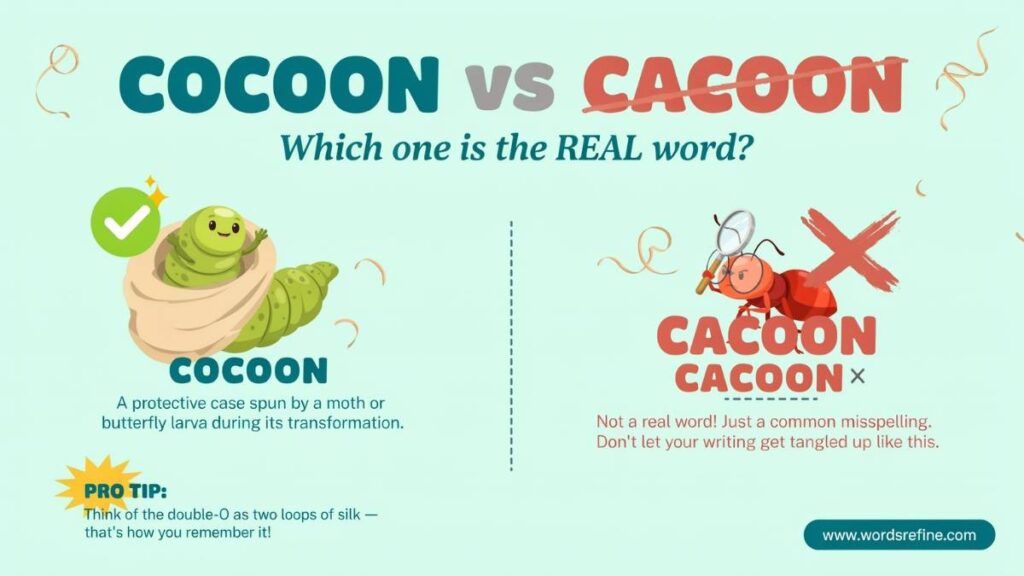
The difference between cocoon vs cacoon may seem like a tiny spelling issue but one missing letter can leave your writing in a tangle. Whether you are describing the silky covering that protects a developing insect or using the word to express comfort and security, the correct spelling is cocoon. So, why does cacoon look familiar, and why do so many writers mix them up? Don’t worry; this confusion is easier to untangle than a caterpillar’s silk. Let’s explore the meaning, spelling, pronunciation, and usage of cocoon so you can avoid this common mistake and write with confidence.
Quick Answer cocoon vs cacoon
The correct spelling is cocoon vs cacoon not cacoon. Both American and British English use cocoon. The alternative spelling is generally a mistake when someone wants to describe an insect’s protective covering or a comfortable environment.
A cocoon is a protective silk covering that certain insect larvae create before entering the pupal stage. In everyday language, it can also describe a comfortable place that provides privacy and protection from outside distractions.
Consider these examples:
| Word | Correctness | Meaning |
|---|---|---|
| Cocoon | Correct | A protective covering made by certain insect larvae or a sheltered environment. |
| Cacoon | Incorrect as a common English spelling | A common misspelling of cocoon. |
For example:
- Correct: The silkworm spun a cocoon around itself.
- Incorrect: The silkworm spun a cacoon around itself.
- Correct: She created a cozy cocoon in her bedroom.
- Incorrect: She created a cozy cacoon in her bedroom.
Therefore, if you’re wondering which spelling to choose, cocoon is the right answer.
However, there’s one small detail worth knowing. Cacoon also appears in certain brand names, including Vivere Cacoon, which sells hanging chairs. This commercial use doesn’t make cacoon an alternative spelling of the biological term.
Learn the difference between commonly mixed-up more words
Saucey vs Saucy Meaning Differences and Correct Usage ?
What Does Cocoon Mean?
A cocoon is a protective structure that certain insects create around themselves during an important stage of development. It usually consists of silk produced by specialized glands in the larva’s body.
The covering provides shelter while the insect develops into its adult form. Depending on the species, it may protect the developing pupa from predators, physical damage, and environmental conditions.
For example, a silkworm produces a silk covering around itself before becoming an adult moth. This structure provides protection during its transformation.
However, cocoon has another meaning outside biology. People also use it to describe a comfortable, private, or protected environment.
Imagine curling up under a thick blanket on a rainy afternoon. You might describe that warm little space as your personal cocoon. Nobody needs to spin silk to enjoy that kind of comfort!
Cocoon as a Biological Structure
As a noun, cocoon refers to the protective covering that certain insect larvae produce around themselves before pupation.
The structure doesn’t function as a separate living organism. Instead, it surrounds the developing insect during a vulnerable period of its life cycle.
Here are some important facts about cocoons:
- Material: Many cocoons consist primarily of silk produced by insect larvae.
- Purpose: They provide protection during pupal development.
- Common producers: Many moth caterpillars, including silkworms, create cocoons.
- Structure: Cocoons vary in size, shape, thickness, and texture depending on the species.
- Development: The insect undergoes major physical changes while developing inside the protective covering.
However, not every insect creates a cocoon. Some species enter the pupal stage without constructing a silk covering.
Cocoon as a Figurative Expression
Outside biology, cocoon describes a place or situation that provides comfort, security, privacy, or protection from the outside world.
This meaning comes from the way an insect’s cocoon surrounds and shelters its developing body. Similarly, people use the word to describe familiar surroundings that make them feel safe and relaxed.
For example:
- I spent the weekend in my cozy cocoon of blankets.
- The little cabin became a cocoon away from the noise of the city.
- She created a peaceful cocoon where she could read and relax.
- He wanted to cocoon himself from distractions while preparing for his exams.
The expression wrapped in a cocoon usually suggests that someone enjoys protection, comfort, or isolation.
However, it doesn’t always describe physical wrapping. A quiet home, a private reading room, or a peaceful garden can also create a cocoon-like environment.
Learn the difference between confusing more English words
Stary vs Starry Meaning Differences Examples and Correct ?
What Does Cocoon Mean in Everyday Language?
In informal conversations cocoon vs cacoon can describe withdrawing from social activities or surrounding yourself with familiar comforts.
For example, someone who wants to spend a cold weekend at home might say, “I’m going to cocoon myself under a blanket and watch movies.”
Depending on the situation, the expression can suggest relaxation, emotional protection, or social isolation.
Why Is Cocoon Spelled With Double O?
The correct spelling follows a specific letter pattern: C-O-C-O-O-N.
The word contains three O letters, including two consecutive O’s near the end. Replacing the second O with A creates cacoon, which isn’t the standard spelling.
This small difference causes confusion because English spelling doesn’t always follow pronunciation perfectly. People sometimes write words according to how they hear them rather than remembering their established spelling.
However, pronunciation doesn’t change the accepted spelling.
Why Do People Misspell Cocoon vs Cacoon?
Several factors explain why people write cocoon vs cacoon instead of cocoon.
1. Pronunciation-based spelling: People sometimes remember how a word sounds but forget its exact letters. When they try to reconstruct it, they may choose the wrong vowel.
2. Typing mistakes: Someone writing quickly might accidentally type A instead of O. Such mistakes can easily survive proofreading.
3. Visual confusion: Both spellings look almost identical. Since they differ by only one letter, the incorrect version can appear convincing at first glance.
4. Repeated exposure to errors: Seeing an incorrect spelling online doesn’t make it correct. However, repeated exposure can make an unfamiliar spelling look acceptable.
5. Uncertainty about English spelling: English contains many unusual vowel combinations. Consequently, writers sometimes guess instead of checking an unfamiliar word.
How to Spell Cocoon Correctly An Easy Memory Trick
The easiest way to remember the spelling is to focus on the two consecutive O’s near the end.
Try this simple reminder:
C-O-C-O-O-N: Two O’s stay together in cocoon.
You can also connect the spelling with the rounded shape of a cocoon. The two O’s can remind you of the enclosed structure surrounding a developing insect.
Here are three simple ways to remember it:
- Write cocoon three times when practicing the spelling.
- Associate the word with a silkworm spinning its protective covering.
- Remember that cacoon isn’t the standard English spelling.
A simple memory trick can save you from a surprisingly persistent spelling mistake.
Learn the difference between tricky grammar more words
Scrapped vs Scraped Differences Examples and Correct Usage?
The Origin and History of the Word Cocoon
The word cocoon has an interesting history that connects language with the natural world. Its spelling and meaning developed through French and regional European languages before English adopted it.
Understanding its origin also explains why the spelling uses OO rather than the A found in cacoon.
Where Does the Word Cocoon Come From?
The English word cocoon comes from the French word cocon. French borrowed the term from Provençal coucoun, which referred to an eggshell or a similar protective covering. The older root is associated with coco, meaning a shell or husk.
The word entered English in the late 17th century. Historical records place its early English use in the 1690s, when writers used it to describe the silky covering that insect larvae produce during development.
Over time, the word developed a broader meaning. Instead of describing only an insect’s protective covering, it also began to describe a sheltered place or comfortable environment.
Today, cocoon works in both literal and figurative contexts.
| Historical development | Explanation |
|---|---|
| Provençal coucoun | An older regional word associated with a shell or protective covering. |
| French cocon | The form from which English borrowed the word. |
| English cocoon | Adopted in the late 17th century to describe an insect’s protective covering. |
| Figurative use | Expanded to describe a sheltered or comfortable environment. |
The historical development of the word also explains why its spelling remained distinct from cacoon.
Learn the difference between confusing word pairs
Igniter vs Ignitor Which One Is Correct?
Why Is the Origin Important to the Spelling?
The French history helps explain why cocoon uses its established spelling. English adopted an existing word rather than creating a new spelling based on how someone might pronounce it.
Therefore, the historical origin supports cocoon as the correct form. It doesn’t provide a reason to treat cacoon as an accepted English alternative.
Cocoon Pronunciation and Spelling
Correct spelling becomes easier when you understand how a word sounds. Fortunately, cocoon has a straightforward pronunciation once you recognize its syllables and stress pattern.
How Do You Pronounce Cocoon?
In American English, cocoon is commonly pronounced /kəˈkuːn/.
The word contains two syllables:
- First syllable: A short, unstressed sound.
- Second syllable: A long OO sound that receives the main stress.
The second syllable carries the emphasis. When saying the word aloud, give that part more weight.
However, pronunciation doesn’t change the spelling. Whether you hear the word in a classroom, documentary, or everyday conversation, the standard written form remains cocoon.
Cocoon Pronunciation and Cacoon Spelling
People sometimes confuse pronunciation with spelling because English doesn’t always represent sounds consistently.
However, a word’s pronunciation doesn’t make every possible spelling acceptable. Someone might hear a word and choose a familiar vowel combination, but that doesn’t make the resulting version correct.
Remember these points:
- Cocoon is the standard written form.
- Cacoon is a misspelling when used in place of the biological or figurative word.
- The double O appears in the accepted spelling.
- American and British English use the same spelling.
Is Cocoon Different in American and British English?
No. There is no American-versus-British spelling difference for cocoon vs cacoon
Both varieties of standard English use the same spelling. You don’t need to change the word when writing for readers in the United States, the United Kingdom, Canada, or Australia.
This makes cocoon different from words such as color and colour, which have established regional spelling variations.
| Feature | American English | British English |
|---|---|---|
| Correct spelling | Cocoon | Cocoon |
| Incorrect common spelling | Cacoon | Cacoon |
| Plural | Cocoons | Cocoons |
| Biological meaning | Protective insect covering | Protective insect covering |
| Figurative meaning | Sheltered or comfortable environment | Sheltered or comfortable environment |
Consequently, neither region uses cacoon as a standard spelling alternative.
Whether you’re writing an academic paper, professional email, school assignment, or casual message, choose cocoon.
How Is a Cocoon Formed?
A cocoon forms when certain insect larvae produce silk and arrange it around themselves. This process creates a protective structure that surrounds the insect during an important stage of development.
The process is particularly familiar in moths and silkworms. However, different species use different materials and construction methods. Some produce dense silk coverings, while others create thinner or more loosely woven structures.
Learn the difference between often confused words
Tinder vs Tender Differences Examples and Correct Usage?
Why Do Caterpillars Make Cocoons?
A caterpillar doesn’t spin a cocoon simply to build a comfortable sleeping space. The structure serves an important biological purpose.
During metamorphosis, the insect undergoes major physical changes as it develops from a larva into an adult. The pupa cannot move around and feed like an active caterpillar. Therefore, a protective covering can help shield it during this vulnerable period.
Depending on the species, a cocoon may provide:
- Physical protection: It helps protect the developing insect from some external disturbances.
- Environmental shelter: It can reduce direct exposure to weather and other environmental conditions.
- A secure location: It provides a relatively sheltered place for pupal development.
- Support during transformation: It surrounds the developing insect while its body changes.
However, a cocoon doesn’t guarantee survival. Predators, parasites, disease, and unfavorable environmental conditions can still threaten an insect during development.
How Does a Caterpillar Make a Cocoon?
The insect uses silk-producing glands to create the material for its protective covering. It then moves its head and body in repeated motions to arrange the silk around itself.
The exact process depends on the species, but the general sequence is straightforward.
- The larva reaches maturity: The caterpillar completes most of its feeding and growth and prepares for pupation.
- Silk production begins: Specialized glands produce silk that the larva releases through its mouthparts.
- The larva builds its covering: It moves its body repeatedly to weave silk strands into a protective structure.
- Pupation takes place: The larva molts and becomes a pupa inside the cocoon.
- Adult development continues: The insect undergoes metamorphosis before eventually emerging as an adult.
The result is a natural protective covering that supports the insect during a major stage of its life cycle.
What Is a Cocoon Made Of?
Many insect cocoons consist of silk, a protein-based fiber produced by specialized glands. Silkworms are particularly well known for producing long, continuous silk filaments.
The silkworm, Bombyx mori, creates a cocoon by secreting silk and winding it around itself. Silk producers can unwind the filaments from suitable cocoons and process them into textile fibers.
However, not every cocoon has exactly the same composition. Some insects combine silk with other materials or use surrounding leaves, soil, and plant matter to strengthen or disguise their coverings.
Ultimately, the cocoon’s structure depends on the insect species and its environment.
Learn the difference between basic English word mistakes
Jibe vs Jive What’s the Difference?
Cocoon vs Chrysalis Are They the Same Thing?
Cocoon and chrysalis are related biological terms, but they don’t mean exactly the same thing.
Both relate to insect metamorphosis. However, they describe different structures or stages.
A cocoon is a protective covering that certain insect larvae spin around themselves. A chrysalis is the pupal stage of a butterfly.
This distinction matters because people often assume that every butterfly develops inside a cocoon. In reality, butterflies generally form chrysalises rather than silk cocoons.
What Is the Difference Between a Cocoon vs a Chrysalis?
| Feature | Cocoon | Chrysalis |
|---|---|---|
| Definition | Protective covering | Butterfly’s pupal stage |
| Common association | Moths | Butterflies |
| Structure | Often made from silk | The pupa’s own outer body |
| Formation | Larva spins a covering | Caterpillar molts into a pupa |
| Purpose | Provides protection during development | Contains the developing butterfly |
| Example | Silkworm cocoon | Monarch butterfly chrysalis |
The distinction is easy to remember: a cocoon vs cacoon is a covering, while a chrysalis is a developmental stage.
Do Butterflies Live in Cocoons?
Generally, no. Most butterflies develop inside chrysalises rather than silk cocoons.
When a butterfly caterpillar reaches maturity, it finds a suitable place to pupate. It attaches itself to a surface, often using silk, and sheds its final larval skin to reveal the chrysalis.
The chrysalis protects the developing butterfly during metamorphosis.
Moths follow a different pattern in many species. Their caterpillars spin silk coverings and form pupae inside them. This is why cocoons are strongly associated with moth development.
However, nature doesn’t always follow simple rules. Some butterflies use silk attachments without forming full cocoons, and some moth species pupate without a conventional silk covering.
What Happens Inside a Cocoon?
Inside a cocoon, the insect enters the pupal stage and undergoes major biological changes.
Its larval body develops into the adult form through metamorphosis. This process involves extensive changes in body structure, including the development of adult features such as wings, legs, and reproductive organs.
The transformation doesn’t happen instantly. Its duration varies considerably depending on the insect species and environmental conditions.
Eventually, the adult insect emerges from the protective covering.
For a silkworm moth, this means emerging as an adult moth. For other cocoon-forming insects, the adult may look very different from the original larva.
Learn the difference between commonly misused words
Foward vs Forward Meaning Spelling and Correct Usage
Cocoon Life Cycle From Caterpillar to Adult Insect
The cocoon plays an important role in the development of many moths and other insects. However, it represents only one part of a much larger biological process.
Complete metamorphosis generally involves four stages: egg, larva, pupa, and adult. Each stage has a different purpose.
The four stages of complete metamorphosis are:
- Egg: The insect begins developing inside an egg laid by an adult female.
- Larva: The young insect emerges and spends much of this stage feeding and growing.
- Pupa: The insect undergoes metamorphosis. In cocoon-forming species, a silk covering protects the pupa.
- Adult: The fully developed insect emerges and eventually reproduces, continuing the life cycle.
The cocoon is particularly important during pupation because it offers protection while the insect undergoes substantial physical changes.
How to Use Cocoon in Everyday Sentences
Understanding a word’s definition is useful, but knowing how to use it naturally makes your writing stronger.
Cocoon appears in scientific explanations, everyday conversations, descriptive writing, and figurative expressions. It can function as both a noun and a verb.
Cocoon as a Noun Sentence Examples
As a noun, cocoon describes an insect’s protective covering or a place that provides comfort and security.
Here are some practical examples:
- The silkworm spun a delicate cocoon around its body.
- The moth caterpillar disappeared inside its protective cocoon.
- The scientist examined the cocoon under a microscope.
- The butterfly emerged from its chrysalis after completing metamorphosis.
- She turned her bedroom into a cozy cocoon with warm lighting and soft blankets.
- The quiet mountain cabin offered a peaceful cocoon away from city life.
- The baby slept comfortably in a cocoon of blankets.
- The small reading corner became his favorite cocoon during winter.
Notice how the meaning changes with the context. In the first four sentences, cocoon refers to biology or insect development. In the remaining examples, it describes comfort and protection.
Cocoon as a Verb Sentence Examples
Cocoon can also function as a verb. It means to surround, wrap, or shelter someone or something in a protective covering or environment.
The verb often appears in figurative expressions.
For example:
- The caterpillar cocooned itself in a layer of silk.
- She cocooned herself in a warm blanket during the storm.
- He cocooned himself from distractions while preparing for his final exams.
- The thick curtains cocooned the bedroom in darkness.
- They cocooned their newborn in soft blankets to keep the baby comfortable.
The verb has several grammatical forms:
| Verb form | Example |
|---|---|
| Base form | Cocoon |
| Third-person singular | Cocoons |
| Present participle | Cocooning |
| Simple past | Cocooned |
| Past participle | Cocooned |
For example, “She cocooned herself in blankets” uses the simple past form.
Cocoon in Formal and Informal Writing
Although cocoon works in different writing styles, its meaning depends on the context.
In scientific writing, use cocoon when describing the silk covering produced by certain insect larvae.
Example: The moth larva constructs a protective cocoon before entering the pupal stage.
In descriptive writing, use cocoon to create an image of warmth, privacy, or shelter.
Example: The small apartment became a comfortable cocoon during the cold winter months.
In everyday conversation, use the word when describing a desire to relax or withdraw from outside distractions.
Example: I just want to cocoon myself at home this weekend.
However, in professional or academic writing, make sure the biological meaning stays accurate. Don’t describe every insect pupa as a cocoon.
What Is the Plural of Cocoon?
The plural of cocoon is cocoons.
To make the word plural, simply add an S to the end. You don’t need to change the double O or add an extra syllable.
Examples:
- Several cocoons hung from the branches.
- The researcher collected three silkworm cocoons for examination.
- The garden contained several moth cocoons.
- The cocoons varied in size and texture.
The spelling remains the same in both American and British English.
Cocoon Synonyms and Related Words
The best synonym for cocoon depends on which meaning you’re using.
When discussing biology, terms such as covering, casing, and silk case may help explain its structure. On the other hand, when discussing comfort, words such as shelter, refuge, sanctuary, and haven may communicate a similar idea.
| Word | Meaning | Best context |
|---|---|---|
| Covering | Something that surrounds or protects | Biology |
| Silk case | A protective structure made from silk | Insect development |
| Casing | An outer protective layer | Biology and general writing |
| Shelter | A place that provides protection | Figurative use |
| Refuge | A place of safety | Figurative use |
| Sanctuary | A peaceful or protected place | Descriptive writing |
| Haven | A place of comfort and security | Figurative use |
However, these words aren’t interchangeable in every sentence. For example, a moth produces a cocoon, not a sanctuary. Similarly, a comfortable bedroom may feel like a cocoon, but calling it a silk case would sound rather unusual!
Is Cacoon Ever Used as a Real Name?
Although cacoon isn’t the correct spelling of the common English word, it does appear in certain brand and product names.
One example is Vivere Cacoon, a product name associated with hanging chairs and suspended pod-style seating. These products create an enclosed, comfortable space for relaxing indoors or outdoors.
This distinction is important:
- Cocoon: The standard English word for an insect’s protective covering.
- Cacoon: A spelling used in particular proper names and branding.
- Cacoon hanging chair: A product name, not a different biological term.
Proper names can use unusual spellings. A company may choose a distinctive spelling for its brand without changing the standard spelling of an ordinary English word.
Therefore, if you’re discussing the hanging chair, use the manufacturer’s spelling. However, if you’re discussing an insect’s protective covering, write cocoon.
Learn the difference between everyday English mistakes
Broke vs Broken Meaning Differences and Correct Usage ?
Common Mistakes When Writing Cocoon vs Cacoon
Even a small spelling mistake can distract readers or make otherwise strong writing look careless.
Fortunately, the difference between cocoon vs cacoon is easy to correct once you recognize the common errors.
Incorrect and Correct Examples
| Incorrect usage | Correct usage |
|---|---|
| The caterpillar spun a cacoon. | The caterpillar spun a cocoon. |
| The moth emerged from its cacoon. | The moth emerged from its cocoon. |
| She created a comfortable cacoon at home. | She created a comfortable cocoon at home. |
| The scientist studied several cacoons. | The scientist studied several cocoons. |
| He cocooned himself in a blanket. | He cocooned himself in a blanket. |
The final example is already correct. Remember that cocooned is the proper past-tense form of the verb cocoon.
Quick Tips to Avoid the Cacoon Spelling Mistake
- Remember the double O in cocoon.
- Learn the spelling as a complete word rather than guessing from its pronunciation.
- Use a dictionary when you’re uncertain.
- Check plural forms carefully: cocoons, not cacoons.
- Remember that the spelling stays the same in American and British English.
A quick spelling check can prevent a small error from appearing throughout an entire article.
Learn the difference between more words people mix up
Appendices vs Appendixes Meaning Difference and Usage ?
Practice Session Cocoon vs Cacoon
- A caterpillar spins a protective ______ before entering the pupal stage.
- ______ is the correct spelling in standard English.
- “Cacoon” is a common ______ of the word “cocoon.”
- Some moth larvae create their cocoons using ______.
- A butterfly develops inside a structure called a ______.
- The plural form of cocoon is ______.
- To cocoon someone means to ______ them from outside stress.
- She spent the rainy afternoon ______ in her cozy bedroom.
- Figuratively, a cocoon can represent safety, warmth, and ______.
- A baby butterfly is called a ______.
- A caterpillar is also known as a ______.
- The butterfly life cycle begins with an ______.
- A cocoon often symbolizes personal growth and ______.
- A peaceful, protected place can be described as a ______.
- The word “cocoon” can function as both a noun and a ______.
- The term “chrysalis” refers to the butterfly’s ______ stage.
- Someone who enjoys staying home in comfort may describe themselves as ______.
- A cocoon provides protection for certain developing ______.
- The verb “cocooning” describes creating a sense of safety and ______.
- A butterfly emerges from its chrysalis as an ______.
- A protective silk covering made by certain insect larvae is called a ______.
- “Haven” and “sanctuary” can express the ______ meaning of cocoon.
- Each caterpillar typically develops in its own ______.
- The transformation from caterpillar to butterfly is called ______.
- When writing about an insect’s protective covering, always use the spelling ______.
Answers
- Cocoon
- Cocoon
- Misspelling
- Silk
- Chrysalis
- Cocoons
- Protect
- Cocooned
- Comfort
- Caterpillar
- Larva
- Egg
- Transformation
- Sanctuary
- Verb
- Pupal
- Cocooning
- Insects
- Security
- Adult
- Cocoon
- Figurative
- Chrysalis
- Metamorphosis
- Cocoon
Here’s a trusted source for clear more words Comparison:
FAQs
What does it mean to cocoon someone?
To cocoon someone means to protect, comfort, or shelter them from outside stress. It can also mean creating a safe, peaceful environment where someone feels secure and cared for.
Is it spelled cacoon vs cocoon?
Cocoon is the correct spelling in standard English. cocoon vs cacoon is a common misspelling and is not an accepted alternative. If you’re writing about an insect’s protective covering, always use cocoon.
What does cocoon mean in slang?
In informal language, cocooning means staying in a comfortable, private space away from the outside world. For example, someone might spend a quiet weekend cocooned at home with a warm blanket, a favorite movie, and no plans to go anywhere.
Can two butterflies be in the same cocoon?
Butterflies do not develop inside cocoons. Instead, they form chrysalises, which are the pupal stage of their life cycle. Each caterpillar typically develops in its own chrysalis rather than sharing one with another butterfly.
What is a butterfly’s baby called?
A baby butterfly is called a caterpillar or larva. It hatches from an egg, feeds and grows, and eventually enters the pupal stage before emerging as an adult butterfly.
What is a sad fact about butterflies?
Some butterflies live for only a few days or weeks after reaching adulthood. Although certain species survive for several months, many have surprisingly short adult lives. Their delicate beauty, unfortunately, doesn’t come with a long expiration date.
What is a fancy word for cocoon?
Casing, silken enclosure, and protective covering are more formal alternatives to cocoon. In figurative writing, sanctuary, refuge, and haven can also describe the feeling of safety and comfort associated with a cocoon.
What is the spiritual meaning of a cocoon?
A cocoon often symbolizes transformation, patience, renewal, and personal growth. Spiritually, it can represent a quiet period of change before a new beginning. Like a caterpillar preparing for its next stage, a person may need time and space to grow before embracing a new chapter.
What is another name for a cocoon?
A cocoon can also be called a casing, silken covering, or protective enclosure. However, the best alternative depends on the context. In butterfly development, the word chrysalis refers to the pupa itself, not the protective covering.
Learn the difference between confusing word pairs
Hustle vs Hussle Which One Is Correct?
Conclusion
The difference between cocoon vs cacoon is simple cocoon is the correct spelling, while cacoon is a common spelling mistake. Whether you’re describing the protective covering spun by certain insect larvae or using the word to express comfort and security, remember to include both o’s. A cocoon represents protection, patience, and transformation, making it a useful word in both scientific and everyday writing. So, the next time you write about a caterpillar’s journey or someone enjoying a peaceful weekend at home, choose cocoon. After all, your spelling deserves a transformation too, but it doesn’t need a chrysalis to get there!

Diora AJS she is an experienced blogger and passionate English language enthusiast at Words Refine. With a keen eye for language and a love for clear communication, she writes practical content about grammar, word meanings, usage, and commonly confused terms. Her goal is to make English easier to understand through clear explanations and relatable examples, helping readers write accurately and communicate with confidence.