
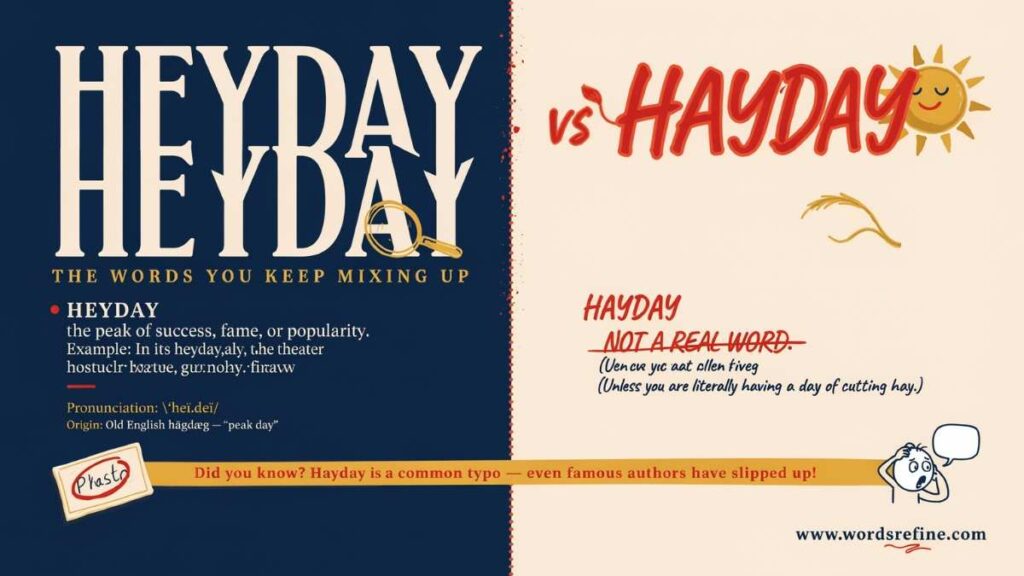
The difference between heyday vs hayday may come down to one letter but that small detail can change the meaning entirely. If you’ve ever wondered whether heyday vs hayday is correct, you are not alone. These similar looking words often create confusion, especially when describing someone’s greatest achievements or a period of remarkable success. Fortunately, the correct spelling is simple once you understand its meaning and usage. In this article, you well learn what heyday means, how to use it correctly, and why hayday is a common misspelling. By the end, you’ll know exactly which spelling to choose without letting a little hay confuse your writing!
Quick Answer Heyday vs Hayday
heyday vs hayday is the correct spelling of the noun that describes a period of greatest success, popularity, power, or influence. Hayday is generally incorrect when used with this meaning.
Consider this example: The bookstore was in its heyday when the neighborhood had few other places to buy books.
The sentence tells us that the bookstore was especially popular and successful during that period.
If you’re wondering which spelling to choose, remember this simple rule: use heyday when talking about someone’s best years or something’s most successful period. Although hayday may appear in a brand name, username, or other specific title, it isn’t a standard alternative spelling of the common noun.
Learn the difference between confusing more English words
Ingenuine vs Ungenuine Which One Is Correct ?
What Does Heyday Mean?
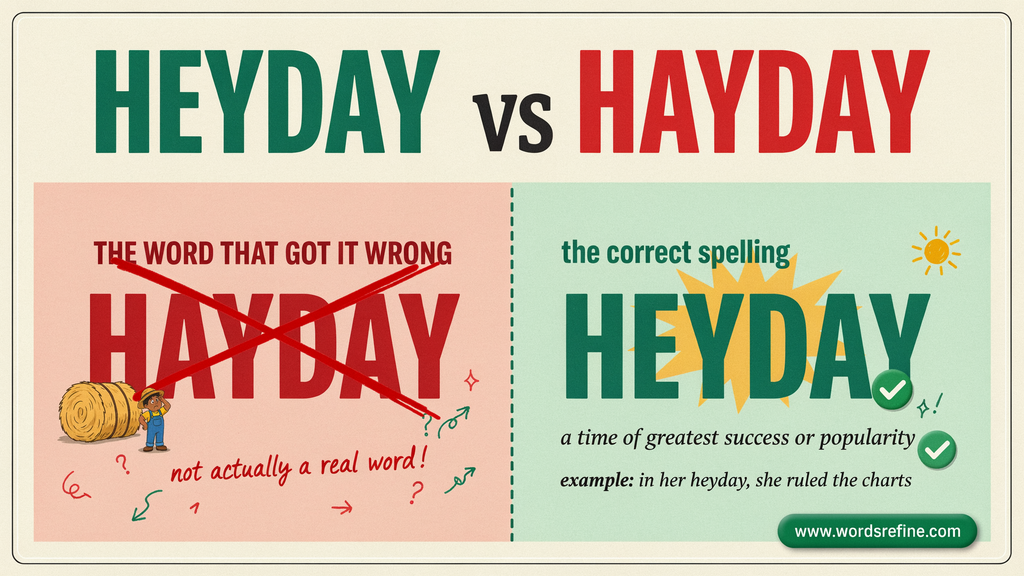
Heyday means the period when a person, organization, business, or thing enjoys its greatest success, popularity, influence, or vitality.
Think about an actor who dominated movie screens for several years. Their heyday might have been the period when they landed leading roles, attracted large audiences, and received widespread recognition. However, that doesn’t mean their career ended afterward. It simply identifies a particularly successful stage of their professional life.
Similarly, a small family business might experience its heyday when customers fill the shop every day. A city might enjoy a heyday during a period of rapid growth, while a musical genre might reach its heyday when its songs dominate the charts.
The word doesn’t always describe fame or financial success. It can also refer to a period of strong activity, achievement, or influence.
Heyday as a Noun
In modern English, heyday functions primarily as a common noun. It names a period rather than a person, object, or action.
You can use it with possessive words such as my, his, her, its, and their.
For example, the actor enjoyed her heyday in the early 2000s. A company might expand rapidly during its heyday, while a sports team might win several championships in its heyday.
The singular form is more common because people usually discuss one particular period of peak success. However, the plural form, heydays, is also grammatically correct when discussing multiple periods of success.
For instance, the industry experienced several heydays as new technologies transformed the market. Each heyday refers to a separate period of growth or popularity.
What Does It Mean to Be in Your Heyday?
When someone says you were in your heyday, they’re referring to a period when you were especially successful, influential, energetic, or popular.
The exact meaning depends on the situation. For an athlete, it might mean the years when they performed at their highest level. For a business owner, it could refer to the most profitable years of their career. and For a musician, it might describe the time when their songs attracted the most attention.
Consider this example: During his heyday, the basketball player led his team to several championship victories.
The sentence highlights the athlete’s strongest period. It doesn’t necessarily suggest that he became unsuccessful afterward. His career may simply have moved into a different stage.
The expression can also refer to youth and vigor, especially in older writing. However, a person’s heyday doesn’t automatically coincide with their youth. Someone might achieve their greatest professional success much later in life.
Heyday Meaning vs Prime of Life Meaning
Although heyday and prime of life sometimes overlap, they don’t always mean the same thing.
| Expression | Meaning | Example |
|---|---|---|
| Heyday | A period of greatest success, influence, or popularity | The singer’s heyday lasted several years. |
| Prime | A period of greatest ability, strength, or success | The athlete was in his prime. |
| Peak | The highest point of achievement or performance | Sales reached their peak in July. |
| Golden age | A period of exceptional achievement or cultural success | The studio experienced a golden age of filmmaking. |
| Glory days | A memorable period of past success | The fans still talk about the team’s glory days. |
These expressions share similar meanings, but each emphasizes something slightly different. Use heyday when discussing a period of exceptional success or popularity. On the other hand, prime of life often focuses on a person’s stage of life, strength, or vitality.
Heyday Pronunciation and Spelling
Heyday is pronounced /ˈheɪ.deɪ/, with two syllables and the stress on the first. In simple terms, it sounds like “HAY-day.”
This pronunciation explains why people sometimes spell the word as hayday. In many English accents, hey and hay sound alike. As a result, listening to the word won’t always help you choose the correct spelling.
The best solution is to remember the established written form. Think of the familiar phrase “in its heyday.” Using that phrase in your everyday writing can help you remember how to spell the word correctly.
Learn the difference between commonly mixed-up more words
Ironic vs Unironic Meaning, Differences, and Correct Usage
Why Is Heyday Spelled With an E?
The spelling comes from the word’s history rather than a simple modern spelling rule. Heyday developed from an older expression associated with excitement, high spirits, or surprise. Over time, its spelling and meaning became established in English.
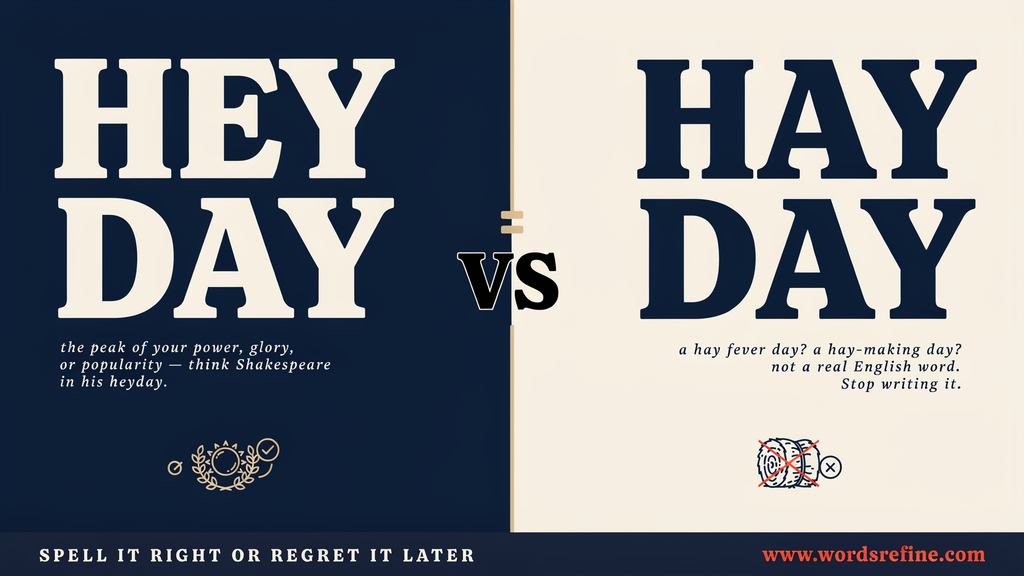
By contrast, hay refers to grass that farmers cut and dry for animal feed. Although hay and hey sound alike in many accents, their meanings and spelling histories differ.
A simple memory trick can help: imagine someone saying, “Hey, those were my best years!” This is only a memory aid, not the word’s actual origin, but it can help you remember the correct spelling.
The Origin and History of Heyday
The word heyday dates back to the late 16th century. It developed from an earlier exclamation used to express excitement, cheerfulness, playfulness, or surprise. Its modern meaning emerged later.
The history is more interesting than the spelling might suggest. At first glance, heyday looks like a combination of hey and day. However, its historical development is more complicated than simply putting those two words together.
Over time, the word became associated with vigor, flourishing, and a period of exceptional success. Today, writers commonly use it when discussing entertainment, business, sports, technology, culture, and historical events.
The word’s development can be understood in three broad stages.
- Early usage involved an exclamation expressing excitement, surprise, or high spirits.
- Later usage connected the word with vigor, flourishing, and a high point.
- Modern usage refers to a period of greatest success, popularity, influence, or prosperity.
For example, you might write that steam locomotives enjoyed their heyday before newer transportation technologies transformed travel. In this sentence, heyday identifies the period when steam locomotives played a particularly important role.
The exact details of the word’s historical development are not entirely certain. Therefore, it’s best to distinguish established dictionary information from theories about its deeper origin.
Heyday vs Hayday in American and British English
Unlike pairs such as color and colour heyday vs hayday has the same standard spelling in American and British English. Neither variety uses hayday as an accepted alternative for the noun meaning a period of greatest success.
| Feature | American English | British English |
|---|---|---|
| Standard spelling | Heyday | Heyday |
| Meaning | Period of greatest success or popularity | Period of greatest success or popularity |
| Alternative spelling | Hayday is generally incorrect | Hayday is generally incorrect |
| Pronunciation | Commonly HAY-day | Commonly HAY-day |
| Example | The store had its heyday before online shopping became widespread. | The store had its heyday before online shopping became widespread. |
Regional accents may affect pronunciation slightly. Nevertheless, those differences don’t create a spelling distinction between the two varieties.
Whether you’re writing a business report, a newspaper article, or a school assignment, heyday is the correct choice.
Learn the difference between tricky grammar more words
Enflamed vs Inflamed Which One Is Correct ?
Heyday vs Hayday vs Hay Day What’s the Difference?
Three similar looking forms can easily cause confusion: heyday vs hayday vs Hay Day. However, they aren’t interchangeable. Their spelling, capitalization, and spacing help distinguish their meanings.
Heyday
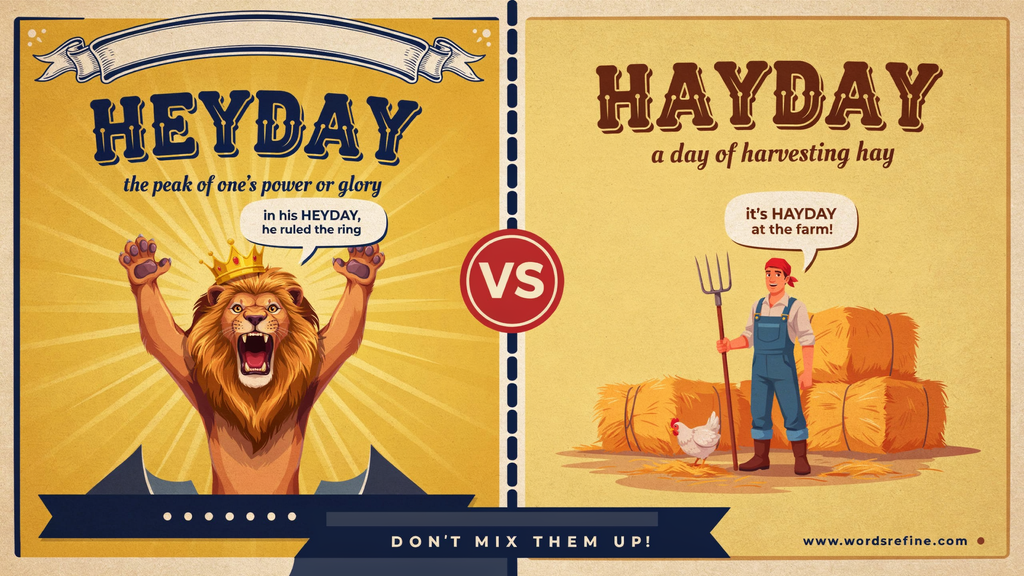
Heyday is the standard English noun for a period of greatest success or popularity.
Example: The band reached its heyday when its albums attracted millions of listeners.
Hayday
Hayday is generally a spelling mistake when someone intends to refer to a period of peak success. It may appear in a proper name or specific title, but it isn’t the standard spelling of the common noun.
Example: “The band reached its hayday” should be written as “The band reached its heyday.”
Hay Day
Hay Day is the name of a farming simulation mobile game developed by Supercell. Players grow crops, raise animals, produce goods, and manage a virtual farm.
For example, you might say, “I play Hay Day on my phone.”
The distinction becomes especially clear when you use both terms in the same sentence: Hay Day became popular among mobile gamers, and the game enjoyed its heyday when farming simulations attracted widespread attention.
Here, Hay Day identifies the game, while heyday describes a period of success.
Learn the difference between confusing word pairs
Siked vs Psyched Which One Is Correct?
Common Mistakes With Heyday vs Hayday
heyday vs hayday A small spelling mistake can distract readers from your message. Fortunately, the most common errors are easy to correct once you understand the word’s meaning and usage.
Spelling Heyday as Hayday
The most common mistake happens when people write the word as they hear it. Because heyday sounds like “hay-day,” the incorrect spelling may look reasonable at first.
However, standard spelling depends on established usage rather than sound alone.
Incorrect: The actor was famous during his hayday.
Correct: The actor was famous during his heyday.
In professional writing, even a small spelling error can distract readers. Using the correct form keeps your writing clear and polished.
Confusing Hay With Hey
The words hay and hey sound alike in many accents, but their meanings differ.
Hay is dried grass used as animal feed. Hey is an informal greeting or an exclamation used to attract attention. Heyday, meanwhile, refers to a period of greatest success or popularity.
For example, a farmer might store hay in a barn. Someone else might say, “Hey, are you coming to the concert?” A music fan might then describe a singer’s most successful years as the artist’s heyday.
Although hayday might seem logical if you associate the word with hay, that connection doesn’t reflect the standard spelling.
Treating Heyday as a Synonym for Youth
Another common mistake is assuming that a person’s heyday must occur when they’re young.
Although the word can refer to youth and vigor, it more broadly describes a period of exceptional success, popularity, or influence. A person might reach their professional heyday in their forties, fifties, or later.
For example, a writer might publish their most influential book at age 65. That period could become the writer’s heyday even though it doesn’t coincide with their youth.
Use the term to describe the person’s peak period rather than making assumptions about their age.
Using Heyday in the Wrong Context
Heyday refers to a period of peak success or influence. It doesn’t simply mean any time something happens.
Awkward: I had a heyday eating lunch at noon.
Better: The restaurant had its heyday when office workers filled the dining room every afternoon.
The second sentence establishes a period of popularity and success. The first doesn’t provide enough context to make the intended meaning clear.
You can use heyday in casual conversation, journalism, essays, and business writing. The important thing is to connect it to a genuine period of prominence.
Writing Redundant Phrases
Some expressions repeat the meaning of heyday unnecessarily. For instance, “the peak of its heyday” usually sounds redundant because heyday already refers to a high point.
Instead, write “during its heyday,” “at its peak,” “in its prime,” or “at the height of its popularity.”
Choose the expression that best communicates your meaning. Clear writing doesn’t need extra words to make a simple point.
Learn the difference between often confused words
Suffix vs Postfix Which One Is Correct?
Heyday Examples How to Use the Word Correctly
The easiest way to understand a word is to see it in context. These examples show how heyday works across different subjects and writing styles.
Heyday of a Career
A person’s heyday often refers to the years when they achieved their greatest professional success.
- The actor starred in several award-winning films during his heyday.
- She built her reputation as a journalist during the heyday of print newspapers.
- The athlete’s heyday included several championship seasons.
- The author’s heyday began when her first novel became a bestseller.
In each example, the word identifies a period of achievement rather than one isolated event.
Heyday of a Band or Music Genre
Music writers often use heyday when discussing an artist’s popularity or the rise of a musical style.
- The band released its most successful albums during its heyday.
- Disco reached its heyday when the genre attracted widespread attention.
- Fans still listen to songs from the band’s heyday.
- The heyday of cassette tapes preceded the widespread shift to digital music.
The term works particularly well in historical discussions because it connects a cultural trend with a period of strong influence.
Heyday of a Business
Businesses can experience a heyday when demand, revenue, reputation, or market influence reaches an exceptional level.
- The bookstore enjoyed its heyday before online shopping became widespread.
- During its heyday, the company employed thousands of workers.
- The local factory’s heyday brought jobs and investment to the town.
- The restaurant chain reached its heyday after expanding across the country.
Keep in mind that heyday doesn’t automatically mean a business earned a specific amount of money. It describes a period of prominence or success. If financial performance matters, use actual revenue, profit, or market-share figures to support the claim.
Heyday in History and Technology
Historical writing frequently uses heyday to describe the strongest period of an industry, invention, movement, or institution.
- The steam locomotive experienced its heyday before newer transportation technologies transformed travel.
- The heyday of silent cinema ended as sound films changed the industry.
- The town prospered during the heyday of the mining industry.
- Early personal websites enjoyed a heyday when people used them to share interests and information online.
These sentences place the subject within a broader historical context. The word helps readers understand when something was especially influential.
Heyday in Casual Conversation and Social Media
You don’t need a formal essay to use heyday correctly. The word also fits naturally into everyday conversations and social posts.
- Those were the days! That was our heyday.
- I still listen to this album because it reminds me of the band’s heyday.
- My old gaming console had its heyday before I switched to PC gaming.
- Remember when everyone carried digital cameras? That was their heyday.
A little nostalgia often accompanies the word, but nostalgia isn’t part of its strict definition. You can discuss a company’s heyday objectively without feeling sentimental about it.
Heyday Synonyms and Antonyms
Choosing the right synonym can make your writing more precise. Although words such as prime, peak, and golden age share similar meanings, each emphasizes a slightly different aspect of success.
What Is Another Word for Heyday?
| Synonym | Meaning | Example |
|---|---|---|
| Prime | A period of greatest ability, strength, or success | The athlete was in his prime. |
| Peak | The highest point of achievement or performance | Sales reached their peak in July. |
| Pinnacle | The highest or most successful point | Winning the award marked the pinnacle of her career. |
| Golden age | A period of exceptional achievement or cultural success | The studio experienced a golden age of filmmaking. |
| Glory days | A memorable period of past success or achievement | The fans still talk about the team’s glory days. |
| Flourishing period | A time of growth, activity, or prosperity | The town enjoyed a flourishing period during the trade boom. |
Use prime when emphasizing someone’s ability or strength. Choose peak for a measurable high point. Meanwhile, golden age often describes a broader historical or cultural period.
What Is the Antonym of Heyday?
An antonym expresses the opposite idea, such as decline, reduced popularity, or a period after peak success.
- Decline describes a reduction in success, strength, or influence.
- Downturn refers to a period of reduced economic or business activity.
- Low point describes a particularly difficult or unsuccessful period.
- Slump means a noticeable drop in performance or activity.
- Doldrums refers to a period of inactivity, stagnation, or low spirits.
For example, “The company experienced a downturn after its heyday.”
However, these words aren’t interchangeable in every situation. A business may decline after its heyday, but a person might simply move into a different phase of life without experiencing a slump.
Learn the difference between basic English word mistakes
Trebled vs Tripled Which One Is Correct?
How to Use Heyday in a Sentence Grammar and Usage Tips
Understanding heyday usage helps you avoid awkward sentences and choose the right expression for your intended meaning.
Common Sentence Patterns
These structures are particularly useful.
- In someone’s heyday: The actor was widely admired in his heyday.
- During its heyday: The factory employed hundreds of workers during its heyday.
- The heyday of something: The 1990s marked the heyday of arcade gaming.
- Enter one’s heyday: The singer entered her heyday after releasing a successful album.
- A heyday for something: The early internet marked a heyday for independent websites.
The expression “in its heyday” is especially common because it connects a subject directly to its most successful period.
Is Heyday Singular or Plural?
Heyday is a countable noun, and its standard plural is heydays.
For example, the industry experienced a heyday in its early years. Later, several heydays shaped its history as different technologies emerged.
The plural is less common because writers often discuss one peak period at a time. Still, it works when a subject experiences multiple distinct periods of success.
Can Heyday Describe a Person?
Yes. You can describe someone as being in their heyday or refer to the heyday of their career.
For example, “The comedian was in her heyday when television audiences eagerly watched her weekly show.”
The noun describes the person’s period of prominence rather than the person themselves. That’s why “She is a heyday” is incorrect, while “She is enjoying her heyday” is grammatically sound.
Learn the difference between everyday English mistakes
Hierarchical vs Hierarchal Which One Is Correct?
Practice Session Heyday vs Hayday
- The famous actor enjoyed his __________ during the early years of his career.
- The correct spelling for a period of great success is __________.
- My younger sister spends hours playing __________ on her tablet.
- The company reached its __________ when its products became popular worldwide.
- Many people remember the __________ of classic rock music.
- The singer released her biggest hits during her __________.
- Farmers use __________ to feed livestock.
- The restaurant attracted large crowds during its __________.
- __________ is a farming simulation game developed by Supercell.
- The athlete reached the peak of his career during his __________.
- People often misspell __________ as “hayday” because the words sound alike.
- The golden age of the movie industry is often described as its __________.
- The small business experienced remarkable growth during its __________.
- My brother downloaded __________ because he enjoys farming games.
- The word __________ describes a period of greatest success or popularity.
- The band’s popularity declined after its __________.
- The farmer stored __________ in the barn for the winter.
- The company hopes to regain the success it enjoyed during its __________.
- Her acting career reached its __________ when she received several prestigious awards.
- The phrase “in your __________” refers to the period when you were most successful or popular.
- The spelling “__________” is incorrect when referring to someone’s best years.
- During its __________, the magazine attracted millions of readers.
- The word __________ is a noun that describes a peak period of success.
- My cousin enjoys building and managing a virtual farm in __________.
- The team’s __________ was marked by several championship victories.
Answers
- heyday
- heyday
- Hay Day
- heyday
- heyday
- heyday
- hay
- heyday
- Hay Day
- heyday
- heyday
- heyday
- heyday
- Hay Day
- heyday
- heyday
- hay
- heyday
- peak
- heyday
- hayday
- heyday
- heyday
- Hay Day
- heyday
Here’s a trusted source for clear more words Comparison:
FAQs
What does “heyday” mean in slang?
“Heyday” is not typically slang. It refers to the period when someone or something enjoyed the greatest success, popularity, or influence. For example, “The actor was famous during his heyday” means he was especially successful during that time.
Is it “heyday” vs “Hay Day”?
“Heyday” is the correct spelling when referring to a period of peak success or popularity. “Hay Day” is the name of a popular farming mobile game. Although the two sound alike, their meanings are different. “Hayday” is generally a misspelling when you mean a person’s or organization’s best years.
What does “hay” mean in slang?
“Hay” usually means dried grass used to feed livestock. Its meaning can vary in informal expressions, but it does not mean a period of success or popularity. Therefore, use “heyday,” not “hayday,” when describing someone’s most successful years.
What’s another word for “heyday”?
Common synonyms for “heyday” include prime, peak, golden age, pinnacle, and height. The best alternative depends on the context. For example, “the singer’s heyday” could also be described as “the singer’s peak years” or “the singer’s golden age.”
What is Hey Day?
“Hey Day” can refer to an event that encourages people to greet one another and create a welcoming atmosphere. Some schools and universities organize Hey Day celebrations to promote friendliness, connection, and school spirit. The meaning and activities depend on the organization hosting the event.
Can you use “heyday” in a sentence?
Yes. For example: “The restaurant attracted customers from across the city during its heyday.”
This sentence means the restaurant was especially popular during its most successful period.
What is the opposite of “heyday”?
Words such as decline, downturn, downfall, and low point can express the opposite of “heyday.” The most suitable choice depends on the context. For instance, “The company struggled after its heyday” suggests that its period of greatest success had ended.
Where did Hay Day originate?
Hay Day is a farming simulation mobile game developed by Supercell, a Finnish game development company. In the game, players grow crops, raise animals, manage their farms, and trade goods. Its name is distinct from “heyday,” which describes a period of peak success or popularity.
What is “Say Hey Day”?
“Say Hey Day” generally refers to an event that encourages people to greet others with a friendly “hey” or “hello.” Schools and community organizations may use it to promote kindness, inclusion, and social interaction. The exact meaning and activities vary depending on the event organizer.
Learn the difference between more words people mix up
Taylored vs Tailored Which One Is Correct?
Conclusion
Choosing between heyday vs hayday may seem like a small spelling decision, but one letter changes everything. Heyday is the correct word for describing someone’s most successful years, greatest achievements, or a period of peak popularity. Hayday is a common misspelling, while Hay Day refers to the popular farming game. Therefore, whenever you describe a singer’s golden years, a company’s greatest success, or an athlete’s best performances, remember to use heyday. Keep the E in its proper place, and you’ll never confuse a golden age with a pile of hay again!

Diora AJS she is an experienced blogger and passionate English language enthusiast at Words Refine. With a keen eye for language and a love for clear communication, she writes practical content about grammar, word meanings, usage, and commonly confused terms. Her goal is to make English easier to understand through clear explanations and relatable examples, helping readers write accurately and communicate with confidence.