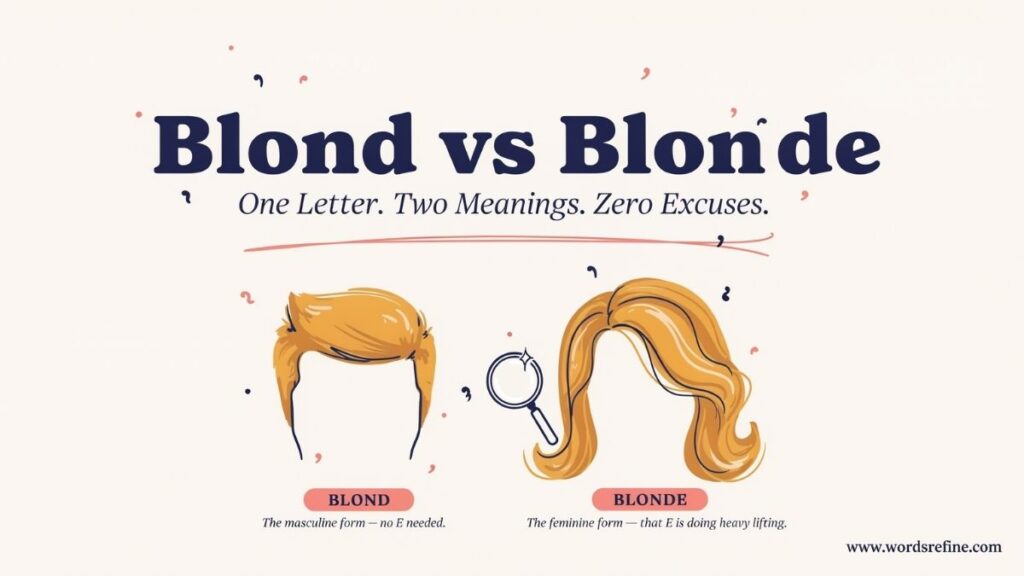
Blond vs blonde may differ by just one letter, but that tiny E can create surprising spelling confusion. Are both spellings correct, or does each serve a different purpose? Fortunately, the distinction is easier to understand than you might think. Both words describe light-colored hair, but traditional usage associates blond with males and blonde with females. However, American English often uses blond as a gender-neutral adjective. Understanding these differences helps you avoid common grammatical mistakes and choose the appropriate spelling for your sentence. Let’s clear up the confusion, explore how each word works, and settle this little spelling debate without splitting hairs over one letter.
Quick Answer Blond vs Blonde
Both blond vs blonde are accepted English spellings. They describe light-colored hair, including shades of pale yellow, gold, and sandy brown. Neither spelling refers to a separate hair color.
Traditionally, English uses blond for men and boys and blonde for women and girls. This distinction is especially common when the word functions as a noun. For example, a writer might describe someone as a blond man or a blonde woman.
However, modern usage isn’t quite so strict. Many writers use blond as an adjective regardless of gender. Therefore, both “She has blond hair” and “She has blonde hair” are acceptable.
The first sentence follows gender-neutral adjective usage, while the second follows the traditional feminine form.
When deciding whether to use blond or blonde, consider the role of the word in your sentence. If you’re describing hair, either spelling may work, depending on your preferred convention. If you’re referring to a person as a noun, the traditional distinction becomes more noticeable.
Learn the difference between confusing more English words
Octopus vs Octopi Which Plural Is Correct and Why?
What Does Blond Mean
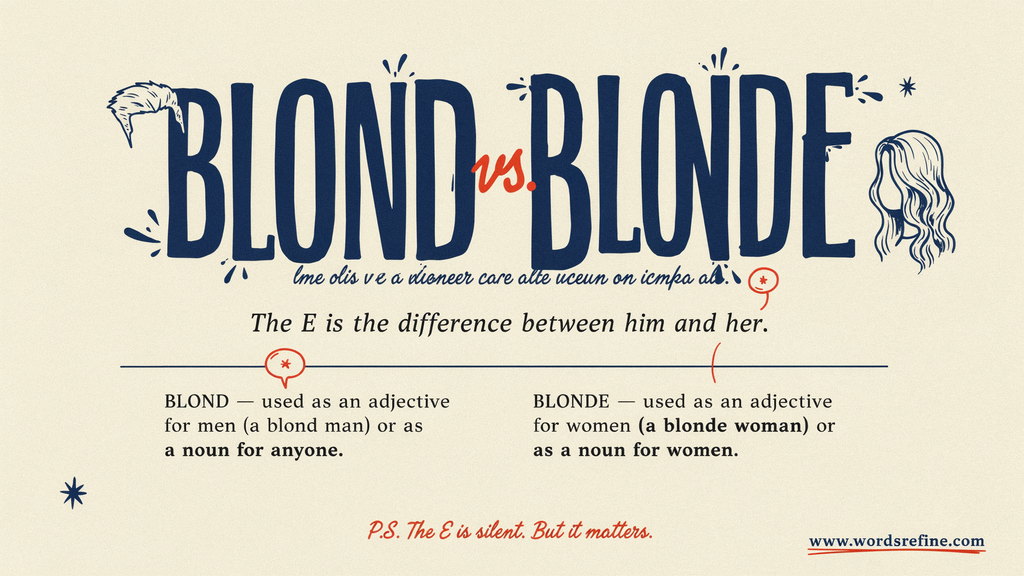
Blond describes hair that has a light color, usually ranging from pale yellow to golden or sandy shades. The word can refer to natural hair color or hair that someone has lightened with dye.
Although blond traditionally describes men and boys, modern English often uses it as a gender-neutral adjective. This means you can use it to describe a person’s hair without considering their gender.
For example, a man might have short blond hair, while a woman might have long blond curls. Both descriptions are correct under gender-neutral usage.
The word doesn’t identify one precise shade, either. Someone with pale golden hair and someone with darker sandy hair can both have blond hair. If you want to describe a particular shade, you can add words such as light, dark, ash, or strawberry.
Examples of Blond in a Sentence
Consider how blond works in everyday writing. “He has naturally blond hair” follows traditional masculine usage, while “She added blond highlights to her hair” uses the word as a gender-neutral adjective.
Similarly, you might write, “The child has soft, blond curls” or “The actor wore a blond wig for the performance.” In each case, the word describes color rather than establishing a rule about the person’s gender.
Blond also appears in descriptions of objects. For instance, blond wood refers to wood with a light, natural color. A blond beer is a pale-colored beer style. In these expressions, the adjective describes appearance rather than a person.
These examples show why context matters. The same word can describe hair, furniture, and beverages without changing its basic meaning.
Learn the difference between commonly mixed-up more words
Sublet vs Sublease Which One Is Correct ?
What Does Blonde Mean?
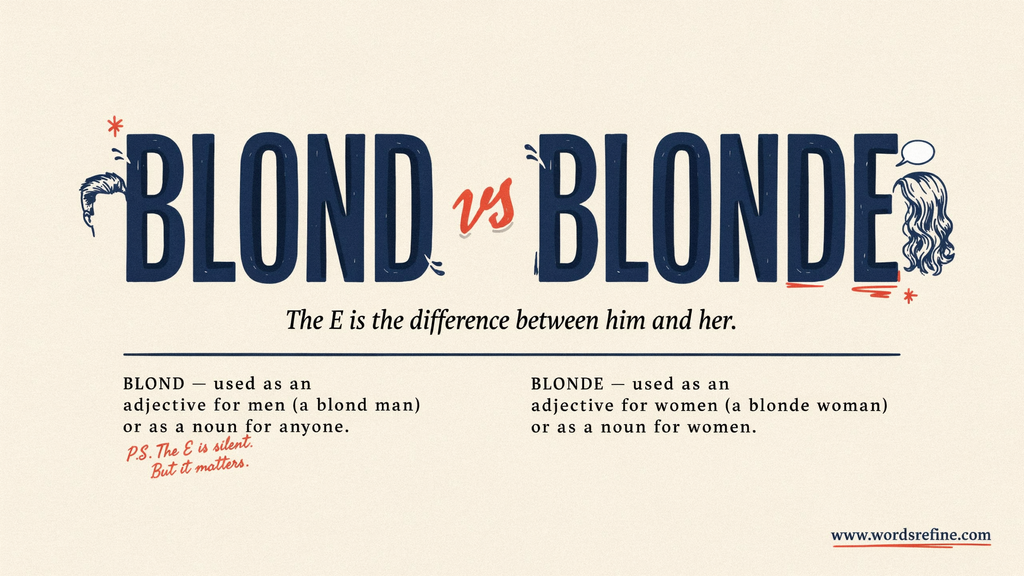
Blonde has the same basic meaning as blond. It describes light-colored hair, but English traditionally associates this spelling with women and girls.
The distinction comes from French, which has masculine and feminine forms of the word. English retained both spellings after borrowing the word, even though most English adjectives don’t change according to a person’s gender.
As a result, blonde remains especially common when describing a woman’s hair. For example, “She has long blonde hair” follows traditional usage, as does “Her blonde curls caught the sunlight.”
However, the spelling doesn’t indicate a different shade. Blonde hair can be pale, golden, sandy, or dark blonde. The surrounding description tells you more about the actual color.
Examples of Blonde in a Sentence
You might write, “The blonde woman entered the room” or “She chose blonde highlights for her new hairstyle.” In both sentences, blonde follows the traditional feminine convention.
The word can also describe certain products. A blonde roast, for example, refers to a light coffee roast. The term describes the roast’s color and general style rather than the gender of a person.
Although blonde is traditionally feminine when referring to people, its use in descriptions of objects doesn’t follow that distinction. The meaning depends on the context.
Blond vs Blonde Understanding the Main Difference
The main difference between blond and blonde involves traditional gender associations and grammatical usage. Their basic meaning remains the same.
Traditionally, blond is the masculine form, while blonde is the feminine form. However, contemporary English often uses blond as a gender-neutral adjective, particularly in American editorial writing.
Consider these sentences: “He has blond hair,” “She has blonde hair,” and “She has blond hair.” All three are correct. The first follows traditional masculine usage, the second follows traditional feminine usage, and the third uses a gender-neutral adjective.
The distinction becomes more noticeable when the word functions as a noun. In traditional usage, a blond refers to a man or boy with light-colored hair, while a blonde refers to a woman or girl with light-colored hair.
Even so, some modern style guides recommend avoiding these nouns altogether. Rather than identifying someone simply as a blond or a blonde, a writer can use the person’s name or a more relevant description.
For example, “The woman with blond hair spoke to the manager” gives readers a clear description without making hair color the person’s defining characteristic.
Is Blond Gender-Neutral?
Yes, blond can function as a gender-neutral adjective. Many writers use it to describe the hair of men, women, and nonbinary people without changing the spelling.
For example, you can write, “He has blond hair,” “She has blond hair,” or “They have blond hair.” The adjective remains the same in each sentence.
This approach makes writing more consistent and avoids a gender distinction that may not be necessary. It also gives writers a straightforward way to describe hair color without making assumptions about a person’s identity.
However, not every writer follows this convention. Some prefer blonde when describing women because they want to preserve the traditional distinction. Others use blond for everyone.
Both approaches appear in contemporary English. The important thing is to understand the convention you’re following and apply it consistently.
Blond vs Blonde for a Woman
You can use either spelling when describing a woman’s hair. Blonde follows traditional feminine usage, while blond is common in gender-neutral writing.
For example, “She has blonde hair” and “She has blond hair” communicate the same basic information. Neither sentence suggests a different hair color.
If you’re writing casually, choose whichever form feels natural to you. For a professional article, however, it’s helpful to follow the publication’s style guide so your spelling remains consistent throughout the text.
Blond vs Blonde for a Man
Blond is the traditional spelling for a man or boy. For example, “The blond man stood near the entrance” follows conventional usage.
Blonde is less common when referring to men, although some speakers and writers use it more broadly as an adjective. Nevertheless, blond remains the clearest choice when you want to follow traditional masculine usage.
If you’re unsure, consider the grammatical role of the word. When describing hair, blond is a practical gender-neutral option. When following traditional gender-specific conventions, use blond for males and blonde for females.
Blond vs Blonde for Nonbinary People
When describing a nonbinary person’s hair, blond works well as a gender-neutral adjective. For example, “Alex has short blond hair” describes the person’s appearance without assigning a gender-specific form to the word.
However, it’s always best to respect a person’s preferred terminology when you know it. You can also avoid mentioning hair color if it doesn’t contribute anything meaningful to the description.
The goal is clear, respectful writing rather than forcing every person into a traditional grammatical distinction.
Learn the difference between tricky grammar more words
Drily vs Dryly Which One Is Correct?
Blond vs Blonde in American English
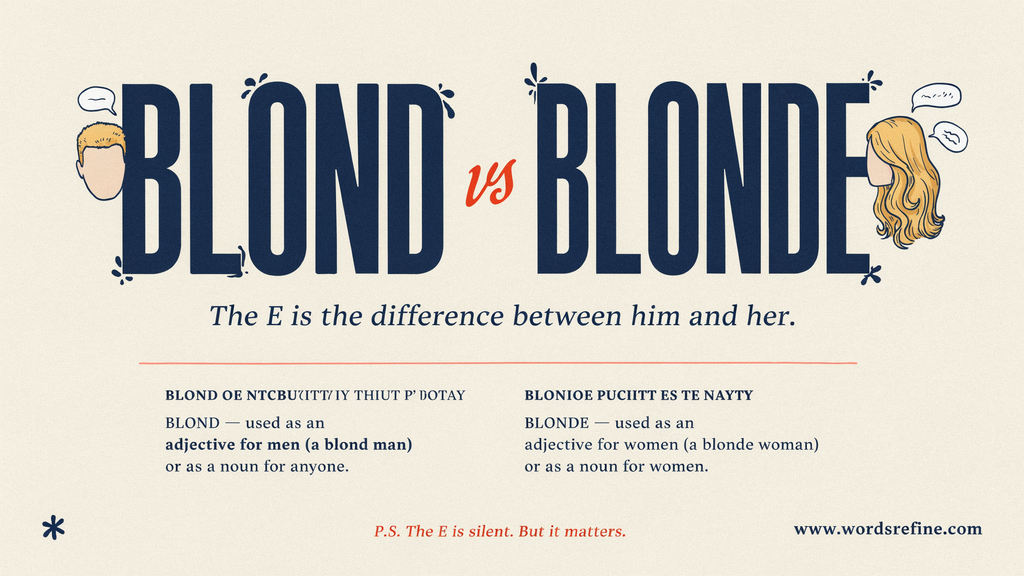
American English uses both blond and blonde, but blond often serves as the general spelling, especially in editorial writing. The distinction isn’t simply a matter of American spelling versus British spelling. Both varieties recognize both forms.
In everyday American writing, you’ll commonly see phrases such as “blond hair,” “blonde hair,” “a blond man,” and “a blonde woman.” The first two describe the same general hair color, while the last two follow traditional gender-specific usage.
Some American publications prefer blond as an adjective for everyone. The Associated Press, for example, recommends using blond regardless of gender when the word functions as an adjective. Its guidance also discourages using blond or blonde as a noun except in direct quotations.
This approach makes the spelling easier to manage. Writers can describe anyone’s hair as blond without switching forms according to gender.
However, other writers and publications continue to use blonde when describing women. Therefore, you shouldn’t assume that blonde is incorrect in American English.
When writing for a newspaper, website, or professional publication, follow its editorial guidelines. Consistency matters more than changing a correct spelling simply to match another writer’s preference.
Blond vs Blonde in British English
British English traditionally preserves the masculine and feminine distinction more visibly. Writers commonly use blond for men and boys and blonde for women and girls.
For example, “The blond boy played in the garden” follows traditional masculine usage, while “The blonde woman opened the door” follows traditional feminine usage.
Nevertheless, British English also uses blond as a gender-neutral adjective. You may encounter phrases such as “blond hair” when describing women or people whose gender isn’t relevant to the sentence.
Both forms are established in British English. The choice depends on the writer’s convention, the context, and any relevant editorial guidelines.
If you’re writing for a British audience, the traditional distinction is a useful starting point. However, don’t assume that blonde is exclusively British or that blond is exclusively American. Neither claim reflects actual usage.
Learn the difference between confusing word pairs
Weighed vs Weighted Which One Is Correct ?
The French Origin of Blond vs Blonde
The difference between blond and blonde becomes easier to understand when you look at their history.
Both words entered English through French. In French, blond is the masculine form, while blonde is the feminine form. English retained these two spellings even though its grammar doesn’t generally require adjectives to change according to gender.
This history explains why the final e appears in blonde. It reflects the feminine form inherited from French rather than a difference in the color itself.
French uses grammatical gender for nouns and requires many adjectives to agree with the nouns they describe. English works differently. Most English adjectives, including tall, happy, and intelligent, retain the same spelling regardless of the person’s gender.
Blond and blonde are exceptions that preserve a historical distinction. Over time, however, English usage became more flexible, particularly when the word functions as an adjective.
The word’s deeper history also connects it to medieval Latin. Its precise earlier origin remains uncertain, but its development into English through French explains the two familiar spellings.
Why Does Blonde Have an E at the End?
The final e comes from the traditional feminine form of the French word. English retained that spelling when referring to women and girls.
A simple way to remember the traditional distinction is to associate blond with the masculine form and blonde with the feminine form. However, this memory trick shouldn’t make you think that blond is wrong when describing a woman’s hair.
Modern English often uses blond as a gender-neutral adjective. Therefore, the final e is a useful reminder of traditional usage, not an absolute grammatical requirement.
Learn the difference between often confused words
Annual vs Anual Which one Is Correct?
Common Mistakes With Blond vs Blonde
One common mistake is assuming that blonde is always required when describing a woman. Although it follows traditional feminine usage, blond is also acceptable as a gender-neutral adjective. Both “She has blonde hair” and “She has blond hair” are correct.
Another mistake is believing that blond can describe only men. This overlooks contemporary usage, in which blond often describes hair regardless of gender. A sentence such as “The singer has blond hair” works for anyone.
Some writers also assume that the two spellings represent different shades. They don’t. Both words describe light-colored hair, and additional terms such as pale, golden, ash, or dark help identify the shade more precisely.
Inconsistent spelling can create another problem. If you use blonde in one paragraph and blond in another without following a clear convention, readers may wonder whether you intended a distinction. Choose a style and maintain it throughout the piece.
Finally, think carefully before using either word as a noun. Phrases such as “the blonde” and “the blond” are traditional, but they can sound reductive when they identify someone only by appearance. Depending on the context, using the person’s name or a more relevant description may produce a clearer sentence.
Blond vs Blonde in Everyday Writing
In casual conversations, text messages, and social media posts, both spellings are widely understood. You might write, “I love her blonde hair,” or “He looks great with blond highlights.” Neither sentence is likely to confuse readers.
Still, consistency helps your writing look polished. If you usually use blond as a gender-neutral adjective, there’s no need to switch to blonde simply because you’re describing a woman.
The same principle applies to formal writing. Whether you’re preparing a professional article, an academic assignment, or a business document, follow the style guide that applies to your work.
If your publication recommends blond as a gender-neutral adjective, use that form throughout. If it preserves the traditional distinction, use blond for males and blonde for females when describing people.
Also, consider whether the hair-color detail matters. In a description of someone’s appearance, it may be useful. In a business report or a news article, it might be irrelevant. Good word choice involves more than spelling; it also means including details that help readers understand the subject.
Blond vs Blonde Examples in Context
Looking at complete sentences makes the distinction easier to apply.
“He has naturally blond hair” follows traditional masculine usage. “She has blonde hair” follows traditional feminine usage. Meanwhile, “She has blond hair” uses the gender-neutral adjective.
The same distinction appears when the word describes a person directly. “The blond man waited outside” follows traditional masculine usage, while “The blonde woman entered the room” follows traditional feminine usage.
However, the word can also describe things. “The cabinet is made of blond wood” refers to a light-colored finish, while “She ordered a blonde roast coffee” describes a light coffee roast.
These examples show why you should consider the sentence rather than relying on a spelling rule alone. The word’s grammatical role and the convention you’re following determine the most suitable choice.
How to Remember Blond vs Blonde
The easiest way to remember the traditional distinction is to associate blond with males and blonde with females. The final e serves as a reminder of the feminine form.
However, keep modern usage in mind. Blond is widely used as a gender-neutral adjective, so you can describe anyone’s hair as blond when that convention suits your writing.
If you’re following a publication’s style guide, use its preferred spelling. Otherwise, choose a convention that feels natural and maintain it throughout your writing.
You don’t need to memorize dozens of exceptions. Understanding the traditional distinction and recognizing modern usage will help you make the right choice in most situations.
Learn the difference between basic English word mistakes
Instinctually vs Instinctively Which One Is Correct ?
Blond vs Blonde Practice Session
- My brother has ______ hair and blue eyes.
- The ______ woman standing near the window is my aunt.
- He decided to dye his hair ______ for the summer.
- The ______ man in the photograph is my cousin.
- She has naturally ______ hair.
- The actor is known for his short, ______ hairstyle.
- A ______ child was playing in the garden.
- The ______ girl wore a yellow dress to the party.
- My friend wants to go ______ before her vacation.
- The ______ boy won the school swimming competition.
- She used a special shampoo to maintain her ______ hair.
- The ______ woman smiled at the photographer.
- His ______ hair became darker as he grew older.
- The ______ actress played the lead role in the movie.
- I noticed a ______ man sitting at the bus stop.
- Her ______ curls looked beautiful in the sunlight.
- The little ______ boy ran toward his father.
- My sister has ______ hair, while I have brown hair.
- The ______ character in the story was a talented musician.
- They hired a ______ woman to model their new clothing collection.
- The baby has soft, ______ hair.
- A ______ man asked us for directions.
- She has always wanted ______ hair.
- The ______ woman in the painting wears a blue hat.
- His hair was naturally ______, but he dyed it black.
Answers
- blond
- blonde
- blond
- blond
- blonde
- blond
- blond
- blonde
- blonde
- blond
- blonde
- blonde
- blond
- blonde
- blond
- blonde
- blond
- blonde
- blond
- blonde
- blond
- blond
- blonde
- blonde
- blond
Here’s a trusted source for clear more words Comparison:
FAQs
Which ethnic groups naturally have blonde hair most often?
Natural blonde hair is most common among people of Northern European ancestry, particularly those with Scandinavian backgrounds. However, blonde hair occurs in other populations, too, and hair color varies widely within every ethnic group.
Which country is famous for blonde women?
Sweden is often associated with blonde women because naturally light hair is relatively common among people of Scandinavian ancestry. However, blonde hair is also found in countries such as Norway, Denmark, Finland, and Iceland. Hair color varies from person to person, regardless of nationality.
Can you spell blond without an E?
Yes. “Blond” is a correct spelling in English. It traditionally describes a man or boy with light-colored hair, but American English also commonly uses it as a gender-neutral adjective. “Blonde” is another accepted spelling, traditionally associated with women and girls.
What is the most common natural hair color in the United Kingdom?
Brown is generally the most common natural hair color in the United Kingdom, although blonde, black, and red hair are also present. The exact distribution varies by population, and reliable nationwide figures are limited.
What are some playful nicknames for guys?
Popular playful nicknames include “handsome,” “cutie,” “stud,” “sunshine,” and “golden boy.” If a guy has blonde hair, you might also use “Golden Boy” or “Blondie,” provided he enjoys the nickname.
What do you call an attractive blonde man?
You could call him a “handsome blond,” “blond heartthrob,” or “golden-haired charmer.” These expressions describe his appearance or appeal without changing the spelling distinction between “blond” and “blonde.”
Are blonde boys considered attractive?
Attractiveness is subjective, so there isn’t one hair color that everyone prefers. Some people find blonde hair appealing, while others prefer brown, black, or red hair. Personality, confidence, and individual preferences also influence attraction.
Learn the difference between commonly misused words
Ingenuine vs Ungenuine Which One Is Correct ?
Conclusion
The difference between blond vs blonde comes down to one small letter, yet it can create surprising spelling confusion. Traditionally, blond describes males, while blonde describes females. However, American English often uses blond as a gender-neutral adjective, particularly when describing hair color. Both spellings are correct, so the right choice depends on context and consistency.
Remember, hair color doesn’t define someone’s personality or attractiveness. Whether you’re writing about a blond actor, a blonde singer, or someone who changes hair color more often than the seasons change, understanding the distinction helps you write clearly and confidently.
Ultimately, grammar shouldn’t leave you pulling your hair out over a single letter. Learn the difference, use each spelling appropriately, and save the hair-splitting for the hairstylist!
Diora AJS she is an experienced blogger and passionate English language enthusiast at Words Refine. With a keen eye for language and a love for clear communication, she writes practical content about grammar, word meanings, usage, and commonly confused terms. Her goal is to make English easier to understand through clear explanations and relatable examples, helping readers write accurately and communicate with confidence.