
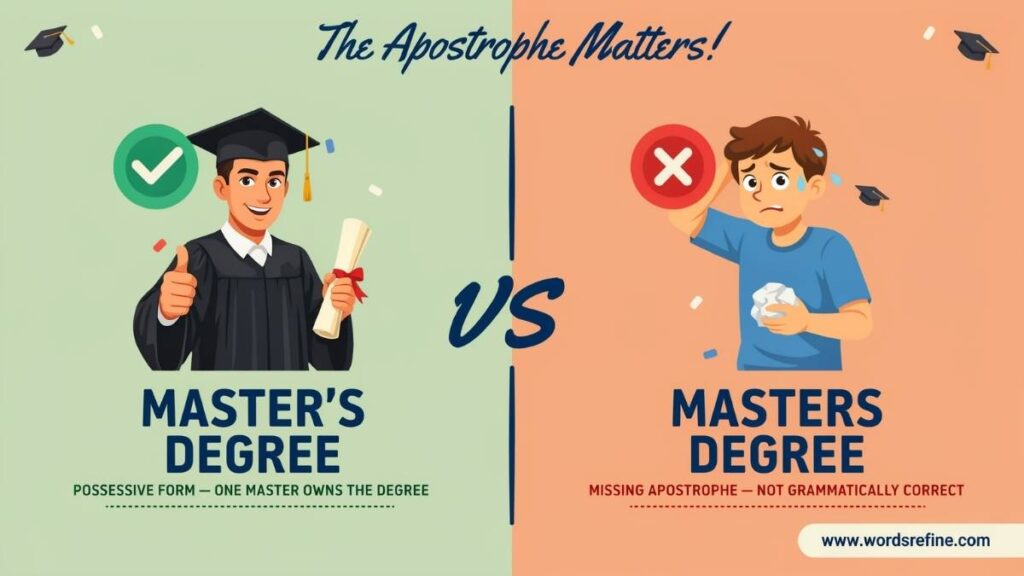
Have you ever second guessed a word because one tiny punctuation mark seemed easy to overlook? The difference between Master’s Degree vs Masters Degree often causes that kind of confusion. Although the phrases look nearly identical, “master’s degree” is the standard spelling in American English. The apostrophe may seem insignificant, but it helps make your writing accurate and professional. Whether you’re updating your resume, applying to graduate school, or highlighting your academic achievements, using the correct form matters. Fortunately, you don’t need an advanced degree in grammar to master this rule. Let’s explore the difference, clear up common mistakes, and make the correct spelling easy to remember.
Quick Answer Master’s Degree vs Masters Degree
Master’s Degree vs Masters Degree is the standard and grammatically correct form in American English. Use the apostrophe before the s when referring to the academic qualification.
The apostrophe isn’t optional in the standard expression. It marks the possessive form of master, reflecting the traditional naming of the qualification.
Consider these examples:
| Form | Correct usage | Explanation |
|---|---|---|
| Master’s degree | Correct | Standard spelling for the qualification |
| Masters degree | Generally incorrect | Missing the apostrophe |
| Master’s degrees | Correct | Standard plural form |
| Masters’ degree | Incorrect in standard usage | Places the apostrophe incorrectly |
| Master degree | Generally incorrect | Not the standard expression in American English |
| Master of Science | Correct | Formal name of a specific degree |
| Master of Arts | Correct | Formal name of a specific degree |
For example, you might write, “Sarah earned a master’s degree in psychology last spring.”
In this sentence, master’s degree refers to one academic qualification. The apostrophe belongs between the r and the s in master’s.
The easiest way to remember the rule is to use master’s degree for the general qualification and capitalize formal degree names when appropriate.
Why Is It Called a Master’s Degree?
The spelling becomes easier to understand when you consider the history behind the term.
The word master has long been associated with expertise, authority, and advanced learning. In medieval European universities, the title identified a person who had achieved a recognized level of academic qualification. Over time, the term became part of the naming convention for advanced university degrees.
The apostrophe in master’s degree reflects the traditional possessive construction. You can think of it as a degree associated with the title of master.
English uses similar possessive forms in familiar expressions such as a day’s work, a week’s vacation, and a bachelor’s degree. In each case, the apostrophe helps establish the grammatical relationship between the words.
Although modern academic qualifications have formal requirements and specific names, the traditional spelling remains standard.
Learn the difference between commonly mixed-up more words
Dork vs Nerd Meaning Differences Examples?
Why the Apostrophe Matters
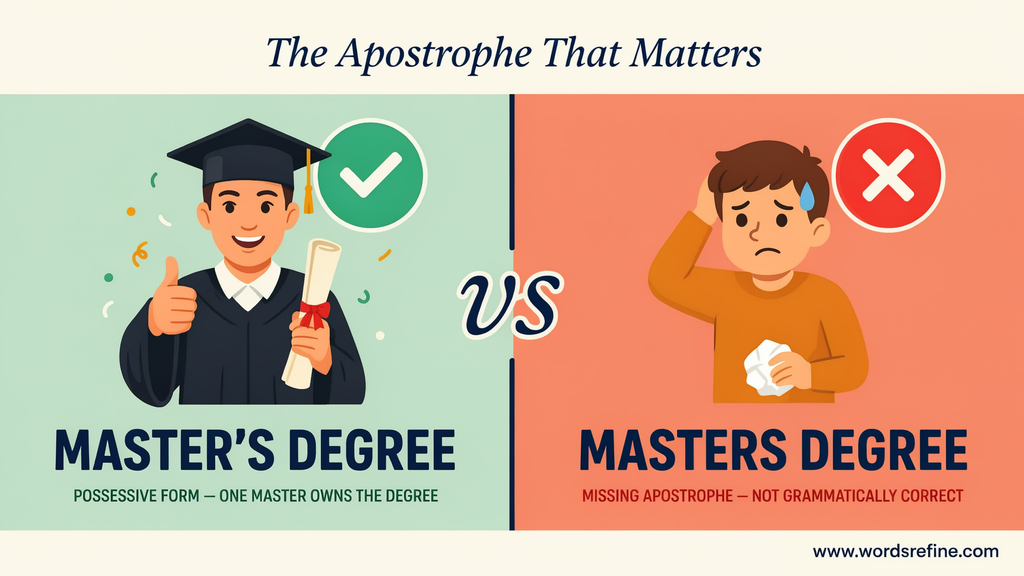
An apostrophe can change how a word functions in a sentence. In master’s degree, it marks the possessive form of the singular noun master.
Consider the differences:
Master’s degree refers to the standard academic qualification.
Master’s degrees refers to two or more such qualifications.
Masters can have other meanings depending on the sentence, including a plural noun or a verb form.
Masters’ degree suggests possession by multiple masters and isn’t the standard spelling of the academic qualification.
Although these forms may look similar, they don’t serve the same purpose. A small punctuation mark can make the difference between standard usage and a grammatical error.
Master’s Degree vs Masters Degree Key Grammar Differences
The main difference between master’s degree vs masters degree is the possessive apostrophe. Understanding how possessive nouns work makes it easier to apply the same rule to other expressions.
The Master’s Degree Apostrophe Rule
In standard American English, singular nouns commonly form possessives by adding an apostrophe and an s.
For example, you might write the teacher’s desk, the student’s application, the company’s policy, or the master’s degree.
In each expression, the possessive form connects one noun to another. The apostrophe in master’s degree follows the same general pattern.
English possessives have developed over time, and not every expression has exactly the same historical origin. Nevertheless, the familiar possessive pattern provides a useful way to remember the correct spelling.
Learn the difference between confusing more English words
favour vs Favor Meaning Differences Spelling and Examples ?
Why Masters Degree Without an Apostrophe Is Incorrect
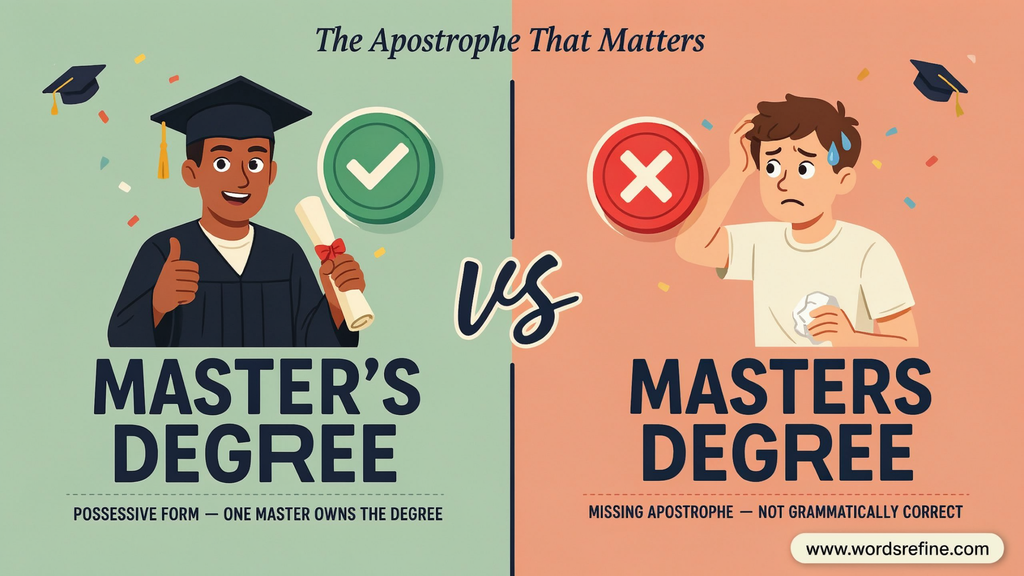
Writers often search for masters degree without apostrophe because they want to know whether the punctuation can be omitted.
In ordinary American English prose, it shouldn’t be. The expression doesn’t follow the established spelling convention for this academic qualification.
You may encounter the incorrect form in informal messages, online discussions, or poorly edited documents. However, seeing a spelling mistake repeatedly doesn’t make it standard.
Incorrect: Daniel completed his masters degree in finance.
Correct: Daniel completed his master’s degree in finance.
The correction requires only one small change, yet it makes the phrase consistent with standard English usage.
Is Master Degree Grammatically Correct?
Writers sometimes wonder whether to use master degree or master’s degree.
For general American English writing, choose master’s degree. The expression master degree isn’t the standard wording for this qualification.
However, academic terminology can vary among educational systems and institutions. You may encounter different constructions in translated materials, institutional names, or international contexts. When reproducing an official title, follow the institution’s published wording.
For ordinary writing, resumes, essays, and professional communication in the United States, master’s degree is the appropriate choice.
Master’s Degree Capitalization When Should You Use Capital Letters?
Apostrophes and capitalization follow different rules. While the apostrophe marks the possessive form, capitalization depends on whether you’re using a general description or a formal degree title.
General References to a Master’s Degree
Use lowercase when referring to the qualification in a general sense.
For example:
She plans to earn a master’s degree in chemistry.
My brother has a master’s degree in education.
A master’s degree can help professionals qualify for specialized roles.
He returned to graduate school to complete his master’s degree.
In each sentence, the phrase describes a type of qualification rather than naming a specific degree formally.
If you’re using the expression as an ordinary noun, lowercase is usually correct.
Learn the difference between tricky grammar more words
Sited vs Cited Meaning Differences Examples and Correct Usage
Official Degree Names Master of Science and Master of Arts
Formal degree names use capital letters according to standard title conventions.
Examples include Master of Science, Master of Arts, Master of Business Administration, Master of Fine Arts, and Master of Public Health.
Compare these sentences:
Olivia earned a master’s degree in biology.
Olivia earned a Master of Science in biology.
Both sentences can be correct. The first uses a general description, while the second identifies a specific degree title.
This distinction also applies when choosing between master’s degree and Master of Science. Use the general phrase when the exact title doesn’t matter. However, when you want to identify the qualification accurately, use its official name.
Should Master’s Degree Be Capitalized in a Heading?
Headings introduce another consideration because writers may use sentence case or title case.
In sentence case, capitalize the first word and proper nouns. In title case, capitalize words according to the relevant style guide.
For example:
Sentence case: How to write a master’s degree on a resume
Title case: How to Write a Master’s Degree on a Resume
The capitalization changes because the heading style changes. The apostrophe rule stays the same.
When preparing a blog post, academic document, or professional report, choose a heading style and apply it consistently.
Master’s Degree AP Style What Should You Follow?
The Associated Press Stylebook, commonly called the AP Stylebook, provides writing conventions used in journalism, public relations, and other professional settings.
AP-style writing generally uses lowercase for generic descriptions such as bachelor’s degree and master’s degree. However, it capitalizes formal degree names such as Bachelor of Arts and Master of Science.
For example, you might write that he earned a master’s degree in economics, that she received a Master of Arts in English, or that the university offers a master’s degree in public health.
These examples illustrate the distinction between general degree descriptions and formal titles.
When following AP style, consult the current stylebook for the precise rules that apply to your publication. A university or employer may also have its own requirements.
Learn the difference between confusing word pairs
Buy vs Bye Meaning Differences Examples ?
Does AP Style Use Master’s Degree vs Masters Degree?
The standard form is Master’s Degree vs Masters Degree with the apostrophe before the s.
It’s important not to confuse capitalization rules with punctuation rules. Writing a phrase in lowercase doesn’t remove its apostrophe, and capitalizing a formal degree title doesn’t change the established spelling of the general expression.
For example, he holds a master’s degree is correct, and she earned a Master of Science is also correct. By contrast, he holds a masters degree doesn’t follow standard usage.
When a style guide specifies how to format a qualification, follow it consistently rather than relying on what looks familiar.
Master’s Degree vs Master of Science vs Master of Arts
These expressions are closely related, but they don’t mean exactly the same thing.
A master’s degree is a broad term for a postgraduate academic qualification. A Master of Science and a Master of Arts are specific degree types.
| Expression | Meaning | Example |
|---|---|---|
| Master’s degree | General category of qualification | He earned a master’s degree in chemistry. |
| Master of Science | Specific degree title, often abbreviated MS or MSc depending on the institution | She earned a Master of Science in chemistry. |
| Master of Arts | Specific degree title, commonly abbreviated MA | He earned a Master of Arts in history. |
| Master of Business Administration | Specific professional degree title | She completed a Master of Business Administration. |
The distinction matters because not every master’s degree is a Master of Science or a Master of Arts. Universities offer different degree types depending on the academic field, program structure, and institutional requirements.
For example, an MBA focuses on business administration. An MFA commonly focuses on creative and performing arts, while a Master of Public Health focuses on public health practice and related fields.
The exact curriculum and degree designation depend on the institution.
Is It Master’s of Science vs Master of Science?
The standard formal title is Master of Science, not Master’s of Science.
The same pattern applies to Master of Arts and Master of Business Administration. The possessive apostrophe belongs in the general expression master’s degree, but it doesn’t belong in these formal degree titles.
For example, she earned a master’s degree in chemistry is correct. She earned a Master of Science in chemistry is also correct. However, she earned a Master’s of Science in chemistry doesn’t use the standard formal title.
This distinction is particularly useful when writing academic credentials or preparing a professional resume.
Learn the difference between often confused words
T- Shirt vs Tee Shirt Which One Is Correct and Why?
How to Write Master’s Degree in Different Contexts
The spelling generally stays the same across different types of writing. However, how you present the qualification may change depending on your purpose.
Master’s Degree in a Sentence
A master’s degree can appear naturally in sentences about education, work, career goals, and academic achievements.
For example, my sister is pursuing a master’s degree in psychology. A master’s degree in education may prepare graduates for specialized teaching or leadership roles. After earning his master’s degree, Marcus applied for research positions.
Notice that the phrase stays lowercase in the middle of each sentence. The apostrophe remains in place regardless of the subject or verb.
Master’s Degree in Education
The phrase master’s degree in education is a general description, so it normally stays lowercase.
For example, Priya earned a master’s degree in education to strengthen her skills in curriculum design.
If you know the official degree title, you can use that instead. A university might award a Master of Education, often abbreviated MEd or M.Ed., depending on its conventions.
A Master of Education isn’t automatically interchangeable with every other master’s degree in education. The exact credential depends on the program and the institution.
Master’s Degree in an Essay or University Application
Academic writing calls for consistency and accuracy. When describing your qualifications, distinguish between a degree you’ve completed, one you’re pursuing, and one you hope to earn.
For example, you might write, “I earned a master’s degree in economics in 2024,” if you’ve completed the qualification. If you’re still studying, write, “I am pursuing a master’s degree in economics.” If it’s a future goal, write, “I plan to pursue a master’s degree in economics after completing my bachelor’s degree.”
Don’t describe a degree as completed before you’ve earned it. That isn’t merely a grammar issue; it affects the accuracy of your academic credentials.
When an application asks for the official degree title, use the wording shown on your transcript, diploma, or university record.
How to Write a Master’s Degree on a Resume or CV
A resume should make your qualifications easy to scan. Correct spelling helps, but accurate details matter even more.
For a completed degree, you can list the qualification in the education section using a format such as:
Education
Master of Science in Computer Science
Example University, 2024
Alternatively, if you prefer a general description, you could write master’s degree in computer science followed by the institution and completion date.
Use the official title whenever you know it. Don’t replace a specific qualification with a broader label if doing so could misrepresent the credential.
Learn the difference between basic English word mistakes
Envisage vs Envision Meaning Differences Examples ?
How to List a Degree in Progress
If you’re still studying, make that clear.
For example, you might write Master of Science in Computer Science, expected 2027, or master’s degree in education, in progress. You could also write Master of Business Administration candidate, expected 2028, if that description accurately reflects your status.
Use an expected completion date only when it’s a reasonable estimate. Follow your institution’s or employer’s preferred wording when the application provides specific instructions.
How to List a Master’s Degree After Your Name
Some professionals place degree abbreviations after their names, especially in academic, clinical, or specialized professional settings.
For example, someone might write Jordan Lee, MA; Taylor Morgan, MS; or Casey Patel, MBA.
Use an abbreviation only when you’ve earned the corresponding qualification. Also, check the degree-granting institution’s official abbreviation and the conventions of your profession.
Not every job application requires degree letters after your name. In many cases, listing the full qualification in the education section is clearer.
Master’s Degree Abbreviations MA MS and MBA
Degree abbreviations save space, but they require care because institutions don’t always use the same formatting conventions.
| Abbreviation | Common meaning | Important note |
|---|---|---|
| MA or M.A. | Master of Arts | Formatting varies by institution and style guide. |
| MS or M.S. | Master of Science | Some institutions use MSc or M.Sc. instead. |
| MBA | Master of Business Administration | A professional graduate degree in business administration. |
| MFA | Master of Fine Arts | Common in creative and performing arts fields. |
| MPH | Master of Public Health | Common in public health education. |
| MEd or M.Ed. | Master of Education | Formatting depends on the institution. |
These abbreviations aren’t universally formatted in the same way. Some institutions use periods, while others omit them. Certain countries also favor different abbreviations.
When in doubt, check the university’s official website or the instructions for the document you’re preparing.
Master’s Degree vs Master’s Degrees Understanding the Plural
The plural of master’s degree is master’s degrees.
To form the plural, you make the main noun degree plural. The possessive form master’s remains unchanged.
For example, she earned a master’s degree in biology, while he holds two master’s degrees. They compared several master’s degrees before choosing a program, and both universities offer master’s degrees in public health.
The apostrophe rule applies whether you’re talking about one qualification or several.
Learn the difference between commonly misused words
Apprised vs Appraised Which One Is Correct and Why It Matters ?
Is It Master’s Degrees vs Masters Degrees?
In standard American English, write master’s degrees.
Incorrect: The university offers several masters degrees.
Correct: The university offers several master’s degrees.
The apostrophe remains because master’s retains its established form. Only degree changes from singular to plural.
How to Write Multiple Master’s Degrees
When someone holds more than one qualification, make the number clear.
For example, Elena holds two master’s degrees, one in education and another in counseling. Similarly, David earned master’s degrees in engineering and computer science.
You don’t need to change master’s to masters’ simply because someone holds multiple qualifications. The plural refers to the degrees, not to multiple people called masters.
Master’s Degree vs Master’s Student vs Master’s Program
These expressions share the same apostrophe pattern, but each refers to something different.
1A master’s degree is the qualification awarded after someone completes the relevant program requirements.
2A master’s student is a student enrolled in a master’s-level program.
3A master’s program is the course of study that leads to a master’s degree.
For example, she earned a master’s degree last year. He is a master’s student at the university. They applied to a master’s program in public policy.
In each example, master’s retains the same possessive form.
Therefore, don’t write masters student or masters program in standard formal American English when referring to a student or program at the master’s level.
Learn the difference between everyday English mistakes
Remediated vs Remedied Which One Is Correct ?
Common Master’s Degree Grammar and Punctuation Mistakes
Even experienced writers can overlook small errors when preparing formal documents. Fortunately, a quick review can help you catch the most common problems.
| Common mistake | Correct form | Explanation |
|---|---|---|
| masters degree | master’s degree | The standard expression requires an apostrophe. |
| masters’ degree | master’s degree | The apostrophe belongs before the s. |
| master degree | master’s degree | The latter is the standard general expression in American English. |
| Master’s Of Science | Master of Science | The formal degree title doesn’t use a possessive apostrophe. |
| She earned two master’s degree | She earned two master’s degrees | The noun must agree with the plural quantity. |
| He is a masters student | He is a master’s student | The standard expression uses the possessive form. |
| She earned a Master’s Degree in Biology | She earned a master’s degree in biology | Generic references normally use lowercase in running text. |
Do Academic Degrees Need Apostrophes?
Not every academic degree name contains an apostrophe.
The general phrases bachelor’s degree and master’s degree use apostrophes. Formal titles such as Bachelor of Arts, Master of Science, and Doctor of Philosophy don’t.
The apostrophe rule depends on the expression itself, not simply on whether the qualification is academic.
Is Master’s Ever Correct on Its Own?
Yes. Writers can use master’s as shorthand when the word degree is clear from context.
For example, “She has a bachelor’s degree, and he has a master’s.”
Here, readers understand that master’s refers to a master’s degree. This shortened construction sounds natural when the surrounding sentence makes the meaning clear.
However, in a formal application or resume, use the complete official degree title whenever the document requires precise credential information.
A Practical Example Editing a Graduate School Application
Imagine that Alex is applying to a graduate program. The first draft of the application contains this sentence:
“I earned my Bachelors degree in biology and plan to pursue a Masters Degree in Public Health.”
The sentence contains several mistakes involving apostrophes and capitalization.
A polished version would read:
“I earned my bachelor’s degree in biology and plan to pursue a master’s degree in public health.”
The revised version corrects the possessive apostrophes and keeps the general degree descriptions lowercase. It also preserves Alex’s intended meaning without adding unnecessary words.
Now suppose Alex knows the official title of the intended qualification is Master of Public Health. The sentence could instead read:
“I earned my bachelor’s degree in biology and plan to pursue a Master of Public Health.”
This version identifies the specific qualification rather than describing it generally.
The lesson is simple: correct spelling, consistent capitalization, and accurate degree names work together to make academic writing clearer.
How to Remember the Correct Spelling of Master’s Degree
If you often forget the apostrophe, a simple proofreading routine can help.
First, check the possessive form. Write master’s, not masters, when referring to the standard academic qualification.
Next, check the noun. Use degree for one qualification and degrees for more than one.
Then, review capitalization. Keep generic references lowercase in ordinary sentences, but capitalize formal titles when appropriate.
Finally, check the official degree name and follow the style guide required by your university, employer, or publication.
A useful memory trick is to remember that the apostrophe goes before the s in master’s, just as it does in student’s when referring to something associated with one student. The familiar possessive pattern makes the spelling easier to recall.
Before submitting a resume or application, search the document for masters degree. If you find that phrase, check whether it should be changed to master’s degree.
Learn the difference between more words people mix up
Vaccum Vs Vacuum Which One Is Correct and Why It Matters ?
Practice Session Master’s Degree vs Masters Degree
- She earned a __________ in English literature.
- He plans to pursue a __________ in business administration.
- The university offers several __________ in different fields.
- My sister completed her __________ in psychology last year.
- A __________ can help you qualify for advanced positions in your field.
- He applied to a __________ program in computer science.
- Many students pursue a __________ to develop specialized skills.
- He holds a __________ in mechanical engineering.
- The college offers online __________ for working professionals.
- She is completing her __________ coursework in education.
- A __________ usually involves more advanced study than a bachelor’s degree.
- He wants to earn a __________ before applying to a doctoral program.
- The university introduced two new __________ in public health.
- She discussed her __________ research project with her professor.
- My cousin has a __________ in environmental science.
- Students must meet specific requirements to complete a __________.
- The school offers several __________ programs for graduate students.
- She earned her __________ while working full-time.
- He plans to pursue a __________ in data science.
- The admissions office explained the requirements for its __________ programs.
- A __________ may be required for certain specialized careers.
- She completed her __________ program in two years.
- The university awarded __________ to students who completed their graduate programs.
- He listed his __________ in education on his resume.
- Before applying, check whether the university offers the __________ you want to pursue.
Answers
- master’s degree
- master’s degree
- master’s degrees
- master’s degree
- master’s degree
- master’s degree
- master’s degree
- master’s degree
- master’s degrees
- master’s-level
- master’s degree
- master’s degree
- master’s degrees
- master’s-level
- master’s degree
- master’s degree
- master’s degree
- master’s degree
- master’s degree
- master’s degree
- master’s degree
- master’s degree
- master’s degrees
- master’s degree
- master’s degree
Here’s a trusted source for clear more words Comparison:
FAQs
Is “master’s degree” correct for an online program?
Yes. The term “master’s degree” is correct whether you earn your degree online, on campus, or through a hybrid program. For example, “She earned her master’s degree through an online program.”
What is the plural of “master’s degree”?
The plural form is “master’s degrees.” The apostrophe remains after “master,” while “degree” becomes “degrees.” For example, “The university offers several master’s degrees in education.”
Should I use an apostrophe in “master’s degree program”?
Yes. The correct spelling is “master’s degree program,” with an apostrophe after “master.” For example, “He applied to a master’s degree program in computer science.”
Should “master’s degree” be capitalized at the beginning of a sentence?
Yes. Capitalize “Master’s” when it begins a sentence. Otherwise, use lowercase unless the phrase appears in a title or heading that follows a specific capitalization style. For example, “Master’s degree programs often require advanced coursework and independent research.”
Is “master’s degree holder” grammatically correct?
Yes. “Master’s degree holder” describes someone who has earned a master’s degree. The apostrophe is necessary in “master’s.” For example, “She is a master’s degree holder with experience in finance.” A more natural alternative is “She holds a master’s degree in finance.”
Should “master’s-level” include an apostrophe and a hyphen?
Yes. Use “master’s-level” when the phrase modifies a noun, as in “master’s-level coursework.” The apostrophe belongs to “master’s,” and the hyphen connects the words to make the meaning clear. However, you can write “study at the master’s level” without a hyphen.
Learn the difference between tricky grammar more words
Effort vs Affort Which One Is Correct and How to Use It?
Conclusion
The difference between “master’s degree” vs “masters degree” comes down to one small apostrophe, but that tiny mark makes a big difference. In standard American English, “master’s degree” is the correct form when referring to the academic qualification.
Fortunately, you don’t need a master’s degree in grammar to remember the rule. Use “master’s degree” for one qualification and “master’s degrees” for more than one. Also, capitalize the phrase only when the sentence or title requires it. Whether you’re updating your resume, writing an academic paper, or applying to graduate school, correct spelling helps keep your writing clear and professional.
After all, earning a master’s degree takes plenty of hard work. Don’t let one missing apostrophe become the most challenging part of your academic journey!

Diora AJS she is an experienced blogger and passionate English language enthusiast at Words Refine. With a keen eye for language and a love for clear communication, she writes practical content about grammar, word meanings, usage, and commonly confused terms. Her goal is to make English easier to understand through clear explanations and relatable examples, helping readers write accurately and communicate with confidence.