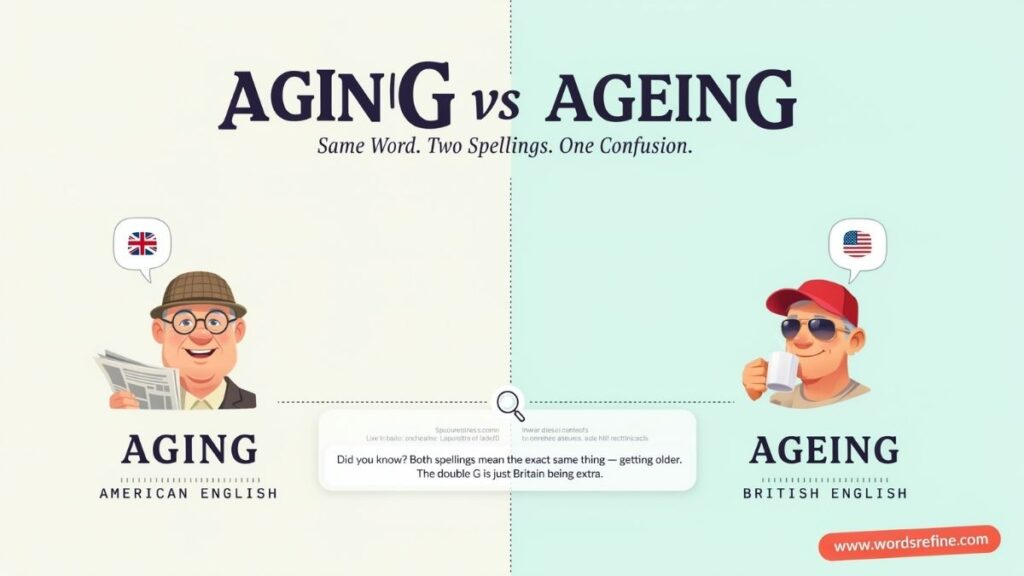
Aging vs ageing which spelling should you use? If this little spelling puzzle has you second guessing yourself, do not worry! You do not need an anti aging cream for your grammar. Both spellings are correct and carry the same meaning, but their usage depends on your audience. American English prefers aging, while British English commonly uses ageing. Although the difference is just one letter, choosing the right spelling helps keep your writing clear and consistent. So, before this tiny word problem ages into a bigger headache, let’s explore the difference between aging and ageing, examine common spelling mistakes, and learn how to use each form confidently.
Quick Answer Aging vs Ageing
Both “aging” vs“ageing” are correct spellings of the same word. They describe the process of growing older or the changes that occur over time.
American English generally uses “aging,” while British English traditionally favors “ageing.” Australian English commonly follows the latter convention, whereas Canadian English accepts both forms in different contexts.
The important point is that neither spelling changes the meaning. Instead, your audience and the style guide you follow determine which version makes the most sense.
Learn the difference between confusing more English words
Labelled vs Labeled Which one Is Correct?
What Does Aging Mean?
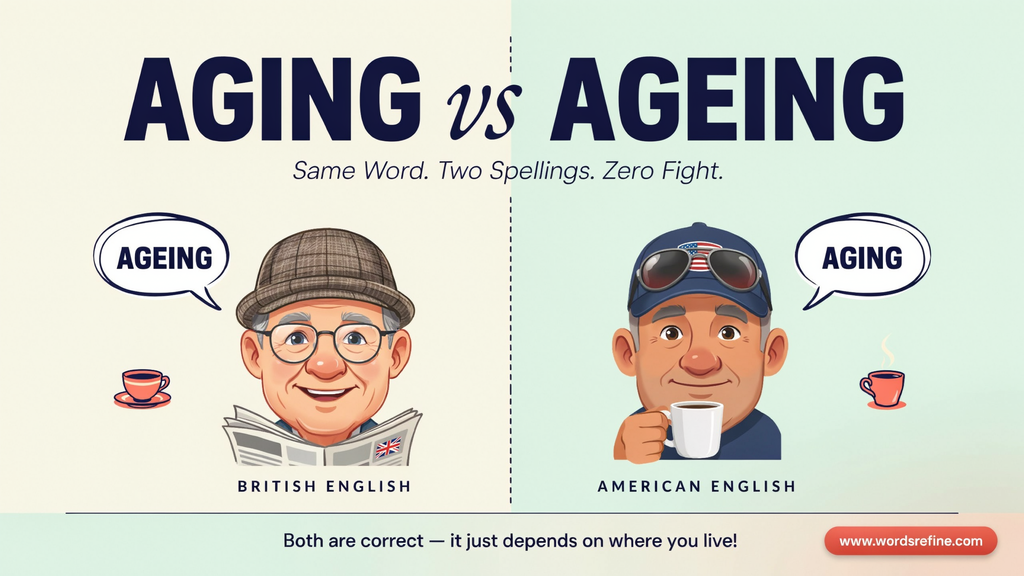
Aging means growing older or experiencing changes associated with the passage of time. The term commonly describes changes in the human body, animals, plants, materials, and even financial accounts.
For example, a person may notice changes in their skin as they age. Similarly, researchers may study how aging affects memory, mobility, and overall health.
The word also appears in expressions such as healthy aging, premature aging, signs of aging, and the aging population.
Consider these examples:
The skin may develop fine lines as part of the natural aging process.
Researchers are studying how aging affects memory and physical strength.
The aging population has increased demand for health care and community services.
In each example, aging describes a process or a condition associated with growing older. The spelling is standard in American English and is common in American medical, academic, and everyday writing.
What Does Ageing Mean?
Ageing has the same meaning as aging. It refers to growing older or the gradual changes that happen over time.
The extra letter “e” does not create a new meaning. Instead, it reflects an established spelling convention used in British English and commonly followed in Australian English.
For example, a British newspaper might discuss an ageing population, while an American newspaper would typically use aging population. Both expressions communicate the same idea.
Here are a few examples:
Ageing is a natural part of life.
The study examines healthy ageing among older adults.
An ageing population can create new challenges for public services.
As these examples show, ageing works in the same grammatical contexts as aging. The main difference is regional spelling preference, not meaning or pronunciation.
Learn the difference between commonly mixed-up more words
Flyer vs Flier Which one Is Correct?
Aging vs Ageing Key Differences
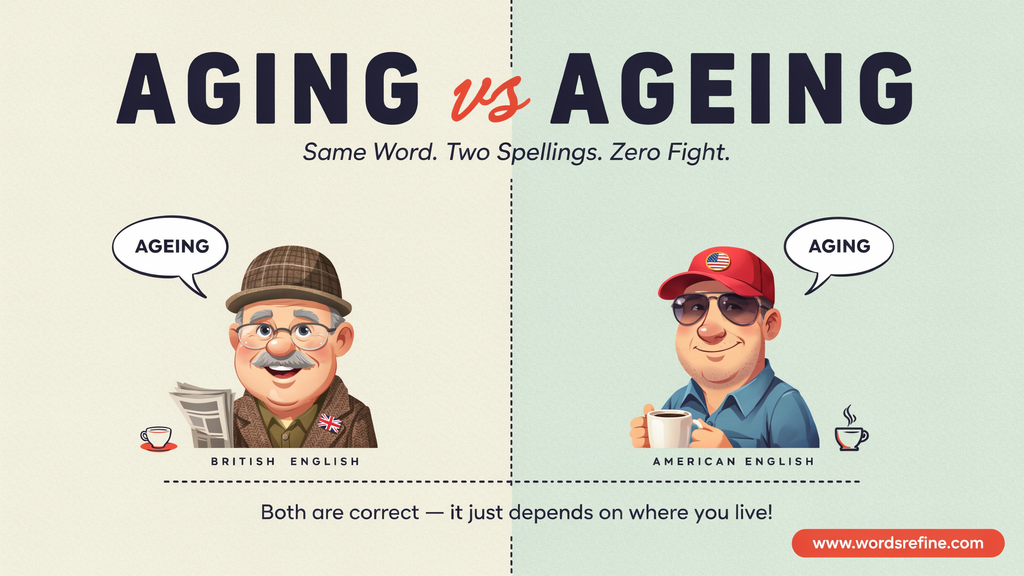
The difference between aging vs ageing is straightforward once you understand how English spelling varies across regions. Both words have the same definition, perform the same grammatical functions, and generally sound alike.
Meaning and Definition
Aging and ageing both describe the process of becoming older. They can refer to biological changes, the passage of time, or the gradual deterioration of materials.
For example, “the effects of aging” and “the effects of ageing” express the same idea. Neither spelling suggests a different stage of life or a separate biological process.
Spelling and Regional Usage
The main distinction lies in regional conventions. American English generally favors aging, while British English traditionally prefers ageing.
Australian English commonly uses ageing, although aging also appears in some publications. Canadian English uses both spellings, so writers should consult the relevant dictionary or style guide.
Consequently, the best spelling depends on where your readers are and which writing conventions your document follows.
Pronunciation
Despite the extra letter, aging and ageing generally have the same pronunciation. The additional “e” in ageing does not usually change the way you say the word.
Therefore, you can focus on the spelling convention rather than worrying about a difference in spoken English.
Grammar and Word Forms
Both aging and ageing can function as a present participle or a gerund, depending on the sentence. A present participle can describe an ongoing action, while a gerund functions as a noun.
For example, in “The population is aging,” the word describes an ongoing process. In “Aging is a natural process,” it functions as a noun.
The same grammatical patterns apply to ageing. Other related words include aged, age-related, ageless, and ageism, although these words do not all follow the same regional spelling variation.
Learn the difference between tricky grammar more words
Reoccurrence vs Recurrence Which One Is Correct ?
Aging vs Ageing in American English
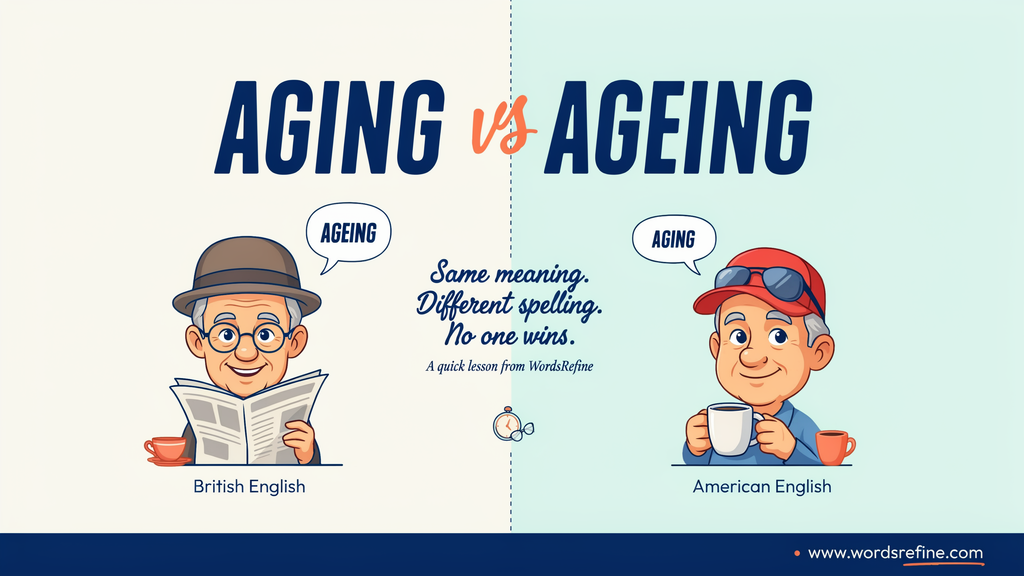
In American English, aging is the standard spelling. American writers generally omit the extra “e” when using the word in everyday communication, academic research, business documents, and professional publications.
For instance, an American health article would typically discuss healthy aging rather than healthy ageing. Similarly, a report might refer to an aging population or the signs of premature aging.
Common American expressions include healthy aging, premature aging, signs of aging, aging population, and aging process.
Consider these examples:
Healthy aging involves habits that support physical and mental well-being.
The researchers examined age-related changes during the natural aging process.
The city is developing new services for its aging population.
The company prepared an aging report to identify overdue customer payments.
In each sentence, aging follows standard American spelling conventions. Therefore, if you are writing for an American audience, this is generally the safest choice.
Aging vs Ageing in British English
British English traditionally favors ageing. The spelling appears in everyday writing, news articles, academic publications, and discussions about health and society.
For example, a British publication might use healthy ageing, signs of ageing, or an ageing population. However, aging is also encountered in British writing, particularly in international material and sources that follow different editorial conventions.
Consider these examples:
Ageing is a natural process that affects everyone differently.
The report examines the needs of an ageing population.
Researchers are investigating the effects of ageing on memory.
The organization supports healthy ageing among older adults.
These sentences use the traditional British spelling. Nevertheless, British writers should still follow the preferences of their publisher, institution, or employer when a particular style guide applies.
Learn the difference between confusing word pairs
Rosin vs Resin Which One Is Correct and What’s the Difference?
Aging vs Ageing in Canadian English
Canadian English combines features of British and American spelling traditions. As a result, both aging and ageing appear in Canadian writing.
Rather than assuming that every Canadian publication follows one spelling, check the dictionary or style guide relevant to your work. A university, government department, newspaper, or medical journal may have its own preferred convention.
For example, a Canadian health organization might discuss healthy aging, while another publication might use healthy ageing. Both expressions are understandable and grammatically correct.
When writing for a Canadian audience, consistency matters more than choosing one form simply because it looks more British or American. Once you establish the preferred spelling, use it throughout the document.
Aging vs Ageing in Australian English
Australian English commonly favors ageing, following a traditional British spelling convention. You may encounter this form in discussions about public health, older adults, social services, and demographic changes.
For example, an Australian report might examine an ageing population or recommend policies that support healthy ageing.
However, aging also appears in Australian writing, especially in international research and publications that follow American spelling conventions.
Consider these examples:
Healthy ageing helps people maintain their independence as they grow older.
The country is preparing for the needs of an ageing population.
The research examines age-related changes throughout the ageing process.
When writing for an Australian audience, ageing is generally a suitable choice. Even so, follow the relevant publication’s spelling guidelines whenever they specify a preferred form.
Why Does Ageing Have an Extra E?
The difference between aging and ageing becomes easier to understand when you look at how English forms words ending in “-ing.”
The Base Word Age
The word age ends with a silent “e.” When English adds the suffix “-ing,” writers often remove that final letter.
For example, make becomes making, write becomes writing, and take becomes taking.
The American spelling aging follows this common pattern. The final “e” disappears before “-ing” is added.
The General Rule for Adding -ing
Many English verbs drop their final silent “e” before taking the “-ing” suffix. This spelling pattern helps explain why aging is the standard American form.
However, English spelling has exceptions and established variations. Not every accepted spelling follows the same pattern in every region.
Why Both Spellings Exist
Ageing preserves the final “e” before adding “-ing.” Although this form does not follow the usual pattern of dropping a silent “e,” it has become an established spelling in British English and is common in Australian English.
Therefore, ageing is not a spelling mistake. It is a recognized regional variant.
The key lesson is simple: general spelling rules can help you understand English, but regional conventions sometimes determine which accepted form a publication prefers.
Learn the difference between often confused words
Waving vs Waiving Which One Is Correct ?
Aging vs Ageing in a Sentence
Seeing both spellings in context makes their relationship clear. The meaning stays the same, even when the spelling changes.
Everyday English
In everyday writing, both forms can describe people growing older or changes that occur over time.
American English: My parents are aging gracefully.
British English: My parents are ageing gracefully.
American English: The signs of aging become more noticeable over time.
British English: The signs of ageing become more noticeable over time.
In both pairs, the sentences communicate the same meaning. The spelling simply reflects the intended regional convention.
Medical and Scientific Writing
Medical and scientific writing frequently uses terms such as biological aging, healthy ageing, premature aging, and age-related changes.
For example, researchers may examine how aging affects physical strength, while another study may investigate the effects of ageing on memory.
In scientific writing, accuracy matters more than regional preference alone. Therefore, follow the terminology and spelling conventions used by the journal, research institution, or professional organization.
Academic Writing
Academic writing requires consistency, especially in essays, dissertations, and research papers. Switching between aging and ageing without a clear reason can distract readers and make the document appear poorly edited.
If your university requires American English, use aging throughout. If your department follows British English, ageing may be the preferred form.
Similarly, when submitting an article to a journal, check its author guidelines before making your final edits.
Business and Financial Writing
The words aging and ageing also appear in business and finance. In these contexts, they can describe how long invoices, debts, or other balances have remained outstanding.
For example, a business might review an aging schedule to identify unpaid customer invoices. Another organization may use the term ageing schedule according to its established spelling convention.
Although the spelling varies, the financial purpose remains the same: helping businesses understand how long balances have been outstanding and which payments need attention.
Learn the difference between more words people mix up
Wisp vs Whisp Which One Is Correct?
Aging vs Ageing in Accounting: What Does an Aging Report Mean?
An aging report is a financial document that groups outstanding invoices or account balances according to how long they have remained unpaid. Businesses use these reports to monitor receivables, manage collections, and identify overdue payments.
For example, a company might organize unpaid customer invoices into categories such as current, 1–30 days overdue, 31–60 days overdue, and 61–90 days overdue.
Suppose a customer has an invoice that remains unpaid for 45 days. The business would place that invoice in the 31–60-day category, assuming the report measures overdue time using those intervals.
This information helps the finance team prioritize collection efforts and assess payment patterns.
The term aging report is common in American English, while ageing report may appear in documents that follow British spelling conventions. The underlying accounting concept does not change.
Similarly, accounts receivable aging and accounts payable aging describe analyses of outstanding customer balances and unpaid supplier obligations, respectively. In either case, the purpose is to understand how long amounts have remained outstanding.
Learn the difference between basic English word mistakes
Cancell vs Cancel Which one Is Correct?
Related Words Do They Also Have Two Spellings?
Although aging and ageing differ by one letter, related words do not necessarily follow the same pattern. Understanding these distinctions will help you avoid creating spelling variations where none are needed.
Ageism
Ageism refers to prejudice, stereotypes, or discrimination based on a person’s age. It can affect older adults, younger people, and anyone judged unfairly because of their age.
For example, rejecting a qualified applicant simply because an employer considers them too old may be an example of age discrimination.
The standard spelling is ageism in both American and British English. It does not become ageism with an extra “e” simply because a writer uses ageing.
Aged
Aged can describe someone or something that has grown older. It can also refer to products that mature over time, such as aged cheese.
For example, the company renovated an aged building, while the restaurant served aged cheese.
Unlike aging and ageing, aged does not normally change its spelling between American and British English.
Age-Related
Age-related describes something associated with age or the process of growing older.
For example, doctors may discuss age-related changes in vision, while researchers may examine age-related differences in memory.
The term is useful in medical, scientific, and everyday writing. Its spelling does not change simply because you choose aging or ageing elsewhere in the document.
Ageless
Ageless describes someone or something that seems unaffected by age or remains relevant across different generations.
For example, a classic song may have an ageless appeal because people continue to enjoy it decades after its release.
However, ageless does not mean the same thing as aging or ageing. One describes a quality that appears timeless, while the others refer to the process of growing older.
Learn the difference between commonly misused words
Compair vs Compare Which One Is Correct?
Common Mistakes When Using Aging vs Ageing
Even a one-letter difference can cause unnecessary confusion. Fortunately, a few simple checks can help you choose the right spelling.
Assuming Ageing Is Always Incorrect
Some writers believe that ageing must be wrong because the general spelling rule removes the final “e” before adding “-ing.”
However, ageing is an established spelling, particularly in British English. Therefore, it should not automatically be treated as a mistake.
Treating Aging as Exclusively American
Aging is the standard American form, but it also appears in other English-speaking regions. Its presence in British, Canadian, or Australian writing does not automatically make the text incorrect.
The important question is whether the spelling fits the document’s intended conventions.
Assuming Canadian English Uses Only One Form
Canadian English draws on more than one spelling tradition. Consequently, both aging and ageing occur in Canadian publications.
Instead of relying on assumptions, consult the dictionary or style guide relevant to your audience.
Mixing Both Spellings in One Document
Using aging in one paragraph and ageing in another can make a document look inconsistent unless you have a specific reason for the change.
Choose the form that suits your audience, then apply it consistently. A quick proofreading pass can catch accidental switches.
Changing Spelling Inside Official Names or Quotations
A publication title, official document title, or direct quotation may contain a spelling that differs from your usual convention.
In these cases, preserve the original wording when accuracy requires it. Do not change a quoted title merely to make it match the spelling used elsewhere.
Confusing Ageism With Aging or Ageing
Although these words share the same root, their meanings differ. Aging and ageing describe growing older, while ageism refers to prejudice or discrimination based on age.
Understanding this distinction prevents both spelling and vocabulary mistakes.
Aging vs Ageing Comparison Table
| Feature | Aging | Ageing |
|---|---|---|
| Meaning | The process of growing older | The process of growing older |
| American English | Standard spelling | Less common |
| British English | Used in some contexts | Traditional, widely preferred spelling |
| Canadian English | Used | Also used |
| Australian English | Used in some contexts | Traditional, commonly preferred spelling |
| Pronunciation | Generally the same | Generally the same |
| Grammatical role | Noun, gerund, or present participle | Noun, gerund, or present participle |
| Example | Healthy aging supports well-being. | Healthy ageing supports well-being. |
Which Spelling Should You Use?
The best spelling depends on your audience and the conventions you need to follow. Fortunately, the choice is easier once you know where your readers are.
If you are writing for an American audience, choose aging. It is the standard American spelling and fits naturally into American academic, professional, and everyday writing.
For British English, ageing is traditionally preferred. Similarly, Australian English commonly favors ageing, although alternative forms may appear in international publications.
In Canada, check the relevant dictionary or style guide because both spellings occur. For international writing, identify your main audience and select the spelling that best fits its conventions.
Most importantly, remain consistent. Spelling tools can help, but you should set them to the appropriate English variety and review the final document yourself.How Can I Come to Terms With Losing My Looks as I Age?
Accepting changes in your appearance takes time, especially when wrinkles, gray hair, or other visible signs of aging affect your confidence. However, your worth goes far beyond how young you look. Focus on your health, nurture meaningful relationships, and make time for activities that help you feel good about yourself. Although growing older changes your appearance, it doesn’t erase your personality, experiences, or ability to feel attractive and confident.
Learn the difference between basic English word mistakes
Performing vs Preforming Which One Is Correct?
Practice Session Aging vs Ageing
- The natural process of ______ affects everyone.
- Scientists are studying the effects of ______ on memory.
- She believes that ______ gracefully begins with taking care of your health.
- The ______ population has increased the demand for health care.
- Many people worry about the visible signs of ______.
- The company is developing products for ______ skin.
- Healthy habits may help reduce some effects of ______.
- The report discusses the challenges of an ______ workforce.
- He accepts ______ as a natural part of life.
- Researchers are investigating how diet affects ______.
- The effects of ______ vary from person to person.
- She studies healthy ______ among older adults.
- The country must prepare for its rapidly ______ population.
- Regular exercise can support healthy ______.
- The article explains common myths about ______.
- Some people have concerns about the ______ process.
- The study examines the relationship between stress and ______.
- Good nutrition can support health while ______.
- The government is reviewing policies for an ______ society.
- Scientists hope to understand the biology of ______.
- He is interested in the science of healthy ______.
- The documentary explores the emotional side of ______.
- Researchers are studying diseases associated with ______.
- She believes that ______ should not stop people from learning new skills.
- The book offers practical advice for healthy ______.
Answers
- Answers
- Aging
- Ageing
- Aging
- Ageing
- Aging
- Ageing
- Aging
- Ageing
- Aging
- Ageing
- Aging
- Ageing
- Aging
- Ageing
- Aging
- Ageing
- Aging
- Ageing
- Aging
- Ageing
- Aging
- Ageing
- Aging
- Ageing
Here’s a trusted source for clear more words Comparison:
FAQs
What Percentage of 80-Year-Olds Live Until 90?
The likelihood of an 80-year-old living to age 90 depends on factors such as sex, overall health, and life circumstances. However, these figures represent population averages rather than individual predictions.
How Much Sleep Does an 80-Year-Old Need?
Most adults aged 65 and older need about seven to eight hours of sleep each night. However, individual needs can vary. Maintaining a regular sleep schedule, staying physically active, and creating a comfortable sleeping environment can improve sleep quality. If an older adult regularly struggles to sleep or feels excessively tired during the day, discussing the problem with a health care professional may help.
Do People Get Meaner as They Age?
No, people don’t automatically become meaner as they grow older. Personality often remains relatively stable throughout adulthood, although stress, loneliness, health problems, and difficult life changes can influence behavior. For example, someone experiencing chronic pain or losing independence may become more irritable. Understanding these challenges can encourage patience and compassion rather than assuming that unkind behavior is simply a natural part of aging.
At What Age Are Americans Considered Old?
There is no universally accepted age at which Americans become old. Many organizations use 65 as a general benchmark for older adulthood, particularly in discussions about retirement and health care. However, perceptions vary depending on culture, personal experience, health, and lifestyle. Someone in their 70s may remain highly active and independent, while another person may experience age-related limitations much earlier.
Is It True That Baby Boomers Are Turning 80?
Yes. Baby boomers are generally defined as people born between 1946 and 1964. The oldest members of this generation turned 80 in 2026, while those born in 1964 will turn 80 in 2044. Therefore, baby boomers are reaching this milestone gradually rather than all at once. Their advancing age has also increased public attention to retirement, health care, and the changing needs of older adults.
Learn the difference between commonly mixed-up more words
Tomatoes vs Tomatos Which one Is Correct?
Conclusion
Choosing between aging vs ageing doesn’t have to make you feel old! Both spellings are correct, and neither needs a spelling makeover. The main difference is regional: American English uses aging, while British English commonly uses ageing. Although that extra “e” may seem like a tiny mystery, it doesn’t change the word’s meaning. To avoid confusion, choose the spelling that suits your audience and use it consistently. After all, getting older is inevitable, but making spelling mistakes isn’t! Now you can write about aging or ageing with confidence and leave the spelling worries behind. Your grammar deserves to age gracefully, too!

Diora AJS she is an experienced blogger and passionate English language enthusiast at Words Refine. With a keen eye for language and a love for clear communication, she writes practical content about grammar, word meanings, usage, and commonly confused terms. Her goal is to make English easier to understand through clear explanations and relatable examples, helping readers write accurately and communicate with confidence.