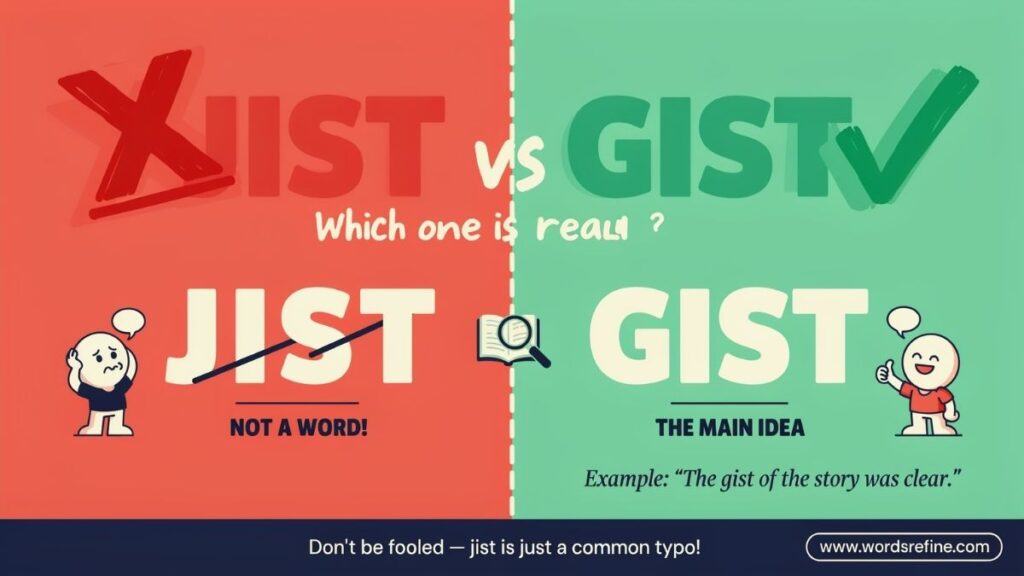
Have you ever written “jist” because it sounds right, only to question your spelling? You are not alone! The confusion between jist vs gist is understandable because English pronunciation does not always follow spelling rules. However, when you want to express the main point of a conversation, article, or situation, “gist” is the correct word. Although “jist” might look convincing, it’s a common spelling mistake in standard English. Fortunately, learning the difference is simple and can help you write with greater confidence. Once you understand why “gist” is correct, you well communicate more clearly and avoid letting one tricky letter turn a simple word into a grammar headache.
Quick Answer Gist vs Jist
| Question | Answer |
|---|---|
| Which spelling is correct? | Gist |
| What does gist mean? | The main point or essential meaning |
| Is jist a word? | It is not the standard spelling for this meaning |
| How is gist pronounced? | With a soft G, like the J in jam |
| Is gist used in American and British English? | Yes |
| Can gist describe a conversation? | Yes, it refers to the conversation’s main point |
The easiest way to remember the difference is to connect gist with the idea of getting to the heart of something. You don’t need every detail to understand the gist. You just need the main message.
Learn the difference between commonly mixed-up more words
Inquiries vs Queries What’s the Difference ?
What Does Gist Mean?
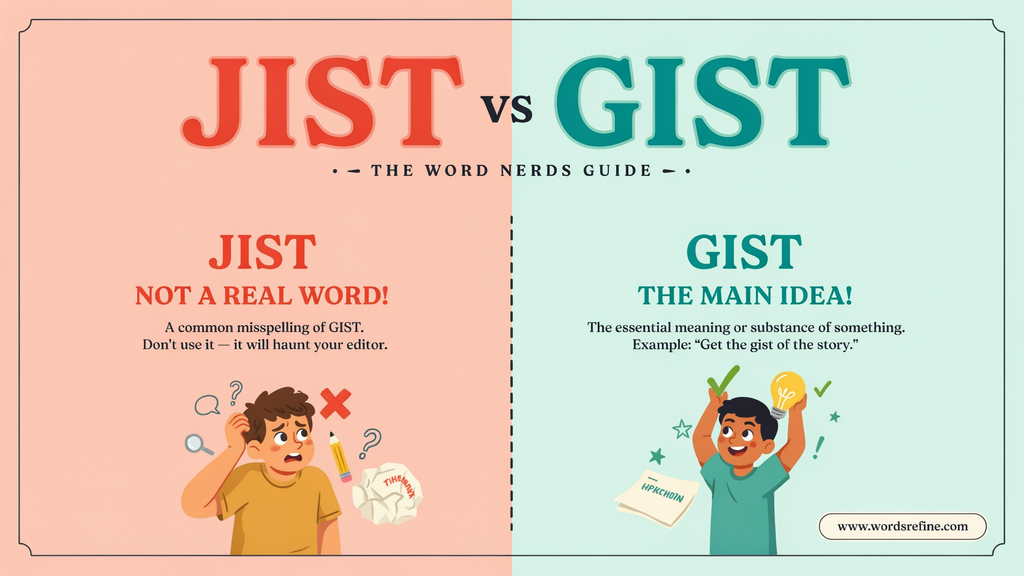
Gist means the essential point, central idea, or general meaning of a statement, conversation, article, story, or situation. It helps you identify what matters most without repeating every detail.
Imagine that a colleague spends ten minutes explaining a new workplace policy. You don’t remember every sentence, but you understand that employees must submit their reports by Friday. In that situation, you’ve understood the gist of the explanation.
The gist doesn’t necessarily include every supporting fact, example, or minor detail. Instead, it captures the information someone needs to understand the main message.
Gist Definition and Meaning
In everyday English, gist is a noun. It identifies the central substance of something rather than describing an action.
For example, the gist of a conversation might be a decision, the gist of an article might be its central argument, and the gist of a story might be the lesson it communicates.
Here are some examples that show how the word works in different situations.
“I missed a few minutes of the conversation, but I caught the gist.”
“The first paragraph gives readers the gist of the article.”
“The gist of the story is that honesty matters more than personal gain.”
“We disagreed about the details, but we understood the gist of the proposal.”
“She explained the gist of the assignment before distributing the full instructions.”
Notice that gist focuses on the essential information. It doesn’t mean someone has memorized every word or understood every minor detail.
What Is the Meaning of Gist in English?
The meaning of gist in English centers on the core idea behind a message. Depending on the context, you might interpret it as the main point, general idea, substance, or essential meaning.
Suppose someone describes a complicated travel plan involving several flights, a hotel change, and a delayed connection. You might summarize the gist as, “Our flight is delayed, so we’ll arrive tomorrow instead of tonight.”
That sentence leaves out several details, but it preserves the information that matters most.
This distinction is especially useful when reading long articles, taking notes during lectures, attending meetings, or following complicated conversations. When someone asks you for the gist, they usually want a brief explanation of what something is about rather than a complete retelling.
Is Gist a Noun or a Verb?
In standard contemporary English, gist functions as a noun.
You can use it in expressions such as “the gist,” “the gist of it,” and “the gist of the matter.” Although people sometimes say “the basic gist,” that phrase can sound repetitive because gist already refers to the essential point.
For example, “I understand the gist of the report” is clear and concise. Similarly, “I understand the main point of the report” communicates the same idea.
However, gist isn’t normally used as a verb in standard modern English. Instead of saying, “I gisted what she said,” write, “I understood the gist of what she said” or “I grasped her main point.”
Learn the difference between confusing more English words
Lend vs Lent What’s the Difference and When to Use Each?
What Does Jist Mean?
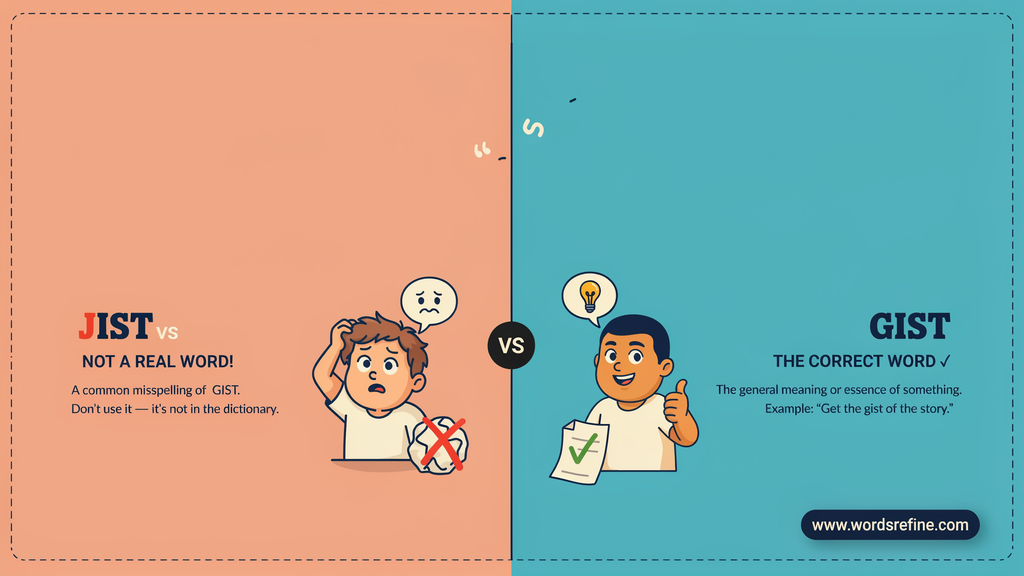
When people search for the meaning of jist, they usually want to know whether the spelling has a meaning of its own or whether it is simply an error.
In most everyday writing, jist is a misspelling of gist. If someone writes, “I got the jist of your message,” the intended meaning is clear, but the standard spelling is still incorrect.
For schoolwork, professional communication, published articles, and formal documents, use gist.
Is Jist a Word or a Misspelling?
The question needs a little context. Jist may appear in nonstandard writing, dialect representations, or specialized names. However, it isn’t the accepted standard spelling of the word meaning the main point of something.
The distinction is easy to understand when you compare the forms.
| Word | Usage | Example |
|---|---|---|
| Gist | Correct standard spelling | I understand the gist of the story. |
| Jist | Common misspelling in this context | I understand the jist of the story. |
| GIST | Medical acronym | The report discusses a gastrointestinal stromal tumor. |
The capitalized acronym GIST has a separate medical meaning. It stands for gastrointestinal stromal tumor, a type of tumor that develops in the digestive tract. This specialized use doesn’t change the spelling rule for the ordinary English word.
Why Do People Spell Gist vs Jist?
The main reason is pronunciation. In jist vs gist the letter G makes a soft sound similar to the J in jump. English contains several other words with this sound, including giant, gentle, and ginger.
Consequently, people sometimes assume that gist should begin with J. They hear the sound, spell the word according to that sound, and end up with a common spelling error.
However, English spelling doesn’t always follow pronunciation in a predictable way. The sound of a word can help you recognize it without telling you exactly how to spell it.
The solution is simple. Learn the written form alongside its meaning. Once you associate gist with the main point of a message, you’re less likely to replace its G with a J.
Learn the difference between tricky grammar more words
Socialise vs Socialize Which one Is Correct ?
Gist vs Jist Understanding the Difference
The difference between gist vs jist isn’t a difference in meaning. For the meaning discussed here, the distinction is primarily one of spelling.
Both forms may appear in online searches and informal messages, but gist is the standard spelling.
| Feature | Gist | Jist |
|---|---|---|
| Spelling | Standard English spelling | Common misspelling |
| Meaning | Main point or essential meaning | Usually intended to mean gist |
| Pronunciation | Soft G, like J | Often intended to sound the same |
| Academic writing | Appropriate | Avoid |
| Professional writing | Appropriate | Correct it to gist |
| Everyday example | I got the gist. | I got the jist. |
Gist vs Jist Examples
Comparing incorrect and correct sentences makes the difference jist vs gist easier to remember.
When discussing a message, write, “I got the gist of your text,” rather than, “I got the jist of your text.”
When discussing a book, write, “Can you tell me the gist of the chapter?” rather than, “Can you tell me the jist of the chapter?”
In a workplace conversation, write, “The manager explained the gist of the new policy.” The word gist correctly describes the policy’s central message.
Similarly, a student might say, “I understand the gist of the lesson,” to explain that they grasp the main idea even if they need to review some details.
In every example, the correction preserves the intended meaning. Only the spelling changes.
Learn the difference between confusing word pairs
Instalments vs Installments Which one Is Correct?
How to Use Gist Correctly in Everyday Writing
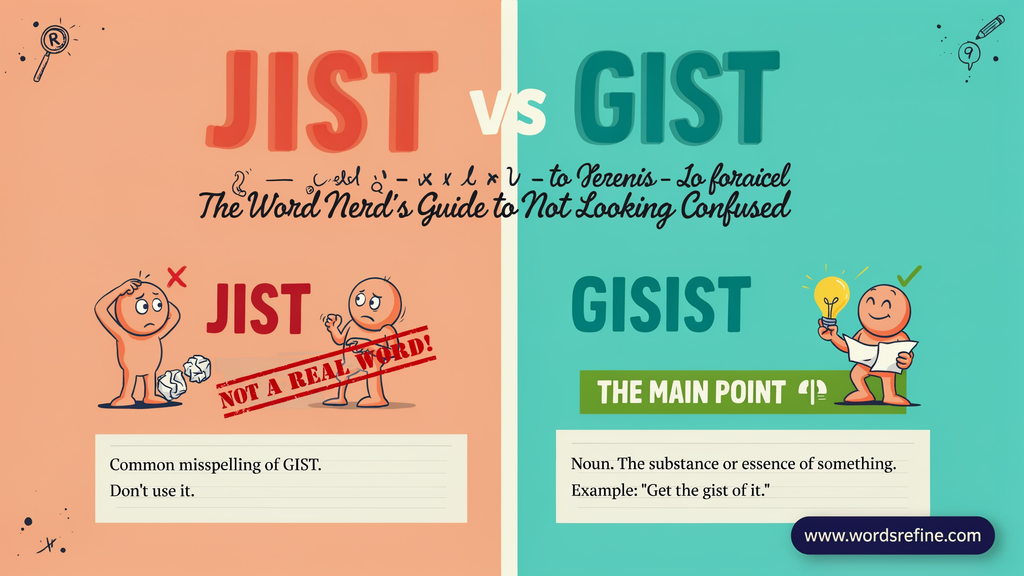
Understanding a definition is one thing. Using a word naturally is another. Fortunately jist vs gist fits comfortably into everyday conversations, academic work, business communication, and informal writing.
The word is especially useful when you want to show that you understand the central message without claiming to remember every detail.
Gist in Conversations
The gist of a conversation is the main message exchanged between people.
Imagine that two friends spend twenty minutes discussing their weekend plans. They compare restaurants, consider travel times, and debate whether to leave on Friday or Saturday. Later, another friend asks what they decided.
You could answer, “The gist of the conversation was that everyone wanted to leave on Friday.”
That sentence communicates the main decision without repeating the entire discussion.
Here are a few more examples.
“I couldn’t hear the whole phone call, but I caught the gist.”
“What’s the gist of your conversation with the landlord?”
“She explained the gist of the discussion in two sentences.”
“I grasped the gist of his argument even though I disagreed with his conclusion.”
As these examples show, gist works best when the emphasis falls on the central message rather than the exact words someone used.
Gist in Academic and Professional Writing
In academic and professional settings, gist can describe the main idea of a lecture, research article, report, presentation, or meeting.
For example, a student might read a long chapter and write one sentence describing its central argument. That sentence captures the gist of the chapter.
Similarly, an employee might summarize a lengthy project meeting by explaining the main decision, the person responsible for the next step, and the deadline.
Consider these examples.
“The gist of the research article is that regular exercise may improve sleep quality.”
“Before reviewing the full report, read the introduction to understand its gist.”
“The presentation’s gist was that the company needed to reduce unnecessary expenses.”
“Please email me the gist of the meeting before the end of the day.”
Although gist works in many professional situations, the best word depends on your purpose. If you’re discussing a study’s central claim, main argument may be more precise. If you’re referring to a condensed account of an entire document, summary may be a better choice.
Common Expressions With jist vs gist
Several familiar expressions use jist vs gist in predictable ways.
| Expression | Meaning | Example |
|---|---|---|
| Get the gist | Understand the main point | I read the introduction to get the gist. |
| Catch the gist | Understand the general message quickly | I joined late but caught the gist. |
| The gist of it | The central point of a matter | The gist of it is that we need more time. |
| The gist of the matter | The essential issue | The gist of the matter is whether the contract was approved. |
| Grasp the gist | Understand the core idea | She grasped the gist of the explanation. |
These expressions are common in spoken and written English. You can use them in casual conversations, emails, and many professional settings without sounding unnatural.
Learn the difference between often confused words
Copyright vs Copywrite Which One Is Correct?
Gist Pronunciation Why Does Gist Sound Like Jist?
One of the biggest reasons for this spelling mistake is that gist doesn’t sound the way some readers expect a word beginning with G to sound.
The word has one syllable and begins with a soft G, represented by the same consonant sound you hear at the beginning of jam. It rhymes with list and fist.
The important point is that pronunciation and spelling are related but separate aspects of English vocabulary.
Is Gist Pronounced With a Hard G?
No. In standard English, gist begins with a soft G sound, not the hard G found in words such as give, go, and garden.
Compare these words.
| Word | Initial sound |
|---|---|
| Gist | Soft G, like J |
| Giant | Soft G, like J |
| Gentle | Soft G, like J |
| Give | Hard G |
| Garden | Hard G |
This variation can seem confusing, but English spelling contains many patterns and exceptions. The letter G often has a soft sound before E, I, or Y, although this isn’t a universal rule.
The best way to remember gist is to connect its spelling with familiar words that also begin with a soft G.
How to Pronounce Gist Correctly
Say gist with one syllable and a short vowel, as in list. The initial consonant sounds like J, but the written word begins with G.
Remember that a word’s sound doesn’t determine whether its spelling is correct. Writing jist because the word sounds that way is a common mistake, but learning the accepted spelling will help you avoid it.
The Origin and History of Gist
The word gist has an interesting history that helps explain its modern meaning. Its roots lie in legal language rather than in the casual conversations where we commonly use it today.
The word developed from an Anglo-French legal expression associated with the idea that a legal action lies or rests. The phrase “cest action gist” can be understood as “this action lies.” In its historical context, the expression concerned whether a legal action was available or could be maintained.
Over time, gist developed its modern sense of the essential point or substance of something.
How the Origin of Gist Connects to Its Modern Meaning
Today, gist describes the core of an idea, statement, or argument. Although its modern use is broader than its legal origins, the underlying concept remains connected to what a matter fundamentally concerns.
Consider a legal dispute involving a disagreement over a contract. The details might include dates, payments, written correspondence, and witness statements. The gist of the dispute would be the central issue that the parties need to resolve.
The same principle applies outside the courtroom. A news article might contain several examples and supporting facts, but its gist is the principal message those details communicate.
This historical connection also explains why gist sometimes appears in discussions of legal terminology. However, its everyday meaning doesn’t require any legal knowledge.
Learn the difference between basic English word mistakes
Dreamt vs Dreamed Which One Is Correct?
Gist in American English and British English
English spelling varies between American and British usage. Words such as color and colour, or organize and organise, demonstrate how accepted spellings can differ between varieties of English.
However, gist is spelled the same way in American and British English.
| Feature | American English | British English |
|---|---|---|
| Correct spelling | Gist | Gist |
| Main meaning | Essential point or idea | Essential point or idea |
| Pronunciation | Soft G | Soft G |
| Common misspelling | Jist | Jist |
There is no standard American-versus-British spelling difference that makes jist correct in one variety and gist correct in the other.
If you’re writing for an American audience, use gist. If you’re writing for a British audience, use gist as well. The same applies to academic papers, business emails, articles, and everyday messages.
What’s the Difference?
Although gist and summary have similar meanings, they aren’t always interchangeable.
The gist is the essential point or central message. A summary is a shortened account of a larger piece of information. A summary can communicate the gist, but it may also include several supporting details.
Imagine reading a twenty-page report about a company’s sales performance.
The gist might be that sales declined because customer demand weakened.
A summary, however, might explain that sales declined in two regions, customer demand weakened, advertising costs increased, and the company plans to revise its marketing strategy.
The first example captures the main point. The second provides a broader overview.
Gist vs Main Idea
The terms gist and main idea often mean almost the same thing, especially in reading comprehension.
However, main idea frequently appears in educational settings when identifying the central point of a paragraph, passage, or text. Gist is more flexible in everyday communication and can refer to the essential meaning of a conversation, explanation, or situation.
For example, “The main idea of the paragraph is that sleep supports memory” works well in a reading assignment.
By contrast, “I got the gist of the doctor’s explanation” sounds natural in a conversation.
Both expressions concern central meaning, but the wording suits different contexts.
Gist vs Meaning
The word meaning can refer to what a word, sentence, action, or event signifies. Gist narrows the focus to the overall point or essential substance of a larger message.
For example, you might ask, “What is the meaning of this sentence?” when a particular phrase confuses you. However, you might ask, “What’s the gist of this article?” when you want to understand its overall message.
In short, meaning can be broad, while gist emphasizes the central idea.
Gist Synonyms What Words Can You Use Instead?
Several words can replace gist, but the best choice depends on what you’re trying to communicate.
Main point works when you want a simple, direct alternative. Essence emphasizes the fundamental nature of an idea. Summary describes a shortened account that may include more than the central point.
| Synonym | Meaning | Example |
|---|---|---|
| Main point | The most important idea | The main point is that the deadline has changed. |
| Core idea | The central concept | The core idea of the proposal is to simplify the process. |
| Essence | The fundamental nature of something | The essence of her argument is fairness. |
| Summary | A shortened account of information | He prepared a summary of the report. |
| Substance | The important content or central matter | We agree on the substance of the proposal. |
| Central argument | The main claim being presented | The central argument is that public transportation needs more funding. |
| General idea | A broad understanding | I have a general idea of how the system works. |
What Is the Best Synonym for Gist?
There isn’t one perfect replacement for gist. Context determines which word communicates your meaning most clearly.
For academic writing, central argument may be appropriate when discussing a writer’s main claim. In a casual conversation, general idea often sounds natural. Meanwhile, summary is useful when you need to describe a shortened account of a larger text.
Choose the word that matches the information you want to convey rather than replacing gist automatically.
Learn the difference between commonly misused words
Mobil vs Mobile Which one Is Correct?
What Is the Antonym of Gist?
There isn’t one universal antonym for gist, but several expressions contrast with its meaning.
Details refer to individual pieces of information rather than the central point. Minor points describe less important aspects of a subject. Trivialities refer to details with little importance to the main issue, while a full account provides a complete explanation instead of a brief description.
For example, “She explained the gist of the discussion” focuses on the central message. By contrast, “She described every detail of the discussion” emphasizes the complete account.
This distinction is useful when deciding whether gist accurately describes what you want to say.
Common Mistakes With jist vs gist How to Avoid Them
Even confident writers sometimes make spelling errors with words that sound different jist vs gist from how they look. The confusion between gist and jist is particularly easy to understand because the incorrect version seems logical when you hear the word aloud.
Writing Jist Instead of Gist
This is the main mistake in the jist vs gist spelling debate. Writers hear the soft G and replace it with J.
Incorrect: “What’s the jist of the email?”
Correct: “What’s the gist of the email?”
To avoid this mistake, memorize the spelling as a complete word rather than trying to build it from individual sounds. If you’re unsure, check a reliable dictionary.
Assuming Pronunciation Determines Spelling
English contains many words whose pronunciation doesn’t make their spelling obvious. The soft G in gist is a good example.
Don’t assume that a word must begin with J simply because you hear a J sound. Instead, learn the accepted spelling and use it consistently.
Using Gist When You Mean Every Detail
Another mistake involves meaning rather than spelling. Some writers use gist when they want to describe a complete explanation.
For instance, “Give me the gist of the meeting” asks for the central points. It doesn’t necessarily ask for every decision, comment, and action item.
If you need a complete record, ask for the meeting notes or a detailed summary instead.
Overusing the Phrase “Basic Gist”
The expression “basic gist” appears frequently in everyday speech. However, it can sound repetitive because gist already refers to the essential point.
Wordy: “The basic gist of the article is that exercise improves health.”
More concise: “The gist of the article is that exercise improves health.”
The shorter version communicates the same information without unnecessary wording.
Gist in a Sentence More Practical Examples
Seeing a word in different contexts makes its meaning easier to remember. These examples show how gist works in everyday communication.
Everyday Conversation
“I didn’t hear the entire announcement, but I caught the gist.”
“Can you explain the gist of what happened?”
“The gist of our conversation was that we needed to leave earlier.”
“He gave me the gist of the story while we waited for the bus.”
Reading and Education
“Read the introduction first to understand the gist of the article.”
“The student identified the gist of the passage correctly.”
“I understood the gist of the chapter but need to review the details.”
“The teacher asked the class to explain the gist of the story in one sentence.”
Workplace Communication
“Please send me the gist of the meeting before noon.”
“The gist of the proposal is to reduce unnecessary expenses.”
“She explained the gist of the new policy to the team.”
“I understand the gist of your email, but I need the exact figures.”
News and Public Information
“The gist of the report is that housing costs have increased.”
“The article’s main message is clear even though it includes several technical terms.”
“He summarized the gist of the announcement for people who missed it.”
These examples demonstrate a consistent pattern. Gist refers to the central point, not the complete collection of details.
Gist in Legal Terminology
The word gist also appears in legal discussions, where it can refer to the essential substance of a claim, dispute, or legal argument.
For example, a lawyer might explain the gist of a case to a client before discussing the evidence and legal authorities in detail. The explanation would identify the central issue without covering every procedural step.
Consider a dispute in which a customer claims that a business failed to deliver goods under a contract. The gist of the dispute might be that one party alleges a contractual obligation wasn’t fulfilled.
That short description helps someone understand the central issue. However, it doesn’t establish whether the claim is legally valid or whether the evidence supports it.
Learn the difference between more words people mix up
Choose vs Chose Difference and which one is Correct?
What Does Gist Mean in Legal Writing?
In legal writing, gist generally retains its ordinary sense of the essential point or substance. Its historical legal origins are interesting, but modern legal uses must still be interpreted in context.
The gist of a legal action refers to the central substance of a claim or dispute. The gist of an argument is the main legal position a party advances. Similarly, the gist of a document is its principal message.
The exact meaning can depend on the document, jurisdiction, and legal issue. Therefore, a brief description of a case’s gist shouldn’t replace reading the relevant legal documents when precise details matter.
Is GIST Different From the Ordinary Word Gist?
Yes. In medical writing, GIST commonly stands for gastrointestinal stromal tumor. This is a type of tumor that develops in the digestive tract, often in the stomach or small intestine.
Although the acronym uses the same letters as the ordinary word gist, the meanings are entirely different.
| Term | Meaning | Example |
|---|---|---|
| Gist | The main point or essential meaning | I understood the gist of the article. |
| GIST | Gastrointestinal stromal tumor | The medical report discusses a GIST diagnosis. |
Context usually makes the distinction clear. If a sentence discusses an article, conversation, or argument, lowercase gist probably refers to the main idea. If it discusses a medical diagnosis or cancer treatment, uppercase GIST may refer to the tumor.
This is a separate use of the same letter sequence, not an exception that makes jist an acceptable spelling of the ordinary noun.
Learn the difference between everyday English mistakes
Fiancé vs Fiancée What’s the Difference and which is Correctly?
Practice Session Gist vs Jist
1. The correct spelling of the word meaning the main point is ______.
2. I missed the beginning of the meeting, but I caught the ______.
3. Could you explain the ______ of this article in one sentence?
4. “Jist” is commonly used as a ______ of “gist” in standard English.
5. The phrase “get the gist” means to understand the ______ idea.
6. The ______ of her message was that we needed to arrive early.
7. Gist begins with a soft ______ sound.
8. Please give me a brief ______ of the report.
9. I didn’t understand every detail, but I grasped the ______ of the conversation.
10. In professional writing, “key takeaway” can be an alternative to ______.
11. The student explained the ______ of the story without retelling every scene.
12. The word gist is a ______, because it names the central point of something.
13. Gist is spelled the same way in American and ______ English.
14. The ______ of the proposal was to reduce unnecessary expenses.
15. “I got the gist” means “I understood the ______ point.”
16. A ______ provides a shortened account of a longer text.
17. The opposite of focusing on the gist would be discussing every small ______.
18. The word gist is not normally used as a ______ in standard contemporary English.
19. In medical terminology, GIST stands for gastrointestinal stromal ______.
20. The phrase “the gist of the matter” refers to the essential ______.
21. If you understand the gist of a conversation, you understand its general ______.
22. “Jist” is not the standard spelling for the meaning of the main ______.
23. The word “essence” can be used as a synonym for ______.
24. When reading a long article, identifying its gist helps you understand its central ______.
25. To avoid spelling mistakes, remember that the correct word begins with the letter ______.
Answers
- Gist
- Gist
- Gist
- Misspelling
- Main
- Gist
- G
- Summary
- Gist
- Gist
- Gist
- Noun
- British
- Gist
- Main
- Summary
- Detail
- Verb
- Tumor
- Point
- Meaning
- Point
- Gist
- Idea
- G
Here’s a trusted source for clear more words Comparison:
FAQS
Is gist a derogatory word?
No, gist is not a derogatory word. It is a neutral term that means the main point or essential meaning of something. For example, “I understood the gist of your message” means you understood its main idea.
What is a professional way to say “gist”?
In professional writing, you can use “main point,” “key takeaway,” “central idea,” or “summary.” For example, instead of saying, “Give me the gist of the meeting,” you could say, “Please share the key takeaways from the meeting.”
Why is gist pronounced like jist?
Gist is pronounced with a soft G, which sounds like the J in “jam.” However, the correct spelling remains gist. Because English pronunciation doesn’t always make spelling obvious, people sometimes mistakenly write “jist.”
What is another way to say “get the gist”?
You can say “understand the main point,” “grasp the central idea,” “catch the general meaning,” or “understand the overall message.” For example, “I got the gist of the article” can become “I understood the article’s main point.”
What does “gist” mean in Urban Dictionary?
On Urban Dictionary, meanings can vary because users contribute their own definitions and slang interpretations. In standard English, gist means the main point or essential meaning of something. When interpreting an informal definition, consider the context rather than assuming it represents the word’s accepted meaning.
What is an antonym for librarian?
There is no direct antonym for librarian because the word describes a profession rather than a quality with an opposite. Depending on the context, you might contrast a librarian with a library patron, a library user, or someone who manages a different type of information resource. However, these are contrasting roles, not true antonyms.
Learn the difference between often confused words
Any time vs anytime meaning Difference with Examples ?
Conclusion
English spelling has a way of keeping writers on their toes, and the difference between “jist vs gist” is a perfect example. Since “gist” sounds like it begins with J, writing “jist” might seem reasonable. However, “gist” is the correct spelling when you mean the main point or essential meaning of something. Whether you’re discussing an article, explaining a conversation, or summarizing a meeting, knowing whether to use jist vs gist can help you avoid common spelling mistakes. Although “jist” may look convincing, it remains a misspelling in standard English. Fortunately, remembering the meaning and correct spelling of gist is simple: keep the G, even when it sounds like J. Once you master this difference, you’ll write with greater confidence. After all, grammar doesn’t have to be complicated. Sometimes, getting one little letter right makes all the difference!

Diora AJS she is an experienced blogger and passionate English language enthusiast at Words Refine. With a keen eye for language and a love for clear communication, she writes practical content about grammar, word meanings, usage, and commonly confused terms. Her goal is to make English easier to understand through clear explanations and relatable examples, helping readers write accurately and communicate with confidence.