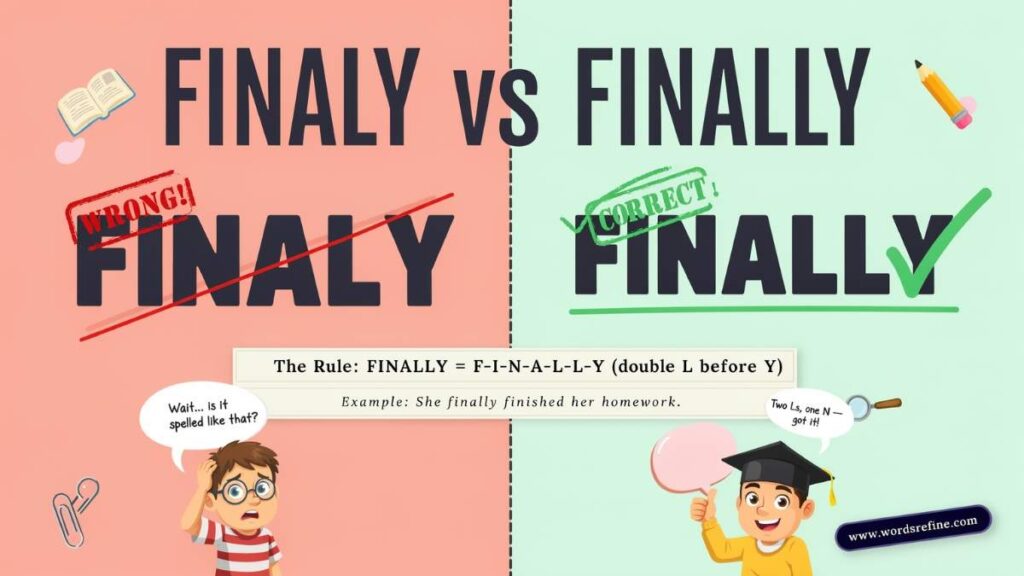
English spelling can make even a simple word feel like a tricky grammar test. The confusion between finaly vs finally proves that one missing letter can cause an unnecessary mistake. So, which spelling should you use? The correct form is finally, with two Ls. Finaly is a misspelling and should be avoided in standard English. Whether you are writing an email, finishing an essay, or explaining the last step in a process, getting the spelling right keeps your message clear and professional. In this article, you well learn the meaning of finally, see how to use it in sentences, and discover how to avoid this common spelling mistake.
Quick Answer Finaly vs Finally
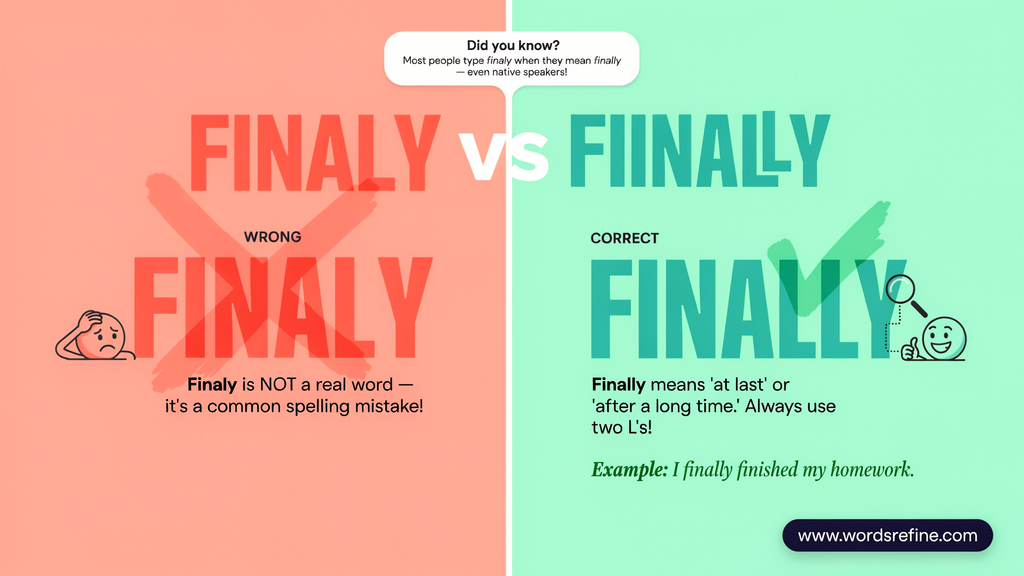
finaly vs finally is the correct spelling. Finaly is a misspelling and isn’t accepted as a standard English word.
Finally is an adverb that usually means at last, after a long wait, or at the end of a process. It can also introduce the last point in a discussion or sequence.
| Word | Correct spelling | Meaning | Example |
|---|---|---|---|
| Finally | Yes | At last or at the end | We finally finished the project. |
| Finaly | No | Incorrect spelling of finally | We finaly finished the project. |
The correct sentence is “We finally finished the project.”
Remember this simple pattern: final + ly = finally. The base word final ends with L, and the suffix -ly begins with another L. Therefore, the correct spelling contains two consecutive Ls.
Finaly vs Finally Key Differences
The difference between finaly vs finally comes down to spelling rather than meaning. Finally is a standard English word, while finaly is a spelling error.
Finally can describe something that happens after a delay, marks the last stage of a process, or introduces the final point in a discussion. Its meaning depends on the context.
For example, consider these sentences:
Correct: After three hours of troubleshooting, the computer finally started.
Incorrect: After three hours of troubleshooting, the computer finaly started.
Although readers can understand the second sentence, it contains a spelling mistake. Understanding the intended meaning doesn’t make the incorrect spelling acceptable.
The pronunciation also doesn’t explain the difference. Both forms are generally intended to represent the same spoken word. The problem occurs when someone leaves out a letter while writing.
Learn the difference between confusing more English words
Jist vs Gist Which One Is Correct ?
What Does Finally Mean?
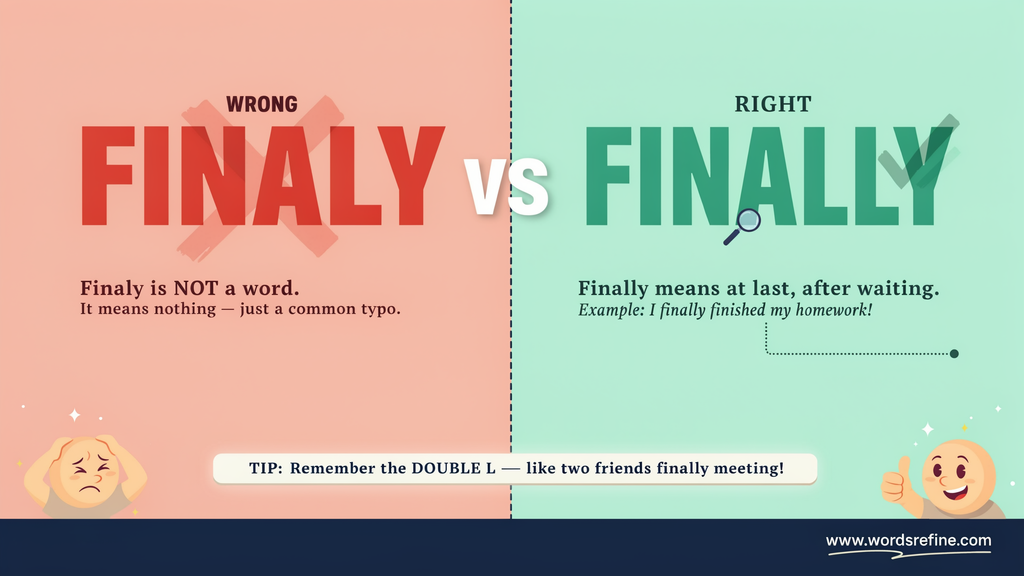
finaly vs finally has several related meanings. It can describe an event that happens after a delay, the last stage of a process, or the final point in an explanation.
Understanding these uses will help you choose the word naturally rather than adding it to every sentence that mentions an ending.
Finally Means After a Long Wait
One common meaning of finally is at last or after a long time. The word often suggests that someone has waited, worked, or struggled before achieving a result.
For example, you might say, “The package finally arrived after two weeks.” Similarly, “She finally passed her driving test” suggests that passing the test took time or several attempts.
Finally can express relief, satisfaction, excitement, or frustration. Imagine waiting for a computer update that seems stuck at 99 percent. When the installation finishes, saying “It finally worked!” communicates both the result and the relief of reaching it.
Finally Means at the End of a Process
Finally can also describe the last stage of a sequence. In this case, the word emphasizes order rather than a long wait.
For example, “First, wash the vegetables. Next, chop them. Finally, add them to the pan.”
Likewise, “The editor reviewed the draft, corrected the errors, and finally approved the article” describes the final action in a series of steps.
The process doesn’t have to take a long time. Instead, finally signals that an action comes after the preceding stages.
Finally Introduces the Last Point
Writers often use finally to introduce the last point in an explanation, argument, presentation, or list of ideas.
For example, “Three factors affect the decision: cost, reliability, and ease of use. Finally, the company must consider long-term maintenance.”
Here, finally helps readers recognize the last consideration. It makes the structure easier to follow and signals that the discussion is moving toward its final point.
However, finally doesn’t always mean that the entire discussion has ended. A writer may introduce a final point and then provide a separate summary or recommendation.
Finally in Everyday English
Finally appears naturally in conversations about completed tasks, delayed events, and resolved problems.
For example, you might say, “I finally found my missing keys,” “We finally agreed on a meeting date,” or “The rain finally stopped.”
Similarly, “I finally understand this grammar rule” suggests that understanding came after some effort.
These examples show why finally is useful. It adds information about timing, completion, or relief without requiring a lengthy explanation.
Learn the difference between commonly mixed-up more words
Aging vs Ageing Which one Is Correct?
Is Finaly a Word?
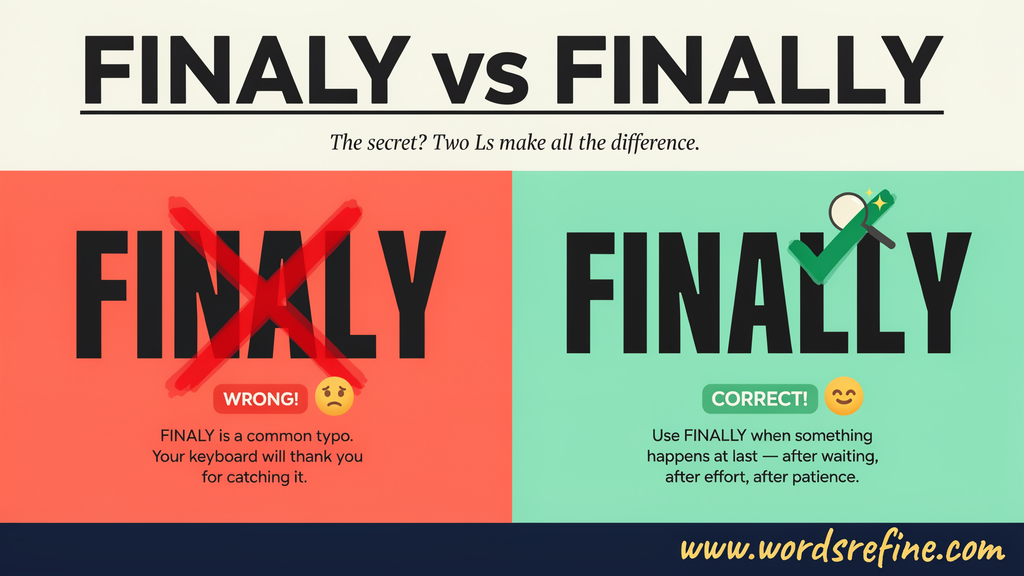
Finaly isn’t the standard spelling of the English adverb. In ordinary writing, it should be treated as a misspelling of finally.
You might encounter finaly in text messages, social media posts, comments, or articles that haven’t been carefully proofread. However, seeing a spelling mistake online doesn’t make it an accepted alternative.
For example, “I finaly submitted my application” should read “I finally submitted my application.”
Similarly, “The manager finaly made a decision” should read “The manager finally made a decision.”
In both cases, the meaning remains clear, but the spelling needs correction.
Is Finally a Word?
Yes, finally is a standard English adverb. It can describe an event that happens after a delay, the last stage of a process, or the final point in a discussion.
It’s also important to distinguish finally from final. Although the words share the same base, they perform different grammatical roles.
For example, “This is the final chapter” uses final to describe the chapter. In contrast, “We finally reached the last chapter” uses finally to modify the action of reaching it.
Once you understand this difference, you’ll find it easier to avoid both spelling and grammar mistakes.
Learn the difference between tricky grammar more words
Master’s Degree vs Masters Degree Which One Is Correct?
Why Is Finally Spelled With Two Ls?
The easiest way to remember the spelling of finaly vs finally is to start with the base word final.
When you add the suffix -ly to final, you keep the original L and add the L that begins the suffix. The result is finally.
Final + ly = finally.
This spelling doesn’t represent a change in pronunciation. Instead, it reflects how the base word and suffix combine.
Adding -ly to Final
The suffix -ly commonly forms adverbs from adjectives. These adverbs can describe how, when, or in what manner something happens.
For example, quick becomes quickly, slow becomes slowly, and careful becomes carefully. Similarly, final becomes finally.
However, English spelling rules vary depending on the base word. In happily, the final Y changes to I before the suffix is added. In finally, both Ls remain.
Therefore, you shouldn’t assume that every word ending in -ly follows precisely the same spelling pattern.
Why Do People Spell Finally vs Finaly?
People often misspell finaly vs finally because they remember how the word sounds but overlook one of its letters. Since the two Ls appear together, it’s easy to leave one out while typing quickly.
Pronunciation doesn’t always reveal every letter in a word. Consequently, learning the word’s structure is more reliable than trying to spell it entirely by sound.
A simple solution is to remember final first. When you add -ly, keep both Ls. This small habit can prevent a common spelling mistake.
Learn the difference between confusing word pairs
Blond vs Blonde What’s the Difference?
Finally Grammar Usage Is Finally an Adverb?
Yes, finally is an adverb. Depending on the sentence, it can describe the timing of an action or help organize a sequence of ideas.
For example, in “The technician finally repaired the printer,” finally modifies the action of repairing the printer. It suggests that the repair happened after a delay or some effort.
Similarly, “After several revisions, the author finally completed the manuscript” emphasizes the completion of the work after multiple revisions.
Finally as a Transition Word
A transition word connects ideas and guides readers through a piece of writing. Finally can serve this purpose when you introduce the last step in a process or the final point in an argument.
For example, “First, compare the prices. Next, check the warranty. Finally, choose the product that meets your needs.”
The word makes the sequence clear. Readers understand that the final instruction follows the earlier steps.
However, finally should have a clear purpose. Repeating it at the beginning of every paragraph can make an article or report sound mechanical. Choose transitions that accurately reflect the relationship between your ideas.
Finally as a Concluding Word
Finally can introduce a concluding point without necessarily ending the entire discussion.
For example, “The team reviewed the budget and checked the timeline. Finally, it approved the proposal.”
Here, finally connects the approval with the preceding stages of the process.
When writing a conclusion, however, consider whether finally or in conclusion better expresses your intention. Finally often introduces the last point, whereas in conclusion more clearly signals an overall summary.
How to Use Finally Correctly in a Sentence
finaly vs finally can appear at the beginning, middle, or end of a sentence. However, its placement affects how natural the sentence sounds.
At the beginning: “Finally, the missing documents arrived.”
In the middle: “The company finally released the new software.”
After an auxiliary verb: “She has finally received the results.”
At the end: “After weeks of searching, we found the missing file finally.”
The last example is grammatically possible, but it sounds less natural in everyday American English than “After weeks of searching, we finally found the missing file.”
Therefore, placing finally before the main action is often the clearest choice.
Finally in Formal Writing
Finally works well in essays, reports, presentations, and professional communication. It can introduce the last stage of a process or help readers follow an organized argument.
For example, “First, the researchers collected the data. Next, they examined the results. Finally, they presented their findings.”
Each transition serves a clear purpose. The sequence is easy to understand, and the reader can follow the process without confusion.
However, avoid repeating finally unnecessarily. If the order of events is already clear, another transition may not be needed.
Learn the difference between often confused words
Anyway vs Anyways Meaning Usage and Examples ?
What Is the Difference?
Final and finally share the same base word, but they serve different grammatical purposes. Final is an adjective, while finally is an adverb.
An adjective describes a noun. An adverb can modify a verb or help organize a statement.
| Word | Part of speech | Meaning | Example |
|---|---|---|---|
| Final | Adjective | Last or definitive | This is the final report. |
| Finally | Adverb | At last or at the end | We finally submitted the report. |
| Finality | Noun | The state of being conclusive | The decision brought a sense of finality. |
| Finalize | Verb | To complete or settle something | We need to finalize the schedule. |
| Finalized | Verb form or adjective | Completed or settled | The team finalized the schedule. |
| Finalist | Noun | Someone who reaches the final stage of a competition | She became a finalist in the contest. |
Final Meaning
Final describes the last item, stage, or version of something. It can also refer to a decision intended to settle a matter.
For example, “The final exam takes place on Friday.” Here, final describes the exam.
Finalize Meaning
Finalize is a verb that means to complete the details of something or make a decision definite.
For example, “The organizers will finalize the event schedule tomorrow.”
Finality Meaning
Finality is a noun that describes the quality of being final or conclusive.
For example, “The signed agreement gave the decision a sense of finality.”
Although these words share a common root, each has its own grammatical role. Understanding those differences helps you select the right word for the sentence.
Finally Synonyms and Antonyms
The best synonym for finally depends on the meaning you want to express. Sometimes it means at last, while in other situations it introduces the final point in a sequence.
Although several words have similar meanings, they aren’t always interchangeable. Context, tone, and sentence structure all matter.
Learn the difference between basic English word mistakes
Onto vs On To What’s the Difference ?
Synonyms for Finally Meaning At Last
At last, eventually, in the end, and ultimately can all express ideas related to finally.
At last often emphasizes the end of a wait. For example, “At last, the train arrived” may convey stronger relief than “The train finally arrived.”
Eventually focuses on an outcome that occurs over time. For example, “She eventually found a solution” emphasizes that the solution came after a period of effort or waiting.
In the end emphasizes the final result of events. For example, “In the end, we chose the simpler option.”
Ultimately often highlights the final outcome after considering different factors. For example, “Ultimately, the board approved the plan.”
Finally vs Eventually
Finally and eventually overlap, but they don’t always carry the same emphasis.
“ The mechanic finally fixed the car” may suggest relief after repeated attempts.
“The mechanic eventually fixed the car” emphasizes that the repair happened after some time.
The distinction is subtle, so choose the word that best matches the intended meaning.
Finally vs Ultimately
Ultimately often emphasizes the final result or the most important consideration.
For example, “After comparing the costs and benefits, the company ultimately chose the less expensive option.”
Finally could also work in this sentence. However, ultimately emphasizes the result of considering different factors rather than simply marking the last step.
Finally vs Lastly
Lastly usually introduces the last item in a list or the final point in an organized explanation.
For example, “First, review the introduction. Second, check the supporting evidence. Lastly, proofread the conclusion.”
Finally can perform the same function. However, it can also express relief after a long wait, whereas lastly generally focuses on sequence.
Finally vs In Conclusion
In conclusion signals that a discussion or piece of writing is reaching its conclusion. Finally can introduce the last point without necessarily ending the entire discussion.
For example, “Finally, the company should review its customer service policy” introduces a last point.
“In conclusion, the evidence supports the proposed changes” signals an overall concluding statement.
In formal writing, choose the expression that best fits the structure of your argument.
Finally Antonyms
Finally doesn’t have one opposite that works in every context. The best antonym depends on its intended meaning.
Initially refers to the beginning of a process. First identifies the earliest item in a sequence. At first describes the earliest stage of an event or experience.
For example, “Initially, the plan seemed expensive, but we finally found a more affordable option.”
Here, initially and finally mark different stages of the same process.
Common Mistakes When Using Finaly vs Finally
Spelling is only one part of using finaly vs finally correctly. Writers can also confuse it with final, place it awkwardly, or repeat it too often.
Leaving Out the Second L
The most obvious mistake is writing finaly instead of finally.
Incorrect: “We finaly completed the assignment.”
Correct: “We finally completed the assignment.”
Remember that final already contains an L at the end. Adding -ly gives you the correct spelling, finally.
Confusing Finally With Final
These words aren’t interchangeable.
Incorrect: “This is the finally version of the document.”
Correct: “This is the final version of the document.”
Similarly, “We final approved the proposal” should be “We finally approved the proposal.”
Use final to describe a noun and finally to modify an action or introduce a concluding point.
Overusing Finally in Formal Writing
Repeated transitions can make writing sound mechanical.
For example, “First, the team collected the data. Finally, it reviewed the data. and Finally, it wrote the report. Finally, it presented the results.”
A smoother version would be: “First, the team collected the data. Next, it reviewed the findings. It then wrote the report and presented the results.”
Use finally when it adds meaning or clarifies the sequence. Otherwise, choose another transition or remove the unnecessary word.
Using Finally Without a Clear Reason
Sometimes finally adds an unnecessary sense of delay or completion.
“The sky is finally blue” sounds natural after several days of rain. However, if there’s no reason to emphasize a change, “The sky is blue” may be more appropriate.
The word itself isn’t wrong. Its usefulness depends on the context.
Relying Too Much on Autocorrect
A grammar checker can catch many spelling errors, but it shouldn’t replace proofreading. Some tools may overlook mistakes when a word resembles another valid English word.
For example, a checker might accept final because it’s a real word, even when you intended to write finally.
Therefore, review the sentence and confirm that the word expresses your intended meaning. Correct spelling and correct word choice are related, but they’re not the same thing.
Learn the difference between commonly misused words
Stint vs Stent Meaning Differences Examples and Correct Usage ?
Why Do People Confuse Finaly vs Finally?
Several factors explain why people type finaly even when they know the correct spelling.
Fast typing can cause writers to omit a repeated letter without noticing. Pronunciation can also contribute to the mistake because the two Ls don’t create separate syllables.
In addition, both spellings look similar, so the incorrect form may escape notice during a quick review. Writers who rely heavily on autocorrect may also miss opportunities to learn the correct spelling.
Fortunately, the solution is simple. Remember the base word, check your spelling when necessary, and proofread the final text before sending or publishing it.
Finally Pronunciation and Spelling Rules
In American English, finally is generally pronounced /ˈfaɪnəli/, with the stress on the first syllable.
Although the word contains two Ls, they don’t produce two separate syllables. That’s one reason someone might pronounce finally correctly yet misspell it.
Instead of trying to hear every letter, focus on the word’s structure.
Final + ly = finally.
This simple pattern connects the spelling to a familiar base word and makes it easier to remember.
Does British English Spell Finally Differently?
No. Standard American and British English both use finally.
Some words have different spellings across these varieties, such as color and colour. However, finally keeps the same spelling in both.
Whether you’re writing for an American, British, or international audience, finally is the correct form.
Finally in Real-Life Examples
Seeing finally in different contexts makes its meaning easier to understand.
Finally in Everyday Conversations
“I finally cleaned out my closet.”
“We finally found a parking spot.”
“The baby finally fell asleep.”
“After months of practice, he finally learned to swim.”
In each example, finally emphasizes a result that came after waiting, effort, or difficulty.
Finally in Academic and Professional Writing
“Finally, the researchers compared the results of both experiments.”
“The committee finally reached a decision after reviewing the evidence.”
“Finally, the report recommends further investigation.”
These examples show how finally can describe the outcome of a process or introduce the last point in an explanation.
Finally in Emails and Messages
“I’ve finally finished the presentation.”
“The client finally approved the proposal.”
“We can finally move forward with the project.”
In professional communication, finally can express progress and completion. However, consider its tone before using it.
For example, “You finally sent the documents” may sound impatient or critical. “Thanks for sending the documents” is more neutral and professional.
Finally in Storytelling
“After wandering through the forest for hours, they finally found the road.”
“The detective finally discovered who had taken the missing painting.”
“After years of searching, the family finally reunited.”
Here, finally helps bring a sequence of events toward a resolution. It can build anticipation and make the result feel more significant.
Learn the difference between everyday English mistakes
Bougie vs Boujee Meaning Origin Spelling and Examples ?
Easy Tricks to Remember the Correct Spelling of Finally
Remembering the spelling of finally doesn’t require a complicated grammar lesson. A few simple habits can help you avoid the mistake.
Remember the Base Word
Start with final, then add -ly.
Final + ly = finally.
Because final already ends in L, the finished word contains two consecutive Ls. This is the simplest way to remember the correct spelling.
Connect the Spelling to the Meaning
Think of finally as the word you use when something reaches its final stage or happens at last. Connecting finally to final reinforces both the spelling and meaning.
Proofread Before Publishing
When reviewing your writing, pay special attention to commonly misspelled words. A quick check can catch missing letters in emails, essays, reports, and articles.
You can also make a habit of checking finally whenever you proofread. With practice, the correct spelling will become easier to recognize.
Learn the difference between more words people mix up
Aluminum vs Aluminium Which One Is Correct?
Practice Session Finally vs Finaly
- After hours of searching, I ______ found my missing keys.
- We ______ reached our destination after a long drive.
- She ______ finished writing her research paper.
- The teacher ______ explained the difficult grammar rule.
- He passed his driving test ______.
- After several delays, the train ______ arrived.
- I can ______ relax after completing all my assignments.
- They ______ agreed on a date for the meeting.
- The missing document was ______ located in the office.
- After weeks of practice, Emma ______ learned to swim.
- We will ______ announce the winner tomorrow.
- The software update has ______ installed successfully.
- After trying different solutions, Mark ______ fixed the computer.
- She ______ understood why the answer was incorrect.
- The guests ______ arrived, so we can begin dinner.
- After a long discussion, the team ______ made a decision.
- I have ______ completed all the tasks on my list.
- The doctor ______ arrived to examine the patient.
- After months of hard work, they ______ opened their new business.
- He ______ realized that he had made a spelling mistake.
- The movie was delayed, but it ______ started.
- We ______ found the information we needed.
- After several attempts, the printer ______ started working.
- She ______ submitted her application before the deadline.
- The long wait is over; we are ______ going on vacation!
Answers
- finally
- finally
- finally
- finally
- finally
- finally
- finally
- finally
- finally
- finally
- finally
- finally
- finally
- finally
- finally
- finally
- finally
- finally
- finally
- finally
- finally
- finally
- finally
- finally
- finally
Here’s a trusted source for clear more words Comparison:
FAQs
Does Finally Always Express Relief?
No. Finally can express relief after a long wait, but it can also mark the last step in a process or the final point in an explanation. Its meaning depends on the sentence.
Can You Use Finally More Than Once in a Paragraph?
Yes, but repeated use can make your writing sound awkward. Try alternatives such as eventually, at last, or ultimately when they fit the meaning.
What Is the Opposite of Finally?
The opposite depends on the context. Words such as initially, first, and at the beginning can contrast with finally when describing the order of events.
Can Finally Describe Something That Happens After Several Attempts?
Yes. Finally often emphasizes success after repeated effort or difficulty. For example, “After three attempts, Jordan finally solved the puzzle.”
Is Finally Suitable for Academic Writing?
Yes. Finally can introduce the last point in an academic discussion or describe the outcome of a process. Use it when it improves clarity, rather than adding it automatically to every conclusion.
Learn the difference between often confused words
Shined vs Shone Which One Is Correct?
conclusion
The difference between finally vs finaly comes down to one small but important letter. Finally is the correct spelling, while finaly is a common spelling mistake. Use finally when you describe a long-awaited achievement, the completion of a task, or the last step in a process. For example, after hours of proofreading, you can finally submit your article! Remember those two Ls before you hit send. After all, you don’t want one missing letter to undermine otherwise excellent writing. Keep your spelling accurate, your sentences clear, and your grammar mistakes at bay.

Diora AJS she is an experienced blogger and passionate English language enthusiast at Words Refine. With a keen eye for language and a love for clear communication, she writes practical content about grammar, word meanings, usage, and commonly confused terms. Her goal is to make English easier to understand through clear explanations and relatable examples, helping readers write accurately and communicate with confidence.