
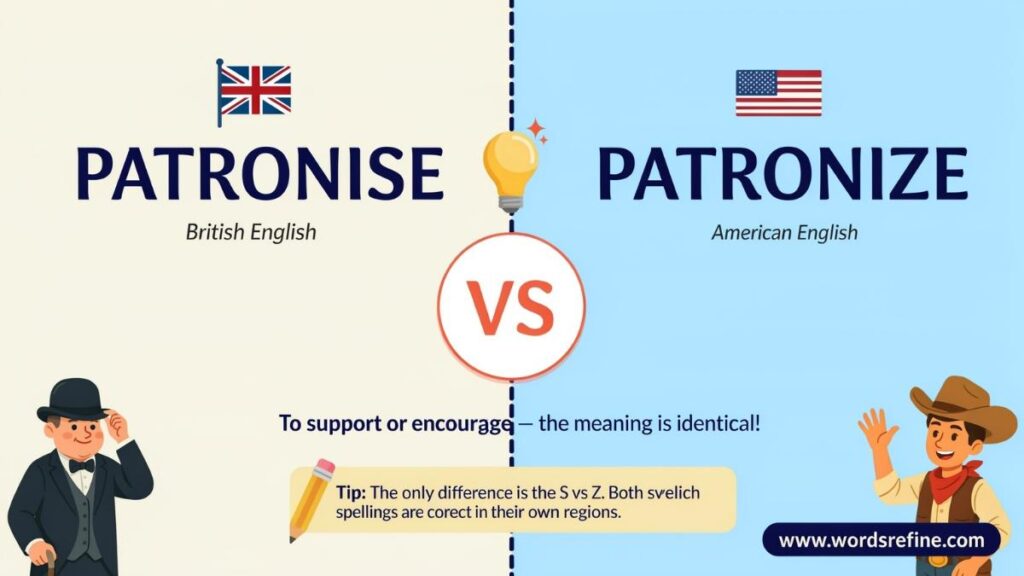
Have you ever hesitated over patronise vs patronize wondering whether to use an S or a Z? You’re not alone. This small spelling difference often confuses writers, but the rule is simple patronise is commonly used in British English, while patronize is the standard American spelling. However, there’s more to this word than its spelling. It has two distinct meanings: supporting a business and treating someone as though they are less intelligent or capable. One expresses support, while the other can sound insulting. Let’s explore the meanings, pronunciation, differences, and examples so you can use both forms with confidence.
Patronise vs Patronize Simple Answer
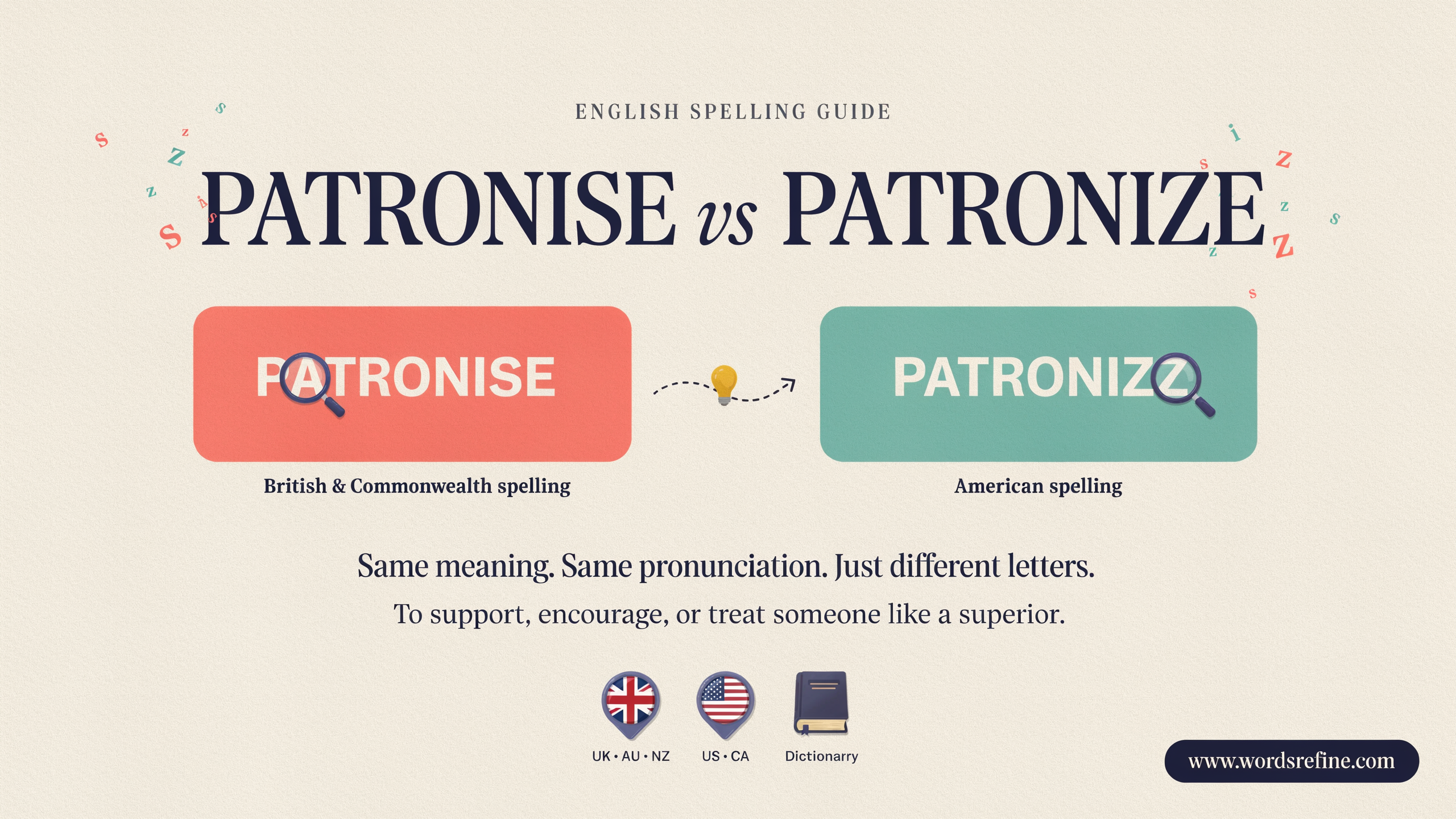
Both patronise vs patronize are correct English spellings. The choice depends on the variety of English you’re using and the spelling conventions you follow.
American English generally uses patronize, while British English commonly prefers patronise. This difference follows a familiar pattern in British and American spelling, particularly the use of ise and ize endings.
For example, American writers typically use organize, recognize, realize, and apologize. British writers commonly use organise, recognise, realise, and apologise.
The same pattern applies to patronize and patronise.
Consider these sentences:
American English: The manager shouldn’t patronize younger employees.
British English: The manager shouldn’t patronise younger employees.
Both sentences communicate exactly the same idea. The spelling changes, but the meaning and grammatical function remain unchanged.
One important detail deserves attention: British English doesn’t reject every ize spelling. Some British dictionaries and publications accept or even prefer this convention. Therefore, patronize isn’t automatically incorrect in British writing.
However, patronise remains a familiar British spelling. If you’re writing for an American audience, choose patronize. If you’re following a British publication’s ise convention, use patronise.
Learn the difference between confusing more English words
Instalments vs Installments Which one Is Correct?
What Does Patronize Mean?
Patronize has two main meanings. The first describes treating someone in a condescending way. The second refers to supporting a business, organization, or establishment by purchasing its products or services.
Although these meanings might seem unrelated, they share a connection with the idea of acting as a patron.
The first meaning often appears in conversations about workplace relationships, personal interactions, and disrespectful behavior. The second commonly appears when people discuss shopping, restaurants, local businesses, and financial support.
Let’s look at both meanings more closely.
Patronize Meaning To Treat Someone Condescendingly
When you patronize someone, you speak or behave toward that person as though you consider yourself more intelligent, capable, or important.
In everyday conversations, people often use this meaning when someone talks down to them, explains something unnecessarily, or treats them like a child.
Consider these examples:
The supervisor patronized the new employee during the meeting.
Please don’t patronize me. I understand the situation perfectly.
His explanation sounded helpful, but his tone was extremely patronizing.
She felt insulted when her colleagues patronized her because of her limited experience.
Notice that patronizing behavior doesn’t always involve obvious insults. Sometimes it hides behind exaggerated kindness, unnecessary praise, or an overly patient tone.
Imagine asking a coworker how to use a computer program. Instead of giving you a straightforward explanation, the coworker smiles and says, “Don’t worry. This is probably too complicated for you.”
That response might sound helpful at first. However, it suggests that the speaker considers you incapable of understanding the task.
That’s what it means to patronize someone.
Learn the difference between confusing more English words
Copyright vs Copywrite Which One Is Correct?
Patronize Meaning To Support a Business
The second meaning is more positive or neutral. It describes supporting a business, restaurant, shop, artist, or organization through purchases or other forms of support.
For example, you might regularly visit the same restaurant, purchase books from an independent bookstore, or shop at a neighborhood grocery store.
Consider these sentences:
We regularly patronize the family-owned restaurant near our office.
Local residents patronize independent bookstores.
Many customers patronize the bakery because of its fresh products.
The museum receives support from wealthy individuals who patronize the institution.
In this context, patronize doesn’t suggest arrogance or disrespect. Instead, it describes customer behavior or financial support.
When someone says, “We encourage everyone to patronize local businesses,” they’re asking people to shop locally and support independent business owners.
Does Patronize Have Two Meanings?
Yes. Patronize has two commonly recognized meanings, and context helps readers understand which one applies.
| Meaning | Explanation | Example |
|---|---|---|
| Condescending behavior | Treating someone as less intelligent or important | He patronized his assistant during the discussion. |
| Customer support | Regularly buying from or visiting a business | We patronize the local coffee shop. |
| Financial or cultural support | Supporting an artist, institution, or activity | The wealthy family patronizes several artists. |
For example, if someone patronizes an employee, the sentence may describe condescending behavior. However, if someone patronizes a restaurant, it usually describes customer support.
Therefore, always consider the surrounding words before deciding what the verb means.
Learn the difference between commonly mixed-up more words
Dreamt vs Dreamed Which One Is Correct?
What Does Patronise Mean?
Patronise has exactly the same meanings as patronize. The only difference is the spelling convention.
British English commonly uses patronise to describe both condescending behavior and support for a business or organization.
For example, someone might say, “Don’t patronise your colleagues just because you have more experience.”
Similarly, a person might write, “We regularly patronise the small restaurant on our street.”
The British spelling doesn’t create a separate word or introduce another meaning. It simply follows the preferred ise spelling convention.
Patronise Meaning in English
In English, patronise can describe either condescending treatment or commercial and financial support.
Consider this sentence:
“She felt that her manager was patronising her during the performance review.”
Here, the manager’s behavior made her feel inferior or less capable.
Now consider another example:
“Residents continue to patronise the independent shops in their neighborhood.”
In this sentence, the residents regularly purchase products from those businesses.
As you can see, the meaning depends on the context rather than the spelling.
Patronise vs Patronize Side-by-Side Comparison
When comparing patronise and patronize, remember that you’re looking at two regional spellings of the same verb.
The following comparison highlights their similarities and differences.
| Feature | Patronise | Patronize |
|---|---|---|
| Spelling convention | Common British English | Standard American English |
| Part of speech | Verb | Verb |
| Meaning | Treat condescendingly or support as a customer | Treat condescendingly or support as a customer |
| Pronunciation | Same within a regional accent | Same within a regional accent |
| Present participle | Patronising | Patronizing |
| Past tense | Patronised | Patronized |
| Third-person singular | Patronises | Patronizes |
| Related noun | Patronage | Patronage |
| Usage | Common in British writing | Standard in American writing |
The most noticeable difference is the letter s versus z. The distinction also appears in related forms.
British English commonly uses patronising and patronised, while American English generally uses patronizing and patronized.
However, both spelling patterns refer to the same actions. Neither form changes the verb’s definition or grammatical role.
Why Does the Spelling Change?
The difference comes from English spelling conventions surrounding verbs ending in ise and ize.
American English generally favors ize in words such as organize, recognize, realize, apologize, and patronize.
British English commonly uses ise in organize’s British equivalent, organise, as well as recognise, realise, apologise, and patronise.
However, British English also accepts ize in many words. Oxford, for example, follows an ize convention in its own house style while recognizing British forms such as patronise.
Therefore, spelling preferences can vary between publishers, dictionaries, and regional writing standards. The best approach is to follow the convention required by your audience or chosen style guide.
Learn the difference between tricky grammar more words
Mobil vs Mobile Which one Is Correct?
Patronise vs Patronize Meaning and Usage Differences
Although the spelling difference is regional, the word’s two meanings deserve closer attention. Understanding them helps prevent awkward or misleading sentences.
To Treat Someone in a Condescending Way
When you patronize someone, you behave as though you have greater knowledge, intelligence, or authority.
This behavior can appear in many everyday situations.
At work, a senior employee might repeatedly explain basic tasks to an experienced colleague without considering that the colleague already understands them.
In education, a teacher might use an unnecessarily childish tone when speaking to adult students.
During an ordinary conversation, someone might dismiss another person’s opinion with comments such as, “You’ll understand when you’re older.”
In each situation, the speaker creates a sense of superiority and inferiority.
Patronizing behavior can damage relationships because it makes people feel disrespected rather than supported. Even when someone intends to help, an unnecessarily superior tone can turn a simple explanation into an uncomfortable exchange.
To Support a Business or Organization
The second meaning involves customer loyalty and financial support.
When you patronize a business, you purchase its products or services. You might visit the same restaurant every weekend, buy books from an independent bookstore, or regularly shop at a neighborhood grocery store.
For example, our family patronizes the same restaurant every Friday.
Similarly, many customers patronize local businesses rather than purchasing everything from large retailers.
Here, patronize describes an ordinary commercial relationship. It doesn’t imply that customers treat business owners as inferior.
A regular customer might also be called a patron, especially when discussing theaters, museums, libraries, and cultural institutions.
How Context Changes the Meaning
Consider these two sentences:
“The director patronized the new employee.”
“The director patronized the local theater.”
The first sentence suggests that the director treated the employee condescendingly.
The second suggests that the director supported the theater by attending performances or contributing financially.
The same verb communicates two different ideas because the objects and surrounding contexts differ.
When you’re unsure, ask yourself whether the sentence describes someone’s attitude toward another person or their support for an establishment. That simple distinction usually clears up the confusion.
Patronise vs Patronize Pronunciation
The pronunciation question is slightly more interesting than the spelling difference.
Patronise and patronize have the same pronunciation within a given regional accent. However, British and American speakers often pronounce the opening syllable differently.
The common pronunciations are shown below.
| English variety | IPA | Easy pronunciation guide |
|---|---|---|
| British English | /ˈpæt.rə.naɪz/ | PAT-ruh-nyze |
| American English | /ˈpeɪ.trə.naɪz/ | PAY-truh-nyze |
The main difference is the vowel sound in the first syllable.
In the British pronunciation, the opening vowel resembles the sound in cat. In the American pronunciation, it resembles the vowel sound in day.
Both versions place the primary stress on the first syllable. The final syllable rhymes with eyes.
Learn the difference between confusing word pairs
Fiancé vs Fiancée What’s the Difference and which is Correctly?
How to Pronounce Patronize
For the common American pronunciation, begin with the sound PAY. Follow it with a relaxed, unstressed middle syllable. Finally, finish with nyze.
The first syllable receives the strongest emphasis.
How to Pronounce Patronise in British English
For the common British pronunciation, begin with PAT, using the vowel sound in cat. Continue with an unstressed middle syllable and finish with the same final sound.
Remember that the spelling itself doesn’t determine the accent. A British speaker can pronounce patronize with a British accent, while an American speaker can pronounce patronise with an American accent.
Patronise vs Patronize Examples in Sentences
Examples make the distinction easier to understand. The following sentences demonstrate both meanings and show how each spelling works in everyday communication.
Patronize Examples in American English
The following examples use the standard American spelling.
When patronize describes condescending behavior:
The manager shouldn’t patronize employees who ask reasonable questions.
I dislike the way he patronizes his younger brother.
Her friendly smile couldn’t hide her patronizing attitude.
The instructor refused to patronize adult learners by oversimplifying the lesson.
He felt insulted because his colleagues continued to patronize him.
When patronize describes business support:
We patronize the restaurant because it serves excellent homemade food.
Many residents patronize local businesses rather than shopping at large chains.
Tourists often patronize the gift shops near the museum.
The theater attracts wealthy supporters who patronize independent productions.
Our family has patronized this bookstore for several years.
Learn the difference between often confused words
Any time vs anytime meaning Difference with Examples ?
Patronise Examples in British English
These examples follow the common British spelling convention.
When patronise describes condescending behavior:
The supervisor shouldn’t patronise employees during team meetings.
She felt uncomfortable when her colleague began to patronise her.
His patronising comments upset the entire department.
Teachers should encourage students rather than patronise them.
I don’t appreciate people who patronise others because of their age.
When patronise describes business support:
Local residents regularly patronise the family-run café.
We encourage visitors to patronise independent shops.
Many students patronise the restaurant near the university.
The organization receives support from wealthy individuals who patronise the arts.
Tourists often patronise traditional markets when visiting the city.
Patronize in a Sentence More Practical Examples
Sometimes a short sentence makes a word’s meaning much easier to recognize.
| Sentence | Meaning |
|---|---|
| Please don’t patronize me. | Don’t treat me as inferior. |
| We patronize the same restaurant every month. | We regularly visit the restaurant as customers. |
| His patronizing tone irritated his colleagues. | His tone suggested superiority. |
| The museum attracts patrons from around the world. | It attracts supporters or visitors. |
| She patronizes several young artists. | She financially supports their work. |
Patronise in a Sentence Understanding the British Form
The following sentences show how to use the British spelling naturally.
You shouldn’t patronise someone simply because they lack experience.
We patronise that independent shop whenever we need fresh bread.
Her patronising remarks made the conversation uncomfortable.
The theater is patronised by people from across the region.
He felt that the sales assistant was patronising him.
Notice that the spelling changes, but the grammar and sentence structure remain the same.
Learn the difference between basic English word mistakes
Choose vs Chose Difference and which one is Correct?
British English vs American English Why Does the Spelling Change?
British and American English developed different spelling preferences over time. Although both varieties share the same linguistic foundations, their written conventions don’t always match.
The ise and ize distinction is one example.
American English generally favors ize endings. British English commonly favors ise in everyday writing, although both conventions exist in the UK.
Consider these familiar comparisons:
| American English | British English |
|---|---|
| Patronize | Patronise |
| Organize | Organise |
| Recognize | Recognise |
| Realize | Realise |
| Apologize | Apologise |
| Standardize | Standardise |
These spelling differences don’t normally affect the words’ meanings.
Is Patronize American or British English?
Patronize is the standard American spelling. However, British English dictionaries also recognize it.
Is Patronise British or American English?
Patronise is the usual British spelling. American writers generally use patronize instead.
Therefore, the most useful approach is to follow the spelling conventions of your intended audience rather than treating one form as universally correct.
Patronize vs Patronage Understanding the Difference
The Patronize and patronage share a common root, but they serve different grammatical purposes.
Patronize is a verb, while patronage is a noun. Understanding this distinction makes it easier to use both words correctly.
What Does Patronage Mean?
Patronage refers to the support, encouragement, financial assistance, or business provided by a patron.
It commonly appears in discussions about customer relationships, business support, arts and culture, charitable organizations, and public institutions.
For example:
“The museum depends on the patronage of private donors.”
Here, patronage describes the financial support the museum receives.
Similarly, a restaurant might appreciate the patronage of its regular customers. In this situation, the word describes the business those customers provide.
Patronize vs Patronage Comparison
| Word | Part of speech | Meaning | Example |
|---|---|---|---|
| Patronize | Verb | To support a business or treat someone condescendingly | We patronize the bookstore. |
| Patronage | Noun | Support or business provided by patrons | The bookstore appreciates local patronage. |
| Patron | Noun | A customer, supporter, or benefactor | She is a regular patron of the theater. |
| Patronizing | Adjective | Showing a condescending attitude | His patronizing remarks offended her. |
Consider another pair of sentences.
Customers patronize the restaurant.
The restaurant appreciates their patronage.
The first sentence describes an action. The second describes the support itself.
Remembering this distinction will help you avoid confusing the verb with its related noun.
Synonyms of Patronise and Patronize
The best synonym depends on which meaning you intend. Using the wrong alternative can change the message of your sentence.
Patronize Synonyms Condescending Meaning
When patronize means treating someone as inferior, several alternatives can express the same general idea.
Condescend describes behaving as though someone is beneath you.
Talk down to means speaking to someone in a disrespectful or superior manner.
Belittle means making someone feel unimportant or incapable.
Disparage means speaking negatively about someone or something.
Look down on means considering someone less worthy or capable.
Undermine means weakening someone’s confidence, authority, or position.
For example, consider this sentence:
“The supervisor patronized his assistant.”
You could rewrite it as:
“The supervisor talked down to his assistant.”
The second sentence communicates the condescending meaning more directly.
Learn the difference between commonly misused words
Discrete vs Discreet What the Difference and which is Correctly?
Patronise Synonyms Business-Support Meaning
When the verb describes supporting a business or organization, consider alternatives such as support, frequent, shop at, purchase from, sponsor, and encourage.
For example:
“We patronize the neighborhood bookstore.”
You could also write:
“We regularly shop at the neighborhood bookstore.”
Both sentences communicate customer support, although the second sounds more conversational.
The best choice depends on your intended meaning and the tone of your writing.
Patronize Antonyms
There isn’t one perfect antonym for both meanings. However, several words express the opposite idea in specific situations.
When patronize describes condescending behavior, alternatives that express the opposite include respect, value, appreciate, encourage, and treat as an equal.
When patronize describes business support, alternatives include boycott, avoid, shun, and refuse to support.
For example, if customers decide to boycott a restaurant, they deliberately stop supporting it. That action contrasts with patronizing the establishment.
Common Mistakes When Using Patronise vs Patronize
Even though the spelling distinction is straightforward, writers sometimes misuse these words or misunderstand their meanings.
Knowing the common mistakes can help you avoid awkward sentences and communicate more clearly.
Assuming the Spellings Have Different Meanings
A common misconception is that patronise means supporting a business, while patronize means treating someone condescendingly.
That’s incorrect. Both spellings have both meanings.
The difference is regional spelling preference, not definition.
Using Inconsistent Regional Spellings
Consider this sentence:
“Our company organizes events and patronises local businesses.”
The sentence mixes American and British spelling conventions.
A consistent American version would be:
“Our company organizes events and patronizes local businesses.”
A consistent British version would be:
“Our company organises events and patronises local businesses.”
Keeping the spelling consistent makes your writing look more professional.
Confusing Patronize With Patronage
Consider this incorrect sentence:
“We appreciate everyone who patronize our business.”
The correct American version is:
“We appreciate everyone who patronizes our business.”
You could also write:
“We appreciate everyone’s patronage.”
The first corrected sentence uses a verb. The second uses a noun.
Assuming Patronize Always Means Something Negative
The word doesn’t always describe disrespectful behavior.
For example:
“We encourage visitors to patronize small businesses.”
This sentence expresses a positive request for customer support. It doesn’t suggest that visitors should treat business owners condescendingly.
Always consider the context before interpreting the word.
Learn the difference between everyday English mistakes
Further vs Farther The Simple Difference and Each Correctly?
Using Patronize When a Clearer Word Would Work Better
Although patronize is correct when discussing business support, some readers may initially interpret it as condescending behavior.
For example:
“Please patronize our online store.”
This sentence is grammatically correct, but some audiences might find the wording unfamiliar or ambiguous.
A clearer alternative would be:
“Please support our online store.”
Choose the simpler expression when it communicates your message more effectively.
Real Sentence Fixes Patronise vs Patronize
Let’s look at some practical corrections that demonstrate the difference between spelling mistakes, grammatical mistakes, and incorrect word usage.
See the Mistake, Fix the Mistake
| Incorrect or confusing sentence | Improved sentence | Explanation |
|---|---|---|
| We patronise local stores. | We patronize local stores. | Use American spelling in American English. |
| He patronize his coworkers. | He patronizes his coworkers. | The third-person singular verb needs an s. |
| She appreciates the patronize of customers. | She appreciates the patronage of customers. | Patronage is the correct noun. |
| Don’t patronize me with that explanation. | Don’t patronize me with that explanation. | The original sentence is correct. |
| Our business depends on people who patronage us. | Our business depends on people who patronize us. | The sentence needs a verb. |
| The company patronising its customers. | The company is patronizing its customers. | The sentence needs an auxiliary verb. |
The main lesson is simple: spelling, grammar, and word choice are separate issues. Correcting one doesn’t automatically fix the others.
Patronise vs Patronize in Professional and Academic Writing
Choosing between patronise and patronize matters in professional documents, academic assignments, business communication, and published articles.
Neither form is inherently more formal or grammatically superior. Your choice should reflect the publication’s language conventions.
In American Academic Writing
Use patronize when following American English conventions.
For example:
“The study examines how consumers patronize independent retail businesses.”
Likewise, use related American forms such as patronizing, patronized, and patronizes.
In British Academic Writing
Use patronise when following a British publication’s ise convention.
For example:
“The research explores why customers patronise independent retailers.”
Keep related forms consistent, including patronising and patronised.
In Business Communication
The intended meaning matters just as much as spelling.
For example, a company might write:
“We appreciate every customer who supports and patronizes our business.”
This wording communicates customer appreciation clearly.
However, if you’re describing employee relationships, avoid using the verb casually without considering its negative connotation.
For example:
“Managers should explain new procedures without patronizing their employees.”
This sentence communicates a workplace expectation of respectful communication.
How to Maintain Consistency
Before submitting a document, identify whether you’re writing in American or British English. Follow your organization’s preferred style guide and keep related word forms consistent.
You should also check the spelling settings in your word processor. This simple step can prevent unnecessary corrections, especially when working on longer documents.
A consistent document looks more professional and makes reading easier.
What Dictionaries and Style Guides Say About Patronise vs Patronize
Major dictionaries recognize the word and its two principal meanings.
The Cambridge Dictionary identifies patronize as the American form and notes that British English usually uses patronise. It also distinguishes the condescending meaning from the business-support meaning.
The Oxford Learner’s Dictionaries lists patronize and identifies patronise as a British English alternative. It includes the meanings of treating someone condescendingly, regularly visiting a business, and financially supporting a person or activity.
Merriam-Webster is another useful reference for American spelling, pronunciation, and definitions.
These references support an important distinction: the spelling choice doesn’t create a different verb.
Why Do Dictionaries Sometimes Prefer Different Spellings?
Dictionaries serve different audiences and follow different editorial conventions.
An American dictionary generally presents the American form as its main entry. A British dictionary may present the same word with a British spelling preference or list both forms.
That doesn’t mean one dictionary considers the other spelling incorrect.
When writing for a particular publication, follow its style guide rather than combining different dictionary preferences.
The Simple Rule to Remember Patronise vs Patronize
Still wondering whether to write patronise or patronize? Remember this straightforward rule.
American English generally uses patronize, while British English commonly uses patronise. Both spellings share the same meanings and grammatical functions.
A useful memory trick is to associate the letter z in patronize with American spelling preferences. Although this isn’t a universal rule for every English word, it works for this particular spelling choice.
Most importantly, don’t confuse the spelling with the meaning. Someone can patronize a restaurant by becoming a regular customer or patronize a coworker by treating them as inferior.
The surrounding sentence tells you which meaning applies.
Learn the difference between more words people mix up
Capital vs Capitol Which One Is Correct?
Quick Recap Patronise vs Patronize at a Glance
Here’s everything worth remembering.
| Question | Answer |
|---|---|
| Is patronize correct? | Yes. It’s the standard American spelling. |
| Is patronise correct? | Yes. It’s the usual British spelling. |
| Do they have different meanings? | No. Both have the same meanings. |
| Are they pronounced differently because of spelling? | No. Regional accents may affect pronunciation. |
| What are their main meanings? | To treat someone condescendingly or support a business. |
| What is the noun form? | Patronage. |
| What does patron mean? | A customer, supporter, or benefactor. |
| What is the American past tense? | Patronized. |
| What is the British past tense? | Patronised. |
The easiest way to remember the distinction is to consider your audience. American readers generally expect patronize, while British readers commonly encounter patronise.
Learn the difference between basic English word mistakes
Loose vs Lose Difference and which is Correctly?
Practice Session Patronise vs Patronize
Fill in each blank with the correct form of patronise or patronize. Pay attention to the context and the variety of English used in each sentence.
Fill in the Blanks
1. Many Americans prefer to ______ local businesses rather than large retail chains.
2. She felt insulted when her manager began to ______ her during the meeting.
3. British writers commonly use ______ instead of patronize.
4. We should ______ small businesses to support the local economy.
5. His ______ tone made the new employee feel uncomfortable.
6. The restaurant hopes more customers will ______ it during the holiday season.
7. Stop trying to ______ me as if I don’t understand basic instructions.
8. The charity encourages people to ______ independent artists.
9. Her ______ remarks made the conversation awkward.
10. Many British publications use the spelling ______.
11. Customers who regularly ______ the bookstore help keep it in business.
12. He tends to ______ people with less professional experience.
13. The shop appreciates everyone who chooses to ______ local retailers.
14. She disliked the way her colleague spoke to her in a ______ manner.
15. American English generally favors the spelling ______.
16. The manager promised not to ______ customers who asked simple questions.
17. Local residents continue to ______ the family-owned bakery.
18. His attempt to explain the obvious sounded ______ rather than helpful.
19. British customers often ______ neighborhood shops.
20. Please don’t ______ your audience by assuming they know nothing about the subject.
21. The author encouraged readers to ______ independent bookstores.
22. Her supervisor’s ______ attitude damaged their working relationship.
23. Many people choose to ______ businesses that support their communities.
24. The teacher explained the lesson without using a ______ tone.
25. Whether you write patronise or patronize depends on the variety of English you follow.
Answers
- Patronize
- Patronize
- Patronise
- Patronize
- Patronizing
- Patronize
- Patronize
- Patronize
- Patronizing
- Patronise
- Patronize
- Patronize
- Patronize
- Patronizing
- Patronize
- Patronize
- Patronize
- Patronizing
- Patronise
- Patronize
- Patronize
- Patronizing
- Patronize
- Patronizing
- Patronise or patronize
Here’s a trusted source for clear more words Comparison:
FAQs
Why does patronize have two meanings?
The word patronize comes from the idea of being a patron or supporter. It can mean supporting a business, artist, or organization through purchases or financial help. However, it can also mean treating someone as though they are less intelligent or capable than you. The surrounding context determines which meaning applies.
What is the difference between condescending and patronizing?
Both words describe behavior that makes someone feel inferior. Condescending refers to acting as though you are more intelligent or important than someone else. Patronizing often describes a similar attitude, especially when someone pretends to be helpful while speaking in a disrespectful or superior tone.
What is another word for patronize?
When patronize means treating someone as inferior, you can use words such as belittle, demean, condescend to, or talk down to. When it means supporting a business, alternatives include support, frequent, shop at, and sponsor.
Is patronizing an insult?
Patronizing is not necessarily a direct insult, but it describes behavior that can feel insulting. For example, explaining something obvious in a childish tone may make someone feel disrespected or underestimated. Describing a person’s behavior as patronizing also expresses criticism of their attitude.
What is another word for patronizing?
Depending on the context, suitable alternatives include condescending, belittling, dismissive, demeaning, and superior. For example, “Her condescending remarks annoyed the team” conveys much the same meaning as “Her patronizing remarks annoyed the team.”
What is an example of patronizing a person?
Imagine an experienced employee telling a new colleague, “Don’t worry. I’ll explain it slowly so even you can understand.” Although the speaker may appear helpful, the comment suggests that the colleague lacks intelligence. This is a clear example of patronizing behavior.
What does patronizing mean in simple terms?
Patronizing means treating someone as though they are less intelligent, experienced, or capable than you. In simple terms, it means acting superior while pretending to be helpful or kind.
Why is someone patronizing?
Someone may act patronizing because they feel superior, want to control a conversation, or assume others need unnecessary help. Sometimes, they simply don’t realize how their words sound. Regardless of the reason, this behavior can make people feel belittled rather than respected.
Learn the difference between often confused words
Lay vs Lie Difference and which is correct?
Conclusion
The difference between patronise vs patronize is easier to understand than it first appears. Both spellings carry the same meanings, but patronise is commonly used in British English, while patronize is the standard American spelling. The real challenge isn’t choosing between the two; it’s recognizing the meaning from the context.
Remember, patronizing someone means treating them as if they are less intelligent or capable than you. Patronizing a business, on the other hand, means supporting it. One can offend your colleague, while the other can help a local shop thrive.
So, before you use the word, check what you want to say. After all, supporting someone’s business is thoughtful, but talking down to them is hardly a kindness. Your spelling may be correct, but your attitude should be, too!

Diora AJS she is an experienced blogger and passionate English language enthusiast at Words Refine. With a keen eye for language and a love for clear communication, she writes practical content about grammar, word meanings, usage, and commonly confused terms. Her goal is to make English easier to understand through clear explanations and relatable examples, helping readers write accurately and communicate with confidence.