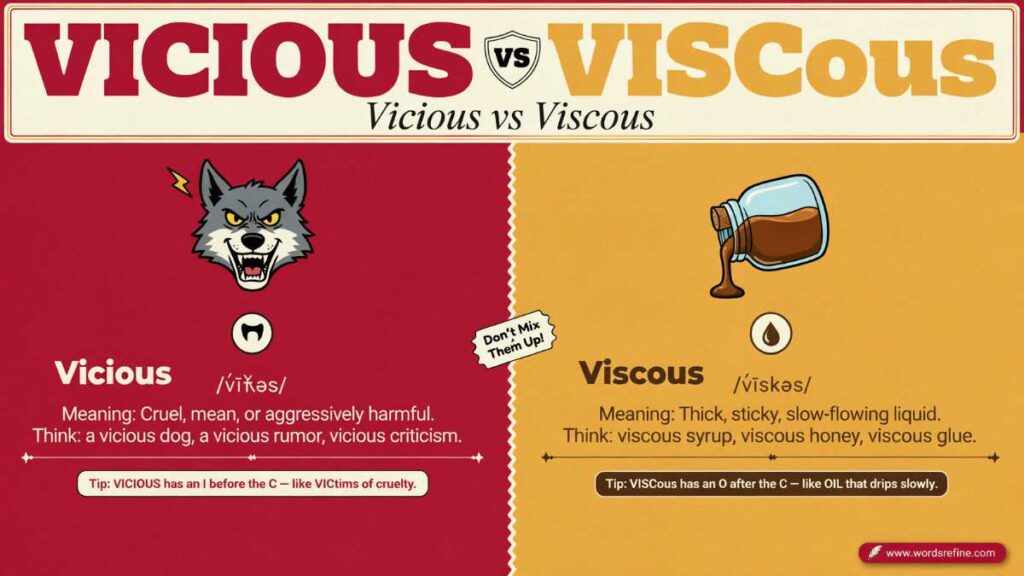
Vicious vs Viscous are easy to confuse because they look and sound alike. However using one in place of the other can create a sentence with an entirely different meaning. A vicious person is cruel, aggressive, or deliberately harmful, while a viscous liquid, such as honey or syrup, flows slowly because of its thickness. Imagine calling honey vicious when you simply mean it’s difficult to pour! Although the mistake may seem small, choosing the wrong word can make your writing unclear or unintentionally funny. Let’s explore the meanings, pronunciation, examples, and common mistakes to help you understand the difference between vicious vs. viscous and use both words correctly.
Quick Answer Vicious vs Viscous
Vicious means cruel, violent, aggressive, or harmful. It describes people, animals, actions, attacks, comments, and unpleasant situations.
Viscous means thick and resistant to flowing. It describes liquids and other fluid substances that move slowly because of their internal resistance.
Consider these examples:
The vicious dog frightened everyone in the neighborhood.
Honey is more viscous than water.
The first sentence describes aggressive behavior. The second explains how easily a liquid flows.
Learn the difference between confusing more English words
Aging vs Ageing Which one Is Correct?
What Is the Difference Between Vicious vs Viscous?
The main difference between vicious vs viscous is their meaning and usage. Although they look and sound similar, they describe entirely different things.
Vicious is an adjective that refers to cruelty, violence, hostility, or harmful behavior. You can use it to describe an aggressive animal, a cruel person, a brutal attack, or a hurtful remark.
For example:
The politician faced vicious criticism after making the controversial statement.
Here, vicious emphasizes how harsh and damaging the criticism was.
Viscous is also an adjective, but it describes the physical properties of a fluid. A viscous substance has a thick consistency and does not flow easily. Honey, syrup, and molasses are familiar examples.
For example:
The viscous syrup moved slowly down the side of the bottle.
In this sentence, viscous explains why the syrup takes longer to flow than water.
The easiest way to remember the distinction is to associate vicious with harmful behavior and viscous with slow-moving liquids.
What Does Vicious Mean?
Vicious describes something cruel, violent, aggressive, or intentionally harmful. It often refers to behavior that causes physical or emotional damage.
You can use the word for people, animals, attacks, arguments, criticism, and difficult situations. Its meaning depends on the context, but it generally carries a negative tone.
For example:
The vicious attacker threatened everyone in the room.
The journalist received vicious comments after publishing the article.
Both sentences describe harmful behavior. In the first, vicious refers to an aggressive person. In the second, it describes cruel and hurtful comments.
Different Meanings of Vicious
Vicious has several related meanings. Understanding them will help you use the word naturally in everyday writing and conversation.
Cruel or mean behavior
Vicious can describe someone who deliberately treats others cruelly or shows little concern for their feelings.
For example:
His vicious remarks upset his coworkers.
She made a vicious comment about her friend’s appearance.
Violent or aggressive behavior
The word can also describe physical aggression, dangerous animals, or violent attacks.
For example:
The vicious dog chased the delivery driver.
Police investigated a vicious attack outside the restaurant.
Severe or damaging situations
Sometimes, vicious describes something extremely intense, harsh, or unpleasant, even when it does not involve deliberate cruelty.
For example:
A vicious storm damaged several homes.
The company faced a vicious financial crisis.
Harsh criticism or arguments
Vicious can also describe criticism, arguments, and personal attacks that are unusually cruel or aggressive.
For example:
The two candidates exchanged vicious insults during the debate.
Her article received vicious criticism online.
Learn the difference between commonly mixed-up more words
Master’s Degree vs Masters Degree Which One Is Correct?
Common Expressions With Vicious
Vicious appears in several familiar expressions. These combinations help communicate cruelty, intensity, or harmful behavior.
| Expression | Meaning | Example |
|---|---|---|
| Vicious attack | A violent or aggressive attack | The victim survived a vicious attack. |
| Vicious cycle | A repeating situation that makes a problem worse | Debt and high interest created a vicious cycle. |
| Vicious criticism | Extremely harsh or cruel criticism | The proposal received vicious criticism. |
| Vicious rumor | A harmful or malicious rumor | A vicious rumor damaged her reputation. |
| Vicious circle | A situation in which one problem causes another | Poor sleep and stress can form a vicious circle. |
| Vicious dog | An aggressive or dangerous dog | The owner warned visitors about the aggressive dog. |
Learn the difference between tricky grammar more words
Blond vs Blonde What’s the Difference?
What Does Viscous Mean?
Viscous describes a liquid or fluid that flows slowly because it has a high resistance to movement. In everyday language, you can think of it as thick or slow-flowing.
Honey, molasses, syrup, and some oils are common examples of viscous substances. They don’t move as freely as water, which has relatively low viscosity.
For example:
The viscous honey took several seconds to pour from the jar.
Viscous is especially useful when discussing liquids and their physical properties. You’ll often encounter it in cooking, science, engineering, and manufacturing.
Everyday Examples of Viscous Substances
You don’t need a science laboratory to understand viscosity. Many everyday products have different levels of thickness and flow.
Honey is highly viscous. It pours slowly and tends to cling to a spoon.
Molasses is another viscous substance. Its thick consistency makes it move much more slowly than water.
Maple syrup is thicker than water, although its viscosity can change with temperature.
Cooking oil is less viscous than honey but generally more viscous than water. It flows easily while still feeling thicker than water.
Shampoo and liquid soap are also viscous. Their consistency helps them stay in your hand instead of running away immediately.
These examples show why viscous is useful when describing how easily or slowly a substance flows.
Learn the difference between confusing word pairs
Anyway vs Anyways Meaning Usage and Examples ?
How Is Viscosity Used in Science and Technology?
Viscosity plays an important role in science and engineering. It describes how strongly a fluid resists flowing. A liquid with high viscosity moves slowly, while one with low viscosity flows more easily.
For example, honey has a higher viscosity than water. That’s why honey pours slowly while water runs freely from a glass.
Scientists and engineers study viscosity because it affects how liquids behave under different conditions. This knowledge helps them choose suitable materials for machines, vehicles, medicines, and industrial products.
In cooking, viscosity affects the texture of sauces, syrups, and other liquids. and In automotive engineering, it helps determine which oil can protect an engine under specific operating conditions. In medicine, viscosity matters when developing liquid medications and other fluid-based products.
Dynamic Viscosity
Dynamic viscosity measures a fluid’s resistance to flowing when an external force acts on it. Scientists commonly represent it with the Greek letter mu (μ).
A fluid with high dynamic viscosity resists movement more strongly than one with low dynamic viscosity.
For example, honey has a higher dynamic viscosity than water at the same temperature. Consequently, honey flows more slowly.
Dynamic viscosity is usually measured in pascal-seconds (Pa·s). This unit helps scientists compare how easily different fluids move.
Kinematic Viscosity
Kinematic viscosity describes a fluid’s dynamic viscosity in relation to its density. Scientists commonly represent it with the Greek letter nu (ν).
The relationship is expressed through this formula:
ν = μ / ρ
Here, μ represents dynamic viscosity, while ρ represents fluid density.
Kinematic viscosity helps scientists study how fluids move under gravity or through pipes. Engineers also consider it when selecting lubricants and evaluating how fluids behave inside machines.
Although dynamic and kinematic viscosity are related, they measure different properties. Dynamic viscosity focuses on a fluid’s resistance to movement, while kinematic viscosity also accounts for its density.
Learn the difference between often confused words
Onto vs On To What’s the Difference ?
Vicious vs Viscous Side-by-Side Comparison
Vicious and viscous may look similar, but their meanings and uses are quite different.
| Feature | Vicious | Viscous |
|---|---|---|
| Part of speech | Adjective | Adjective |
| Meaning | Cruel, violent, aggressive, or harmful | Thick and resistant to flowing |
| Describes | People, animals, actions, attacks, and situations | Liquids and fluid substances |
| Common context | Behavior, conflict, criticism, and violence | Cooking, chemistry, physics, and engineering |
| Example | The vicious argument upset everyone. | The viscous syrup flowed slowly. |
| Related noun | Viciousness | Viscosity |
| Opposite idea | Kind or gentle | Thin or free-flowing |
The distinction is straightforward: vicious describes harmful behavior or intense situations, while viscous describes how easily a substance flows.
How to Pronounce Vicious vs Viscous
Vicious and viscous sound similar, but their pronunciation is slightly different.
Vicious is pronounced VISH-us. Its phonetic spelling is /ˈvɪʃ.əs/. The middle sound resembles the “sh” in words such as ship and shower.
Viscous is pronounced VIS-kus. Its phonetic spelling is /ˈvɪs.kəs/. The middle contains a clear “s” sound followed by a hard “k.”
Try saying both words slowly:
Vicious: VISH-us
Viscous: VIS-kus
Pay attention to the middle consonant sounds. Vicious has a “sh” sound, while viscous has an “s” sound followed by “k.”
A Simple Way to Remember Vicious vs Viscous
If you often mix up these words, connect each one with something familiar.
Vicious contains a “sh” sound that you can associate with an aggressive action. Think of a vicious attack or a cruel remark.
Viscous is closely connected to viscosity, the scientific term for a fluid’s resistance to flowing. Think of honey slowly dripping from a spoon.
These two examples make the difference easier to remember:
A vicious animal may bite.
A viscous liquid may barely pour.
This simple connection can help you choose the right word without reaching for a dictionary every time.
Learn the difference between basic English word mistakes
Bougie vs Boujee Meaning Origin Spelling and Examples ?
When Should You Use Vicious?
Use vicious when describing cruelty, aggression, violence, or something unusually harsh. The word works in both literal and figurative situations.
For example, you might describe a dangerous animal as vicious because it attacks people. You could also describe a personal insult as vicious because it causes emotional harm.
Consider these examples:
The vicious dog barked and lunged at the stranger.
The journalist faced vicious attacks after publishing the investigation.
A vicious argument ruined their evening.
The region experienced a vicious winter storm.
His vicious comments hurt more than he realized.
In each example, vicious communicates aggression, cruelty, or severity. It does not describe the thickness of a liquid.
When Should You Use Viscous?
Use viscous when describing a liquid or fluid that resists flowing. The word is particularly useful when discussing texture, consistency, or movement.
Honey is a familiar example because it flows slowly. Some oils, gels, syrups, and liquid products also have relatively high viscosity.
Consider these examples:
The viscous mixture was difficult to stir.
The machine requires oil with a specific viscosity.
Cold honey becomes more viscous and pours more slowly.
The thick, viscous sauce coated the pasta evenly.
Scientists measured the liquid’s viscosity during the experiment.
In these examples, viscous describes a physical property rather than someone’s behavior or an unpleasant situation.
Can Vicious vs Viscous Be Used Interchangeably?
No. Vicious and viscous are not interchangeable because they have completely different meanings. Using one in place of the other can change your sentence or make it sound incorrect.
Consider this example:
Incorrect: The vicious honey poured slowly from the jar.
Correct: The viscous honey poured slowly from the jar.
The first sentence suggests that the honey is cruel or aggressive, which doesn’t make sense. The second correctly describes its thick consistency.
Now consider another example:
Incorrect: The viscous dog attacked the stranger.
Correct: The vicious dog attacked the stranger.
Viscous is unsuitable here because viscosity describes a fluid’s resistance to flowing. Vicious is the correct choice because the sentence describes aggressive behavior.
To avoid this mistake, first identify what you’re describing. If you’re talking about cruelty or aggression, use vicious. If you’re describing a thick liquid, use viscous.
Learn the difference between commonly misused words
Aluminum vs Aluminium Which One Is Correct?
Common Mistakes When Using Vicious vs Viscous
Because vicious and viscous look and sound alike, it’s easy to confuse them. However, a little attention to context can help you avoid common mistakes.
Using Vicious to Describe a Thick Liquid
Vicious describes cruelty, aggression, or harmful behavior. It doesn’t describe the thickness of a liquid.
Incorrect: The vicious syrup stuck to the spoon.
Correct: The viscous syrup stuck to the spoon.
The correct word is viscous because the sentence describes the syrup’s thick consistency.
Using Viscous to Describe Aggressive Behavior
Viscous refers to a fluid’s resistance to flowing. It doesn’t describe an aggressive person or animal.
Incorrect: The viscous dog frightened the children.
Correct: The vicious dog frightened the children.
The dog is described as aggressive, so vicious is the appropriate word.
Assuming Both Words Have Similar Meanings
Their similar spelling doesn’t mean they share a definition. Vicious relates to cruelty or aggression, while viscous relates to the movement of fluids.
For example:
The vicious argument continued for hours.
The viscous liquid moved slowly through the pipe.
Each word has a specific purpose, so choosing the correct one depends on the subject of your sentence.
Vicious vs Viscous in Everyday Sentences
Seeing these words in different situations can make their meanings easier to understand.
Examples Using Vicious
The vicious lion attacked its prey.
Her vicious response ended the conversation.
The team faced vicious criticism after losing the championship.
A vicious storm knocked down several trees.
The two neighbors had a vicious argument over the property boundary.
The online discussion quickly turned into a series of vicious personal attacks.
Examples Using Viscous
The viscous honey slowly dripped from the spoon.
The chef added water to thin the viscous sauce.
The laboratory tested the viscosity of the liquid.
Cold syrup becomes more viscous and takes longer to pour.
The factory uses a viscous lubricant to protect its machinery.
The thick mixture was too viscous to pass easily through the narrow pipe.
Incorrect and Correct Examples
| Incorrect sentence | Correct sentence |
|---|---|
| The viscous dog chased the cyclist. | The vicious dog chased the cyclist. |
| The vicious honey was difficult to pour. | The viscous honey was difficult to pour. |
| She made a viscous remark about her colleague. | She made a vicious remark about her colleague. |
| The viscous attack shocked the neighborhood. | The vicious attack shocked the neighborhood. |
| The vicious oil moved slowly through the pipe. | The viscous oil moved slowly through the pipe. |
These examples show why context matters. A word that fits one situation may sound completely wrong in another.
Related Words Vicious vs Viscous
Understanding related words can help you recognize the difference more easily. 1.Vicious belongs to the vocabulary of cruelty and aggression, while viscous belongs to the language of liquids and physical properties.
Vicious vs Ferocious
The Vicious and ferocious both describe aggressive or dangerous behavior, but they aren’t always interchangeable.
Vicious often suggests cruelty, hostility, or an intention to cause harm. Ferocious emphasizes extreme fierceness, intensity, or aggression.
For example:
The vicious attacker deliberately hurt the victim.
The ferocious tiger roared at the approaching animal.
A person can be vicious because of cruel behavior, while an animal can be ferocious because of its fierce nature.
Vicious vs Malicious
The Vicious and malicious have related meanings, but they emphasize different things.
Vicious describes cruel, violent, or aggressive behavior. Malicious refers to an intention to cause harm, trouble, or damage.
For example:
The vicious attack left several people injured.
He spread malicious rumors to damage her reputation.
The first sentence emphasizes aggressive behavior. The second highlights someone’s harmful intention.
Antonyms of Vicious
An antonym is a word with the opposite meaning. Depending on the context, several words can serve as opposites of vicious.
Kind describes someone who treats others with care and consideration.
Gentle refers to someone or something that is mild rather than harsh or aggressive.
Friendly describes a warm, welcoming, or pleasant attitude.
Compassionate describes someone who shows sympathy and concern for others.
For example:
Instead of making vicious remarks, she offered a kind response.
The gentle dog welcomed the visitors without barking.
Words Related to Viscous
Several words describe substances that share some qualities with viscous liquids. However, they don’t all mean exactly the same thing.
Thick describes a substance with a dense or heavy consistency. For example, a thick milkshake is difficult to drink through a narrow straw.
Sticky describes something that clings to surfaces or objects. Honey is both thick and sticky, but the two words describe different properties.
Dense describes how much material exists within a given volume. A substance can be dense without being highly viscous.
These distinctions matter because thickness, stickiness, density, and viscosity are related but separate properties.
Learn the difference between everyday English mistakes
Shined vs Shone Which One Is Correct?
What Is a Vicious Cycle?
A vicious cycle is a repeating situation in which one problem creates another, making the original problem worse. The pattern continues until something interrupts it.
For example, financial difficulties can create a vicious cycle. Someone struggling to pay bills may borrow money, accumulate interest, and end up with even more debt. The growing debt then makes it harder to manage everyday expenses.
Another example involves sleep and stress. Poor sleep can increase stress, while stress can make it harder to sleep. Without a change in habits or circumstances, the problem may continue.
The expression uses vicious because it describes a harmful pattern, not a liquid’s physical properties.
What Is a Vicious Circle?
A vicious circle has essentially the same meaning as a vicious cycle. Both describe a situation in which connected problems keep making one another worse.
For example, a student who struggles with a subject may lose confidence. As confidence drops, the student may avoid studying. Without enough practice, performance may decline further, creating an ongoing problem.
Vicious circle and vicious cycle are both correct expressions. You can generally use either one without changing the meaning.
What Is a Viscous Liquid?
A viscous liquid is a fluid that resists flowing. It usually has a thicker consistency than a liquid with low viscosity.
Honey, molasses, syrup, and some oils are common examples. These substances move more slowly than water under similar conditions.
Temperature can also affect viscosity. For example, honey generally becomes less viscous when warmed, allowing it to flow more easily. When it cools, it becomes thicker and pours more slowly.
Viscosity also matters in industrial settings. Manufacturers consider it when producing lubricants, paints, cosmetics, and other liquid products. The right consistency helps products work as intended.
A Practical Example Honey vs Water
Imagine pouring honey and water into two separate glasses. Both are liquids, but they behave very differently.
Water flows quickly and spreads across the bottom of the glass almost immediately. Honey moves much more slowly and may cling to the spoon or container.
This difference comes from viscosity. Honey has a higher viscosity than water, so it offers greater resistance to flowing.
Now imagine describing the same situation with vicious. The word wouldn’t make sense because neither liquid is showing cruelty or aggression.
This everyday example captures the distinction perfectly: vicious describes harmful behavior, while viscous describes a fluid’s resistance to movement.
Learn the difference between more words people mix up
Stint vs Stent Meaning Differences Examples and Correct Usage ?
Practice Session Vicious vs Viscous
- The ______ dog barked loudly and chased the stranger.
- Honey is more ______ than water.
- The journalist received ______ criticism after publishing the article.
- The chef added warm water to make the ______ sauce easier to pour.
- The two neighbors had a ______ argument over their property boundary.
- Cold syrup becomes more ______ and flows slowly.
- The police investigated a ______ attack outside the shopping center.
- The laboratory measured the ______ of the liquid.
- Her ______ comments hurt her friend’s feelings.
- Molasses is a highly ______ substance.
- The candidates exchanged ______ insults during the debate.
- The machine requires oil with the correct level of ______.
- A ______ rumor damaged the teacher’s reputation.
- The mixture was too ______ to pass through the narrow pipe.
- The lion became ______ when another animal approached its territory.
- The scientist studied how temperature affected the liquid’s ______.
- The online discussion turned into a ______ argument.
- The ______ shampoo took longer to flow out of the bottle.
- The victim suffered injuries during the ______ attack.
- Heating the honey made it less ______ and easier to pour.
- The company faced ______ competition from its rivals.
- The factory uses a ______ lubricant to protect its machinery.
- His ______ remarks made everyone uncomfortable.
- The researcher compared the viscosity of two ______ liquids.
- Poor sleep and stress can create a ______ cycle.
Answers
- Vicious
- Viscous
- Vicious
- Viscous
- Vicious
- Viscous
- Vicious
- Viscosity
- Vicious
- Viscous
- Vicious
- Viscosity
- Vicious
- Viscous
- Vicious
- Viscosity
- Vicious
- Viscous
- Vicious
- Viscous
- Vicious
- Viscous
- Vicious
- Viscous
- Vicious
Here’s a trusted source for clear more words Comparison:
FAQs
What is a better word for vicious?
The best alternative depends on the situation. Words such as cruel, brutal, fearless hostile, aggressive, and malicious can replace vicious in different contexts. For example, cruel describes someone who deliberately hurts others, while aggressive emphasizes threatening or forceful behavior.
What is the antonym of viscous?
Common opposites of viscous include thin, runny, and free-flowing. These words describe liquids that move easily rather than resisting flow. Water is a familiar example of a low-viscosity liquid.
Is it vicious vs viscous?
Both spellings are correct, but they have different meanings. Vicious describes cruelty, aggression, or harmful behavior. Viscous describes a thick liquid that flows slowly. A vicious dog may attack, while viscous honey takes longer to pour.
What does “vicious woman” mean?
A vicious woman is someone who behaves cruelly, aggressively, or maliciously toward others. The expression often suggests that she deliberately hurts people through her words or actions. The exact meaning depends on the situation.
What is another word for a vicious person?
Depending on the person’s behavior, alternatives include cruel, malicious, hostile, brutal, aggressive, and mean-spirited. For example, malicious describes someone who intentionally tries to cause harm, while hostile suggests an unfriendly or aggressive attitude.
What is viscous behavior?
Viscous behavior isn’t a standard expression because viscous describes the physical properties of fluids, not human actions. If you want to describe someone’s cruel or aggressive actions, vicious behavior is the correct expression.
What is a synonym for viscous?
Common alternatives include thick, syrupy, sticky, and slow-flowing. However, these words aren’t exact replacements in every situation. In scientific writing, viscous is more precise because it describes a fluid’s resistance to flowing.
Is water considered viscous?
Yes. All fluids have viscosity, including water. However, water has relatively low viscosity compared with substances such as honey, molasses, and syrup. That’s why it flows much more easily.
What does “vicious” mean in slang?
In informal conversation, vicious can describe something extremely harsh, brutal, or impressively intense. For example, someone might call a sharp comeback vicious because it was particularly cutting. The intended meaning depends on the speaker’s tone and the situation.
What does it mean if someone is vicious?
If someone is vicious, they behave in a cruel, violent, or deliberately harmful way. They may hurt others through physical aggression, insulting remarks, threats, or malicious actions. The word generally carries a strongly negative meaning.
How do you say “vicious”?
Vicious is pronounced VISH-us, with the stress on the first syllable. Its IPA pronunciation is /ˈvɪʃ.əs/. The middle sound is like the “sh” in “ship.” Be careful not to confuse it with viscous, which has a different middle sound.
Conclusion
Vicious vs viscous may look nearly identical, but their meanings are worlds apart. Vicious describes cruelty, aggression, or harmful behavior, whereas viscous refers to a thick liquid that flows slowly. Simply put, a vicious person can ruin your day, while a viscous substance might only make pouring honey a little more difficult.
Remember this simple distinction: vicious relates to violence and cruelty, while viscous relates to viscosity. Use vicious when describing a cruel remark, an aggressive animal, or a harmful action. Choose viscous when discussing honey, syrup, oil, or any other liquid that resists flowing.
Although the spelling difference is small, confusing these words can lead to some amusing misunderstandings. After all, you don’t want to describe a thick milkshake as cruel or an aggressive person as a slow-moving liquid. Pay attention to the context, choose the correct word, and your writing will remain clear, accurate, and free from this common vocabulary mistake.

Diora AJS she is an experienced blogger and passionate English language enthusiast at Words Refine. With a keen eye for language and a love for clear communication, she writes practical content about grammar, word meanings, usage, and commonly confused terms. Her goal is to make English easier to understand through clear explanations and relatable examples, helping readers write accurately and communicate with confidence.