
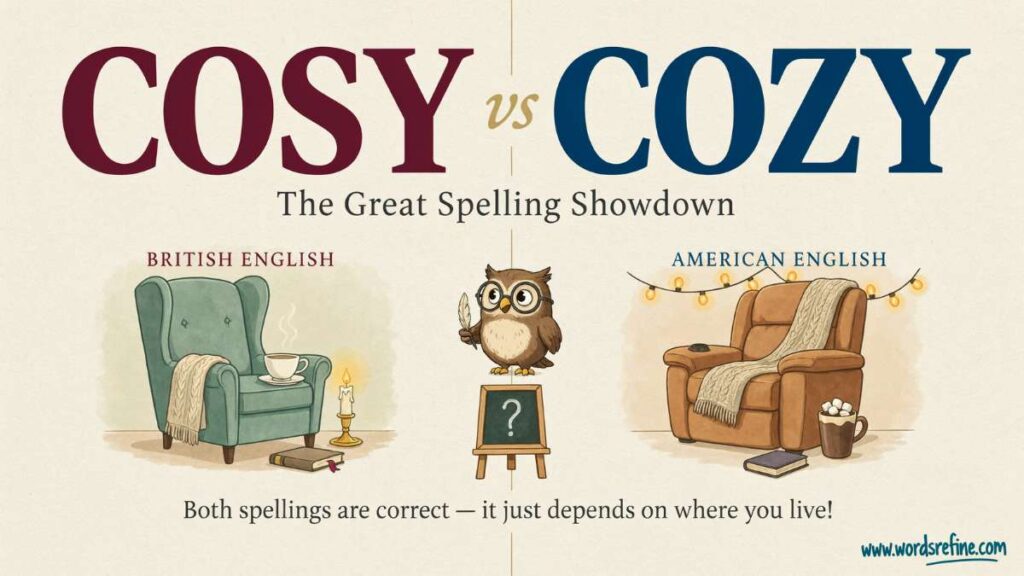
Cosy vs cozy which one belongs in your writing? At first glance, the difference seems tiny, but it can leave even confident writers second guessing themselves. Here’s the good news both spellings are correct and describe the same feeling of warmth comfort and relaxation. The difference comes from regional preferences, with American English favoring cozy and British English generally using cosy. However, related forms such as cozier cosier coziness, and cosiness can add another layer of confusion. Don’t worry; you don’t need a grammar detective to solve this one. Let’s look at the meanings, spelling rules, and examples to help you choose the right form every time.
Quick Answer Cosy vs cozy
The correct spelling depends on the variety of English you’re writing.
Cozy is the standard spelling in American English.
Cosy is the standard spelling in British English and is also commonly used in Australian and New Zealand English.
Both spellings have the same meaning. Neither is grammatically incorrect.
| English variety | Preferred spelling | Example |
|---|---|---|
| American English | Cozy | A cozy bedroom |
| British English | Cosy | A cosy bedroom |
| Canadian English | Both | A cozy or cosy bedroom |
| Australian English | Cosy | A cosy bedroom |
| New Zealand English | Cosy | A cosy bedroom |
For example, an American might say, “We spent the evening in a cozy little cabin.” A British speaker would probably write, “We spent the evening in a cosy little cottage.”
The meaning doesn’t change. Only the spelling does.
Therefore, if you’re writing for an American audience, choose cozy. If your readers are primarily in the UK, choose cosy. Most importantly, maintain the same spelling throughout your writing.
Learn the difference between confusing more English words
Patronise vs Patronize Meaning Spelling Differences?
What Does Cosy or Cozy Mean?
Cosy and cozy have exactly the same meaning. Both words describe a feeling of warmth, comfort, relaxation, and security.
Think about sitting on a comfortable sofa with a warm blanket while rain taps against the windows. Perhaps there’s a cup of hot chocolate on the table and a fireplace nearby. That’s a perfect example of a cozy atmosphere.
However, the word doesn’t describe physical warmth alone. It can also express emotional comfort, familiarity, and closeness.
For example, a hotel room can feel cozy and welcoming. Two friends might enjoy a cozy conversation over coffee. Similarly, a family gathering can create a cosy atmosphere where everyone feels relaxed and at home.
The word can describe several situations:
Physical comfort: The hotel room feels cozy and welcoming.
Emotional comfort: We had a cozy conversation over coffee.
Social closeness: The two families share a cosy friendship.
Atmosphere: The restaurant has a warm and cozy interior.
Cosy vs Cozy as an Adjective
The most common use of cosy or cozy is as an adjective. It describes a person, place, object, or situation that creates a pleasant feeling of comfort.
You might describe a room as cozy because it has soft lighting, comfortable furniture, warm colors, and a relaxing atmosphere.
Similarly, a thick sweater can feel cozy on a cold winter morning. Even a small reading corner can become your favorite place when it has a comfortable chair, a soft blanket, and good lighting.
Here are some examples:
The living room looks cozy with its soft cushions and warm lighting.
She bought a cosy sweater for the winter holidays.
We found a cozy little restaurant near the beach.
Their new house has a warm and welcoming atmosphere.
I love spending quiet evenings in my cosy bedroom.
Notice that the word can describe both physical surroundings and the feeling they create.
Cosy vs Cozy as a Noun
Although people mainly use cosy and cozy as adjectives, both spellings also have a noun use.
In British English, a tea cosy is a padded fabric cover placed over a teapot to keep the tea warm for longer. American English commonly uses tea cozy for the same object.
Imagine preparing a pot of tea for guests. Instead of letting it cool while everyone finishes their conversation, you cover the teapot with an insulated fabric warmer.
That’s a tea cosy!
The plural forms are cosies in British spelling and cozies in American spelling.
Cosy vs Cozy as a Verb
Both spellings can also function as verbs, although this use is less common than the adjective.
The verb generally means to make someone comfortable or to settle into a comfortable position.
Its related forms follow the same regional spelling pattern.
| American English | British English |
|---|---|
| Cozy | Cosy |
| Cozies | Cosies |
| Cozied | Cosied |
| Cozying | Cosying |
For example, an American might write, “She cozied up beside the fireplace.” A British writer would usually write, “She cosied up beside the fireplace.”
The expression cozy up to or cosy up to someone can also mean becoming friendly with that person, sometimes to gain an advantage.
For example, the company tried to cozy up to influential business leaders.
Learn the difference between commonly mixed-up more words
Glinda vs Galinda Which One Is Correct and ?
Why Are There Two Spellings Cosy vs Cozy?
The difference between cosy and cozy developed through regional spelling preferences rather than a change in meaning.
The word has Scottish roots and appeared in English during the early eighteenth century. Historical records include several spellings, including colsie, cosie, cosy, and cozy.
As English developed in different regions, spelling preferences became more established.
British English generally retained the spelling cosy, while American English favored cozy. This reflects a broader pattern in which American spelling sometimes uses a final z where British English uses s.
Consider these familiar examples:
| American English | British English |
|---|---|
| Cozy | Cosy |
| Organize | Organise |
| Realize | Realise |
| Recognize | Recognise |
However, not every word ending in -ize follows a simple American-versus-British distinction. British English also accepts many -ize forms.
The important point is that cosy and cozy represent established regional spelling preferences. Neither spelling changes the original word’s meaning.
Is the Origin of Cozy Scandinavian?
You might encounter claims that cozy comes directly from Norwegian. The connection is interesting, but the evidence isn’t conclusive.
The word’s Scottish origin is well established, while its deeper etymology remains uncertain. Some etymological sources suggest a possible connection with Scandinavian words such as the Norwegian kose seg, meaning to enjoy oneself or relax.
However, dictionaries don’t establish this as a definite origin.
It’s more accurate to say that cosy originated in Scottish English and that its ultimate linguistic roots remain uncertain.
Learn the difference between tricky grammar more words
Hoodie vs Hoody Which One Is Correct?
British English vs American English Cosy vs Cozy?
The main difference between cosy and cozy comes down to regional spelling preferences.
American English uses cozy, while British English generally prefers cosy. Both spellings are correct, and neither changes the word’s meaning or pronunciation.
For example, an American writer might describe a small apartment as cozy. A British writer would usually call the same apartment cosy.
You’ll find these spellings in everyday conversations, books, newspapers, advertisements, and product descriptions.
Which Spelling Does Each Country Use?
English spelling varies from one country to another. Here’s how different English-speaking regions generally use cosy and cozy.
| Country | Preferred spelling |
|---|---|
| United States | Cozy |
| United Kingdom | Cosy |
| Canada | Both are used; cozy is common |
| Australia | Cosy |
| New Zealand | Cosy |
American English favors cozy, whereas British, Australian, and New Zealand English generally use cosy.
Canadian English accepts both forms. Since Canadian spelling follows a mixture of British and American conventions, you may encounter either version.
The best approach is to consider your readers. If you’re writing for an American audience, choose cozy. If your readers are mainly British, use cosy. Most importantly, stick with one spelling throughout your writing.
Is Cosy vs Cozy Correct in the UK?
Cosy is the standard British English spelling.
You’ll often see it in descriptions of homes, restaurants, hotels, clothing, and comfortable places. For example, a British travel writer might describe a small countryside cottage as a cosy retreat.
Although cozy is the American spelling, it isn’t incorrect English. It simply doesn’t follow the usual British convention.
Is Cozy vs Cosy Correct in the US?
Cozy is the standard American English spelling.
American dictionaries, newspapers, and publications generally prefer cozy. The same spelling appears in related words such as cozier, coziest, cozily, and coziness.
Here are a few examples:
The café has a cozy atmosphere.
I bought a cozy blanket for my bedroom.
We found a cozy cabin in the mountains.
The little reading corner looks cozy and inviting.
If you’re writing an American school assignment, business email, or article, cozy is the better choice.
Do Canadians Write Cosy vs Cozy?
Canadian English accepts both spellings, although cozy is commonly used.
Canada has a mixed spelling tradition. Some words follow British conventions, while others follow American patterns. That’s why you might encounter both cosy and cozy in Canadian writing.
There’s no need to overthink the choice. Pick one spelling and use it consistently throughout your document.
Learn the difference between confusing word pairs
Heyday vs Hayday Meaning Correct One Differences?
Cosy vs Cozy Different Word Forms
The difference between cosy and cozy doesn’t disappear when you add endings. Their related forms follow the same regional spelling patterns.
American English uses cozy, cozier, coziest, cozily, and coziness.
British English uses cosy, cosier, cosiest, cosily, and cosiness.
Here’s a simple comparison:
| American English | British English |
|---|---|
| Cozy | Cosy |
| Cozier | Cosier |
| Coziest | Cosiest |
| Cozily | Cosily |
| Coziness | Cosiness |
| Cozying | Cosying |
| Cozied | Cosied |
| Cozies | Cosies |
The meaning stays the same regardless of which spelling you choose. Just follow the conventions of your intended audience.
Cozy vs Cosy Comparative Form
The comparative form helps you compare the comfort of two places, objects, or experiences.
American English uses cozier, while British English uses cosier.
For example:
This bedroom feels cozier than the guest room.
The little cottage looks cosier than the modern apartment.
Both sentences are correct. The spelling changes, but the meaning doesn’t.
Cozy vs Cosy Superlative Form
The superlative form describes something that feels more comfortable than all the other options being compared.
American English uses coziest, while British English uses cosiest.
For example:
This is the coziest corner of our house.
That was the cosiest hotel room we found during our trip.
Whether you write coziest or cosiest depends on your preferred variety of English.
Is It Coziness or Cosiness?
Both spellings are correct.
Coziness is the American English form, while cosiness is the British English form.
The word describes the feeling or quality of being comfortable, warm, and relaxed.
For example:
The coziness of the cabin made our weekend special.
I love the cosiness of small cafés during winter.
Use the form that matches your audience, and keep it consistent throughout your writing.
Learn the difference between often confused words
cocoon vs cacoon Which One Is Correct?
How to Use Cosy vs Cozy in Everyday Sentences
People use cosy and cozy to describe comfortable homes, relaxing environments, warm clothing, pleasant experiences, and friendly relationships.
The word fits many everyday situations. Here are some examples to show how naturally it works.
Describing a Comfortable Home
A home doesn’t need expensive furniture or perfect decorations to feel cozy. Sometimes, a comfortable sofa, warm lighting, and a few personal touches are all you need.
For example:
We made the living room cozy with soft cushions and warm blankets.
Her new apartment has a cosy little kitchen.
The fireplace makes the house feel warm and inviting.
I turned the spare room into a cozy reading space.
Describing Clothing and Accessories
People also use cosy or cozy to describe clothing and accessories that feel soft, warm, and comfortable.
For example:
I bought a cozy sweater for chilly mornings.
These cosy socks are perfect for winter evenings.
She wrapped herself in a warm and cozy scarf.
This blanket is so comfortable that I never want to leave the sofa.
Describing Restaurants and Cafés
Restaurants and cafés often use these words to create a welcoming impression. A cozy café might have comfortable seating, gentle lighting, and a relaxed atmosphere.
For example:
We found a cozy café tucked away on a quiet street.
The restaurant has a cosy atmosphere and friendly staff.
Let’s spend the afternoon in that little coffee shop. It looks so cozy.
The small bakery feels warm and welcoming.
Describing Relationships and Experiences
Cosy and cozy can also describe emotional comfort, affection, and friendly moments.
For example:
We enjoyed a cozy evening with close friends.
They shared a cosy conversation over a cup of tea.
The family gathered around the fireplace for a warm and relaxing evening.
It was a cozy little celebration with the people we love.
Learn the difference between basic English word mistakes
Arised vs Arose Which Is Correct?
What Does Cozy Up or Cosy Up Mean?
Cozy up and cosy up are informal expressions. They can describe moving closer to someone or something to feel warm and comfortable.
For example, you might cozy up under a blanket on a cold evening or sit close to someone while watching a movie.
However, the expression has a figurative meaning, too.
When someone cozies up to another person, they try to build a friendly relationship. Sometimes, they do this because they want a personal or professional advantage.
For example:
The child cozied up beside her mother during the storm.
He likes to cozy up to influential people at business events.
The politician was accused of cozying up to wealthy donors.
In the first sentence, the expression describes physical closeness. In the other examples, it suggests someone is trying to gain another person’s favor.
The surrounding words make the intended meaning clear.
Cozy Mystery vs Cosy Mystery Which Spelling Is Correct?
A cozy mystery, also known as a cosy mystery, is a type of crime fiction that focuses on solving a mystery without graphic violence, disturbing scenes, or excessive profanity.
These stories often take place in small towns, friendly neighborhoods, cafés, bookstores, or other familiar settings. They usually feature an amateur detective who investigates a crime and works to uncover the truth.
The word cozy reflects the comfortable atmosphere surrounding the mystery. Although a crime may drive the story, readers don’t have to deal with the darker details found in many traditional crime novels.
For example, a story might follow a small-town baker who discovers a murder and decides to investigate with help from her friends.
Both spellings are correct. American publishers generally use cozy mystery, while British publishers may use cosy mystery.
Cozy vs Cosy Pronunciation
Despite their different spellings, cozy and cosy are pronounced the same way.
Both are commonly pronounced as KOH-zee, with two syllables. The first sounds like the word go, while the second sounds like zee.
The difference exists only in writing. Whether you see cozy in an American novel or cosy in a British magazine, you pronounce the word the same way.
For example:
The room feels cozy.
The room feels cosy.
Both sentences sound identical when spoken aloud.
Cozy vs Comfortable What’s the Difference?
Cozy and comfortable have similar meanings, but they aren’t always interchangeable.
Comfortable describes something that provides physical ease or helps you relax. You can use it for furniture, clothing, shoes, surroundings, or even a situation.
Cozy usually suggests warmth, closeness, and a pleasant sense of comfort. It often brings to mind a welcoming place where you want to spend time.
For example:
This chair is comfortable enough to sit in for hours.
This little reading corner feels cozy with its soft cushions and warm lighting.
The first sentence focuses on physical comfort. The second creates a warmer, more inviting picture.
You can also use both words together:
We spent a comfortable and cozy evening at home.
Although their meanings overlap, cozy adds a sense of warmth and atmosphere that comfortable doesn’t always convey.
Cozy vs Homely Are They the Same?
Cozy and homely can both describe welcoming surroundings, but their meanings depend partly on regional English.
In British English, homely usually describes a place that feels comfortable, familiar, and welcoming. It often brings to mind the warmth and simplicity of home.
American English uses homely differently. The word traditionally describes someone or something unattractive in appearance. This difference can confuse readers from different English-speaking countries.
For example:
The cottage has a cosy, homely atmosphere.
The apartment has a warm and cozy feeling.
If you’re writing for an international audience, cozy is often a clearer choice when you want to describe a comfortable and welcoming place.
Synonyms of Cosy vs Cozy
Several words express feelings similar to cosy and cozy, but each has its own meaning. Choosing the right one can make your writing more natural and precise.
| Word | Meaning |
|---|---|
| Comfortable | Providing physical ease or relaxation |
| Snug | Fitting closely or providing warmth and comfort |
| Warm | Giving a feeling of heat, friendliness, or affection |
| Inviting | Making someone feel welcome |
| Homelike | Having the comfortable feeling of home |
| Intimate | Creating a private, personal, or close atmosphere |
| Welcoming | Making people feel accepted and comfortable |
| Relaxing | Helping someone feel calm and free from stress |
For example, a small room with soft lighting might feel cozy and inviting. A thick blanket might feel snug, while a friendly conversation might create a warm atmosphere.
These words are related, but they aren’t always interchangeable. Think about the feeling you want to describe before choosing one.
Learn the difference between commonly misused words
Carmel vs Caramel Which One Is Correct?
Common Mistakes When Using Cosy vs Cozy
Choosing between cosy and cozy is easy once you understand the difference. However, a few common mistakes can make your writing look inconsistent.
Mixing American and British Spellings
One common mistake is switching between regional spellings in the same document.
For example:
The living room looks cozy, and the bedroom feels cosy.
Both spellings are correct, but using them together without a reason can make your writing look inconsistent.
Instead, choose one spelling style and stick with it throughout your document.
Assuming Cosy Is Incorrect
Some American writers assume cosy is a misspelling because American English uses cozy.
That’s not true. Cosy is the standard British spelling and is also used in other varieties of English.
Assuming Cozy Is Incorrect
The opposite mistake happens when British writers assume cozy is always wrong.
Cozy is perfectly correct in American English. It simply follows a different regional spelling convention.
Changing the Meaning
Cosy and cozy have exactly the same meaning. You don’t need to use one spelling for physical comfort and the other for emotional warmth.
For example, both a cozy bedroom and a cosy bedroom describe a comfortable, welcoming space.
Forgetting Related Word Forms
The spelling difference continues in related words. If you use cozy, write cozier and coziness. If you use cosy, write cosier and cosiness.
Keeping these forms consistent makes your writing clearer and more polished.
Learn the difference between everyday English mistakes
Liter vs Litre Which One Is Correct?
Practice Session: Cosy vs Cozy
- We spent the evening in a ______ cabin surrounded by snow-covered mountains.
- The British writer described the little cottage as ______ and welcoming.
- I bought a ______ sweater to wear during the cold winter months.
- This reading corner looks even ______ with its soft pillows and warm lighting.
- That was the ______ hotel room I’ve ever stayed in.
- The café has a warm and ______ atmosphere.
- She loves the ______ of her small apartment.
- The family ______ up beside the fireplace to watch a movie.
- This blanket feels so ______ that I could sleep under it all day.
- The little restaurant is ______ than the busy café downtown.
- We enjoyed a ______ evening with our closest friends.
- The British magazine described the bedroom as the ______ room in the house.
- Her home has a wonderful feeling of ______ and warmth.
- The children ______ up under their blankets during the storm.
- I prefer a ______ chair when I read for long periods.
- The garden room looks ______ than it did before we added the cushions.
- The hotel offers a ______ atmosphere that makes guests feel at home.
- The ______ of the small cabin made our holiday unforgettable.
- He was accused of ______ up to influential businesspeople to gain an advantage.
- The shop sells warm blankets and ______ winter clothing.
- This is the ______ place in the entire house.
- The couple spent a quiet evening in their ______ living room.
- We made the guest bedroom more ______ by adding soft lighting.
- The children enjoyed the ______ atmosphere of their grandmother’s house.
- After a long day at work, I like to get ______ on the sofa with a good book.
Answers
- Cozy
- Cosy
- Cozy
- Cozier
- Coziest
- Cozy
- Coziness
- Cozied
- Cozy
- Cozier
- Cozy
- Cosiest
- Coziness
- Cozied
- Cozy
- Cozier
- Cozy
- Coziness
- Cozying
- Cozy
- Coziest
- Cozy
- Cozy
- Cosy
- Cozy
Here’s a trusted source for clear more words Comparison:
FAQs
What Is Another Word for Cozy Vibes?
Words such as warm, welcoming, snug, relaxing, and inviting can describe cozy vibes. You can also use phrases like a comforting atmosphere, a peaceful setting, or a laid-back environment.
What Does Cozy Mean in Simple Words?
Cozy means warm, comfortable, and relaxing. It describes a place or feeling that makes you want to settle in and enjoy yourself. A soft blanket, a warm drink, and a quiet evening are simple examples of coziness.
What Is a Posh Word for Comfortable?
Words such as luxurious, sumptuous, plush, elegant, and well-appointed can replace comfortable in certain situations. For example, a luxurious hotel room suggests a high level of comfort, while plush describes something especially soft and inviting.
What Is a Stronger Word for Comfort?
Words such as contentment, serenity, ease, and well-being express deeper forms of comfort. Serenity suggests a sense of complete peace, while contentment describes the satisfaction of feeling happy and at ease.
What Is Another Word for a Cozy Home?
You can describe a cozy home as welcoming, snug, homelike, warm, inviting, or comfortable. For a more expressive description, try a peaceful retreat, a welcoming haven, or a warm and inviting space.
What Is Another Word for Nice?
The best alternative depends on what you’re describing. You can use pleasant, lovely, delightful, kind, thoughtful, enjoyable, attractive, or excellent.
For example, a nice person might be kind or considerate, while a nice room might be beautiful, comfortable, or inviting.
What Are 10 Good Words to Describe Something Cozy?
These ten words capture different aspects of coziness:
- Snug
- Warm
- Inviting
- Comfortable
- Welcoming
- Peaceful
- Relaxing
- Homelike
- Plush
- Charming
Each word adds a slightly different feeling. Together, they can help you describe both physical comfort and a welcoming atmosphere.
What’s a Better Word for Cozy?
There isn’t one perfect replacement for cozy. The best choice depends on the situation. Use snug for a warm, comfortable space, inviting for a welcoming atmosphere, plush for luxurious softness, and serene for a peaceful environment.
For example, instead of writing, “The room is cozy,” you could say, “The room has a warm and inviting atmosphere.”
What Is a Slang Word for Cozy?
Comfy is one of the most common informal alternatives to cozy. Words such as snug and chill can also express a relaxed, comfortable feeling.
For example, “This sofa is so comfy” sounds natural in casual conversation.
What Are Some Synonyms for Cozy?
Common synonyms include snug, comfy, comfortable, warm, inviting, welcoming, homelike, relaxing, peaceful, and intimate.
Each word emphasizes something different. Snug suggests warmth and closeness, inviting creates a sense of friendliness, and peaceful highlights a calm atmosphere.
Do We Say Cosy or Cozy?
Both spellings are correct. Cozy is the standard American English spelling, while cosy is generally preferred in British English. Choose the version that matches your audience and use it consistently.
What Does Cozy Actually Mean?
Cozy describes a feeling of warmth, comfort, and relaxation. It can refer to a physical place, such as a bedroom or café, or an enjoyable experience, such as a quiet evening with friends.
The word often suggests a welcoming atmosphere where people feel comfortable and at ease.
What Is the Noun Form of Cozy?
The noun form is coziness in American English and cosiness in British English. Both words describe the quality or feeling of being comfortable, warm, and relaxed.
For example, “The coziness of the cabin made our weekend memorable.”
Learn the difference between more words people mix up
Don’ts vs Donts Which One Is Correct?
Conclusion
Choosing between cosy vs cozy is simpler than deciding which blanket to grab on a chilly evening. Both spellings are correct, and both describe the same sense of warmth, comfort, and relaxation. The difference is regional: American English prefers cozy, while British English generally uses cosy.
The key is to choose the spelling that suits your audience and use it consistently. Pay attention to related forms such as cozier, cosier, coziness, and cosiness, too. Remember that synonyms like comfortable, snug, and inviting have slightly different meanings, so choose the one that best expresses your intended feeling.
Whether you call your favorite reading corner cozy or cosy, you won’t make a spelling mistake. Just follow the right regional convention and enjoy writing. After all, grammar should clear up confusion, not make you feel like you need a blanket to survive it!

Diora AJS she is an experienced blogger and passionate English language enthusiast at Words Refine. With a keen eye for language and a love for clear communication, she writes practical content about grammar, word meanings, usage, and commonly confused terms. Her goal is to make English easier to understand through clear explanations and relatable examples, helping readers write accurately and communicate with confidence.