
Have you ever wondered whether to write familiarise vs familiarize? You’re not alone. These two spellings often confuse writers because they look different but mean exactly the same thing. The main distinction lies in regional spelling preferences. Familiarize is the standard form in American English, while familiarise is commonly used in traditional British English. However, British English also accepts the ize spelling, which makes the choice a little more interesting. In this article, you well learn the meaning, pronunciation, and correct usage of both forms, explore their regional differences, and discover common mistakes to avoid. By the end, choosing the right spelling will feel familiar!
Quick Answer Familiarise vs Familiarize?
Familiarize is the preferred spelling in American English, while familiarise is commonly used in traditional British English.
Both words mean to help someone learn about something, understand it, or become comfortable with it.
For example:
American English: Please familiarize yourself with the company guidelines.
British English: Please familiarise yourself with the company guidelines.
Both sentences are correct. The only difference is the spelling.
Learn the difference between confusing more English words
Offered vs Offerred Which One Is Correct?
What Is the Difference Between Familiarise vs Familiarize?
The difference between familiarise vs familiarize comes down to regional spelling preferences. American English generally uses familiarize, whereas traditional British English often uses familiarise.
Both words are verbs, and they describe the same action: helping someone become familiar with a subject, situation, place, or process.
For example:
The teacher helped students familiarize themselves with the new software.
The teacher helped students familiarise themselves with the new software.
Both sentences express the same idea. The first follows American spelling conventions, while the second follows traditional British conventions.
However, British English also accepts familiarize. Oxford-style English, for instance, generally favors the -ize ending in words that appropriately take this suffix. So, it’s not quite accurate to say that every British writer must use familiarise.
Familiarise vs Familiarize Meaning and Definition
Both spellings mean to make someone familiar with something. You can use either word when talking about learning a new subject, understanding a process, or becoming comfortable in an unfamiliar environment.
The word commonly appears in education, workplaces, and everyday conversations.
It can describe introducing someone to a new topic, helping them understand how something works, or giving them enough experience to feel comfortable with a situation.
For example:
You should familiarize yourself with the instructions before operating the machine.
The training session will familiarise employees with the updated procedures.
Reading the guide can help you familiarize yourself with the application.
In each example, the word describes the process of gaining knowledge or becoming more comfortable with something.
Familiarize in American English
Familiarize is the standard spelling in American English. If you’re writing for an American audience, use this version in emails, business documents, school assignments, and professional communication.
American English generally favors the -ize ending in words such as organize, recognize, and realize. Familiarize follows the same spelling pattern.
For example:
Please familiarize yourself with the new office policies.
The instructor familiarized the students with the course requirements.
I need to familiarize myself with this software before the meeting.
New employees should familiarize themselves with the safety procedures.
If your readers are primarily American, choose familiarize and use it consistently throughout your writing.
Familiarise in British English
Familiarise is a common spelling in traditional British English. Writers in the United Kingdom often use the -ise ending in words such as organise, recognise, and realise.
Familiarise follows this spelling preference.
For example:
Please familiarise yourself with the company’s policies.
The teacher familiarised the children with their new classroom.
Employees should familiarise themselves with the updated regulations.
She took some time to familiarise herself with the local area.
However, familiarize is also accepted in British English, particularly in Oxford-style writing. The best choice depends on the spelling convention you follow. Whichever version you choose, keep it consistent throughout your document.
Learn the difference between commonly mixed-up more words
Constant vs Consistent Differences and Examples?
When to Use Familiarise vs Familiarize
Choosing between familiarise and familiarize depends on your audience and the spelling style you’re following. Both forms are correct and carry the same meaning.
Use familiarize when writing in American English. Familiarise is more common in traditional British English.
For example:
American English: I want to familiarize myself with the new company software.
British English: I want to familiarise myself with the new company software.
Both sentences are correct. The only difference is the spelling.
Consistency matters more than the version you choose. If you start a document using American spelling, stick with it throughout. Switching between American and British spellings can make your writing look uneven and distract readers.
Familiarise vs Familiarize in Different English-Speaking Countries
Spelling preferences vary across English-speaking countries. and American and British conventions provide a useful starting point, but other regions have their own preferences.
American English
The American English uses familiarize. This spelling follows the common American preference for words ending in -ize.
Example: Employees must familiarize themselves with the updated company rules.
British English
Traditional British English commonly uses familiarise. However, familiarize is also accepted, particularly in Oxford-style writing. The choice often depends on the publication’s preferred style.
Example: Students should familiarise themselves with the examination guidelines.
Canadian English
Canadian English often favors -ize spellings, so familiarize is a common choice. However, familiarise may also appear depending on the writer or publication.
Example: Please familiarize yourself with the application process before submitting your documents.
Australian English
Australian English generally favors familiarise and other -ise spellings. However, familiarize is also recognized and may appear in publications that follow a different style.
Example: New staff members should familiarise themselves with workplace procedures.
New Zealand English
New Zealand English commonly follows the -ise spelling convention. Therefore, familiarise is a natural choice in many local publications and professional documents.
Example: You should familiarise yourself with the safety instructions before starting work.
| Country | Common spelling |
|---|---|
| United States | Familiarize |
| United Kingdom | Familiarise or familiarize |
| Canada | Familiarize |
| Australia | Familiarise |
| New Zealand | Familiarise |
These are general preferences, not strict rules. Individual publishers, organizations, and style guides may follow different conventions.
Learn the difference between tricky grammar more words
Opening vs Openning Which One Is Correct?
Examples of Familiarise vs Familiarize in Sentences
Sometimes, seeing a word in context makes its meaning much easier to understand. Both spellings work naturally in everyday conversations, workplace instructions, and academic writing.
The new employees need to familiarize themselves with the company’s policies.
She took a few days to familiarise herself with her new surroundings.
Before using the equipment, familiarize yourself with the operating instructions.
The teacher familiarised the students with the basic principles of science.
I want to familiarize myself with the new project before the meeting.
The guide helped visitors familiarise themselves with the museum’s layout.
You should familiarize yourself with the rules before joining the competition.
He spent the afternoon familiarising himself with the computer system.
As these examples show, the spelling changes, but the meaning remains exactly the same.
Familiarise vs Familiarize Verb Forms
Both spellings follow the same grammatical pattern. The difference appears in the endings used for different verb forms.
American English uses familiarize, familiarizes, familiarizing, and familiarized.
Traditional British English commonly uses familiarise, familiarises, familiarising, and familiarised.
| Verb form | American English | Traditional British English |
|---|---|---|
| Base form | Familiarize | Familiarise |
| Third-person singular | Familiarizes | Familiarises |
| Present participle | Familiarizing | Familiarising |
| Past tense | Familiarized | Familiarised |
| Past participle | Familiarized | Familiarised |
For example:
She familiarizes herself with new technology quickly.
She familiarises herself with new technology quickly.
He is familiarizing himself with the new system.
He is familiarising himself with the new system.
They familiarized themselves with the instructions yesterday.
They familiarised themselves with the instructions yesterday.
Each version is grammatically correct. Choose the spelling that matches your preferred style and use it consistently.
Learn the difference between confusing word pairs
Really vs Realy Which One Is Correct?
How to Use Familiarise vs Familiarize Correctly
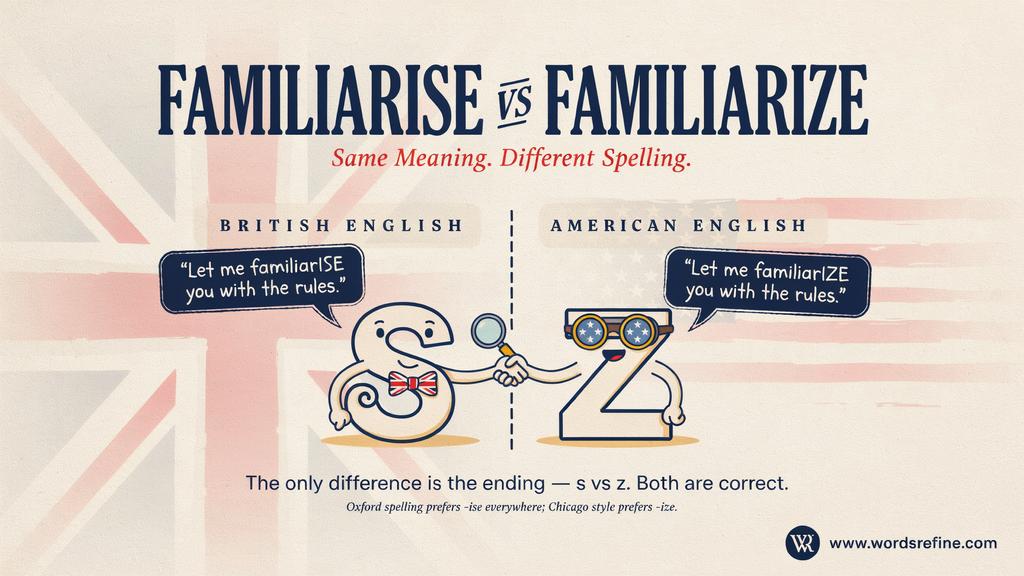
Both familiarise and familiarize are verbs. They describe the process of helping someone learn about something or become comfortable with it.
A common expression is “familiarize yourself with” or “familiarise yourself with.” It means learning about something so you can understand it or use it confidently.
For example:
Please familiarize yourself with the new office procedures.
She familiarised herself with the local customs before moving abroad.
I need to familiarize myself with the updated software.
The students familiarised themselves with the course material before the first lesson.
Notice that each sentence uses the word “with” to introduce the subject someone needs to learn about.
Avoid writing “familiarize yourself to the rules.” The correct expression is “familiarize yourself with the rules.”
Learn the difference between often confused words
Base vs Bass What’s the Difference?
Common Mistakes When Using Familiarise vs Familiarize
Although both spellings are easy to understand, writers sometimes use them incorrectly or confuse them with related words. A few simple guidelines can help you avoid these mistakes.
Mixing Both Spellings in One Document
Using familiarise and familiarize interchangeably can make your writing inconsistent.
Incorrect: The manager asked employees to familiarize themselves with the rules. Later, she reminded them to familiarise themselves with the new procedures.
Correct: The manager asked employees to familiarize themselves with the rules. Later, she reminded them to familiarize themselves with the new procedures.
You can also use familiarise throughout the document if you’re following traditional British spelling. The important thing is to stick with one version.
Choosing the Wrong Preposition
The standard expression is “familiarize yourself with,” not “familiarize yourself to.”
Incorrect: Please familiarize yourself to the new system.
Correct: Please familiarize yourself with the new system.
Using the right preposition makes your sentence sound natural and grammatically correct.
Confusing Familiar With Familiarize
Although these words are related, they have different grammatical roles.
Familiar is an adjective. It describes something you recognize, know, or understand.
Example: This building looks familiar to me.
Familiarize is a verb. It describes the process of learning about something or helping another person understand it.
Example: I want to familiarize myself with the neighborhood.
The first sentence describes recognition, while the second explains the process of becoming familiar with a place.
Assuming Every -ize Word Has an -ise Alternative
Although both familiarize and familiarise are accepted, you can’t change every word ending in -ize to -ise.
For example, advertise, exercise, revise, and compromise are standard spellings. Changing their endings simply because you prefer British English would be incorrect.
Always check the accepted spelling of a word rather than applying the same rule to every situation.
Learn the difference between basic English word mistakes
Cart vs Kart Which One Is Correct?
What Is the Difference Between Familiar Familiarize vs Familiarization?
These three words share the same root, but each serves a different grammatical purpose.
Familiar is an adjective. It describes something you already know, recognize, or understand.
Example: This building looks familiar to me.
Familiarize is a verb. It describes helping someone learn about something or become accustomed to it.
Example: The instructor will familiarize the students with the new equipment.
Familiarization is a noun. It refers to the process of becoming familiar with something.
Example: The first training session focuses on familiarization with workplace procedures.
Understanding these differences makes it easier to choose the right word when writing.
Familiarize Yourself With vs Familiarize Yourself To?
The correct expression is “familiarize yourself with.” The same rule applies to the British spelling, “familiarise yourself with.”
Use with when introducing the subject, place, system, or situation someone needs to understand.
For example:
You should familiarize yourself with the company’s policies.
She familiarised herself with the new neighborhood.
The students familiarized themselves with the examination format.
The expression “familiarize yourself to” is generally incorrect in this context. When you want to explain what someone needs to learn about or become comfortable with, use with instead.
Learn the difference between commonly misused words
Coral vs Corral Differences and Examples?
Practice Session Familiarise vs Familiarize
- Please ______ yourself with the company rules before your first day.
- The teacher helped students ______ themselves with the new software.
- I need to ______ myself with the instructions before using this machine.
- She quickly ______ herself with her new surroundings.
- Employees should ______ themselves with workplace safety procedures.
- The manager ______ the new staff with the company’s policies.
- He is ______ himself with the updated computer system.
- You should ______ yourself with the examination guidelines.
- The students ______ themselves with the course material before the lesson.
- I want to become more ______ with this application.
- The training session will help workers ______ themselves with the new equipment.
- She spent the afternoon ______ herself with the local area.
- Please make sure you are ______ with the latest instructions.
- The guide helped visitors ______ themselves with the museum.
- We need to ______ the team with the new procedures.
- He has ______ himself with the company’s history.
- New students should ______ themselves with the school environment.
- The instructor is ______ the participants with the training materials.
- It took her a few days to ______ herself with the new routine.
- The employees became ______ with the updated system after training.
- The first lesson focuses on ______ with basic computer skills.
- She wants to ______ herself with the rules before joining the competition.
- The supervisor ______ the workers with their new responsibilities.
- You should already be ______ with the basic safety requirements.
- The new staff members are ______ themselves with the office procedures.
Answers
- Familiarize / Familiarise
- Familiarize / Familiarise
- Familiarize / Familiarise
- Familiarized / Familiarised
- Familiarize / Familiarise
- Familiarized / Familiarised
- Familiarizing / Familiarising
- Familiarize / Familiarise
- Familiarized / Familiarised
- Familiar
- Familiarize / Familiarise
- Familiarizing / Familiarising
- Familiar
- Familiarize / Familiarise
- Familiarize / Familiarise
- Familiarized / Familiarised
- Familiarize / Familiarise
- Familiarizing / Familiarising
- Familiarize / Familiarise
- Familiar
- Familiarization
- Familiarize / Familiarise
- Familiarized / Familiarised
- Familiar
- Familiarizing / Familiarising
Here’s a trusted source for clear more words Comparison:
FAQs
What is a synonym for familiarise?
Common synonyms for familiarise include acquaint, introduce, inform, educate, and orient. The best choice depends on the context. For example, acquaint works well when helping someone learn about a new subject, while introduce is suitable when presenting an unfamiliar idea.
How do you use familiarise in a sentence?
Use familiarise when describing the process of helping someone learn about something or become comfortable with a new situation.
Example: Please familiarise yourself with the workplace policies before your first day.
Is familiarize a word?
Yes, familiarize is a correctly spelled English word. It is the standard American spelling of familiarise. Both forms have the same meaning and function as verbs.
Which is correct to be familiarized or to be familiar?
Both expressions are grammatically correct, but they have slightly different meanings. To be familiar means to already know or understand something, while to be familiarized means to have been introduced to something or helped to learn about it.
Example: I am familiar with the software.
Example: I was familiarized with the software during training.
What type of word is familiarise?
Familiarise is a verb. It describes the action of helping someone learn about something or become comfortable with an unfamiliar subject, place, or situation. Its American spelling is familiarize.
How do you spell conceptualize in British English?
Both conceptualise and conceptualize are accepted in British English. Conceptualise is common in traditional British spelling, while conceptualize is preferred by Oxford-style conventions.
What does familiarism mean?
Familiarism is an uncommon term associated with an emphasis on familiarity, established relationships, or familiar ways of thinking. Its meaning can vary depending on the context. It is not a standard substitute for familiarisation or familiarization.
What is the full meaning of familiarise?
Familiarise means to help someone become familiar with a person, subject, place, process, or situation. It can also describe becoming accustomed to something through learning or experience.
Example: She familiarised herself with the local customs before moving abroad.
How is familiarise pronounced?
Familiarise is pronounced /fəˈmɪl.i.ə.raɪz/. It has five syllables, with the main stress on the second syllable. Familiarize has the same pronunciation.
What does familiarization mean?
Familiarization is the process of becoming familiar with something or helping someone understand it. It usually involves learning, observation, or practical experience.
Example: The first training session focuses on familiarization with the company’s equipment.
American English generally uses familiarization, while traditional British English commonly uses familiarisation.
Learn the difference between everyday English mistakes
Emaculate vs Immaculate Which One Is Correct ?
Conclusion
Choosing between familiarise vs familiarize doesn’t have to be confusing. Both spellings are correct, carry the same meaning, and have the same pronunciation. The only difference is regional preference. American English generally uses familiarize, while traditional British English favors familiarise. However, British English also accepts the -ize spelling.
The key is to choose the form that suits your audience and use it consistently. Also, remember the difference between familiar, a noun? No, it’s an adjective! Familiarise and familiarize are verbs, while familiarisation and familiarization are nouns. Keeping these word forms straight will help you avoid common grammar mistakes and write with confidence.
So, whether you familiarize yourself with the rules or familiarise yourself with them, you’re on the right track. After all, good spelling should make your writing clearer, not leave you wondering which version is having an identity crisis!

Diora AJS she is an experienced blogger and passionate English language enthusiast at Words Refine. With a keen eye for language and a love for clear communication, she writes practical content about grammar, word meanings, usage, and commonly confused terms. Her goal is to make English easier to understand through clear explanations and relatable examples, helping readers write accurately and communicate with confidence.