
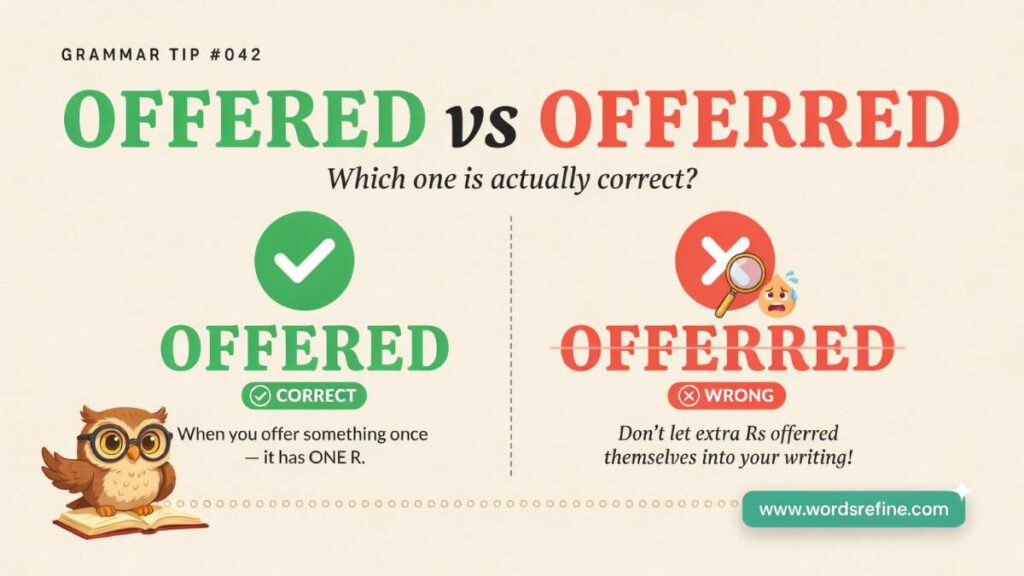
Why does one small letter cause so much confusion? When it comes to offered vs offerred many writers wonder whether the past tense of offer needs an extra r. It’s an understandable mistake, especially when words like preferred and referred follow a different spelling pattern. However, there’s no need to second guess yourself: offered is the only correct spelling, and offerred is incorrect. Understanding this simple difference can save you from an embarrassing typo in an email, assignment, or professional document. Let’s explore the meaning of offered, its correct usage, common spelling mistakes, and the easy rule that will help you remember it.
Quick Answer offered vs offerred
offered vs offerred is the correct spelling in standard English. Offerred is incorrect because it contains an unnecessary extra r.
The word offered is formed by adding the past-tense ending -ed to the verb offer. The final r doesn’t double because the first syllable receives the primary stress.
Consider these examples:
Correct: The company offered me a full-time position.
Incorrect: The company offerred me a full-time position.
Correct: She offered to help with the presentation.
Incorrect: She offerred to help with the presentation.
The difference is simple. Always write offered with one r after the double f.
Learn the difference between confusing more English words
Wisp vs Whisp Which One Is Correct?
What Does Offered Mean?
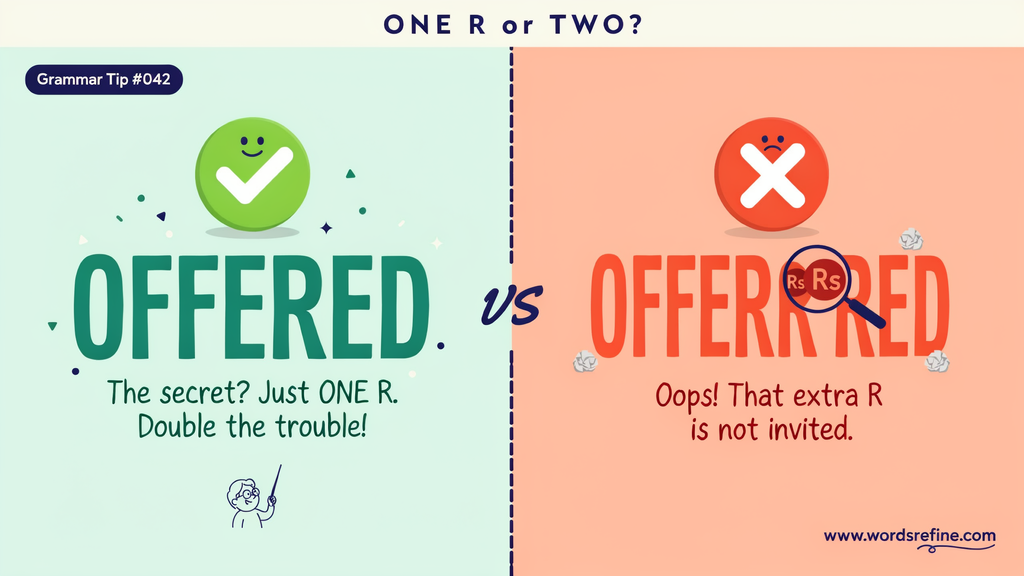
offered vs offerred describes an action in which someone presents something, suggests an idea, provides assistance, or makes an opportunity available to another person.
It is the past-tense and past-participle form of the verb offer. Its exact meaning depends on the situation, but the central idea remains the same: someone makes something available for another person to accept, consider, or use.
For example, a company might offer an employee a promotion, a friend might offer advice, or a restaurant might offer customers a discount. In each situation, someone presents something to another person.
Offered Definition
The verb offer means to present something for someone to accept, consider, or use. It can describe physical objects as well as ideas, opportunities, and services.
Here are some common meanings of offered:
Presented: She offered her research findings to the committee.
Proposed: The buyer offered $30,000 for the vehicle.
Provided: The organization offered free transportation.
Suggested: He offered a practical solution to the problem.
Volunteered: Sarah offered to organize the event.
Made available: The university offered several online courses.
Offering something doesn’t necessarily mean the other person accepts it. For instance, an employer can offer someone a position, but the candidate might decline the opportunity.
Similarly, a friend can offer assistance even when the other person doesn’t need it. The offer still exists, regardless of whether anyone accepts it.
Common Uses of Offered
The word offered appears in everyday conversations, professional communication, education, and business writing. It works in several situations because people can offer much more than physical objects.
Here are some common expressions and examples.
1.Offered help: My neighbor offered help with the repairs.
2.Offered advice: The teacher offered useful advice before the examination.
3.Offered support: Her family offered support during a difficult time.
4.Offered a solution: The engineer offered a practical solution to the problem.
5.Offered an opportunity: The company offered him a promotion.
6.Offered a discount: The store offered customers a 20% discount.
7.Offered a position: The hospital offered her a nursing position.
The verb also appears in several common sentence structures.
8.Offer someone something: The manager offered me a new assignment.
9.Offer something to someone: The manager offered a new assignment to me.
10.Offer to do something: She offered to drive us home.
11.Offer something for consideration: The committee offered a new proposal.
These structures make offer a flexible verb that works naturally in both formal and informal English.
Learn the difference between commonly mixed-up more words
Cancell vs Cancel Which one Is Correct?
Why Do People Spell Offered vs Offerred?
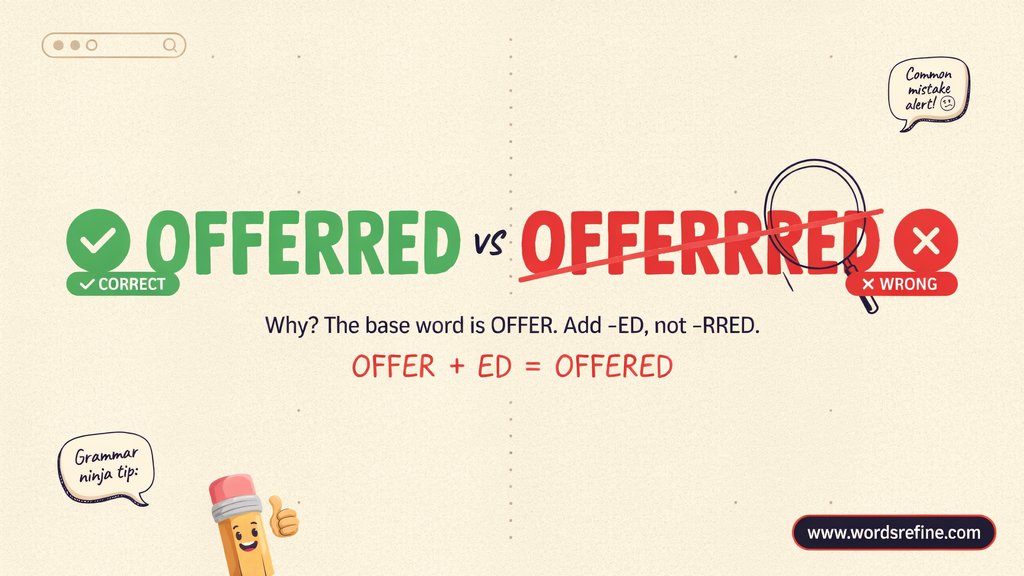
The spelling mistake usually happens because writers confuse offer with verbs such as refer and prefer.
These words have similar endings, but their past-tense forms follow different offered vs offerred spelling patterns.
Offer becomes offered.
Refer becomes referred.
Prefer becomes preferred.
The difference comes from English word stress and the consonant-doubling rule. In offer, the first syllable receives the primary stress. In refer and prefer, the final syllable receives the primary stress.
This difference affects whether the final consonant doubles when adding an ending such as -ed.
Another reason for the confusion is visual memory. When writers frequently see preferred and referred, they may assume that every verb ending in -er needs a doubled r in its past-tense form.
However, English spelling doesn’t follow that shortcut. You need to consider the base word, its pronunciation, and its stress pattern.
The Grammar Rule Behind Offered
Understanding the grammar behind offered makes it easier to avoid similar spelling mistakes.
In English, regular verbs generally form their simple past tense and past participle by adding -ed to the base form.
For example:
Walk becomes walked.
Clean becomes cleaned.
Help becomes helped.
Open becomes opened.
Offer becomes offered.
However, some verbs require spelling changes before the ending is added. One important example is the final consonant-doubling rule.
The Consonant Doubling Rule
The consonant-doubling rule explains when a verb’s final consonant must appear twice before adding an ending that begins with a vowel.
For many one-syllable verbs ending in a consonant-vowel-consonant pattern, the final consonant doubles before -ed or -ing.
For example:
Stop becomes stopped and stopping.
Plan becomes planned and planning.
Drop becomes dropped and dropping.
Hug becomes hugged and hugging.
Rob becomes robbed and robbing.
However, this rule doesn’t apply to every verb.
For multisyllabic verbs, the final consonant generally doubles when the final syllable receives primary stress and follows the appropriate consonant-vowel-consonant pattern.
Consider these examples:
Prefer becomes preferred.
Refer becomes referred.
Admit becomes admitted.
Visit becomes visited.
Open becomes opened.
Offer becomes offered.
The stressed-syllable rule helps explain why preferred and referred double their final consonants while offered does not.
Learn the difference between tricky grammar more words
Compair vs Compare Which One Is Correct?
Why Is Offered Spelled With One R?
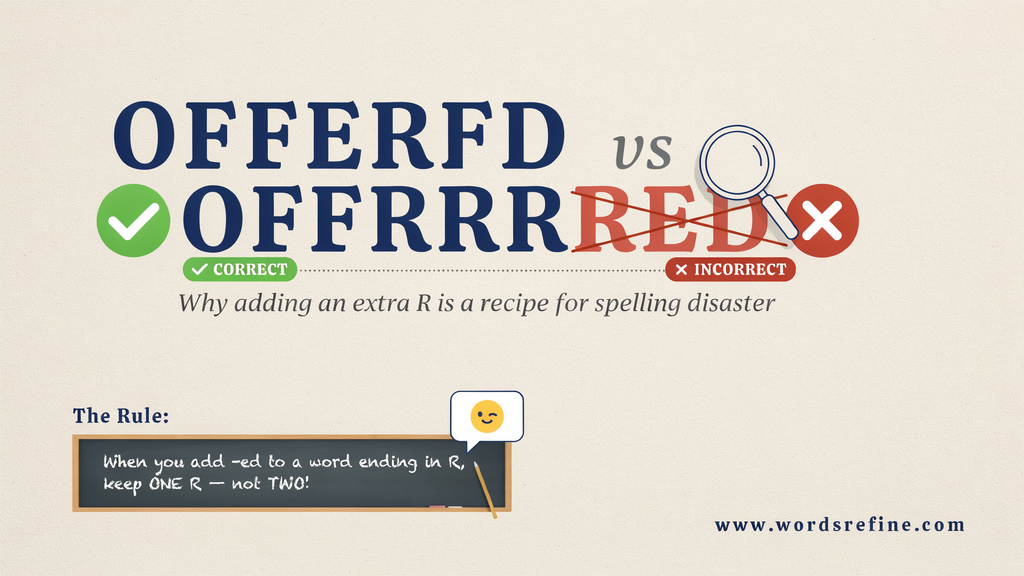
The answer comes down to the pronunciation and stress pattern of the base verb offer.
The word offer contains two syllables: of and fer.
In standard American English, the first syllable receives primary stress, while the second syllable remains unstressed.
Because the final syllable doesn’t receive primary stress, the final r doesn’t double when you add -ed.
The correct formation is offer + ed = offered.
The double f already appears in the original word. Adding -ed doesn’t change that spelling.
Compare this with refer:
Refer + ed = referred.
The final syllable of refer receives primary stress. Therefore, the final r doubles before the ending is added.
This explains why offerred is incorrect. It applies a consonant-doubling pattern that standard English spelling doesn’t require.
Offered Pronunciation Explained
Although offered and offerred look different, they don’t have separate standard pronunciations. The second spelling is simply incorrect.
In American English, offered generally has two syllables. Its pronunciation is represented by the International Phonetic Alphabet as /ˈɔː.fɚd/.
The first syllable receives primary stress, while the second syllable remains unstressed.
The word contains two syllables, and the stress falls on the first. The double f represents one consonant sound, while the final r belongs to the second syllable.
The -ed ending sounds like /d/ rather than creating an additional syllable.
For example, offered and walked both have an -ed ending pronounced as /d/.
The pronunciation of this ending depends on the sound immediately before it. In English, -ed can represent /t/, /d/, or /ɪd/ in different words.
Offered vs Offerred Understanding the Difference
The difference between offered vs offerred comes down to correct spelling. Offered is the accepted form in standard English, while offerred is a common spelling mistake.
Although offerred might look reasonable, it doesn’t follow the spelling pattern of the verb offer. When you add -ed to offer, you don’t need another consonant. The original double f stays the same, giving you offered.
Consider these examples:
The university offered several scholarships to international students.
My colleague offered to review the report.
The restaurant offered a special discount to its customers.
The company offered me a full-time position.
The spelling remains offered in every situation. Whether you’re discussing employment, education, business, or everyday activities, offerred is never the correct alternative.
Offered vs Offerred in Different Sentences
Looking at complete sentences makes it easier to understand how offered vs offerred works in everyday writing. It also helps you recognize the correct spelling without having to stop and think about the grammar rule every time.
Everyday Conversations
People often use offered when talking about help, advice, invitations, and personal support.
My brother offered to pick me up from the airport.
She offered me a cup of coffee before the meeting.
Our neighbor offered to look after the dog.
He offered his seat to an older passenger.
They offered us a place to stay for the weekend.
In each example, someone makes something available to another person. The spelling stays the same: offered.
Workplace and Business Communication
In professional settings, offered often describes employment opportunities, services, financial arrangements, and business proposals.
The company offered him a permanent position after the interview.
Our supplier offered a lower price for the bulk order.
The manager offered additional training to new employees.
The organization offered financial assistance to eligible applicants.
The client offered a reasonable solution to the disagreement.
Using the correct spelling matters in professional communication. Even a small spelling mistake can distract readers from an otherwise clear message.
Academic and Educational Writing
Students and teachers also use offered when discussing educational opportunities, explanations, suggestions, and assistance.
The professor offered additional guidance before the final examination.
The school offered free tutoring to students who needed extra support.
The research team offered a different explanation for the results.
The university offered several courses in environmental science.
The teacher offered constructive feedback on my essay.
These examples show that offered fits naturally into both formal and informal writing.
Learn the difference between confusing word pairs
Performing vs Preforming Which One Is Correct?
Common Spelling Mistakes With Offered
The most common mistake is adding an unnecessary r to offered. However, writers sometimes make other errors when using this verb and its related forms.
Understanding these mistakes can help you avoid them.
Writing Offerred Instead of Offered
This is the most frequent error. Writers sometimes double the final r because they remember words such as referred and preferred.
Incorrect: The organization offerred free meals to visitors.
Correct: The organization offered free meals to visitors.
Remember that offer follows a different stress pattern. Its final r doesn’t double before -ed.
Confusing Offered With Offering
Offered and offering are both correct words, but they serve different grammatical purposes.
Offered describes an action in the past or helps form certain verb structures.
Example: The company offered a new training program.
Offering can function as a gerund, a present participle, or a noun.
Example: The company is offering a new training program.
Example: The university’s latest offering includes several online courses.
The right choice depends on the meaning and tense of your sentence.
Adding an Extra R to Offering
The same spelling mistake sometimes appears when people write offering.
Incorrect: The company is offerring free consultations.
Correct: The company is offering free consultations.
The base verb is offer, so its present participle becomes offering. You don’t need to add another r.
Using Offered When Offer Is Needed
Another common mistake involves choosing the wrong verb form.
Incorrect: She offered to helps me with the assignment.
Correct: She offered to help me with the assignment.
After offered to, use the base form of the verb. Therefore, help is correct, not helps, helping, or helped.
Offered vs Preferred vs Referred
Offered, preferred, and referred often confuse writers because they have similar endings. However, their past-tense spellings follow different patterns.
Offered comes from offer, preferred comes from prefer, and referred comes from refer.
The key difference is where the primary stress falls.
In offer, the first syllable receives the stress. In prefer and refer, the final syllable receives the stress. This explains why the last two verbs double their final consonants before adding -ed.
Consider these examples:
The company offered me a new position.
She preferred the smaller apartment.
The manager referred the customer to another department.
All three sentences use the correct past-tense forms.
The same difference appears when adding -ing.
Offer becomes offering.
Prefer becomes preferring.
Refer becomes referring.
Notice that offer keeps one r after the double f, while prefer and refer double their final r.
Once you understand this distinction, you’re less likely to apply the wrong spelling pattern to similar verbs.
Is Offerred Ever Correct?
No. Offerred isn’t the standard spelling of any form of the verb offer in modern English.
The correct forms include offer, offers, offered, and offering. None requires an additional r after the original double f.
You might occasionally see offerred in an old document, an informal online post, or someone’s writing mistake. However, seeing a word in print or online doesn’t automatically make it correct.
If you’re writing an email, report, article, assignment, or professional document, always use offered.
Learn the difference between often confused words
Tomatoes vs Tomatos Which one Is Correct?
Offered vs Offering Understanding the Difference
The Offered vs offering come from the same verb, but they have different grammatical functions.
Offered is the simple past tense and past participle of offer. It usually describes an action that happened in the past.
Example: The company offered me a position last week.
Offering is the present participle and gerund form of offer. It can describe an ongoing action or function as a noun.
Example: The company is offering several new positions.
Example: The company’s latest offering attracted many customers.
The context determines which form you need. If the action happened in the past, offered is usually appropriate. If you’re describing an ongoing action or using the verb as a noun, offering may be the better choice.
Using Offered in Professional and Academic Writing
Correct spelling matters in professional and academic communication because readers expect clear, accurate language.
The word offered appears frequently in employment letters, business proposals, research papers, educational documents, and formal reports.
For example, an employment letter might say:
We are pleased to inform you that the company offered you the position of marketing assistant.
A business report might include:
The supplier offered a revised payment arrangement to improve the agreement.
An academic paper might state:
The researchers offered an alternative explanation for the observed results.
In each case, offered communicates the intended meaning clearly. Using offerred instead would introduce an unnecessary spelling error and make the writing look less polished.
Learn the difference between basic English word mistakes
Inquiries vs Queries What’s the Difference ?
How to Remember the Correct Spelling
Remembering offered doesn’t require complicated grammar exercises. A few simple habits can help you avoid this mistake.
First, remember the base word: offer. It already contains a double f and ends with one r. When you add -ed, the result is offered.
Second, compare offer with refer and prefer. Their different stress patterns explain why their past-tense forms are spelled differently.
Third, use the word in a sentence whenever you’re unsure. For example, say, “The manager offered me the opportunity.” Repeating the correct form can help you remember it.
Finally, check your writing before submitting an important document. Spell-checking tools can catch offerred, but understanding the rule helps you recognize the mistake without depending entirely on software.
Synonyms of Offered
The word offered has several synonyms, but the best alternative depends on what you want to express. Although these words have similar meanings, they don’t always work in the same situations.
For example, provided is suitable when someone supplies something, while suggested works better when someone shares an idea.
Here are some useful alternatives:
Provided: The organization provided free meals to families in need.
Presented: She presented her proposal to the management team.
Suggested: He suggested a practical solution to the problem.
Proposed: The committee proposed a new approach to improve the service.
Supplied: The company supplied the equipment for the project.
Extended: The university extended an invitation to several guest speakers.
Volunteered: My colleague volunteered to help with the event.
Made available: The library made additional resources available to students.
Choosing the right alternative can make your writing sound more natural and prevent unnecessary repetition. However, always consider the context before replacing offered with another word.
Different Forms of the Verb Offer
Understanding the different forms of offer helps you use the verb correctly in everyday conversations and formal writing.
Offer is a regular verb, so its past tense and past participle follow the usual -ed pattern. You don’t need to add another r.
The main forms are:
Base form: Offer
Third-person singular: Offers
Simple past: Offered
Past participle: Offered
Present participle: Offering
Here are some examples showing how these forms work in sentences.
Offer: I want to offer my assistance.
Offers: The company offers health insurance to its employees.
Offered: She offered me a useful suggestion yesterday.
Offering: The university is offering several new courses.
Offered: They have offered him a permanent position.
Notice that offered works as both the simple past tense and the past participle. The surrounding sentence tells you which grammatical role it performs.
For example, “She offered help” uses the simple past tense. However, “She has offered help” uses the past participle with the helping verb has.
Does American or British English Use a Different Spelling?
No. Both American and British English use offered as the correct spelling.
Some English words have different spellings depending on the region. For example, American English uses traveled, while British English commonly uses travelled. Similarly, American English uses canceled, while British English often uses cancelled.
However, offered doesn’t follow this regional spelling difference. Its spelling remains the same in both varieties.
You should use offered whether you’re writing for an American, British, Canadian, or Australian audience.
Can Spell-Checkers Identify Offerred?
Most modern spell-checking tools can identify offerred as a spelling error and suggest offered as the correction.
Programs such as Microsoft Word and Google Docs often highlight misspelled words as you type. Other writing assistants can also help you catch this mistake.
However, spell-checkers aren’t perfect. They may overlook errors when a misspelled word resembles another correctly spelled word. They also can’t always determine whether you’ve chosen the right word for your sentence.
For example, a spell-checker might recognize offered as correctly spelled but fail to identify an incorrect verb form in a sentence.
That’s why understanding basic grammar still matters. Technology can help you catch mistakes, but it shouldn’t replace careful proofreading.
Learn the difference between commonly misused words
Lend vs Lent What’s the Difference and When to Use Each?
Why Correct Spelling Matters
An extra letter might seem unimportant, but spelling mistakes can affect how readers understand and judge your writing.
Imagine receiving a job offer that says, “We offerred you the position.” The message is clear, but the spelling error might distract you from the good news.
Correct spelling makes your writing easier to read and helps you communicate professionally.
It also gives you confidence. Once you understand why offered is correct, you won’t need to second-guess yourself whenever you use the word.
Whether you’re writing a business email, an academic assignment, a personal message, or a formal report, taking a moment to check your spelling can make a noticeable difference.
Learn the difference between everyday English mistakes
Socialise vs Socialize Which one Is Correct ?
Practice Session Offered vs Offerred
Complete each sentence with the appropriate form of the verb offer.
- The company ______ me a permanent position after the interview.
- She ______ to help her neighbor with the shopping.
- Our school ______ free evening classes to students.
- The manager has ______ everyone an opportunity to share their ideas.
- My friend is ______ me some useful advice.
- The restaurant ______ a special discount to its customers yesterday.
- They have ______ financial support to several families.
- The university is ______ new courses this semester.
- He ______ his seat to an older passenger.
- The organization ______ free meals to people in need.
- I would like to ______ my assistance with the project.
- The hotel ______ its guests complimentary breakfast.
- She has ______ to organize the entire event.
- The company is ______ several new services.
- The teacher ______ extra guidance before the examination.
- My employer ______ me a promotion last month.
- The supplier has ______ a lower price for the equipment.
- We ______ professional training to new employees.
- The committee ______ a practical solution to the problem.
- The manager is ______ additional support to the team.
- She ______ to drive us home after the party.
- The school ______ several educational opportunities to its students.
- They have ______ me a better position.
- The company introduced a new service ______ for its customers.
- He wanted to ______ his opinion during the meeting.
Answers
- Offered
- Offered
- Offers
- Offered
- Offering
- Offered
- Offered
- Offering
- Offered
- Offers
- Offer
- Offers
- Offered
- Offering
- Offered
- Offered
- Offered
- Offer
- Offered
- Offering
- Offered
- Offers
- Offered
- Offering
- Offer
Here’s a trusted source for clear more words Comparison:
FAQs
What does offered mean in English?
Offered is the past tense and past participle of offer. It means someone presented, suggested, provided, or made something available to another person. For example, “The company offered me a new position.”
How do you spell offering correctly?
The correct spelling is offering, with two f’s and one r. It is formed by adding -ing to offer. For example, “The university is offering free courses.”
Should you use offering vs offerings?
Both offered vs offerred forms are correct, but they have slightly different uses. Offering can refer to something provided or the act of providing it. Offerings is the plural form and usually refers to several products, services, or opportunities. For example, “The company introduced a new offering” and “The company’s offerings include several training programs.”
What does “What are you offering?” mean?
This question asks someone what they are willing to provide, suggest, or give. It might refer to a job, price, service, opportunity, or assistance. For example, a customer might ask a seller this question when discussing a purchase.
How do you use offer in a sentence?
Use offer when someone presents something for another person to consider, accept, or use. You can follow it with a noun or an infinitive phrase. For example, “I want to offer my help” or “She offered to organize the meeting.”
Is offered a past-tense verb?
Yes. Offered is the simple past tense of offer. It describes something someone presented or made available in the past. For example, “The manager offered me a promotion yesterday.”
What is the difference between brang and brought?
Brought is the correct past tense of bring. Brang is a nonstandard form and should be avoided in standard English. For example, “She brought her laptop to work” is correct.
What are the different verb forms of offer?
The main forms are offer, offers, offered, and offering. Offered serves as both the simple past tense and past participle. For example, “I offer assistance,” “She offers advice,” and “They have offered support.”
What is another word for offered?
Depending on the context, you can use provided, presented, suggested, proposed, supplied, extended, or volunteered. For example, “The company provided additional training” can replace “The company offered additional training.”
What is a professional way to say offer?
In professional writing, you can use words such as propose, extend, provide, present, or make available. For example, “We would like to extend an invitation” sounds more formal than “We want to offer an invitation.”
What is the noun form of offer?
Offer is already both a noun and a verb. As a noun, it refers to a proposal, opportunity, or amount someone is willing to pay. For example, “She accepted the company’s job offer.” Offering is another related noun.
What is it called when you offer something?
The act of offering something can be called an offer, proposal, suggestion, or presentation, depending on the situation. When you voluntarily provide help, it may also be called an offer of assistance.
What does “I offered” mean?
“I offered” means you presented something, suggested an idea, or made something available to someone in the past. For example, “I offered to help my friend move” means you volunteered to assist.
What are five sentences using offered?
Here are five examples showing how offered works in everyday situations.
The teacher offered extra help before the examination.
My employer offered me a better position.
She offered to prepare dinner for everyone.
The hotel offered a discount to its guests.
He offered his opinion during the discussion.
How do you make a sentence with offer?
To make a sentence with offer, use the verb before the thing being presented or the action you are willing to perform. For example, “I offer my support” expresses a willingness to help, while “She offered to drive us home” describes a past offer.
What does offers mean?
Offers is the third-person singular present-tense form of offer. It describes something a person, company, or organization provides or makes available. For example, “The school offers evening classes.”
How do you correctly use “offer someone something”?
You can use either “offer someone something” or “offer something to someone.” Both structures are grammatically correct. For example, “She offered me a job” and “She offered a job to me” express the same idea.
What is another way to say “offered me”?
Depending on the context, you can use provided me with, presented me with, proposed to me, or extended to me. For example, “The company offered me a position” can become “The company extended a job opportunity to me.”
What is another way to say “we offer”?
Professional alternatives include “we provide,” “we supply,” “we deliver,” “we make available,” and “we specialize in providing.” For example, “We offer customer support” can become “We provide customer support.”
Learn the difference between more words people mix up
Instalments vs Installments Which one Is Correct?
Conclusion
The difference between offered vs offerred comes down to one small letter, but that extra r can make a noticeable difference in your writing. The correct spelling is always offered. Whether you’re describing help, presenting an opportunity, or explaining what someone provided, remember that offer becomes offered by adding -ed without doubling the r.
It’s easy to confuse offered with words like preferred and referred, but they follow a different spelling pattern. Once you understand this distinction, you’ll avoid a common spelling mistake and write with greater confidence. After all, you want to offer clear communication, not offerred confusion!

Diora AJS she is an experienced blogger and passionate English language enthusiast at Words Refine. With a keen eye for language and a love for clear communication, she writes practical content about grammar, word meanings, usage, and commonly confused terms. Her goal is to make English easier to understand through clear explanations and relatable examples, helping readers write accurately and communicate with confidence.