
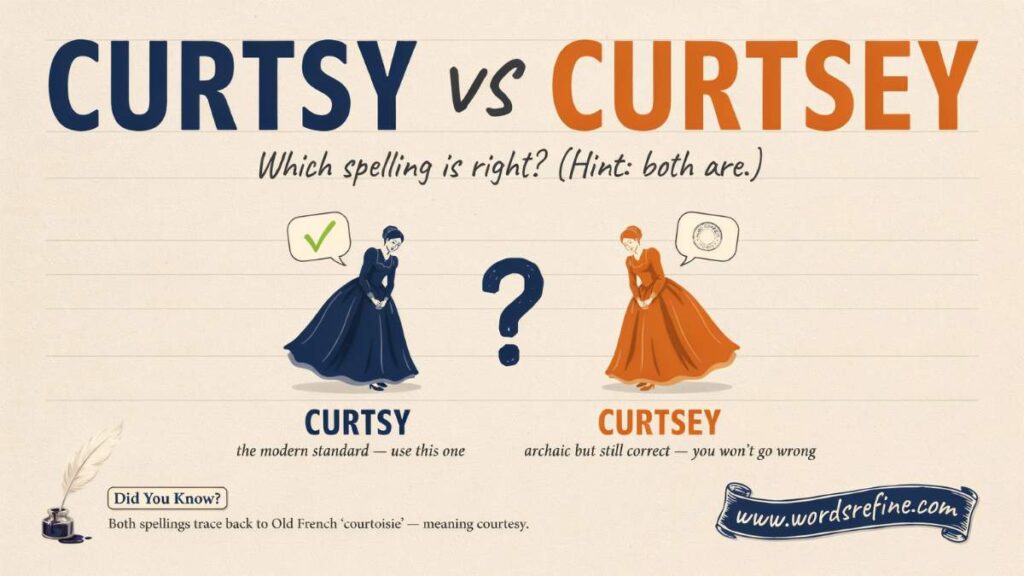
Have you ever paused while writing, wondering whether the correct spelling is curtsy vs curtsey? You’re not alone! These two words often confuse writers because they look slightly different but describe the same graceful gesture. Whether a princess greets royalty or a ballet dancer acknowledges an applauding audience, the action remains the same. But is one spelling correct while the other is a mistake? Not at all! The difference comes down mainly to regional spelling preferences. Understanding curtsy vs curtsey will help you avoid common mistakes, choose the appropriate spelling, and write with confidence. Let’s explore their meanings, uses, and differences.
Quick Answer curtsy vs curtsey
Curtsy vs curtsey have the same meaning. Both refer to a formal gesture in which a person bends their knees and lowers their body slightly, often as a sign of respect, greeting, or politeness.
Curtsy is the more common spelling in American English. Curtsey is more frequently used in British English, although curtsy also appears in British writing.
For example:
She performed a graceful curtsy before the queen.
The young dancer gave a polite curtsey after her performance.
Neither spelling changes the meaning. Your choice mainly depends on the variety of English you’re using.
Learn the difference between confusing more English words
Dysregulated vs Disregulated Which Word Is Correct?
What Does Curtsy Mean?
Curtsy is a noun and a verb. As a noun, it describes a formal gesture of respect in which someone bends their knees and lowers their body. As a verb, it means to perform that gesture.
People traditionally use a curtsy when greeting royalty, showing respect to an important person, or participating in formal ceremonies. Dancers and performers may also curtsy after a show to acknowledge applause.
For example, imagine a young dancer finishing her first ballet performance. The audience applauds, and she steps forward to lower her body gracefully. That gesture is a curtsy.
The word can also appear in everyday situations, although the gesture itself is less common outside formal or traditional settings.
Curtsy as a Noun
When curtsy functions as a noun, it names the gesture itself. It usually appears after an article or another determiner, such as a, the, or her.
Examples:
The princess gave a graceful curtsy to the guests.
Her curtsy showed respect for the visiting queen.
The little girl practiced her curtsy before the school performance.
The audience applauded when the dancer finished with a perfect curtsy.
In each sentence, curtsy identifies the action as a thing or gesture.
Curtsy as a Verb
Curtsy can also describe the action of performing the gesture. In this form, it tells you what someone does.
Examples:
The young woman curtsied before greeting the duchess.
The dancers curtsied after the final scene.
She learned to curtsy properly for the formal ceremony.
The children curtsied when the royal guests entered the room.
Notice that the spelling changes when the verb moves into the past tense. The past-tense form is curtsied, not curtsyed.
Learn the difference between more words people mix up
Acception vs Exception Differences and Correct Usage?
What Does Curtsey Mean?
Curtsey has the same meaning as curtsy. It refers to the same respectful gesture and can function as both a noun and a verb.
The spelling difference doesn’t create a separate action or change the level of formality. Instead, it reflects a regional spelling preference.
For example:
The actress gave a small curtsey to acknowledge the audience.
She learned how to curtsey during her dance lessons.
The first sentence uses curtsey as a noun. The second uses it as a verb.
Curtsey as a Noun
As a noun, curtsey identifies the gesture of lowering the body by bending the knees.
Examples:
The queen returned the greeting with a gentle curtsey.
Her curtsey was elegant and carefully practiced.
The young performer finished her routine with a traditional curtsey.
Everyone admired the child’s polite curtsey.
Curtsey as a Verb
As a verb, curtsey describes the act of performing the gesture.
Examples:
The students learned to curtsey during their theater lessons.
She curtseyed before leaving the royal reception.
The performer curtseyed as the audience applauded.
The young girl was nervous, but she managed to curtsey gracefully.
Like curtsy, the past-tense form of curtsey is curtseyed.
Learn the difference between commonly mixed-up more words
Association vs Organization Meaning Differences Usage ?
Curtsy vs Curtsey Key Differences
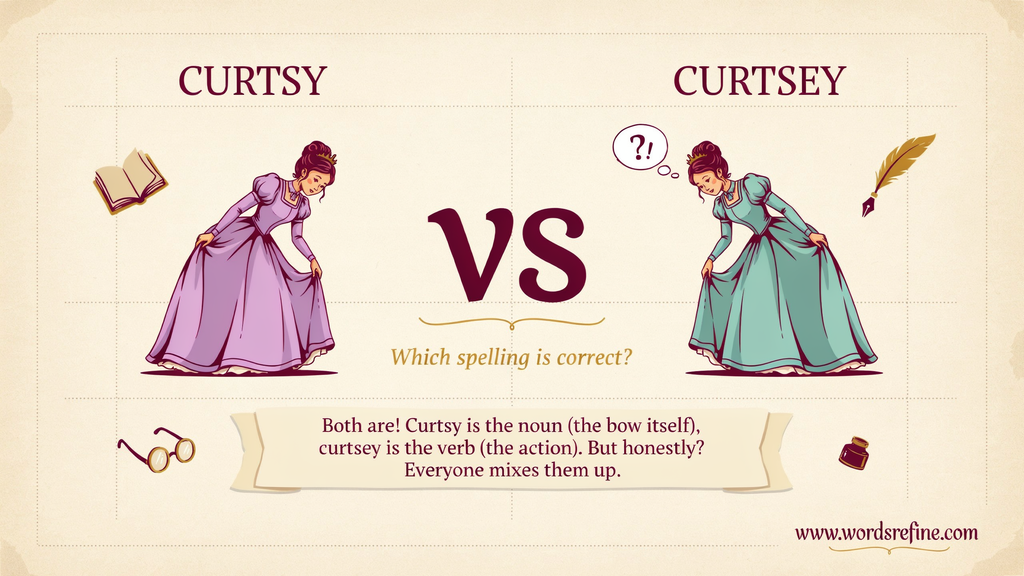
The main difference between curtsy vs curtsey is regional spelling preference. Both words describe the same gesture, and neither has a different meaning.
Curtsy is generally preferred in American English, while curtsey is more commonly associated with British English. However, both forms are recognized and understood in English-speaking countries.
| Feature | Curtsy | Curtsey |
|---|---|---|
| Meaning | A respectful bending gesture | A respectful bending gesture |
| Part of speech | Noun and verb | Noun and verb |
| American English | More common | Less common |
| British English | Also used | More common |
| Pronunciation | The same | The same |
| Past tense | Curtsied | Curtseyed |
| Main distinction | Preferred American spelling | Common British spelling |
You don’t need to learn two different definitions. Simply choose the spelling that matches your audience and keep it consistent throughout your writing.
Curtsy in American and British English
English spelling often changes depending on where you use it. Words such as color and colour, center and centre, and traveled and travelled follow different regional conventions. Curtsy vs curtsey fit into this same pattern.
American English Curtsy
In American English, curtsy is generally the preferred spelling. You’ll commonly see it in American books, newspapers, educational materials, and everyday writing.
Examples:
The little girl gave a curtsy to her dance instructor.
The actress curtsied after receiving the award.
She practiced her curtsy before attending the formal event.
If you’re writing for an American audience, curtsy is usually the safest choice.
British English Curtsey
British English commonly favors curtsey, although curtsy is also accepted and used. The spelling curtsey has a long history in British writing and remains familiar to British readers.
Examples:
The young woman gave a curtsey to the queen.
The dancers curtseyed before leaving the stage.
She learned to curtsey during her early ballet lessons.
If you’re writing for a British audience, curtsey is a natural choice. However, don’t assume that curtsy is incorrect in British English. Both spellings are understood.
Learn the difference between tricky grammar more words
Encorporate vs Incorporate Which Spelling Is Correct?
Which Spelling Is Used in Canada and Australia?
Canada and Australia generally follow British spelling conventions in many areas, but their usage can vary depending on the publication, writer, and context.
In both countries, curtsy vs curtsey are understood. Curtsey may feel more familiar to readers who follow traditional British spelling, while curtsy is also widely recognizable.
For example:
The young performer gave a graceful curtsey at the ceremony.
The dancer finished her routine with a curtsy.
If you’re writing for a Canadian or Australian audience, either spelling can work. The most important thing is to follow the spelling style used by your publication or organization and remain consistent.
The History and Origin of Curtsy vs Curtsey
Curtsy vs curtsey share the same historical background. The word developed from the idea of courtesy, which refers to polite behavior, respect, and good manners.
Over time, the word became associated with a formal gesture performed by bending the knees and lowering the body. People traditionally used this movement to show respect, especially when greeting members of royalty or people of higher social status.
The spelling changed over the years, resulting in the two forms used today. Although their written forms differ slightly, their meaning remains the same.
The gesture itself also has a long cultural history. In European royal courts, women traditionally performed curtsies when greeting monarchs or other important figures. Today, people still use the gesture in certain formal settings, particularly in ballet, theater, historical ceremonies, and royal traditions.
Learn the difference between confusing word pairs
Esthetically vs Aesthetically Meaning Differences and Correct ?
How to Use Curtsy vs Curtsey in Sentences
Understanding the meaning is only half the job. You also need to know how these words work in everyday sentences.
Both spellings can function as nouns and verbs. The sentence structure usually makes their role clear.
When you use curtsy vs curtsey as a noun, you’re talking about the gesture itself.
Examples:
The princess gave a graceful curtsy to the visiting guests.
Her curtsey was simple but elegant.
The dancer practiced her curtsy before the performance.
The little girl gave a shy curtsey to her teacher.
When you use either word as a verb, you’re describing the action.
Examples:
She curtsied before greeting the queen.
The performers curtseyed as the audience applauded.
The young dancer learned to curtsy during her first ballet lesson.
The children curtseyed before leaving the stage.
The choice between curtsy vs curtsey doesn’t affect the sentence’s meaning. It only changes the spelling.
Learn the difference between often confused words
Grey vs Gray What’s the Difference?
Common Word Forms and Their Usage
Both words have related forms that you should recognize. The spelling changes slightly depending on how you use the word.
| Word form | Curtsy | Curtsey |
|---|---|---|
| Base form | Curtsy | Curtsey |
| Past tense | Curtsied | Curtseyed |
| Present participle | Curtsying | Curtseying |
| Noun | A curtsy | A curtsey |
For example:
She curtsies whenever she greets the royal family.
The dancer curtsied after the performance.
The young performer is curtsying before the audience.
She gave a beautiful curtsy.
The same patterns apply to curtsey:
She curtseys before the ceremony begins.
The actress curtseyed to acknowledge the applause.
The children are curtseying as part of their dance routine.
Her curtsey impressed the guests.
One common mistake is writing curtsyed. The correct past-tense spelling is curtsied because the final y changes to i before adding -ed.
Curtsy vs Bow What’s the Difference?
Curtsy and bow are both gestures of respect, but they involve different movements.
A curtsy usually involves bending the knees and lowering the body. Traditionally, women and girls perform this gesture, although anyone can perform one in a theatrical or historical setting.
A bow involves bending the upper body forward, usually at the waist or neck. People of different genders and backgrounds use bows to show respect, greet others, or acknowledge an audience.
For example:
The young woman gave a curtsy to the queen.
The gentleman bowed before greeting the guests.
The ballet dancers performed a curtsy at the end of the show.
The actor bowed to thank the audience.
A curtsy is more specific than a bow because it involves a particular movement of the knees. A bow is a broader gesture that can take several forms depending on the culture and situation.
Learn the difference between basic English word mistakes
Swang vs Swung Which Is Correct?
How to Perform a Curtsy
A curtsy may look simple, but performing one gracefully takes a little practice. The movement is usually gentle and controlled rather than dramatic.
Stand upright with your feet close together.
Keep your back straight and your shoulders relaxed.
Move one foot slightly behind the other.
Bend both knees gently while lowering your body.
Keep your balance and avoid leaning too far forward.
Return to your original standing position smoothly.
The exact movement can vary depending on the tradition or occasion. A ballet curtsy, for example, may look different from a traditional royal curtsy.
You don’t need to make the movement complicated. A natural, balanced gesture is usually more graceful than an exaggerated one.
Synonyms and Related Words
Curtsy vs curtsey have several related words, but not all of them describe exactly the same movement.
A bow is the closest general alternative. It involves bending the upper body forward as a sign of respect or greeting.
A salute is a formal gesture used to show respect, especially in military settings.
A nod is a small movement of the head that can communicate agreement, recognition, or politeness.
A gesture of respect is a broader expression that includes curtsies, bows, salutes, and other polite movements.
A courtesy is an act of politeness or consideration. Although it shares a historical connection with curtsy, it doesn’t describe the physical gesture itself.
Choosing the right word depends on the action you’re describing. If someone bends their knees in a traditional gesture of respect, curtsy vs curtsey is more precise than bow or nod.
Learn the difference between commonly misused words
Curb vs Kerb the Difference Meaning and Correct ?
Common Mistakes When Using Curtsy vs Curtsey
Although curtsy vs curtsey have the same meaning, writers sometimes confuse their spelling, verb forms, and plural forms. A few simple rules can help you avoid these mistakes.
Using Curtsyed Instead of Curtsied
One common mistake is adding -ed directly to curtsy and writing curtsyed. The correct past-tense form is curtsied.
Incorrect: She curtsyed before greeting the queen.
Correct: She curtsied before greeting the queen.
When you add -ed to curtsy, the final y changes to i. The same spelling pattern appears in words such as carried and hurried.
Treating Curtsey as a Different Gesture
Some writers assume that curtsy vs curtsey describe two different movements. They don’t. Both words refer to the same gesture of bending the knees and lowering the body as a sign of respect.
Incorrect: She performed a curtsy, while her sister performed a different curtsey.
Correct: She performed a curtsy, and her sister performed one too.
The spelling changes, but the action remains the same.
Writing Courtsey Instead of Curtsey
Another spelling mistake is courtsey. It may look reasonable because curtsy vs curtsey are historically connected to courtesy, but courtsey is not the correct spelling.
Incorrect: The young dancer gave a courtsey.
Correct: The young dancer gave a curtsey.
Remember that the correct options are curtsy vs curtsey. Avoid adding an extra o.
Confusing the Plural Forms
The plural of curtsy is curtsies. The plural of curtsey is usually curtseys. However, some dictionaries also recognize curtseys and curtsies as alternative plural forms in British usage.
Incorrect: The dancers performed three curtsy.
Correct: The dancers performed three curtsies.
Correct: The performers practiced their curtseys before the ceremony.
The key is to make the noun plural when you’re referring to more than one gesture.
Using the Wrong Present Participles
The present participle describes an action that is happening. Curtsy becomes curtsying, while curtsey becomes curtseying.
Incorrect: She is curtsyng before the audience.
Correct: She is curtsying before the audience.
Correct: She is curtseying before the audience.
Both forms are understandable, but you should match the form to the spelling you’re using.
Assuming Curtsey Is Incorrect in American English
Curtsy is the standard and more familiar spelling in American English. However, that doesn’t mean curtsey is an invalid word.
Incorrect: Curtsey is always a spelling mistake in American English.
Correct: Curtsy is generally preferred in American English, but curtsey is also recognized.
Choose the spelling that suits your audience, and use it consistently.
Mixing Both Spellings in the Same Article
Switching between curtsy vs curtsey without a reason can make your writing look inconsistent.
Inconsistent: She performed a curtsy before the guests. Later, she practiced her curtsey for the ceremony.
Consistent: She performed a curtsy before the guests. Later, she practiced another curtsy for the ceremony.
If you’re writing in American English, stick with curtsy. If you’re following a style that prefers curtsey, use that spelling throughout.
More Example Sentences With Curtsy vs Curtsey
Seeing both words in different situations can make their usage easier to remember.
The princess gave a graceful curtsy before greeting the visitors.
The young actress curtsied after receiving applause.
The ballet instructor showed the students how to perform a proper curtsy.
The little girl practiced curtsying in front of the mirror.
The performer gave a curtsey before leaving the stage.
The dancers curtseyed together at the end of the show.
She learned to curtsey during her theater lessons.
The guests admired her elegant curtsey.
These examples show that both spellings can work as nouns and verbs. The intended meaning stays the same.
Learn the difference between everyday English mistakes
DPhil vs PhD Meaning Differences Recognition Salary?
Practice Session Curtsy vs Curtsey
1. The young princess gave a graceful ______ to the queen.
2. The ballet dancer ______ after completing her performance.
3. The little girl practiced her ______ before the school ceremony.
4. The performers ______ together as the audience applauded.
5. She learned how to ______ during her ballet lessons.
6. The actress gave a polite ______ before leaving the stage.
7. The students watched their teacher demonstrate how to ______.
8. The princess ______ before greeting the royal guests.
9. Her elegant ______ impressed everyone at the ceremony.
10. The dancers practiced their ______ before the final performance.
11. She is ______ in front of the audience.
12. The young performer is ______ gracefully before the guests.
13. The girl performed two graceful ______ during the ceremony.
14. The dancers practiced several ______ before the show.
15. She ______ politely when the queen entered the room.
16. The little girl learned to ______ during her theater lessons.
17. The actress ______ to acknowledge the audience’s applause.
18. Her beautiful ______ showed respect for the visiting guests.
19. The children are ______ as part of their dance routine.
20. The princess performed a traditional ______ at the royal reception.
21. The performer ______ before walking off the stage.
22. She practiced her ______ in front of the mirror.
23. The dancer gave a graceful ______ after the final scene.
24. The young woman ______ before greeting the duchess.
25. The students learned how to perform a proper ______ during their drama class.
Answers
- Curtsy
- Curtsied
- Curtsy
- Curtseyed
- Curtsy
- Curtsey
- Curtsey
- Curtsied
- Curtsey
- Curtseys
- Curtsying
- Curtseying
- Curtsies
- Curtseys
- Curtsied
- Curtsey
- Curtseyed
- Curtsy
- Curtsying
- Curtsey
- Curtseyed
- Curtsy
- Curtsey
- Curtsied
- Curtsy
Here’s a trusted source for clear more words Comparison:
FAQs
What Is a Male Curtsy Called?
A male curtsy doesn’t have a specific traditional name. Men usually perform a bow, which involves bending the upper body forward to show respect. Although men can perform a curtsy in theatrical or historical settings, a bow is the more common traditional gesture.
What Is the Difference Between Courtesy vs Curtsy?
Courtesy means showing politeness, respect, or consideration toward others. A curtsy is a physical gesture in which someone bends their knees and lowers their body slightly. For example, holding a door open for someone shows courtesy, while greeting royalty with a curtsy is a formal gesture.
What Is Another Word for Curtsy?
A bow is the closest general alternative to curtsy, although the two gestures involve different movements. A curtsy requires bending the knees, while a bow usually involves bending the upper body forward. You can also describe a curtsy as a respectful or formal gesture.
How Do You Use Curtsy in a Sentence?
You can use curtsy as either a noun or a verb. As a noun, it names the gesture. For example, “The princess gave a graceful curtsy to the guests.” As a verb, it describes the action: “The young dancer curtsied after the performance.”
Does Princess Charlotte Curtsy to Queen Camilla?
Princess Charlotte may follow traditional royal etiquette when greeting Queen Camilla, but she isn’t required to curtsy every time they meet. Curtsying is a traditional gesture of respect rather than a compulsory action at every royal gathering.
Do Kate Middleton’s Parents Have to Curtsy to Kate?
No. Kate Middleton’s parents, Carole and Michael Middleton, aren’t required to curtsy to their daughter. Although royal etiquette includes traditional gestures such as bowing and curtsying, these customs don’t require every family member to perform them during personal interactions.
Do Female Servants Bow or Curtsy?
Traditionally, female servants often curtsied when greeting members of the royal family or their employers, while male servants commonly bowed. However, customs varied depending on the household, historical period, and social setting. Today, these gestures are mainly associated with formal ceremonies and traditional etiquette.
Did Queen Elizabeth Ever Curtsy?
Yes. Before becoming queen, Princess Elizabeth followed royal traditions and curtsied to senior members of the Royal Family. After becoming monarch, she wasn’t expected to curtsy to other members of the British Royal Family. However, she sometimes made respectful gestures during formal ceremonies.
What Is the Plural of Curtsey?
The plural of curtsey is curtseys. The alternative spelling, curtsy, has the plural form curtsies. Both forms refer to more than one respectful gesture.
Learn the difference between often confused words
Hoover vs Hover Meaning Differences Pronunciation?
Conclusion
Choosing between curtsy vs curtsey is easier than performing a perfect royal greeting. Both spellings describe the same graceful gesture, and neither changes the meaning. The main difference is regional preference: curtsy is generally favored in American English, while curtsey is more common in British English.
Remember to use the correct word forms. Curtsied is the past tense of curtsy, while curtseyed is the past tense of curtsey. Also, avoid writing courtsey. It isn’t an alternative spelling; it’s simply a mistake.
Whether you’re describing a princess greeting royalty or a dancer thanking an audience, choose the spelling that fits your preferred English style and use it consistently. Once you understand the difference, you can write with confidence and leave the grammar confusion behind. After all, your spelling deserves as much grace as the curtsy itself!

Diora AJS she is an experienced blogger and passionate English language enthusiast at Words Refine. With a keen eye for language and a love for clear communication, she writes practical content about grammar, word meanings, usage, and commonly confused terms. Her goal is to make English easier to understand through clear explanations and relatable examples, helping readers write accurately and communicate with confidence.