
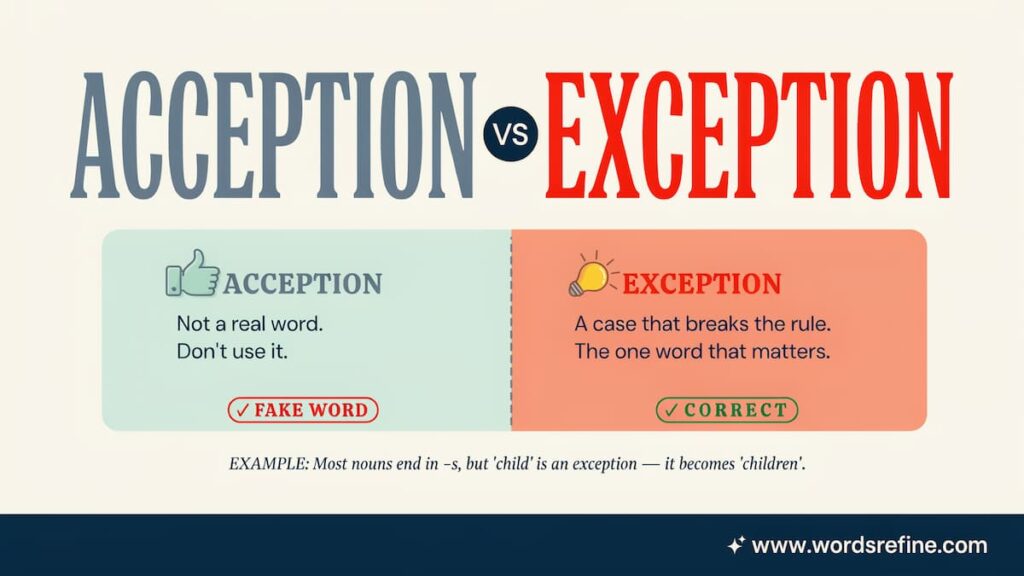
The difference between Acception vs Exception seem subtle, but choosing the wrong word can change the clarity of your sentence. Although both terms share a similar spelling, they have very different uses. Exception is the standard English word for something or someone that falls outside a general rule, condition, or expectation. Acception, on the other hand, is an obsolete term that is rarely used in modern English. The confusion can grow when acceptance and acceptation enter the picture, as both have distinct meanings. Understanding these differences will help you use each word accurately, avoid common grammatical mistakes, and make your writing clearer and more professional.
Quick Answer Acception vs Exception
The main difference between acception vs exception lies in their meanings and how people use them today.
Exception is the standard English word for something that doesn’t follow a general rule or falls outside an established requirement. For example, “Everyone must attend the meeting without exception.”
Acception is a genuine but extremely rare historical English word. Older texts use it to describe receiving something, showing favor, or understanding a word in a particular sense.
Acceptance is the modern word for receiving, approving, or agreeing to something. For example, “Her acceptance of the job offer made her family proud.”
Therefore, if you’re writing an email, school assignment, business report, or everyday message, exception is usually the word you need when discussing a special case.
| Word | Meaning | Modern usage |
|---|---|---|
| Acception | A historical term associated with receiving or interpreting something | Extremely rare |
| Exception | Something excluded from a general rule | Common |
| Acceptance | The act of receiving, approving, or agreeing | Common |
The easiest way to remember the difference is simple: you make an exception to a rule, but you give or receive acceptance. Meanwhile, acception belongs mainly to older English usage.
Learn the difference between confusing more English words
Stary vs Starry Meaning Differences Examples and Correct ?
What Does Exception Mean?
An exception is a person, thing, or situation that doesn’t follow a general rule or pattern. It describes something that differs from what normally happens or falls outside an established requirement.
Imagine that a school requires every student to wear a uniform. However, the principal allows students to wear traditional clothing during a cultural celebration. That special permission is an exception to the uniform policy.
In other words, an exception creates a special case within a general rule.
For example, consider these sentences:
Everyone must arrive at the office by 9 a.m., with the exception of the night-shift supervisor.
The restaurant serves breakfast every day except Sunday.
Everyone passed the examination with one exception.
The manager made an exception and approved the late application.
In each example, the word identifies someone or something that differs from the usual situation.
Exception as a Noun
In modern English, exception primarily functions as a noun. It identifies a special case, exclusion, or departure from an established rule.
For instance, you might say, “Most students prefer studying in the morning, but Daniel is an exception.” Here, Daniel behaves differently from the general group.
Similarly, consider this sentence: “All electronic devices must remain switched off, with the exception of medical equipment.” In this case, medical equipment receives different treatment under the rule.
You can also use exception when someone receives special permission. For example, “The teacher made an exception and accepted the assignment one day late.”
As these examples demonstrate, an exception can involve a person, object, event, or special arrangement. Its exact meaning depends on the surrounding sentence.
Exception Examples in Everyday Sentences
The easiest way to understand exception is to see how naturally it fits into different situations.
| Example sentence | Explanation |
|---|---|
| Everyone received an invitation without exception. | Nobody was excluded. |
| The store opens every day except Christmas. | Christmas is excluded from the schedule. |
| My brother is an exception to our family’s early-rising habit. | He behaves differently from the others. |
| The teacher made an exception for a student with a medical emergency. | The teacher allowed a special arrangement. |
| No employee can enter the laboratory without permission, without exception. | The rule applies to everyone. |
| The new policy includes one important exception. | One situation receives different treatment. |
These examples show that exception works naturally in everyday conversations, academic discussions, and professional writing.
Common Phrases With Exception
English speakers frequently use exception in familiar expressions. Learning these phrases will help you understand the word and use it naturally.
Exception to the rule
This expression describes something that doesn’t follow an established general rule.
For example, “Most birds can fly, but penguins are an exception to the rule.”
Make an exception
This means allowing someone or something to avoid a normal requirement or restriction.
For example, “The manager decided to make an exception because the employee had a family emergency.”
Without exception
This means that something applies to everyone or everything without exclusions.
For example, “All participants must complete the registration form without exception.”
With the exception of
This phrase identifies someone or something excluded from a particular statement.
For example, “The entire office attended the training session, with the exception of two employees.”
Take exception to
This expression means to object to or feel offended by something.
For example, “She took exception to the suggestion that her team had performed poorly.”
No exceptions
This expression communicates that a rule applies to everyone and allows no special treatment.
For example, “Safety helmets are required inside the construction area. No exceptions.”
Learn the difference between commonly mixed-up more words
Scrapped vs Scraped Differences Examples and Correct Usage?
Different Situations Where Exception Is Used
Although exception appears in ordinary conversations, it also plays an important role in professional and technical communication.
In education, a school may excuse a student from an attendance requirement because of a documented medical emergency.
Similarly, a company may make an exception to its refund policy when a customer receives a damaged product.
In legal documents, a general rule may include specific exceptions that allow different treatment under certain circumstances.
Technology also uses the term. For example, a software program may generate an exception when it encounters an unexpected condition that prevents normal execution.
Even in everyday family life, the word fits naturally. A family might limit screen time but make an exception during a holiday.
Across all these situations, the central idea remains the same: an exception identifies something that falls outside the normal rule or pattern.
What Does Acception Mean?
Acception has a genuine place in English vocabulary, although you’re unlikely to encounter it in everyday conversation or contemporary writing.
Historically, the word referred to the act of receiving or accepting something. It also described the particular sense or meaning in which someone understood a word. Older English dictionaries recorded these meanings, but the word gradually disappeared from ordinary use.
For example, historical dictionaries document acception as a term associated with the received sense of a word. This shows that it wasn’t simply an invented spelling mistake created by people confusing it with exception.
The meaning of acception therefore depends on its historical context. It can refer to receiving something or understanding a word in a particular sense.
Acception Definition and Historical Usage
Historical dictionaries associate acception with several related meanings.
Reception refers to the act of receiving or taking something offered.
Acceptance describes receiving something favorably or willingly.
Interpretation refers to the particular meaning assigned to a word or expression.
Favoritism describes showing preference toward one person instead of another.
These meanings developed through the word’s connection with the Latin term acceptio, which relates to receiving.
The word also appeared in older religious and legal expressions. For example, acception of persons referred to showing favoritism or treating certain people more favorably than others.
Although these historical meanings explain why the word exists, they don’t make acception a suitable replacement for exception in modern writing.
Learn the difference between confusing word pairs
Tinder vs Tender Differences Examples and Correct Usage?
Historical Meaning of Acception in Language and Grammar
One particularly interesting historical use of acception involved the meaning of words.
Older writers sometimes used it to describe the sense in which a particular word was understood. This meaning is closely related to the modern linguistic concept of acceptation.
For example, imagine an older writer discussing the word bright. The writer might explain that the word has one acception when describing light and another when describing intelligence.
Today, a writer would naturally say that the word bright has several meanings or that its meaning changes according to context.
In modern English, acceptation is the established formal word for the accepted meaning of a word.
This distinction matters because acception and acceptation have historical connections, but they shouldn’t be treated as interchangeable in contemporary writing.
Acception Examples in Historical Contexts
Because acception is obsolete or extremely rare in modern English, everyday examples can give readers the wrong impression. It’s better to understand its historical use through carefully explained illustrations.
| Historical context | Illustrative example | Intended meaning |
|---|---|---|
| Receiving something | The acception of the offered gift | The reception of something |
| Word interpretation | The acception of a term in an older text | The particular meaning of a word |
| Favoritism | Acception of persons | Preference shown to certain people |
| Historical writing | The word was used in an unusual acception. | The word was understood in a particular sense |
These examples illustrate historical meanings rather than recommend expressions for contemporary writing.
For modern readers, reception, acceptance, meaning, sense, and interpretation will usually communicate the intended idea more clearly.
Is Acception a Real Word?
Yes, acception is a genuine historical English word. However, there’s an important difference between a word’s historical existence and its usefulness in modern writing.
Historical dictionaries document acception, and older English writers used it in several contexts. Nevertheless, its general meaning of receiving something was gradually replaced by acceptance.
Its linguistic meaning also became associated with acceptation, which remains a formal term for the meaning of a word.
Historical records trace acception back to the late fourteenth century. It remained in use for centuries, although its popularity gradually declined. Acceptance became established later and eventually replaced the older word in its general sense.
Therefore, the most accurate answers are straightforward.
Acception is a real English word, but it isn’t common in modern English. It isn’t a standard alternative to exception, and you generally shouldn’t use it in everyday writing.
Learn the difference between tricky grammar more words
Jibe vs Jive What’s the Difference?
Why Is Acception Considered Obsolete?
Language changes as people adopt new expressions and abandon older ones. A word that once appeared regularly in books may eventually become unfamiliar to most readers.
That’s what happened to acception.
The word lost ground as acceptance became the usual term for receiving or approving something. Meanwhile, acceptation became established as a term for the meaning of a word.
Several factors explain its decline.
Changing vocabulary encouraged English speakers to prefer acceptance.
Clearer word distinctions allowed different terms to develop more specialized meanings.
Modern communication favored familiar words such as meaning, sense, and interpretation.
Reduced common usage gradually pushed acception into historical texts and rare terminology.
However, obsolete doesn’t mean imaginary. Many archaic English words remain in historical documents and dictionaries even though modern speakers rarely use them.
When to Use Acception
So, when should you use acception? In ordinary contemporary writing, almost never.
You might encounter it in historical dictionaries, older books, research discussing the development of English vocabulary, direct quotations from historical documents, or discussions about obsolete terminology.
For example, a language historian might write, “The term acception once referred to the received meaning of a word.”
That sentence discusses the historical word itself, so its use is appropriate.
However, if you’re writing a modern article, meaning or interpretation will usually be a better choice.
The practical lesson is simple: Don’t use an unfamiliar historical word just because it looks more formal. Clear communication matters more than impressive-looking vocabulary.
Acception vs Exception Side-by-Side Comparison
Now that both words have separate definitions, comparing them makes their differences easier to remember.
The difference between acception vs exception involves meaning, historical development, spelling, and modern usage.
Although the words share several letters, they come from different Latin roots and developed different meanings.
| Feature | Acception | Exception |
|---|---|---|
| Part of speech | Noun | Noun |
| Historical origin | Latin acceptio | Latin exceptio |
| Historical meaning | Receiving, acceptance, or a particular word sense | Exclusion, objection, or exemption |
| Modern meaning | Rare or obsolete historical meanings | Something excluded from a general rule |
| Common usage | Very rare | Very common |
| Typical context | Historical and linguistic discussions | Everyday and professional writing |
| Recommended modern alternative | Acceptance, meaning, or interpretation | Exception itself |
Acception vs Exception Meaning in Real Sentences
Consider these examples to see how their meanings differ.
Example: Using exception correctly.
“The company allows no exception to its safety requirements.”
Here, exception refers to a situation in which someone might receive permission to avoid a general requirement.
Example: Discussing acception historically.
“The historian examined the older acception of the term.”
Here, acception refers to a particular historical meaning or interpretation.
Example: Using acceptance correctly.
“Her acceptance of the scholarship made her parents proud.”
Here, acceptance refers to receiving or approving an offer.
These sentences show why the three words cannot replace one another.
Learn the difference between confusing word pairs
Foward vs Forward Meaning Spelling and Correct Usage
Which Is Correct?
If you’re trying to describe something excluded from a rule, exception is correct.
For example:
Incorrect: The manager made an acception for the new employee.
Correct: The manager made an exception for the new employee.
However, if you’re discussing an old linguistic term, acception may be appropriate in its historical context.
Meanwhile, if you’re referring to approval or receiving an offer, choose acceptance.
The correct choice depends on what you want to communicate, not simply which spelling looks familiar.
Which Is Correct in Modern English?
For everyday communication, exception is the correct word when discussing a special case or exclusion.
For example, there are no exceptions to this policy.
Everyone attended the event, with one exception.
The teacher made an exception for the student.
You shouldn’t write acception in these sentences because it doesn’t carry the intended meaning.
Remember that a dictionary may recognize a historical word without recommending it for ordinary contemporary writing.
acception vs exception What’s the Difference?
Here’s where the confusion becomes slightly more interesting.
Although acception vs acceptance look similar, they have different levels of usefulness in modern English.
Acceptance is a standard modern noun derived from the verb accept. It describes the act of receiving, agreeing to, or approving something.
By contrast, acception is an older term that historically carried related meanings but has largely disappeared from everyday English.
What Does Acceptance Mean?
Acceptance refers to the act or state of accepting something.
It can describe several situations, such as agreeing to an invitation, receiving an offer, approving an application, recognizing someone, or becoming comfortable with a particular situation.
For example, “After reviewing her qualifications, the university confirmed her acceptance into the program.”
Here, acceptance means the university approved her admission.
Other examples include:
Her acceptance of the job offer surprised her colleagues.
The company announced the acceptance of the revised proposal.
Social acceptance can help people feel included.
She struggled with accepting the unexpected changes.
Which Should You Use?
In modern English, choose acceptance when referring to receiving, approving, or agreeing to something.
| Incorrect or outdated usage | Correct modern usage |
|---|---|
| Her acception of the invitation was immediate. | Her acceptance of the invitation was immediate. |
| The company confirmed his acception. | The company confirmed his acceptance. |
| We are waiting for their acception of the offer. | We are waiting for their acceptance of the offer. |
The distinction is straightforward: acceptance belongs to modern English, while acception mainly belongs to historical discussions.
Acception vs Acceptation Another Important Distinction
There’s one more word worth understanding acception vs exception
Unlike acception, acceptation remains a recognized formal English term. It refers to the generally accepted meaning of a word or expression.
For example, “In the common acceptation of the term, a professional athlete earns a living through sports.”
Here, acceptation means the accepted meaning or understanding of the term.
The distinction is simple.
Acceptance refers to receiving, approving, or agreeing to something.
Acceptation refers to the accepted meaning of a word or expression.
Acception is a historical form associated with receiving or a particular word sense.
For modern writing, acceptation may be appropriate in specialized linguistic discussions. However, meaning or interpretation will usually sound more natural to everyday readers.
Learn the difference between often confused words
Broke vs Broken Meaning Differences and Correct Usage ?
Accept vs Except Understanding the Difference
Another reason people confuse acception vs exception is that they resemble two familiar words: accept and except.
Although their spellings differ by only one letter, their meanings are quite different.
Accept is a verb that means to receive, agree to, or approve something.
Except can function as a preposition, conjunction, or verb. It generally means excluding something or someone.
Understanding the difference between accept and except will help you avoid another common group of English spelling mistakes.
Accept Meaning and Examples
Use accept when someone receives something, agrees to an offer, or approves a suggestion.
For example, she decided to accept the invitation.
The university will accept applications until Friday.
He accepted responsibility for the mistake.
My parents accepted my decision to study abroad.
The manager refused to accept the incomplete report.
A useful memory trick is to connect accept with agreement. If someone agrees to receive something, accept is usually the correct verb.
Except as a Preposition
As a preposition, except means excluding someone or something.
For example, everyone attended the meeting except David.
The store opens every day except Sunday.
All students passed the examination except two.
The entire family enjoyed the vacation except my younger brother.
In these sentences, except identifies someone or something left out of a group.
Except as a Verb
Except can also function as a verb, although this use is less common in everyday conversation.
As a verb, it means to exclude or leave something out.
For example, “The new policy excepts temporary employees from the additional benefit.”
Here, temporary employees don’t qualify for that benefit.
You might encounter this construction in formal or legal writing. In everyday English, people often prefer excludes because it sounds more natural.
Quick Comparison Accept vs Except
| Word | Part of speech | Meaning | Example |
|---|---|---|---|
| Accept | Verb | Receive or agree to something | I accept your invitation. |
| Except | Preposition | Excluding someone or something | Everyone came except Sarah. |
| Except | Verb | Exclude or leave something out | The policy excepts certain employees. |
| Exception | Noun | Something excluded from a general rule | Sarah received an exception. |
| Acceptance | Noun | The act of accepting | Her acceptance arrived yesterday. |
Remember this simple distinction: You accept an invitation, but you attend a party except when you’re unable to go. An exception is the special circumstance that changes the general rule.
Why Do People Confuse Acception vs Exception?
At first glance, the confusion seems understandable. Both acception vs exception words contain similar letters and have connections to older English vocabulary.
However, several specific factors contribute to their misuse.
Similar Spelling
The words acception vs exception share much of their spelling.
Both contain the sequence ception, which makes them easy to mix up when typing quickly.
However, their first letters signal an important distinction. Acception begins with A, while exception begins with E.
One letter can change the entire meaning of a sentence.
For example, “The manager made an exception” means the manager allowed a special arrangement.
However, “The manager made an acception” isn’t standard modern English.
A quick spelling check can prevent this mistake.
Sound Similarity
Both words have three syllables and share a similar ending sound. As a result, someone who learns English mainly through conversation may struggle to distinguish their spelling.
Pronunciation alone isn’t always enough to identify the correct word.
Instead, consider the meaning of the sentence before choosing its spelling.
For example, if you’re discussing a rule that doesn’t apply to everyone, the intended word is exception.
Confusion With Acceptance
The familiar word acceptance also contributes to the problem.
Because accept, acceptance, and acception share similar beginnings, writers sometimes assume they can use them interchangeably.
However, their meanings and grammatical roles differ.
Consider these examples:
She accepted the invitation.
Her acceptance of the invitation surprised us.
The old text discussed the historical acception of the term.
Each sentence uses a different word for a specific reason.
Limited Knowledge of Historical Vocabulary
Many English speakers have never encountered acception in ordinary conversation.
When they see it in an older text, they may assume it’s a typo. Others may mistakenly use it as an alternative spelling of exception.
Understanding the history of uncommon vocabulary helps prevent these errors.
However, knowing that a rare word exists doesn’t mean you should use it whenever a familiar word looks similar.
Learn the difference between basic English word mistakes
Cloth vs Clothe Differences Examples and Correct Usage ?
Common Mistakes When Using Acception vs Exception
Even experienced acception vs exception writers occasionally choose the wrong word when two spellings look almost identical.
The following examples demonstrate common mistakes and explain how to correct them.
Using Acception Instead of Exception
Incorrect: Everyone must follow the workplace rules without acception.
Correct: Everyone must follow the workplace rules without exception.
The sentence means that nobody receives special treatment. Therefore, exception is the correct noun.
Writing Acception Instead of Acceptance
Incorrect: Her acception of the scholarship made her family proud.
Correct: Her acceptance of the scholarship made her family proud.
The student received or agreed to the scholarship. Consequently, the correct word is acceptance.
Confusing Make an Exception With Make an Acception
Incorrect: The principal decided to make an acception for the absent student.
Correct: The principal decided to make an exception for the absent student.
Make an exception is the established expression for allowing someone to avoid a general rule.
Using Exception When You Mean Acceptance
Incorrect: His exception of the invitation surprised everyone.
Correct: His acceptance of the invitation surprised everyone.
The sentence describes agreeing to an invitation, not receiving special treatment.
Using Acception in Professional Writing
Incorrect: The company granted an acception to the customer who missed the refund deadline.
Correct: The company granted an exception to the customer who missed the refund deadline.
The company allowed a special arrangement outside its usual refund policy.
Confusing Exception With Except
Incorrect: Everyone accept James completed the training.
Correct: Everyone except James completed the training.
The sentence excludes James from the group. Therefore, it needs the preposition except, not the verb accept.
Learn the difference between commonly misused words
Peak vs Pique Differences Examples and Correct Usage ?
American vs British English Is There a Spelling Difference?
Some English words have different spellings in American and British English. For example, Americans write color, while British writers generally use colour.
However, exception follows the same standard spelling in both varieties.
| American English | British English | Difference |
|---|---|---|
| Exception | Exception | None |
| Acceptance | Acceptance | None |
| Acception | Acception | Historical or rare usage |
Neither American nor British English uses acception as a standard alternative to exception.
Therefore, whether you’re writing for an American audience or a British publication, use exception when discussing something excluded from a rule.
The distinction concerns meaning and historical usage, not regional spelling differences.
How to Spell Exception Correctly
If you frequently confuse these words, learning the correct spelling of exception can help you avoid unnecessary mistakes.
The standard spelling is E-X-C-E-P-T-I-O-N.
The word contains three syllables and ends in tion.
A useful way to remember its spelling is to connect it with the verb except.
Except, exception, exceptional, exceptionally, exceptionable, and exceptionality all belong to the same word family.
Words Related to Exception
Understanding related vocabulary also improves your English spelling and word choice.
| Word | Part of speech | Meaning |
|---|---|---|
| Exception | Noun | Something excluded from a general rule |
| Except | Preposition, conjunction, or verb | Excluding or leaving something out |
| Excepted | Verb or adjective | Excluded from something |
| Exceptional | Adjective | Unusually good or different from the ordinary |
| Exceptionally | Adverb | To an unusually high degree |
| Exceptionable | Adjective | Open to objection or criticism |
| Exceptionality | Noun | The quality or condition of being exceptional or unusual |
For example, “Her exceptional performance earned her an award.”
Here, exceptional describes something unusually impressive.
Similarly, “All applications were reviewed except those submitted after the deadline.”
In this sentence, except identifies the excluded applications.
Learning these related forms makes it easier to recognize the correct spelling in different sentence structures.
Synonyms and Related Words
Although synonyms can make writing more interesting, choosing a replacement requires attention to context. Not every alternative carries exactly the same meaning.
Synonyms for Exception
Here are several words related to exception.
| Synonym | Meaning | Example |
|---|---|---|
| Exclusion | Leaving someone or something out | The exclusion of late applications was necessary. |
| Exemption | Freedom from a rule or obligation | She received an exemption from the requirement. |
| Special case | A situation requiring different treatment | This customer represents a special case. |
| Irregularity | Something that differs from what is expected | The audit identified an irregularity. |
| Anomaly | Something unusual or unexpected | The unusual result was an anomaly. |
| Deviation | A departure from a standard or pattern | The report showed a deviation from the normal procedure. |
These terms overlap with exception, but their meanings aren’t identical.
For example, an exemption usually involves permission not to follow a requirement, while an anomaly describes something unusual that may not involve any rule at all.
Related Words for Acceptance
When discussing acceptance, consider these alternatives.
Approval means official agreement or permission.
Agreement refers to a shared decision or understanding.
Consent means permission given willingly.
Admission describes permission to enter or join something.
Reception refers to the way someone or something is received.
Recognition means acknowledging someone’s achievements, identity, or qualities.
For example, “The university approved her application” may communicate a similar idea to “The university confirmed her acceptance.”
However, the best choice depends on the sentence.
Words Related to Acception
Because acception is a historical term, its related vocabulary requires a little more care.
Acceptation refers to the accepted meaning of a word.
Acceptance describes the act of receiving or approving something.
Interpretation means the way someone understands something.
Sense refers to a particular meaning of a word.
Signification describes the meaning or significance of a word or expression.
For modern writing, meaning, sense, and interpretation are usually clearer alternatives when discussing language.
Real-World Usage Scenarios Choosing the Correct Word
Understanding definitions is useful, but applying them correctly in real situations is even more important.
Let’s consider a few practical examples.
A Workplace Policy
Imagine a company requires all employees to submit their monthly reports by the last working day of each month.
One employee experiences a medical emergency and requests additional time. The manager approves the request.
The correct sentence is:
“The manager made an exception to the reporting deadline because of the employee’s medical emergency.”
Why does exception work here?
The company has a general rule, but the manager allows one employee to follow a different arrangement.
Using acception would be incorrect because the sentence doesn’t discuss historical acceptance or word interpretation.
A University Admission
A student applies to a university and receives an official admission letter.
The correct sentence is:
“Her acceptance into the university marked the beginning of an exciting academic journey.”
Why does acceptance work here?
The university has approved her application. Nobody has been excluded from a rule, so exception wouldn’t express the intended meaning.
A Historical Language Discussion
A researcher studies an old English manuscript and examines how writers understood a particular word centuries ago.
The researcher writes:
“The historical acception of the term differed from its modern interpretation.”
Why might acception appear here?
The discussion concerns an older linguistic usage. The researcher isn’t describing a modern approval or a special exemption.
These situations demonstrate an important principle: Choose words according to their meaning and context, not simply their appearance.
Easy Ways to Remember the Difference
You don’t need to memorize complicated dictionary definitions to distinguish these words. A few simple connections can make the correct choice easier.
Remember Exception Through Exclusion
Think of exception as something excluded from a general rule.
For example, “Everyone received a certificate except Daniel.”
Daniel is excluded from the group.
You can also connect exception with the phrase exception to the rule. Both expressions describe something that doesn’t follow the usual pattern.
Remember Acceptance Through Accept
The word acceptance comes from accept.
If someone accepts an invitation, the act of agreeing to that invitation is called acceptance.
For example, “She accepted the job offer and confirmed her acceptance by email.”
The relationship between these two words makes their spelling easier to remember.
Remember Acception as a Historical Word
Associate acception with old books, historical dictionaries, and specialized discussions about word meanings.
If you’re writing an ordinary email or article, you’ll almost always need acceptance or exception instead.
A Simple Memory Guide
| If you mean… | Use this word |
|---|---|
| Something excluded from a rule | Exception |
| Receiving or approving something | Acceptance |
| The accepted meaning of a word | Acceptation |
| An old word associated with receiving or interpretation | Acception |
| Agreeing to receive something | Accept |
| Leaving someone or something out | Except |
One quick check can save you from several common spelling mistakes: ask yourself whether you’re discussing exclusion, approval, or word meaning.
Learn the difference between everyday English mistakes
Labor Day vs Labour Day Meaning and Usage ?
Practice Session Acception vs Exception
Fill in each blank with the correct word. Choose between Acception vs Exception unless the sentence asks for a different form.
1. Everyone attended the meeting, with the ______ of Sarah.
2. The school made an ______ to its uniform policy for the special event.
3. Please ______ my apology for arriving late.
4. There is no ______ to this rule; everyone must follow it.
5. His work was so ______ that the manager praised him.
6. The company granted her an ______ from the attendance requirement.
7. The dictionary explains the different ______ of the word.
8. She is an ______ to the usual pattern because she prefers working at night.
9. We accept all applications without ______.
10. The teacher agreed to ______ the student’s late assignment.
11. Everyone enjoyed the trip, with one ______: the rainy weather.
12. Her performance was truly ______ and impressed the entire audience.
13. The manager refused to make an ______ to the company policy.
14. Thank you for your kind ______ of our invitation.
15. The word ______ is extremely rare and largely obsolete in modern English.
16. The new employee quickly gained ______ from the entire team.
17. His behavior was an ______ to the company’s usual standards.
18. The law does not provide an ______ for this particular requirement.
19. The word has a different ______ in legal and everyday language.
20. She is no ______ to the rule because the same conditions apply to everyone.
21. The principal made a special ______ for students who needed extra time.
22. Her exceptional skills make her ______ among her colleagues.
23. The store accepts returns within 30 days, without ______.
24. The committee gave its ______ to the proposed changes.
25. Everyone must complete the training, with no ______.
Answers
- Exception
- Exception
- Accept
- Exception
- Exceptional
- Exemption
- Acceptations
- Exception
- Exception
- Accept
- Exception
- Exceptional
- Exception
- Acceptance
- Acception
- Acceptance
- Exception
- Exemption
- Acceptation
- Exception
- Exception
- Stand out
- Exception
- Acceptance
- Exception
Here’s a trusted source for clear more words Comparison:
FAQs
What does it mean when someone calls you an exception?
When someone calls you an exception, they mean you stand out from the usual pattern or differ from what they normally expect. Depending on the situation, it can be a compliment that recognizes your unique qualities.
What is the primary purpose of an exception?
An exception identifies a person, situation, or case that does not follow a general rule. It helps clarify when a rule applies and when a particular case requires different treatment.
What type of word is exception?
Exception is a noun. It describes someone or something excluded from a general rule, statement, or situation.
What are the different ways to handle exceptions?
The approach depends on the context. In everyday situations, you can allow, explain, or reject an exception to a rule. In programming, developers handle exceptions using tools such as try, catch, and finally blocks to manage errors and prevent unexpected interruptions.
What is exception in one word?
The simplest one-word meaning of exception is “exclusion.” Depending on the context, “deviation” or “irregularity” may also express its meaning.
What’s a better word than exceptional?
The best alternative depends on your intended meaning. Words such as “outstanding,” “remarkable,” “extraordinary,” and “excellent” describe something impressive, while “unusual” emphasizes something different from the norm.
What is the opposite of exception?
The opposite of exception is generally “rule” or “norm.” An exception describes something outside the usual pattern, whereas a rule or norm describes what generally applies.
What is the real meaning of exception?
An exception is a person, thing, or situation that does not follow a general rule or expectation. For example, if a store allows returns within 30 days but accepts a return after 45 days in a special case, that situation is an exception.
What does exception mean when describing a person?
When you describe someone as an exception, you mean they differ from the usual group or do not fit a common pattern. For example, “She is an exception to the rule” means she does not follow the pattern that applies to most people.
What is an example of an exception?
Consider a school that requires all students to wear uniforms. However, it allows students to wear regular clothes on special event days. Those days are exceptions to the uniform rule.
What does acception mean?
Acception is a real but extremely rare and largely obsolete English word. Historically, it referred to acceptance, reception, or a particular meaning assigned to a word. In modern English, “acceptance” or “acceptation” is usually the more appropriate choice.
Which is correct: “with the exception” vs”with the acception”?
“With the exception” is correct. It means excluding someone or something from a general statement. “With the acception” is incorrect in modern standard English because acception does not serve as a replacement for exception.
Can you use acception in a sentence?
Yes, although acception is an obsolete word and rarely appears in modern writing. For example: “The old dictionary discussed the acception of the term.” In contemporary English, “acceptation” would be a more suitable word when referring to a recognized meaning.
How do you use exception in a sentence?
Use exception when referring to something that does not follow a general rule or pattern. For example: “Everyone must attend the meeting, without exception.” Here, exception indicates that nobody is excluded from the requirement.
Is exceptional a good compliment?
Yes. Calling someone exceptional is generally a strong compliment. It suggests that the person has outstanding qualities, impressive abilities, or achievements that distinguish them from others.
Is it correct to say “with the exception of”?
Yes. “With the exception of” is a correct and common expression meaning “excluding” or “apart from.” For example: “Everyone attended the party with the exception of Daniel.”
What does acception mean in English?
Acception is an obsolete English noun historically associated with receiving, accepting, or interpreting something in a particular sense. It is rarely used today, so “acceptance” or “acceptation” is generally clearer.
How do you pronounce acception?
Acception is generally pronounced uh-SEP-shun. However, because the word is obsolete and uncommon, you are unlikely to encounter it in everyday conversation.
Is acceptation a real word?
Yes. Acceptation is a real English noun that refers to the commonly recognized meaning or interpretation of a word. For example, “The term has a different acceptation in legal writing.” It is particularly useful in discussions about language and word meanings.
Is it correct to say “no exception vs no exemption”?
Both expressions are correct, but they have different meanings. “No exception” means that a rule applies to everyone or every situation without special treatment. “No exemption” means nobody is officially excused from a requirement, duty, or obligation.
What is another word for “without exception”?
Depending on the sentence, you can use “universally,” “invariably,” “without fail,” or “in every case.” For example, “All employees must follow the policy without exception” can become “All employees must follow the policy without fail.”
What does exception mean?
Exception means a person, thing, or situation that falls outside a general rule or expectation. For example, if everyone receives the same treatment except one person, that person represents an exception.
Learn the difference between more words people mix up
Traveled vs Travelled Which one Is Correct in English?
Conclusion
The difference between acception vs exception may seem minor, but using the wrong word can leave your reader scratching their head. Exception is the standard word for something that does not follow a general rule or expectation. Acception, however, is an obsolete term with little place in modern writing. Meanwhile, acceptance refers to receiving or agreeing to something, and acceptation describes the recognized meaning of a word. Once you know how these terms differ, choosing the right one becomes much easier. So, give your spelling the attention it deserves and don’t let one extra letter make an exception of your grammar!

Diora AJS she is an experienced blogger and passionate English language enthusiast at Words Refine. With a keen eye for language and a love for clear communication, she writes practical content about grammar, word meanings, usage, and commonly confused terms. Her goal is to make English easier to understand through clear explanations and relatable examples, helping readers write accurately and communicate with confidence.