
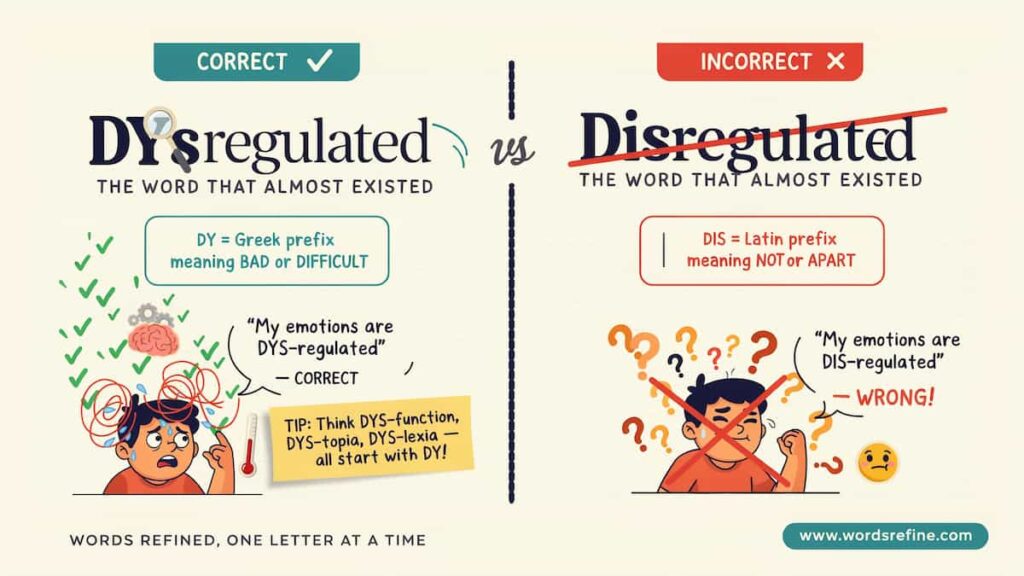
The difference between dysregulated vs disregulated may seem like a minor spelling issue, but choosing the wrong word can create unnecessary confusion. Although the two forms look similar, dysregulated is the standard spelling when referring to impaired emotional, behavioral, or physiological regulation. From emotional responses to nervous system function, this term appears in many everyday and professional contexts. However, it is also important to distinguish it from unregulated and deregulated, which carry different meanings. In this guide, you’ll explore their definitions, differences, and correct usage through clear examples. After all, good writing begins with choosing the right words!
Quick Answer dysregulated vs disregulated
dysregulated vs disregulated is the correct and standard spelling when describing something that has impaired, abnormal, or poorly functioning regulation. In contrast, disregulated is generally considered a nonstandard spelling when writers intend the same meaning.
The confusion comes from the prefixes dys- and dis-. Although they look similar, they don’t serve the same purpose in every word.
The prefix dys- comes from Greek and commonly indicates something abnormal, impaired, or difficult. Meanwhile, dis- has several meanings in English, including separation, reversal, and negation.
Here’s how the three commonly confused words differ:
| Word | Meaning | Correct usage |
|---|---|---|
| Dysregulated | Poorly or abnormally regulated | A dysregulated emotional response |
| Disregulated | Generally a nonstandard spelling of dysregulated | Avoid when dysregulated is intended |
| Deregulated | Released from certain rules or restrictions | A deregulated industry |
| Unregulated | Not controlled by sufficient rules or oversight | An unregulated market |
For example, a child may become emotionally dysregulated after a stressful day. Similarly, a patient may experience a dysregulated physiological response. However, a government may deregulate an industry by removing certain restrictions.
Therefore, when discussing impaired emotional, behavioral, or physiological regulation, dysregulated is the word to choose.
Learn the difference between confusing more English words
Acception vs Exception Differences and Correct Usage?
What Does Dysregulated Mean?
Dysregulated describes a system, process, or response that doesn’t operate according to its normal regulatory patterns. Its regulation may be impaired, excessive, inconsistent, or poorly controlled.
In simple terms, something is dysregulated when its usual control system doesn’t work as effectively as it should.
For example, your body constantly regulates its temperature to maintain a healthy internal balance. When this process becomes impaired, your body may struggle to maintain its normal temperature. Similarly, emotional dysregulation describes difficulty managing feelings and responding appropriately to different situations.
The word appears in several fields, including psychology, medicine, biology, neuroscience, and everyday communication.
In psychology, it often describes difficulty managing emotional responses and impulses. In medicine, it may refer to abnormal control of physiological processes. Likewise, biological researchers use it when discussing disrupted cellular activity, immune responses, and metabolic functions.
Simple Definition of Dysregulated
The simplest definition of dysregulated is a condition in which normal regulation becomes impaired or doesn’t function properly.
Consider these examples:
A person experiencing emotional dysregulation may struggle to manage intense feelings.
A dysregulated immune response may involve excessive or inappropriate immune activity.
Dysregulated glucose metabolism describes problems with the processes that control blood sugar levels.
Similarly, dysregulated behavior may involve difficulty managing impulses or emotional reactions.
However, dysregulated doesn’t always mean a complete loss of control. Sometimes, a system continues working but fails to maintain the balance or consistency needed for normal functioning.
Learn the difference between commonly mixed-up more words
Association vs Organization Meaning Differences Usage ?
Origin and Word Formation of Dysregulated
Understanding how the word developed makes its spelling much easier to remember.
Dysregulated combines the prefix dys- with regulated. The prefix comes from Greek and commonly indicates something abnormal, impaired, difficult, or faulty. Regulated comes from the verb regulate, which means to control, manage, or adjust something according to a particular process.
Together, these elements describe something whose normal regulatory process isn’t working properly.
The same prefix appears in several familiar English words:
| Word | Meaning |
|---|---|
| Dysfunction | Impaired or abnormal functioning |
| Dyslexia | A learning disorder that affects reading and related language skills |
| Dysphagia | Difficulty swallowing |
| Dysrhythmia | An abnormal rhythm |
| Dysregulation | Impaired or abnormal regulation |
These examples reveal a useful spelling pattern. When a word describes abnormal or impaired functioning, dys- is often the appropriate prefix.
Is Dysregulated a Word?
Yes. Dysregulated is an established English word used in medical, psychological, biological, and everyday writing.
It’s also the past-tense and past-participle form of the verb dysregulate.
For example, prolonged stress may dysregulate normal sleep patterns. Likewise, researchers may investigate dysregulated immune activity or changes in physiological processes.
The related word forms include:
| Word form | Example |
|---|---|
| Dysregulate | Chronic stress may dysregulate normal processes. |
| Dysregulated | The system became dysregulated. |
| Dysregulating | The ongoing pressure was dysregulating his routine. |
| Dysregulation | Emotional dysregulation can affect relationships. |
Knowing these related forms makes it easier to recognize the correct spelling in different sentences.
Learn the difference between tricky grammar more words
Arised vs Arose Which Is Correct?
What Does Disregulated Mean?
The spelling disregulated sometimes appears when people intend to write dysregulated. However, it isn’t the standard spelling for impaired or abnormal regulation in contemporary English usage.
The confusion is understandable. English contains many familiar words beginning with dis-, and the prefix can suggest separation, reversal, or an opposite action.
For instance, disagree means to have a different opinion. Disappear means to vanish. Disapprove means to express an unfavorable opinion. Similarly, disconnect means to separate something from a connection.
Because dis- appears in so many everyday words, writers may mistakenly apply it to dysregulated.
Is Disregulated a Word?
If you’re asking whether disregulated is the correct standard spelling for something that cannot regulate itself properly, the answer is no.
It’s generally treated as a nonstandard spelling of dysregulated in this context. Therefore, writers should use dysregulated in medical, scientific, psychological, and educational discussions.
Consider these examples:
Incorrect: The patient showed signs of a disregulated stress response.
Correct: The patient showed signs of a dysregulated stress response.
Incorrect: Emotional disregulation can affect relationships.
Correct: Emotional dysregulation can affect relationships.
The related noun follows the same spelling pattern. Therefore, write dysregulation rather than disregulation when discussing impaired regulation.
Learn the difference between confusing word pairs
Esthetically vs Aesthetically Meaning Differences and Correct ?
Why Do People Write Disregulated Instead of Dysregulated?
Several factors contribute to this common spelling confusion.
First, pronunciation plays a role. Both spellings look similar and can sound almost identical in ordinary conversation. Consequently, people who learn the word by hearing it may choose the wrong prefix when writing it.
Another reason involves familiarity with English prefixes. Since dis- appears in many common words, writers may automatically choose it without considering the word’s origin or meaning.
Furthermore, confusion with deregulated makes the problem worse. Both words contain similar letters, but their meanings are different.
Typing habits can also contribute. When someone repeatedly uses an incorrect spelling, predictive text and autocorrect may not always recognize the intended word.
Finally, social media spreads informal language quickly. When people repeatedly encounter disregulated in online discussions about emotional health, ADHD, trauma, or parenting, the spelling may begin to look correct.
However, familiarity doesn’t make a spelling standard. When discussing impaired regulation, dysregulated remains the appropriate choice.
Dysregulated vs Disregulated Key Differences
The main difference between dysregulated vs disregulated involves standard English spelling and word formation.
Dysregulated is the established word used to describe impaired or abnormal regulation. In contrast, disregulated is generally an incorrect alternative when writers intend the same meaning.
| Feature | Dysregulated | Disregulated |
|---|---|---|
| Standard spelling | Yes | No, for the intended meaning |
| Prefix | Dys- | Dis- |
| Meaning | Impaired or abnormal regulation | Usually intended to mean dysregulated |
| Medical usage | Established | Generally nonstandard |
| Psychological usage | Established | Generally nonstandard |
| Formal writing | Recommended | Avoid |
Dysregulated vs Disregulated Which Is Correct?
Choose dysregulated whenever you’re describing an impaired regulatory process.
For example, a person’s emotional responses may become dysregulated during a stressful situation. Similarly, researchers may examine dysregulated hormone activity or abnormal immune responses.
Here are a few more examples:
The child’s emotional responses became dysregulated after a difficult day.
Researchers investigated dysregulated immune activity in the study participants.
Chronic stress may affect the body’s normal regulatory processes.
She struggled to manage her emotions during the disagreement.
The easiest rule to remember is that dysregulation, dysregulated, and dysregulate all use the prefix dys-.
Dysregulated vs Deregulated vs Unregulated
Although these words look similar and relate to regulation, they describe different dysregulated vs disregulated situations. Understanding their meanings can help you avoid another common vocabulary mistake.
Dysregulated A System Isn’t Functioning Properly
Dysregulated describes a system or process that has difficulty maintaining its normal regulatory functions.
For example, someone experiencing emotional dysregulation may struggle to manage intense feelings. Similarly, dysregulated glucose metabolism describes impaired control of processes involved in maintaining blood sugar levels.
The important point is that the regulatory process exists but doesn’t function effectively.
Learn the difference between often confused words
Grey vs Gray What’s the Difference?
Deregulated Rules or Controls Have Been Removed
Deregulated describes something from which official regulations, restrictions, or controls have been removed or reduced.
This word frequently appears in discussions about economics, business, government, and public policy.
For example, a government may deregulate an industry to reduce restrictions on businesses. Similarly, a company may enter a deregulated energy market.
A deregulated industry doesn’t necessarily operate poorly. It simply functions under fewer government-imposed restrictions.
Unregulated Without Effective Rules or Oversight
Unregulated describes something that isn’t controlled or governed by sufficient rules, standards, or oversight.
For instance, an unregulated market may lack adequate consumer protections. Likewise, an unregulated product may enter the market without sufficient safety oversight.
Unlike dysregulated, which describes impaired functioning within a regulatory process, unregulated focuses on the absence of adequate control.
Dysregulated vs Deregulated vs Unregulated Examples
| Word | Example sentence | Explanation |
|---|---|---|
| Dysregulated | Her emotional responses became dysregulated during the argument. | Her emotional regulation was impaired. |
| Deregulated | The government deregulated the industry. | Official restrictions were reduced. |
| Unregulated | The product entered an unregulated market. | The market lacked sufficient oversight. |
Remember the distinction: dysregulated means poorly regulated, dysregulated vs disregulated means released from certain regulations, and unregulated means lacking adequate regulation.
Learn the difference between basic English word mistakes
Swang vs Swung Which Is Correct?
What Does Emotional Dysregulation Mean?
Emotional dysregulation describes difficulty managing the intensity, duration, or expression of emotional responses.
Everyone experiences strong emotions. Anger, sadness, excitement, disappointment, and fear are normal parts of life. However, emotional regulation helps people respond to these feelings in ways that fit their circumstances.
Imagine receiving disappointing news at work. Naturally, you may feel frustrated or upset. With effective emotional regulation, you can acknowledge your feelings, consider your options, and respond without allowing the emotion to control every decision.
However, someone experiencing emotional dysregulation may find this process much harder.
Emotional regulation doesn’t mean avoiding feelings or pretending everything is fine. Instead, it involves recognizing emotions, understanding their triggers, and choosing appropriate ways to respond.
Common Signs of Emotional Dysregulation
Emotional dysregulation can look different from one person to another. Nevertheless, some common patterns include:
Intense emotional reactions that seem disproportionate to a situation.
Difficulty calming down after becoming upset.
Impulsive responses, such as speaking or acting before considering the consequences.
Frequent emotional changes or sudden shifts in emotional intensity.
Low frustration tolerance, especially when dealing with ordinary setbacks.
Emotional overwhelm when several stressful situations happen together.
These patterns may affect relationships, work, education, and everyday responsibilities. However, they don’t automatically indicate a mental health condition. A single emotional outburst is a normal human experience, not proof of persistent dysregulation.
Dysregulated Emotions Everyday Examples
Consider a few familiar situations.
At work, an employee receives constructive criticism and becomes extremely upset. Instead of discussing the feedback, they react angrily and struggle to return to their usual routine.
At home, someone becomes overwhelmed when several small responsibilities arise at once. As a result, they find it difficult to organize their thoughts or manage their frustration.
In a relationship, a person interprets a delayed response to a message as rejection. Consequently, they experience an intense emotional reaction before considering other possible explanations.
During stressful situations, someone may continue feeling overwhelmed long after the original problem has ended.
These examples demonstrate how difficulty regulating emotions can affect ordinary activities and relationships.
Emotional Regulation vs Emotional Suppression
One important distinction is that emotional regulation doesn’t mean hiding or suppressing feelings.
Emotional regulation involves recognizing emotions, understanding what triggers them, and choosing healthy ways to respond.
For example, suppression means pretending you’re not angry when you actually feel upset. Regulation means recognizing your anger, understanding why you feel that way, and deciding how to address the situation constructively.
In other words, the goal isn’t to eliminate emotions. It’s to develop healthier ways of responding to them.
Learn the difference between commonly misused words
Curb vs Kerb the Difference Meaning and Correct ?
What Does a Dysregulated Nervous System Mean?
The phrase dysregulated nervous system generally describes impaired or disrupted regulation of nervous system responses.
Your nervous system coordinates communication between your brain, spinal cord, and the rest of your body. It helps control movement, sensory information, stress responses, and many automatic physiological processes.
One important part is the autonomic nervous system, which manages functions that usually happen without conscious effort.
These functions include heart rate, blood pressure, digestion, sweating, breathing patterns, and pupil responses.
The autonomic nervous system has several divisions, including the sympathetic and parasympathetic nervous systems.
The sympathetic nervous system helps prepare your body for action during stress or danger. Meanwhile, the parasympathetic nervous system supports functions associated with rest, digestion, and recovery.
Both systems work together to help maintain physiological balance.
Fight Flight and Freeze Responses
When your brain detects a possible threat, your body may activate protective responses. These reactions are commonly described as fight, flight, and freeze.
The fight response prepares the body to confront a perceived threat. A person may feel tense, defensive, or ready to act.
The flight response prepares the body to escape or avoid danger. It may involve restlessness, increased alertness, or a strong urge to leave.
The freeze response may leave someone temporarily unable to move, speak, or respond effectively when overwhelmed by a threatening situation.
You may also encounter the term fawn, which describes an appeasing response sometimes discussed in trauma-related contexts.
However, these reactions aren’t automatically signs of nervous system dysregulation. They’re protective responses that can occur during stressful or dangerous situations.
The concern arises when stress responses become persistent, difficult to manage, or disruptive to normal functioning.
How Chronic Stress Can Affect Nervous System Regulation
Short-term stress can help you respond to challenges. However, prolonged stress places continued demands on the body’s regulatory systems.
For example, chronic stress may contribute to sleep difficulties, persistent muscle tension, irritability, changes in appetite, difficulty concentrating, and physical or emotional exhaustion.
The autonomic nervous system plays an important role in the body’s stress response. When stress continues, repeated activation may affect several physiological processes.
Nevertheless, these symptoms have many possible causes. They shouldn’t automatically be treated as proof of a dysregulated nervous system.
Dysregulation in Children
Children are still developing the skills needed to recognize, understand, and manage their emotions. Consequently, they may struggle with emotional regulation more often than adults.
A dysregulated child is a child who has difficulty managing emotional or behavioral responses in certain situations.
This doesn’t mean the child is deliberately behaving badly. Instead, their current ability to manage frustration, excitement, disappointment, or sensory demands may not match the situation.
Learn the difference between everyday English mistakes
DPhil vs PhD Meaning Differences Recognition Salary?
What Does Dysregulated Behavior Look Like in Children?
Dysregulated behavior in children may include crying intensely when an activity ends, becoming overwhelmed by loud environments, struggling with transitions between activities, reacting strongly to unexpected changes, or having difficulty calming down after disappointment.
For example, imagine a six-year-old playing with building blocks. A parent announces that playtime is over and it’s time for dinner.
The child begins shouting, crying, and refusing to move. Even after the parent explains the situation, the child struggles to calm down.
This reaction may reflect difficulty managing disappointment or transitioning between activities. However, one incident isn’t enough to conclude that the child has a persistent regulation problem.
What Can Cause Emotional Dysregulation in Children?
Several factors may contribute to emotional regulation difficulties.
Developmental stage plays an important role because young children are still developing the cognitive and emotional skills needed to manage frustration and impulses.
Sleep difficulties can also affect mood, attention, and behavior. Similarly, family changes, school pressures, and stressful experiences may make emotional regulation harder.
Sensory overload is another possible factor. Loud noises, bright lights, crowded spaces, and uncomfortable textures may overwhelm some children.
Furthermore, developmental and mental health conditions such as ADHD, autism, and anxiety may involve emotional regulation difficulties.
These factors don’t affect every child in the same way. Therefore, it’s important to consider the child’s individual needs and circumstances.
How Parents Can Support a Dysregulated Child
Parents and caregivers can help children develop healthier self-regulation skills through everyday support.
Consistent routines can make daily transitions easier and help children understand what to expect.
Naming emotions can also help. Encourage children to recognize whether they feel angry, disappointed, worried, or overwhelmed.
Furthermore, adults can model calm behavior. Children often learn by watching how parents and caregivers handle frustration.
Giving advance warnings before ending an enjoyable activity may also reduce difficult transitions.
When noise or activity becomes overwhelming, provide a quieter environment and allow the child some time to settle.
Finally, introduce age-appropriate calming strategies, such as taking a break, practicing slow breathing, or working through a problem one step at a time.
If emotional or behavioral difficulties persist and interfere with school, relationships, sleep, or everyday activities, a qualified professional can help assess the situation.
Dysregulation and ADHD
Emotional dysregulation is commonly discussed in connection with attention-deficit/hyperactivity disorder, also known as ADHD.
ADHD is a neurodevelopmental condition characterized by persistent patterns of inattention, hyperactivity, and impulsivity that interfere with everyday functioning.
Some people with ADHD also experience difficulties managing emotional responses.
For example, they may become frustrated quickly, struggle with disappointment, or react impulsively during emotionally challenging situations.
What Is ADHD Related Emotional Dysregulation?
ADHD-related emotional dysregulation refers to difficulties managing emotional reactions that may occur alongside ADHD.
Some individuals experience intense frustration, irritability, difficulty managing disappointment, impulsive emotional reactions, sensitivity to criticism, or trouble calming down after upsetting experiences.
These difficulties can affect school performance, friendships, family relationships, and workplace interactions.
However, emotional dysregulation isn’t a universal experience among people with ADHD.
Dysregulated ADHD Everyday Examples
Imagine an employee with ADHD receiving feedback about a mistake. They understand that the feedback is intended to help, but they experience an intense emotional reaction and struggle to move past it.
Similarly, a student may encounter a difficult assignment and become frustrated quickly. Instead of calmly working through the problem, they abandon the task.
Another person may respond angrily during a disagreement and later regret speaking before thinking.
These situations can illustrate emotional regulation difficulties. However, they don’t establish an ADHD diagnosis.
Does Everyone With ADHD Experience Emotional Dysregulation?
No. Emotional dysregulation doesn’t affect everyone with ADHD.
Some individuals experience significant difficulties managing emotions, while others don’t report the same challenges.
It’s also important to distinguish associated emotional difficulties from the formal diagnostic criteria for ADHD. The core diagnostic features involve inattention and/or hyperactivity and impulsivity.
A qualified healthcare professional considers the full pattern of symptoms, their duration, and their impact on everyday functioning.
Dysregulation and Autism
Autism spectrum disorder is a neurodevelopmental condition that can involve differences in social communication, interaction, behavior, and sensory processing.
Some autistic people experience difficulties with emotional regulation, particularly when they encounter unexpected changes, sensory overload, or demanding environments.
However, autism doesn’t affect everyone in the same way. Emotional and sensory experiences vary considerably.
Learn the difference between more words people mix up
Hoover vs Hover Meaning Differences Pronunciation?
What Does Dysregulation Mean in Autism?
In autism-related discussions, dysregulation may describe difficulty managing emotional or behavioral responses when environmental demands become overwhelming.
For example, a person may find a crowded shopping center difficult because of loud conversations, bright lights, movement, and unexpected sounds.
These experiences can increase stress and make it harder to manage emotional responses.
Examples of Dysregulation in Autistic People
An autistic person may become overwhelmed by loud or repetitive sounds. Another may experience distress when familiar routines change unexpectedly.
Similarly, crowded environments may create sensory challenges. Transitions between activities may also require additional time and preparation.
After sensory overload, some people may need a quieter environment and extra time to recover.
Emotional Dysregulation vs Sensory Overload
Although these concepts are related, they aren’t identical.
| Emotional dysregulation | Sensory overload |
|---|---|
| Difficulty managing emotional responses | Difficulty processing intense sensory input |
| May involve anger, frustration, or distress | May involve noise, light, touch, or movement |
| Can occur in many situations | Often linked to overwhelming sensory environments |
| Affects emotional regulation | Involves sensory processing demands |
Sensory overload can contribute to emotional dysregulation. However, the two terms shouldn’t be used interchangeably.
A meltdown, for example, shouldn’t automatically be interpreted as intentional misbehavior. It may reflect difficulty coping with overwhelming demands.
Other Types of Biological and Physiological Dysregulation
Although emotional dysregulation receives considerable attention, the word also appears in medical and biological discussions.
In these contexts, dysregulated describes impaired control of normal physiological processes.
Hormonal Dysregulation
Hormones are chemical messengers that help coordinate many bodily functions. They influence growth, metabolism, reproduction, stress responses, and other physiological activities.
Hormonal dysregulation occurs when hormone production, release, signaling, or control becomes abnormal.
For example, abnormal thyroid hormone levels may affect metabolism. Similarly, disrupted cortisol regulation may influence the body’s response to stress.
Irregular insulin production or signaling may also affect blood glucose control.
The specific effects depend on which hormones and regulatory mechanisms are involved.
Blood Sugar Dysregulation
Blood glucose regulation helps maintain an appropriate level of sugar in the bloodstream.
Insulin, a hormone produced by the pancreas, plays a central role in helping glucose enter cells.
When this regulatory process becomes impaired, blood glucose levels may remain too high or fall too low.
Diabetes is an important example of a condition involving impaired blood glucose regulation.
The phrase dysregulated glucose metabolism may describe abnormalities in the processes responsible for maintaining normal glucose balance.
Immune System Dysregulation
The immune system protects the body against harmful microorganisms and other threats. However, immune activity must remain properly controlled.
Immune system dysregulation describes abnormal immune responses. These may involve excessive activity, insufficient activity, or inappropriate responses against the body’s own tissues.
For example, autoimmune conditions involve immune responses directed against the body’s own cells or tissues.
The term also appears in discussions of inflammation and immune signaling.
Metabolic Dysregulation
Metabolism includes the chemical processes through which the body produces and uses energy.
Metabolic dysregulation describes impaired control of these processes. It may involve abnormalities in glucose metabolism, lipid metabolism, energy production, insulin signaling, and metabolic hormone regulation.
The term appears in medical and scientific discussions involving conditions such as insulin resistance and metabolic syndrome.
Dysregulated Behavior Meaning and Examples
Dysregulated behavior describes actions or reactions associated with difficulty managing impulses, emotions, or behavioral responses.
The term frequently appears in psychology, education, and parenting discussions.
For example, a student who becomes overwhelmed during a difficult classroom activity may shout, leave their seat, or refuse to continue.
These actions may reflect difficulty managing frustration or stress.
However, behavior alone doesn’t reveal someone’s intentions. A person may react strongly because of frustration, anxiety, sensory overload, fatigue, or other factors.
Dysregulated vs Defiant Behavior
These terms shouldn’t be treated as synonyms.
Dysregulated behavior describes behavior associated with difficulty managing emotional or behavioral responses.
Defiant behavior generally describes resistance to instructions, requests, or authority.
For example, a child who cries because a classroom becomes overwhelming may be experiencing emotional dysregulation.
In contrast, a child who deliberately refuses a reasonable instruction may be displaying defiant behavior.
Of course, real situations can be more complicated. A child may experience emotional distress while also struggling to follow instructions.
Therefore, it’s better to understand the circumstances instead of automatically labeling behavior as intentional disobedience.
Learn the difference between often confused words
Patronise vs Patronize Meaning Spelling Differences?
Dysregulated Behavior in Different Settings
| Setting | Example |
|---|---|
| Home | A child becomes overwhelmed when asked to stop playing. |
| School | A student struggles to manage frustration during a difficult assignment. |
| Workplace | An employee reacts intensely to unexpected criticism. |
| Social situations | Someone has difficulty managing emotions during an argument. |
These examples demonstrate how difficulty with emotional and behavioral regulation may appear in different environments.
How to Use Dysregulated Correctly in a Sentence
Understanding the definition is useful, but seeing the word in context makes correct usage much easier.
The following examples show how to use dysregulated naturally in everyday, medical, and scientific writing.
Dysregulated Examples in Everyday Writing
Her emotional responses became dysregulated during the stressful conversation.
The child appeared dysregulated after several hours of activity.
He struggled to manage his dysregulated behavior during the disagreement.
Stress can affect a person’s ability to regulate emotions.
The sudden change disrupted her normal routine and increased her emotional distress.
Dysregulated Examples in Medical and Scientific Writing
Researchers investigated dysregulated immune activity in the study participants.
The study examined abnormal glucose regulation.
Hormonal dysregulation can affect several physiological processes.
Scientists explored the relationship between inflammation and immune dysregulation.
The researchers identified changes in metabolic regulation.
Dysregulated vs Disregulated in a Sentence
The following dysregulated vs disregulated comparisons demonstrate common spelling mistakes and their corrections.
| Incorrect sentence | Correct sentence |
|---|---|
| The patient experienced emotional disregulation. | The patient experienced emotional dysregulation. |
| Her nervous system became disregulated. | Her nervous system became dysregulated. |
| The child showed disregulated behavior. | The child showed dysregulated behavior. |
| Researchers examined disregulated immune activity. | Researchers examined dysregulated immune activity. |
Better Alternatives to Dysregulated
Although dysregulated is correct, it isn’t always the clearest choice for every situation.
Depending on your intended meaning, you can use alternatives such as poorly regulated, impaired regulation, emotionally overwhelmed, uncontrolled, disrupted, unbalanced, or difficult to manage.
For example, instead of writing, “The employee became dysregulated after receiving criticism,” you might write, “The employee became emotionally overwhelmed after receiving criticism.”
The second sentence may be easier for a general audience to understand.
Nevertheless, when discussing a specific psychological or physiological process, dysregulated may be the more precise choice.
Learn the difference between commonly misused words
Glinda vs Galinda Which One Is Correct and ?
Dysregulated vs Disregulated Common Mistakes to Avoid
Even experienced writers sometimes confuse these terms. Fortunately, understanding dysregulated vs disregulated a few common mistakes can improve your spelling and word choice.
One frequent mistake is using disregulated instead of dysregulated.
Incorrect: The patient showed signs of emotional disregulation.
Correct: The patient showed signs of emotional dysregulation.
Another mistake involves confusing dysregulated vs disregulated
Incorrect: The government dysregulated the energy industry by removing restrictions.
Correct: The government deregulated the energy industry by removing restrictions.
Writers also sometimes treat dysregulation as a formal diagnosis. However, emotional dysregulation describes difficulty managing emotional responses and may occur in different conditions or circumstances.
Another common misunderstanding is assuming that every strong emotional reaction indicates dysregulation. That’s not true. Anger, sadness, and frustration are normal emotions. Persistent or disproportionate difficulties managing emotional responses may suggest a regulation problem, but context matters.
Finally, avoid using dysregulated and unregulated interchangeably. Dysregulated describes impaired regulation, whereas unregulated generally describes something that lacks adequate rules or control.
How to Remember the Correct Spelling of Dysregulated
If you frequently confuse dysregulated vs disregulated, a simple word association can help.
Remember the Prefix Dys-
Think of the word dysfunction.
Both dysfunction and dysregulation use the Greek-derived prefix dys-.
Dysfunction means impaired functioning.
Dysregulation means impaired or abnormal regulation.
Dysregulated describes something functioning with impaired regulation.
This connection makes the correct spelling easier to remember.
Connect Dysregulated vs Dysregulation
Another helpful trick is to memorize the related words together.
Dysregulate is the verb.
Dysregulated is the past-tense and past-participle form.
Dysregulation is the related noun.
All three use the same prefix. Therefore, once you remember the spelling of dysregulation, you can easily identify the correct spelling of dysregulated.
A Simple Spelling Rule
When describing impaired emotional, behavioral, biological, or physiological regulation, use dys-, not dis-.
Remember this example: An emotionally dysregulated person may experience difficulty managing emotional responses.
Once you connect the spelling with its meaning, the confusion becomes much easier to avoid.
Why Accurate Use of Dysregulated Matters
Correct terminology makes writing clearer, especially when discussing psychology, medicine, education, and mental health.
Using dysregulated instead of disregulated helps readers recognize the established term and understand the intended meaning.
Accuracy also matters when discussing children and people with ADHD or autism. These terms describe particular patterns of regulation, not someone’s personality or intentions.
For example, describing a child as dysregulated communicates something different from calling the child difficult or badly behaved. The first description points toward challenges with emotional or behavioral regulation, while the second may sound like a judgment about the child’s character.
Similarly, describing someone as emotionally dysregulated shouldn’t automatically imply a specific mental health diagnosis.
Good writing uses accurate terminology without turning descriptive language into an unsupported medical label.
When your audience may not recognize the word, explain it in simpler language. For instance, difficulty managing emotional responses may communicate the idea more clearly than emotional dysregulation alone.
Learn the difference between tricky grammar more words
Hoodie vs Hoody Which One Is Correct?
Practice Session Dysregulated vs Disregulated
1. Emotional __________ can make it difficult to manage intense feelings.
2. After a stressful day, she felt emotionally __________ and struggled to calm down.
3. The company benefited from the government’s decision to __________ the industry.
4. A __________ nervous system may struggle to respond appropriately to stress.
5. The child became __________ after several hours in a noisy environment.
6. The term __________ describes impaired or abnormal regulation.
7. The government introduced new policies to prevent __________ business practices.
8. People with ADHD may sometimes experience emotional __________.
9. The therapist helped him recognize the signs of emotional __________
10. Removing unnecessary government restrictions is known as __________.
11. She felt emotionally __________ after dealing with several unexpected problems.
12. An __________ market may lack sufficient rules or oversight.
13. Scientists studied how stress affects the body’s regulatory systems and contributes to __________.
14. The company operates in a highly __________ industry with few formal restrictions.
15. Sensory overload can sometimes leave an autistic person feeling __________.
16. The new policy aims to reduce government control through financial __________.
17. Difficulty managing emotional reactions may be a sign of emotional __________.
18. The doctor examined whether hormonal __________ contributed to the patient’s symptoms.
19. Without proper supervision, the activity could become __________.
20. After taking a break from the overwhelming environment, he gradually felt less __________.
21. The researchers investigated the relationship between sleep problems and emotional __________.
22. The government decided to __________ certain industries to encourage competition.
23. An emotionally __________ person may find it difficult to calm down after a stressful event.
24. The study explored how immune system __________ can affect overall health.
25. The word __________ is the standard spelling when describing impaired emotional or physiological regulation.
Answers
- Dysregulation
- Dysregulated
- Deregulate
- Dysregulated
- Dysregulated
- Dysregulation
- Unregulated
- Dysregulation
- Dysregulation
- Deregulation
- Dysregulated
- Unregulated
- Dysregulation
- Unregulated
- Dysregulated
- Deregulation
- Dysregulation
- Dysregulation
- Unregulated
- Dysregulated
- Dysregulation
- Deregulate
- Dysregulated
- Dysregulation
- Dysregulated
Here’s a trusted source for clear more words Comparison:
FAQs
Is ADHD a Form of Dysregulation?
No. ADHD is a neurodevelopmental condition, not a form of dysregulation. However, some people with ADHD experience emotional dysregulation, which can make it difficult to manage frustration, impulses, and intense emotional reactions.
Are Dysregulated and Unregulated the Same Thing?
No. Dysregulated describes a system that struggles to maintain normal regulation, whereas unregulated refers to something that lacks adequate control, rules, or oversight. Although the meanings are related, the words aren’t interchangeable.
When Did Dysregulated Become a Word?
Dysregulated developed from the word regulate and the Greek-derived prefix dys-, which indicates something abnormal or impaired. The term became increasingly common in medical, psychological, and scientific writing as researchers discussed difficulties with emotional, biological, and physiological regulation. However, its exact first recorded use is difficult to establish.
Is Dysregulation a Proper Word?
Yes. Dysregulation is an established English word used in psychology, medicine, biology, and neuroscience. It describes impaired or abnormal regulation of a process, such as emotional responses, hormone activity, or immune function.
What Does It Mean If Someone Is Disregulated?
When someone describes a person as disregulated, they usually mean that the person is struggling to manage emotions, behavior, or stress responses. However, dysregulated is the standard spelling for this meaning. It may describe emotional overwhelm, intense reactions, or difficulty calming down.
Is It Disregulated vs Deregulated?
The correct word depends on the intended meaning. dysregulated vs disregulated describes impaired or abnormal regulation, whereas deregulated means that official rules or restrictions have been removed or reduced. If you’re discussing emotional or nervous system regulation, use dysregulated.
Why Am I So Dysregulated?
Feeling dysregulated may be associated with ongoing stress, poor sleep, emotional overwhelm, sensory overload, or difficulty managing challenging situations. Certain mental health and developmental conditions may also contribute. However, occasional emotional overwhelm is a normal human experience and doesn’t automatically indicate a disorder. If these difficulties persist or interfere with daily life, consider speaking with a qualified healthcare professional.
What’s Another Word for Dysregulated?
Depending on the context, alternatives include poorly regulated, impaired, disrupted, unbalanced, emotionally overwhelmed, or difficult to control. For example, emotionally overwhelmed may sound more natural in everyday conversation, while impaired regulation may be more suitable for professional or scientific writing.
What Does Dysregulated Mean in Autism?
In autism, dysregulated generally describes difficulty managing emotional or behavioral responses, particularly during sensory overload, unexpected changes, or stressful situations. An autistic person may become overwhelmed by loud noises, crowded environments, or sudden changes in routine. However, experiences vary, and dysregulation doesn’t affect every autistic person in the same way.
Learn the difference between tricky grammar more words
Heyday vs Hayday Meaning Correct One Differences?
Conclusion
Understanding the difference between dysregulated vs disregulated, unregulated, and deregulated helps you avoid a common spelling and grammar mistake. Dysregulated is the standard term for impaired or abnormal regulation, particularly when discussing emotions, behavior, or bodily functions. Disregulated is generally considered a nonstandard spelling in this context. Meanwhile, unregulated describes something that lacks adequate control or oversight, whereas deregulated refers to the removal or reduction of official restrictions. Once you understand these distinctions, choosing the right word becomes straightforward. Remember, clear writing starts with precise word choices and even the most complicated emotions deserve the right spelling!

Diora AJS she is an experienced blogger and passionate English language enthusiast at Words Refine. With a keen eye for language and a love for clear communication, she writes practical content about grammar, word meanings, usage, and commonly confused terms. Her goal is to make English easier to understand through clear explanations and relatable examples, helping readers write accurately and communicate with confidence.