
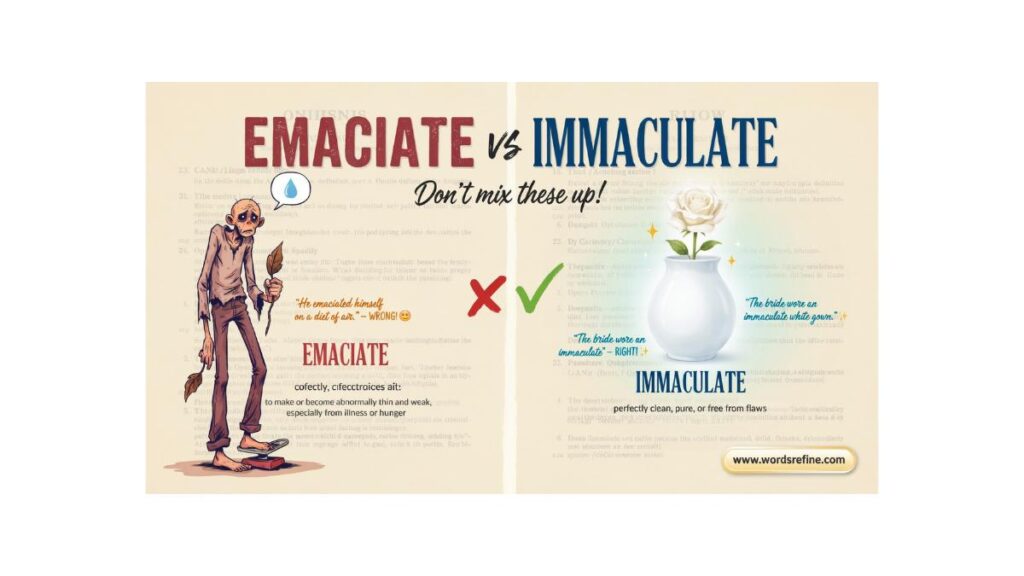
Choosing between emaculate vs immaculate may seem like a minor spelling decision, but using the wrong form can affect the clarity of your writing. Although the two look and sound similar, only immaculate is correct in standard English. It describes something exceptionally clean, flawless, or free from imperfections. Emaculate, on the other hand, is a common misspelling that often causes confusion. Whether you are describing a spotless home, an elegant appearance, or an outstanding performance, knowing the correct word helps you communicate with confidence. Let’s examine their differences, explore useful examples, and uncover simple ways to remember the correct spelling.
Quick Answer Emaculate vs Immaculate?
If you are wondering whether to write emaculate vs immaculate the answer is simple: immaculate is correct.
Emaculate is an incorrect spelling of immaculate. It isn’t an accepted standard spelling, so you shouldn’t use it in formal writing, professional communication, or everyday sentences.
Here’s the difference in context:
Emaculate: An incorrect spelling with no established standard English meaning.
Immaculate: The correct adjective meaning perfectly clean, spotless, or free from flaws.
Consider these examples:
Incorrect: Her kitchen looks emaculate after the renovation.
Correct: Her kitchen looks immaculate after the renovation.
The corrected sentence describes a kitchen that’s exceptionally clean, tidy, and well-maintained.
Remember one simple rule: When you mean spotless or flawless, always write immaculate. It begins with an I and contains two M’s.
Learn the difference between confusing more English words
Want vs Wont Meaning Differences and Usage ?
What Does Immaculate Mean?
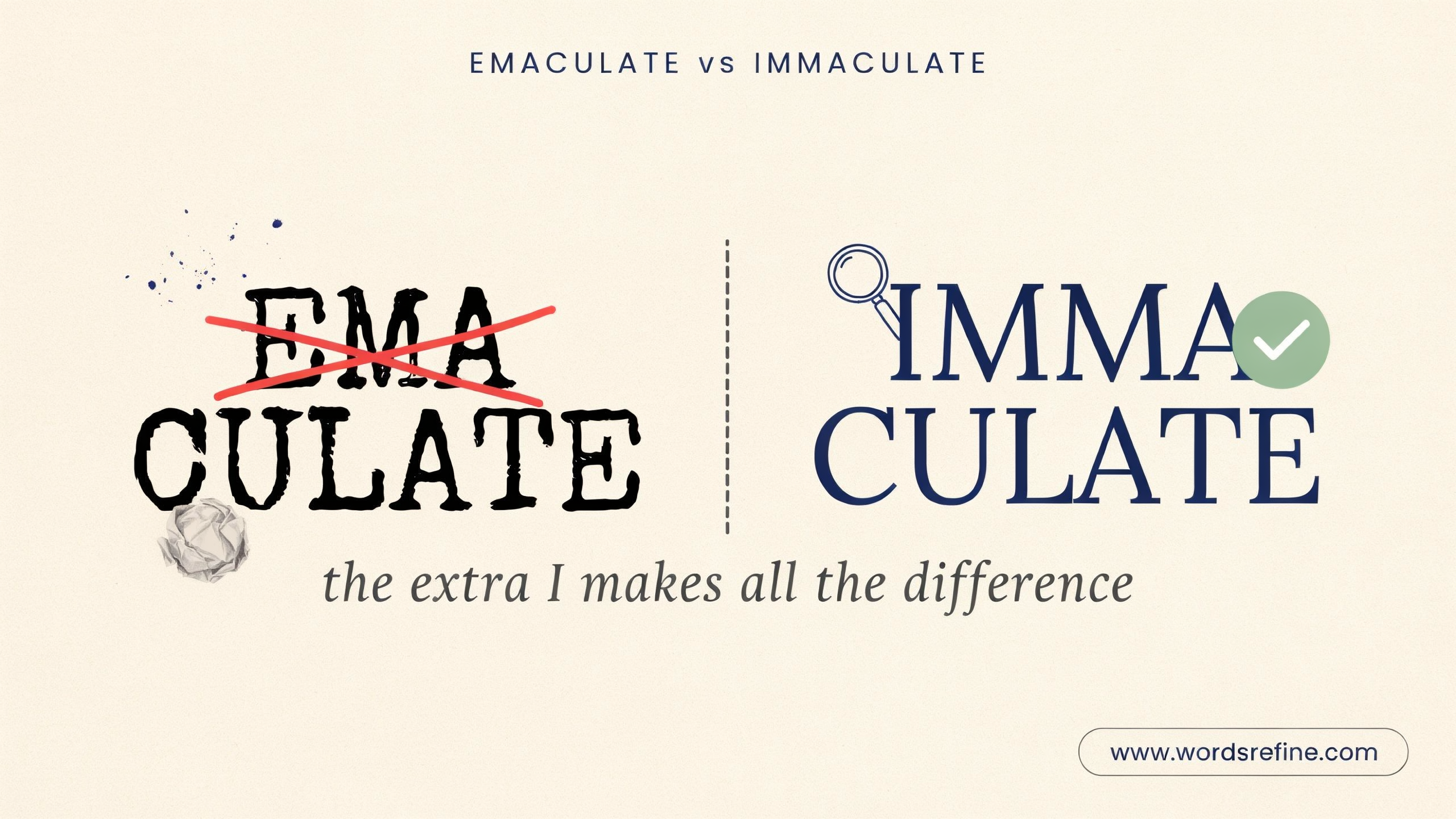
emaculate vs immaculate describes something completely free from dirt, stains, marks, or noticeable flaws. It can refer to physical cleanliness, but it also describes something that meets an exceptionally high standard.
Imagine walking into a hotel room where the floors shine, the furniture looks well maintained, the bathroom smells fresh, and everything sits neatly in its place. You could easily describe that room as immaculate.
However, the word isn’t limited to cleanliness. People also use it to describe impressive performances, elegant appearances, excellent work, and spotless records.
Immaculate Meaning in Simple English
In simple terms, immaculate means perfectly clean or free from noticeable flaws.
Depending on the situation, it can describe something that is:
Completely clean and free from dirt.
Neat, organized, and carefully maintained.
Without stains, marks, or blemishes.
Flawless in appearance or execution.
Free from mistakes or serious imperfections.
Pure or morally unblemished in certain religious contexts.
For example, an immaculate bedroom has no visible mess or dirt. An immaculate performance contains no noticeable errors. Similarly, an immaculate record suggests a history without recorded violations or failures.
The exact meaning depends on what you’re describing.
Immaculate Definition and Grammatical Use
Immaculate is an adjective. It describes a noun by telling readers about its condition, appearance, or quality.
Its meaning can be summarized as perfectly clean, neat, or free from flaws, stains, and imperfections.
You can use it in two common ways.
Before a noun:
She bought an immaculate white dress.
They live in an immaculate apartment.
The museum displays an immaculate antique collection.
After a linking verb:
The kitchen looks immaculate.
His driving record remains immaculate.
Her presentation was immaculate.
In each sentence, immaculate describes the condition or quality of something.
How Immaculate Is Used in Different Situations
One interesting thing about emaculate vs immaculate is that it works in several contexts. Its central idea remains the same, but the meaning shifts slightly depending on what it describes.
| Context | Meaning | Example |
|---|---|---|
| Cleanliness | Completely free from dirt or mess | An immaculate bathroom |
| Appearance | Exceptionally neat and polished | Immaculate clothing |
| Performance | Completed without noticeable mistakes | An immaculate performance |
| Property | Carefully maintained | An immaculate home |
| Work | Completed with exceptional accuracy | Immaculate work |
| Reputation | Free from known wrongdoing or scandal | An immaculate reputation |
| Records | Without recorded violations or errors | An immaculate driving record |
Notice that immaculate doesn’t always describe something physically clean. A performance can’t be washed with soap and water, but it can still be immaculate when someone executes every part of it exceptionally well.
Learn the difference between commonly mixed-up more words
Councillor vs Counsellor Difference Spelling and Usage ?
What Does Emaculate Mean?
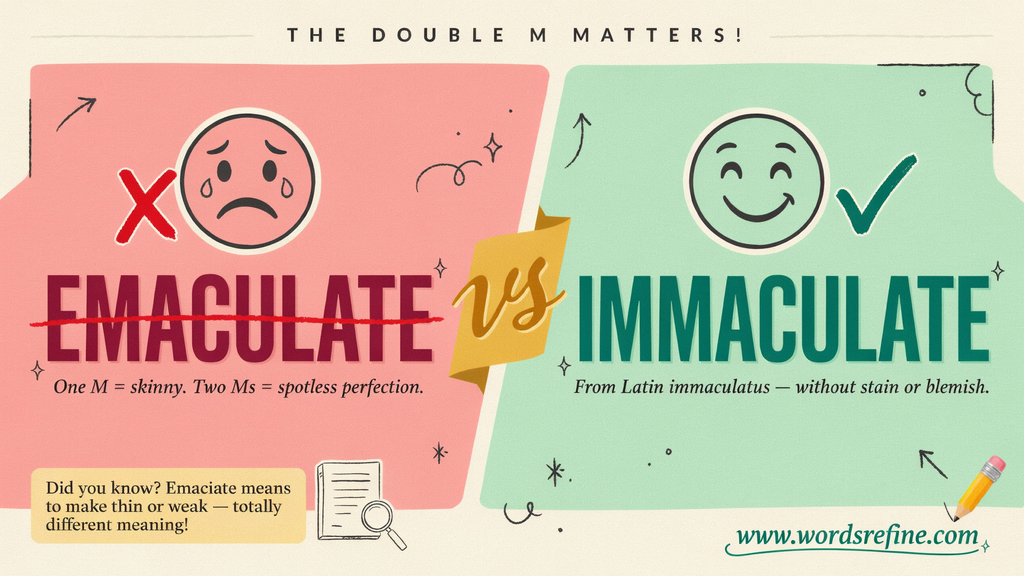
Emaculate usually appears when someone intends to write immaculate but chooses the wrong opening vowel.
It has no recognized standard English definition in major general dictionaries. Therefore, writers shouldn’t treat it as an alternative spelling or a separate adjective.
For example, someone might write:
“Her wedding dress looked emaculate.”
The intended meaning is clear, but the spelling is incorrect. The correct sentence is:
“Her wedding dress looked immaculate.”
This is a useful reminder that English contains many words that look or sound similar but have different meanings. In this case, however, emaculate isn’t a separate standard vocabulary word.
Is Emaculate a Real Word?
No. Emaculate isn’t recognized as a standard word in contemporary English.
Standard dictionaries recognize immaculate as the adjective meaning spotless or flawless. Although people sometimes use emaculate in informal messages, online posts, or personal writing, seeing a spelling online doesn’t automatically make it correct.
It may also appear as a personal name, username, or creative brand name. However, those uses don’t make it a standard English adjective.
Why Do People Spell Immaculate vs Emaculate?
People often make this mistake because they rely on pronunciation rather than remembering the correct spelling.
Several things can contribute to the confusion.
The first vowel can be difficult emaculate vs immaculate to remember. English speakers sometimes confuse the sounds represented by I and E. Since immaculate isn’t a word everyone uses every day, its spelling may not immediately come to mind.
Unfamiliarity can also play a part. Someone who has heard the word in conversation but rarely seen it in writing may recognize how it sounds without knowing how to spell it.
English pronunciation adds another challenge. Its spelling patterns aren’t always predictable, so similar-sounding words can have different written forms.
Typing mistakes are another possibility. Fast typing, autocorrect, and incorrect spelling suggestions can introduce errors, especially when someone hasn’t memorized the word.
The best solution is to learn the correct spelling instead of guessing from its pronunciation.
Is Immaculant Another Correct Spelling?
No. Immaculant isn’t a standard alternative spelling of immaculate.
The confusion comes from the similar appearance of the two forms. However, the correct adjective ends in -late, not -lant.
Compare these examples:
Incorrect: The artist created an immaculant design.
Correct: The artist created an immaculate design.
English contains plenty of adjectives with different endings, but that doesn’t mean those endings can be exchanged whenever two words look similar. In this case, immaculate is the form you need.
How to Use Immaculate in a Sentence
Immaculate is a useful word when you want to describe something exceptionally clean, neat, or flawless. Instead of relying on simple words such as clean or perfect, you can use immaculate to make your description more precise.
For example, saying that a room is clean tells readers that someone has tidied it. Calling the same room immaculate suggests that every detail is in excellent condition. The floors are spotless, the furniture is neatly arranged, and nothing looks out of place.
Consider these everyday examples:
Her kitchen looks immaculate, making it a pleasure to cook in.
He arrived at the interview wearing a spotless black suit.
The hotel staff kept every room in excellent condition.
Despite years of use, the vintage car still looks immaculate.
The editor praised her flawless writing and attention to detail.
The athlete delivered an outstanding performance during the final match.
His driving record was free from any recorded violations.
The garden looked beautiful after an afternoon of careful work.
These examples show that immaculate can describe people, places, objects, records, and performances. The key is to use it when something looks exceptionally clean or free from noticeable flaws.
Can Immaculate Describe a Person?
Yes. You can use immaculate to describe someone’s appearance, clothing, grooming, or overall presentation. It suggests that the person looks exceptionally neat and well-presented.
For example:
She looked immaculate in her tailored navy suit.
He always keeps his hair and beard perfectly groomed.
The presenter looked polished throughout the event.
However, immaculate doesn’t automatically describe someone’s personality. If you say that a person looks immaculate, you’re commenting on their appearance, not claiming that they’re perfect in every way.
You can also use the word when discussing someone’s reputation. An immaculate reputation suggests that the person has no known history of misconduct or wrongdoing.
Learn the difference between tricky grammar more words
skepticism vs scepticism Meaning Spelling and Correct Usage
What Does Immaculate Condition Mean?
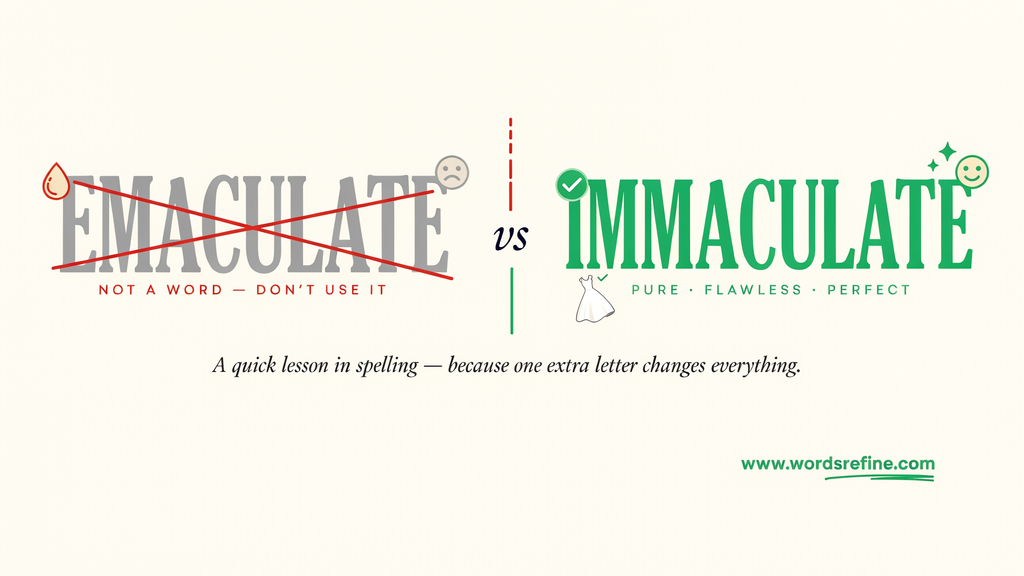
The phrase immaculate condition describes something that is exceptionally well-preserved, clean, and free from visible damage or defects.
For example, a used car in immaculate condition might have a spotless interior, polished exterior, well-maintained seats, and very few visible signs of wear.
Here are a few examples:
The antique table remains in excellent condition despite its age.
The seller advertised the laptop as being in immaculate condition.
The museum carefully preserves its historical paintings.
This phrase is especially common when people discuss cars, furniture, clothing, electronics, collectibles, and property.
Keep in mind that immaculate condition doesn’t necessarily mean an item is brand-new. An older object can still look immaculate if someone has taken good care of it.
What Does Immaculate Appearance Mean?
An immaculate appearance refers to an exceptionally neat, polished, and well-maintained look.
Imagine someone attending a formal event in a perfectly pressed suit, clean shoes, carefully styled hair, and coordinated accessories. You could describe that person’s appearance as immaculate.
The phrase can also describe objects and places.
The hotel lobby looked spotless before the guests arrived.
Her immaculate appearance made a strong impression at the ceremony.
The showroom remained neat and well-maintained throughout the exhibition.
In each example, the emphasis is on how something looks rather than how it functions.
Immaculate Pronunciation
Immaculate is commonly pronounced ih-MAK-yuh-lit.
Its International Phonetic Alphabet pronunciation is /ɪˈmæk.jə.lət/.
The word has four syllables: im, mac, u, and late. The strongest stress falls on the second syllable, MAK.
Try saying it slowly before increasing your speed: im-MAK-yuh-lit.
Once you become familiar with the pronunciation, remembering the word may become easier. However, don’t rely on pronunciation alone. English spelling doesn’t always follow predictable patterns.
The Origin and History of Immaculate
Immaculate comes from the Latin word immaculatus, which means unspotted or unstained.
The Latin word combines in-, meaning not, with macula, meaning spot or stain. The spelling changes from in- to im- before the letter M, following a common pattern in Latin word formation.
Over time, the word entered English and developed the meaning we use today. It came to describe things that are free from physical stains, visible flaws, or imperfections.
Its history also explains why immaculate begins with IM rather than EM. The spelling reflects its Latin roots, not simply the way someone might guess the word sounds.
Today, immaculate appears in everyday conversations, literature, professional writing, and religious discussions.
Learn the difference between confusing word pairs
Moustache vs Mustache Meaning Spelling and Usage ?
Immaculate Perfect and Impeccable What’s the Difference?
Immaculate, perfect, and impeccable are closely related words. They can sometimes describe the same thing, but they don’t always mean exactly the same thing.
Immaculate emphasizes cleanliness, neatness, or the absence of visible flaws.
Perfect suggests that something has no faults or meets an ideal standard.
Impeccable describes something done with exceptional care, accuracy, or good judgment.
Consider these examples:
Her bedroom is immaculate.
Her presentation was perfect.
His manners were impeccable.
Each word highlights a slightly different emaculate vs immaculate quality. An immaculate bedroom is spotless and tidy. A perfect presentation meets an ideal standard. Impeccable manners show excellent behavior and social awareness.
Although these words overlap, choosing the most suitable one makes your writing clearer and more natural.
Synonyms and Antonyms of Immaculate
Knowing similar and opposite words can help you use immaculate more confidently.
Some words with similar meanings include spotless, flawless, pristine, unblemished, faultless, unstained, untarnished, perfect, pure, and clean.
The best choice depends on the sentence. For example, spotless works particularly well when describing a clean room, while flawless may be more suitable for an excellent performance.
Words with opposite meanings include dirty, stained, messy, flawed, imperfect, defective, tarnished, and unclean.
For example, an immaculate kitchen is clean and organized, while a messy kitchen has clutter, stains, or other signs of neglect.
Learn the difference between often confused words
Mortality vs Fatality Meaning Differences and Correct Usage ?
What Does Immaculate Conception Mean?
The phrase Immaculate Conception has a specific meaning in Catholic theology. It refers to the belief that Mary, the mother of Jesus, was preserved from original sin from the first moment of her conception.
The phrase doesn’t refer to the conception of Jesus. This is a common misunderstanding because people sometimes confuse the Immaculate Conception with the virgin birth of Jesus.
In this religious expression, immaculate carries the meaning of being free from sin or spiritual stain.
The phrase has a special religious meaning, so it differs from everyday descriptions of clean rooms, polished shoes, or flawless performances.
What Does Immaculate Vibes Mean?
Immaculate vibes is an informal expression people use to describe an atmosphere, feeling, or overall impression that seems exceptionally good.
For example, someone might walk into a beautifully decorated café, notice the relaxing music and welcoming atmosphere, and say, “This place has immaculate vibes.”
The expression doesn’t mean the café is literally spotless. Instead, it suggests that everything feels just right.
People also use the phrase when describing music, fashion, events, photographs, and enjoyable experiences.
It’s casual language, so it works well in conversations and social media posts. However, a more precise expression may be better in formal writing.
Learn the difference between basic English word mistakes
Mama vs Mamma Meaning Spelling and Usage?
Common Mistakes When Using Immaculate
Although immaculate has a straightforward meaning, a few common mistakes can make your writing less accurate.
One frequent mistake is writing emaculate instead of immaculate. Always begin the correct word with IM.
Another mistake is using immaculant as an alternative spelling. The standard form is immaculate, ending in -late.
Some writers also use immaculate when they simply mean clean. Although the words are related, immaculate suggests an unusually high level of cleanliness or flawlessness. A slightly untidy desk might still be clean, but it probably isn’t immaculate.
Finally, don’t assume that immaculate always refers to physical cleanliness. It can also describe performances, reputations, work, and appearances.
Understanding these differences will help you choose the right word naturally and avoid awkward sentences.
How to Remember the Correct Spelling of Immaculate
If you often confuse immaculate with emaculate, a simple trick can help you remember the correct spelling.
Remember that immaculate begins with IM and contains two M’s. You can associate it with the idea of something being free from imperfections. When you picture a spotless room or a perfectly pressed outfit, think of immaculate.
Another helpful approach is to write the word several times and use it in everyday sentences. For example:
The hotel room looked immaculate.
Her handwriting was immaculate.
He maintained an immaculate garden.
The more familiar you become with the correct spelling, the less likely you are to make the same mistake.
Examples of Immaculate in Everyday Situations
The easiest way to understand a word is to see how it works in real situations. People use immaculate when talking about homes, clothing, work, vehicles, and personal achievements.
Immaculate Home
An immaculate home is exceptionally clean, organized, and well-maintained. Every room looks tidy, the surfaces are spotless, and belongings are arranged neatly.
Example: Their home looked immaculate before the family gathering.
Immaculate Clothing
When someone describes clothing as immaculate, they mean it looks exceptionally clean, neat, and well-presented.
Example: He wore an immaculate white shirt to the wedding.
Immaculate Work
Immaculate work is completed with great care and attention to detail. It contains no noticeable mistakes or imperfections.
Example: The carpenter did immaculate work, paying attention to every small detail.
Immaculate Performance
An immaculate performance is one that appears flawless. The person performs exceptionally well without making noticeable mistakes.
Example: The singer gave an immaculate performance that impressed the entire audience.
Immaculate Reputation
An immaculate reputation suggests that someone has maintained a good public record without known scandals or serious wrongdoing.
Example: Years of honest service helped her build an immaculate reputation.
These examples show that immaculate describes much more than physical cleanliness. It can also express excellence, careful work, and a lack of noticeable imperfections.
Learn the difference between commonly misused words
Stripes vs Strips Meaning Differences and Correct Usage ?
Practice Session Immaculate vs Emaculate
- Her bedroom was so __________ that everything looked perfectly organized.
- The chef maintained an __________ kitchen throughout the cooking process.
- Your presentation was __________, with no spelling or grammatical errors.
- He wore an __________ white suit to the wedding.
- The hotel staff kept the guest rooms __________.
- Despite years of use, her car remained in __________ condition.
- The artist created an __________ painting with incredible attention to detail.
- His __________ manners impressed everyone at the formal dinner.
- The house looked __________ after the cleaning service finished.
- She has an __________ sense of style.
- The company received praise for its __________ customer service.
- His desk was __________, with every document in its proper place.
- The restaurant was known for its __________ cleanliness.
- The bride looked __________ in her elegant wedding dress.
- The mechanic returned the vehicle in __________ condition.
- Her handwriting was so __________ that every word was easy to read.
- The museum preserved the ancient artwork in __________ condition.
- He delivered an __________ performance during the competition.
- The garden looked __________ after the gardener finished trimming the plants.
- The teacher appreciated his __________ homework.
- The luxury hotel was famous for its __________ rooms and elegant decorations.
- She kept her shoes __________ despite walking through the muddy streets.
- The lawyer presented an __________ argument in court.
- His kitchen was __________, even after preparing a large family meal.
- Everyone admired the __________ appearance of the newly renovated house.
Answers
- Immaculate
- Immaculate
- Immaculate
- Immaculate
- Immaculate
- Immaculate
- Immaculate
- Immaculate
- Immaculate
- Immaculate
- Immaculate
- Immaculate
- Immaculate
- Immaculate
- Immaculate
- Immaculate
- Immaculate
- Immaculate
- Immaculate
- Immaculate
- Immaculate
- Immaculate
- Immaculate
- Immaculate
- Immaculate
Here’s a trusted source for clear more words Comparison:
FAQs
How Do You Spell Emmaculate?
The correct spelling is immaculate. Emmaculate is incorrect. Remember the correct form: I-M-M-A-C-U-L-A-T-E.
What Does Immaculate Mean in Slang?
In informal conversations, immaculate can mean exceptionally good, impressive, or perfectly put together. For example, saying “Those shoes are immaculate” means they look fantastic. Similarly, “immaculate vibes” describes an atmosphere that feels just right.
What Is the Opposite of Immaculate?
The opposite depends on the context. When describing cleanliness, words such as dirty, filthy, messy, or stained work well. When describing quality, flawed, imperfect, defective, or faulty may be more appropriate.
What Does Immaculacy Mean?
Immaculacy is a noun that refers to the state of being immaculate. It describes spotless cleanliness, purity, or freedom from imperfections. Although it’s a valid word, immaculate is much more common in everyday conversation.
Can You Say Food Is Immaculate?
Yes. You can describe food as immaculate when it looks beautifully prepared or exceptionally well-presented. For example, “The chef’s presentation was immaculate” praises the care and attention given to the dish. In casual conversation, you might also say, “This food is immaculate” to express how much you enjoy it.
What Is a Classy Word for Beautiful?
Several elegant words can replace beautiful, depending on what you’re describing. Exquisite suggests exceptional beauty and detail, elegant emphasizes grace and style, and stunning describes something that makes a strong impression. Radiant works particularly well for someone with a glowing appearance.
What Is Another Word for Rubenesque?
Voluptuous, curvy, full-figured, and shapely are possible alternatives to Rubenesque. The best choice depends on the tone and context. Rubenesque traditionally describes a woman with a fuller, rounded figure, inspired by the paintings of Peter Paul Rubens.
What Is a Classy Word for Clean?
Pristine is an elegant alternative to clean. It suggests something is exceptionally fresh, spotless, and well-maintained. Other options include spotless, immaculate, and polished. Sanitary is also related, but it specifically refers to cleanliness that supports good hygiene.
Is It Emaculate vs Immaculate?
Immaculate is correct. Emaculate is a common spelling mistake and isn’t a standard English word. Use immaculate when describing something perfectly clean, neat, or free from noticeable flaws.
Can You Say Immaculately Clean?
Yes. Immaculately clean is a correct and natural expression. It emphasizes that something is exceptionally clean, with no visible dirt, stains, or mess. For example, “The kitchen was immaculately clean before the guests arrived.”
Is Immovable a Real Word?
Yes. Immovable is a standard English adjective meaning impossible or very difficult to move. It can also describe someone who refuses to change an opinion or decision. For example, “The heavy stone was practically immovable.”
What’s a Better Word for Immaculate?
The best alternative depends on what you want to describe. Use pristine for something exceptionally clean, flawless for something without defects, and impeccable for excellent quality or execution. Exquisite works well when you want to emphasize beauty or exceptional detail.
What Is the Meaning of Emmaculate?
Emmaculate isn’t a recognized standard English word. It’s usually a misspelling of immaculate, which means perfectly clean, spotless, or free from imperfections. The correct spelling begins with I and contains two consecutive M’s.
Can Immaculate Mean Perfect?
Yes. In certain contexts, immaculate can mean flawless or free from noticeable mistakes. For example, an immaculate performance is completed exceptionally well. However, perfect has a broader meaning and can describe anything that meets an ideal standard, while immaculate often emphasizes cleanliness, neatness, or freedom from flaws.
Learn the difference between more words people mix up
Nevertheless vs Nonetheless Meaning and Usage?
Conclusion
The difference between emaculate vs immaculate comes down to one small spelling detail, but getting it right makes your writing clearer and more polished. Immaculate is the correct word for describing something spotless, flawless, or exceptionally well maintained. Emaculate is simply a common misspelling, not an accepted alternative. Whether you’re describing a sparkling kitchen, an elegant outfit, a delicious meal, or a flawless performance, immaculate is the word you need. Just remember its opening I and double M, and you’ll avoid this common mistake. After all, your house doesn’t have to be immaculate, but your spelling should be!

Diora AJS she is an experienced blogger and passionate English language enthusiast at Words Refine. With a keen eye for language and a love for clear communication, she writes practical content about grammar, word meanings, usage, and commonly confused terms. Her goal is to make English easier to understand through clear explanations and relatable examples, helping readers write accurately and communicate with confidence.