
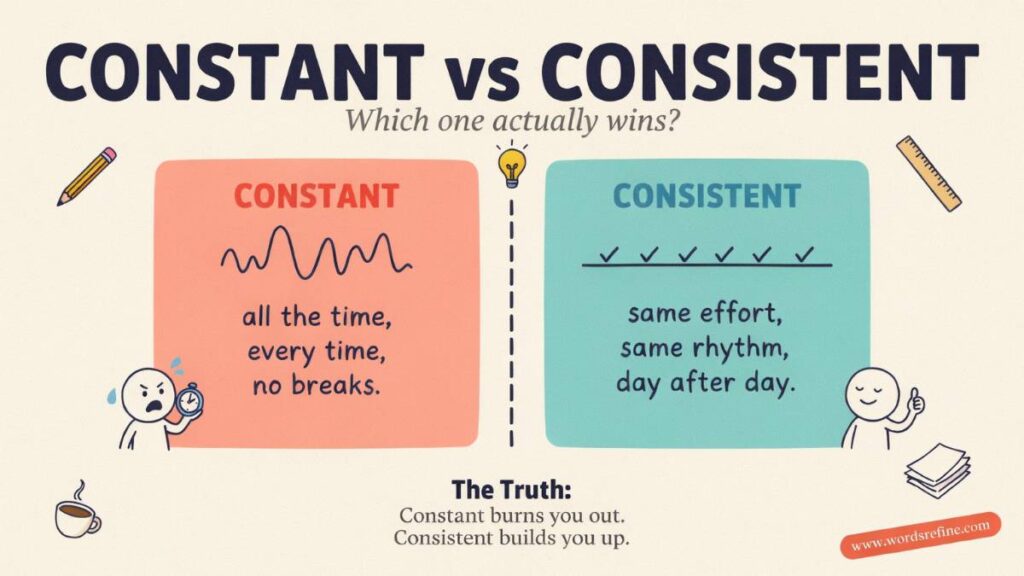
Constant vs consistent sound almost alike, but using one in place of the other can create confusion. Imagine dealing with constant interruptions at work while trying to maintain a consistent routine. The first keeps disrupting your day; the second helps you stay organized. That’s the key difference between these commonly confused words. Constant describes something that remains unchanged or happens repeatedly, whereas consistent refers to something steady, reliable, or maintained over time. Although both words can suggest regularity, they aren’t interchangeable. Understanding the constant vs consistent difference will help you avoid common grammar mistakes and express your ideas with greater clarity and confidence.
Quick Answer Constant vs Consistent
Constant describes something that stays unchanged or happens repeatedly. Consistent describes something that remains steady, reliable, or similar over time.
For example, a constant temperature stays at the same level, while consistent performance means delivering dependable results over time.
Although both words suggest stability, constant focuses more on an unchanging condition or repeated occurrence. Consistent focuses on reliability and a recognizable pattern.
Learn the difference between confusing more English words
Copyright vs Copywrite Which One Is Correct?
What Is the Difference Between Constant vs Consistent?
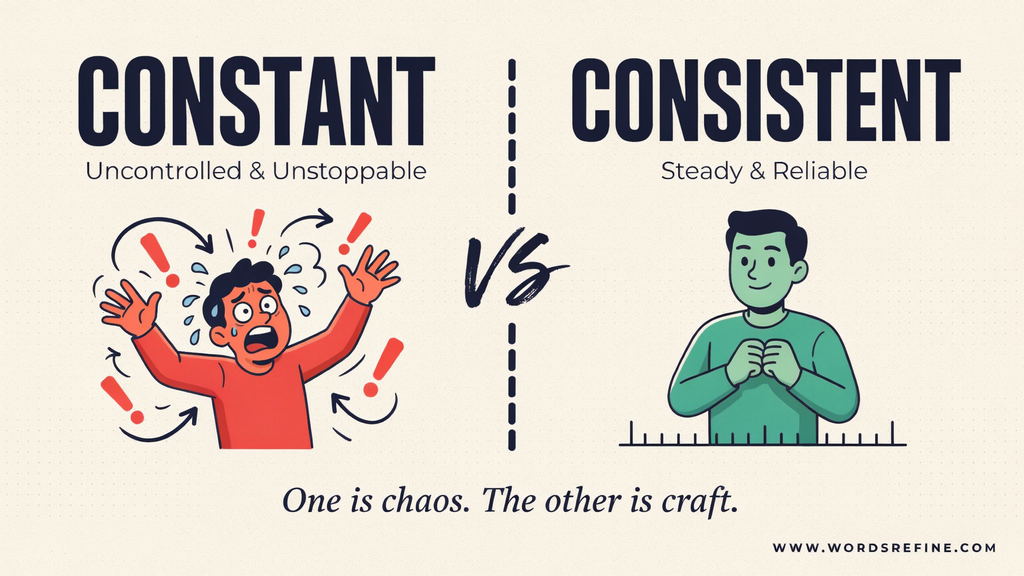
The difference between constant vs consistent depends on the type of stability you want to describe.
Constant refers to something that does not change or keeps happening. It can describe a fixed value, an ongoing condition, or something that occurs frequently. For example, a constant speed means that an object maintains the same speed.
Consistent refers to something that follows a dependable pattern or maintains a similar standard. It often describes behavior, effort, quality, or performance. For instance, a consistent student studies regularly and makes a steady effort to improve.
Consider two simple examples:
The constant rain ruined our outdoor plans.
Her consistent effort helped her improve her writing.
In the first sentence, constant describes rain that keeps falling or occurring. In the second, consistent describes regular effort that produces dependable progress.
The words can sometimes appear in similar situations, but they emphasize different things. and Constant highlights continuity or repetition, while consistent highlights stability and reliability.
Constant Meaning and Definition
The Constant is an adjective that describes something that remains unchanged or happens repeatedly. It can refer to a condition, amount, sound, movement, or situation that continues or keeps occurring.
In everyday English, people often use constant when they want to emphasize that something does not stop changing its presence or keeps returning. The exact meaning depends on the sentence.
For example, a constant temperature remains at the same level. Constant interruptions, however, are repeated disruptions that keep disturbing someone.
The word can also function as a noun. In mathematics and science, a constant is a fixed value that does not change within a particular situation or equation.
Learn the difference between tricky grammar more words
Dreamt vs Dreamed Which One Is Correct?
How to Use Constant in a Sentence
Constant usually comes before a noun when it works as an adjective. It can describe things such as noise, pressure, movement, change, attention, or temperature.
Here are some natural examples:
The constant noise outside made it difficult to concentrate.
She felt constant pressure to finish the project before Friday.
The machine operates at a constant speed.
His constant complaints frustrated everyone in the room.
The company needs constant attention to maintain its equipment.
In each example, constant describes something that stays present, remains unchanged, or occurs repeatedly.
Constant in Everyday Situations
You can use constant in many situations, especially when something continues or keeps happening.
At work, constant interruptions can make it difficult to complete important tasks. In daily life, constant traffic noise may disturb people living near a busy road. In science, a constant value remains fixed under the conditions being discussed.
The word can also describe repeated changes. For example, constant changes in a company’s schedule may confuse employees. Here, the changes keep happening rather than remaining the same.
This is an important distinction: constant does not always mean that something is completely unchanged. It can also describe something that happens again and again.
Synonyms and Antonyms of Constant
Depending on the context, synonyms for constant include continuous, steady, unchanging, continual, fixed, regular, and persistent.
However, these words are not always interchangeable. Continuous usually emphasizes something happening without interruption, while persistent often describes something that continues despite difficulty or opposition.
Common antonyms include changing, occasional, irregular, temporary, unstable, and intermittent.
For example, a constant sound may continue or return frequently, while an intermittent sound stops and starts at different times.
Learn the difference between confusing word pairs
Mobil vs Mobile Which one Is Correct?
Consistent Meaning and Definition
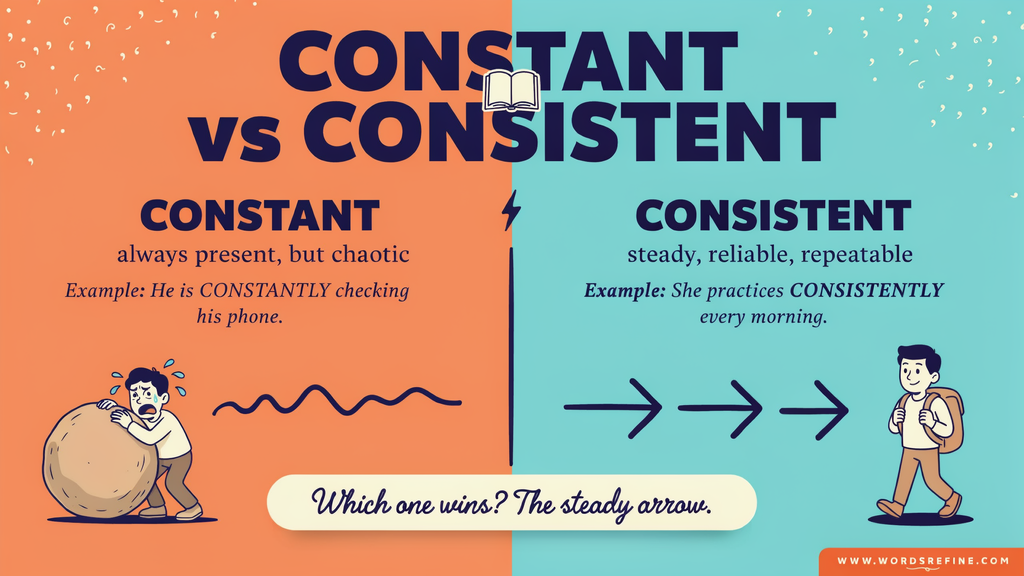
The Consistent is an adjective that describes something that remains steady, dependable, or similar over time. It often refers to behavior, effort, quality, performance, or results.
When someone is consistent, they follow a reliable pattern instead of acting unpredictably. Their actions may not be identical every time, but they maintain a similar standard or level of effort.
For example, a consistent employee completes tasks reliably and meets expectations. A consistent workout routine helps someone build a lasting habit.
Consistency does not mean perfection. A person can make occasional mistakes and still be consistent if they continue to show reliable effort and maintain a dependable pattern.
How to Use Consistent in a Sentence
Consistent usually appears before a noun or after linking verbs such as is, seems, and remains.
Here are some examples:
She delivers consistent results at work.
His consistent practice helped him become a better musician.
The company maintains consistent quality across its products.
You need consistent effort to develop a new skill.
Their communication has been consistent throughout the project.
These examples show how consistent describes reliability, regular behavior, or a similar standard over time.
Consistent in Everyday Situations
Consistent is useful when discussing habits, routines, performance, and dependable behavior.
At school, a student who studies regularly may achieve consistent academic results. At work, a team that communicates clearly and meets deadlines demonstrates consistent performance. In relationships, consistent support helps build trust because people know they can rely on one another.
The word also appears in discussions about quality. A restaurant that serves meals at a similar standard each time offers consistent quality. Customers appreciate knowing what to expect.
Synonyms and Antonyms of Consistent
Depending on the sentence, synonyms for consistent include steady, reliable, dependable, regular, uniform, stable, and predictable.
Each synonym has a slightly different emphasis. Reliable highlights trustworthiness, while uniform suggests that something remains similar in form or appearance.
Common antonyms include inconsistent, irregular, unreliable, unpredictable, variable, and erratic.
For example, a consistent schedule follows a dependable pattern, while an irregular schedule changes without a predictable routine.
Learn the difference between often confused words
Fiancé vs Fiancée What’s the Difference and which is Correctly?
Constant vs Consistent Side-by-Side Comparison
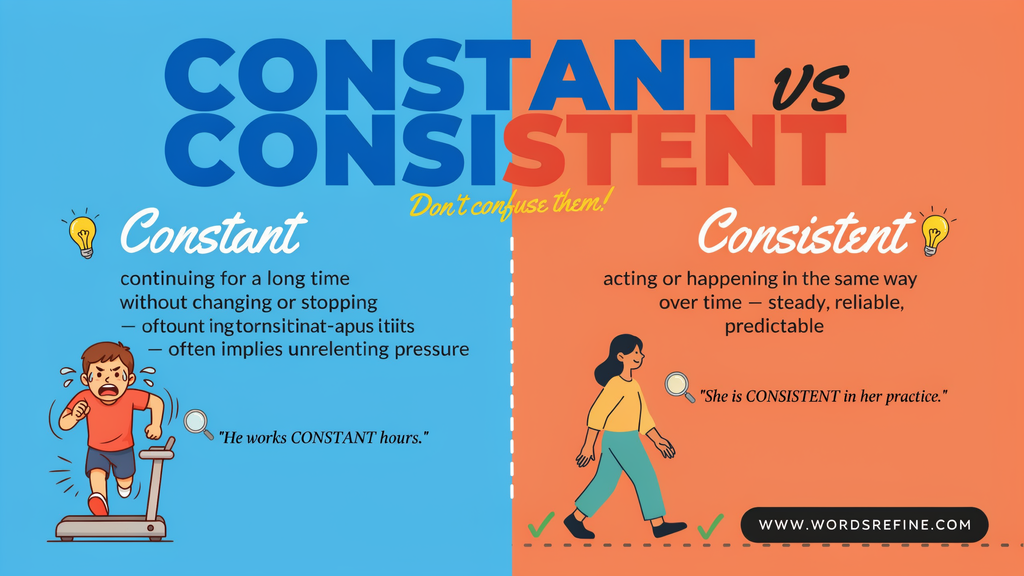
Although constant and consistent both describe forms of stability, they focus on different qualities.
| Feature | Constant | Consistent |
|---|---|---|
| Main meaning | Unchanging or repeatedly occurring | Steady, reliable, or similar over time |
| Main focus | Continuity, frequency, or an unchanged condition | Reliability and a dependable pattern |
| Common use | Noise, temperature, speed, pressure, and interruptions | Effort, behavior, quality, performance, and habits |
| Example | The constant noise disturbed the neighbors. | Her consistent effort improved her skills. |
| Opposite | Changing or intermittent | Inconsistent or unreliable |
Constant Behavior vs Consistent Behavior
Constant behavior may describe actions that happen repeatedly or seem difficult to stop. Consistent behavior describes actions that follow a dependable pattern.
For example, someone who constantly checks their phone may do so so frequently that it interrupts other activities. Someone who consistently checks their messages at scheduled times follows a regular routine.
The difference is subtle but important. and Constant emphasizes how often something happens, while consistent emphasizes the reliability of the pattern.
Constant Effort vs Consistent Effort
The Constant effort suggests continuous or repeated effort. Consistent effort highlights steady work over time.
For example:
He made a constant effort to fix the problem.
She showed consistent effort throughout the semester.
The first sentence emphasizes ongoing attempts. The second describes dependable effort maintained over a period.
An Easy Way to Remember the Difference
Think of constant as something that stays the same or keeps happening. Think of consistent as something you can depend on.
A constant temperature stays at the same level. Consistent performance means maintaining a dependable standard.
Remember this simple distinction: constant focuses on an unchanged condition or repeated occurrence, while consistent focuses on reliability and a steady pattern.
Learn the difference between basic English word mistakes
Any time vs anytime meaning Difference with Examples ?
Can Constant vs Consistent Be Used Interchangeably?
Constant and consistent sometimes appear in similar sentences, but they don’t always mean the same thing. Replacing one with the other can change the meaning of your sentence.
Constant usually describes something that remains unchanged or keeps happening. Consistent describes something that follows a reliable pattern or maintains a similar standard.
For example:
The constant noise disturbed everyone in the office.
The consistent quality of the service impressed the customers.
In the first sentence, constant describes noise that continues or occurs repeatedly. In the second, consistent describes a dependable level of quality.
Sometimes, both words can work in the same situation, depending on what you want to express.
Consider these examples:
The company provides constant support to its customers.
The company provides consistent support to its customers.
The first sentence suggests that support remains available or continues. The second suggests that customers can depend on receiving reliable help.
Both sentences are correct, but they communicate slightly different ideas. Before choosing either word, consider whether you mean something continues or whether it remains dependable.
Learn the difference between everyday English mistakes
Choose vs Chose Difference and which one is Correct?
Constant vs Consistent in Different Situations
Understanding how these words work in everyday situations makes the difference easier to recognize. You can use them when discussing work, education, relationships, technology, and business.
At Work
In professional settings, constant often describes ongoing demands, interruptions, or changes. Consistent usually describes reliable performance, communication, or work quality.
For example:
The constant meetings left little time for individual tasks.
Her consistent performance earned the manager’s trust.
The first sentence describes meetings that happen frequently. The second highlights dependable work.
Similarly, constant changes in company policies may confuse employees. However, consistent leadership helps a team understand expectations and work toward shared goals.
In Education
Students and teachers use both words when discussing learning habits, classroom conditions, and academic performance.
Constant distractions can make studying difficult. Consistent practice, on the other hand, helps students understand difficult subjects and remember what they learn.
For example:
The constant noise in the classroom affected the students’ concentration.
Consistent revision helped him prepare for his final exams.
You can also describe a student’s performance as consistent when they regularly achieve similar results. Constant performance would suggest that the performance remains unchanged or continues without variation. It doesn’t communicate the same idea as reliable academic performance.
In Relationships
Constant and consistent can describe different aspects of personal relationships.
Constant attention suggests frequent or ongoing attention. Consistent support means being dependable and offering help when needed.
For example:
Her constant messages made him feel overwhelmed.
His consistent support helped her through a difficult period.
The first sentence focuses on how frequently someone sends messages. The second highlights reliability and trust.
In healthy relationships, consistency often matters more than constant attention. People don’t need to communicate every minute to show that they care. They need to be dependable, respectful, and present when it matters.
In Technology and Science
These words also have important uses in technical and scientific discussions.
In science, constant often describes a fixed value or condition. For example, an object moving at a constant speed maintains the same speed during the period being considered.
Consistent, meanwhile, often describes results or measurements that remain similar across repeated tests.
For example:
The experiment was conducted at a constant temperature.
The instrument produced consistent readings during repeated tests.
The first sentence describes a controlled condition. The second describes dependable results.
In technology, a constant internet connection may suggest that the connection remains available without frequent interruptions. Consistent internet performance suggests that the connection delivers dependable speed and quality.
In Business and Marketing
Businesses often use consistent when discussing product quality, customer service, branding, and performance.
A company that maintains consistent quality gives customers a similar experience each time they purchase its products. Consistent communication also helps customers understand what a brand offers.
Constant can describe ongoing business activities or repeated changes.
For example:
The business faces constant pressure from competitors.
The company maintains consistent product quality.
The first sentence describes pressure that continues or frequently occurs. The second highlights a dependable standard.
A business needs both qualities in different situations. It may need constant attention to changing customer needs while maintaining consistent service quality.
Constant vs Continuous
The Constant and continuous are related words, but they don’t always mean the same thing.
Constant describes something that remains unchanged or happens repeatedly. Continuous specifically describes something that continues without interruption.
For example:
The constant noise from the construction site annoyed the neighbors.
The continuous flow of water filled the tank.
The first sentence may describe noise that remains present or keeps returning. The second describes water flowing without stopping.
This distinction matters because something can be constant without being completely continuous.
For example, a person may receive constant phone calls throughout the afternoon. The calls keep coming, but each one eventually ends. They don’t form one uninterrupted phone call.
Continuous is more precise when you want to emphasize an action or state that happens without a break.
Examples of Constant vs Continuous
The constant changes in the schedule confused the employees.
The machine ran continuously for several hours.
She experienced constant interruptions while working.
The continuous sound of the alarm made it impossible to sleep.
The constant interruptions happened repeatedly. The continuous sound continued without a break.
Constant vs Continual
Constant and continual have closely related meanings. Both can describe something that happens repeatedly or continues over time. However, continual often emphasizes repeated occurrences with breaks between them.
For example:
The constant noise made it difficult to concentrate.
The continual interruptions delayed the meeting.
The first sentence may suggest noise that remains present or keeps returning. The second emphasizes interruptions that happen again and again.
In everyday English, people sometimes use these words in similar ways. Still, continual is particularly useful when something happens repeatedly rather than without interruption.
For example, continual delays suggest that delays keep occurring. Constant pressure suggests pressure that remains present or continues to affect someone.
Consistent vs Persistent
The Consistent and persistent both describe qualities that continue over time, but their meanings are different.
Consistent means steady, reliable, or similar in behavior or quality. Persistent means continuing despite difficulty, resistance, or obstacles.
For example:
She made consistent progress throughout the course.
He was persistent and refused to give up after several failed attempts.
The first sentence highlights steady progress. The second describes determination despite difficulties.
You can also use both words to describe the same person, but each highlights a different quality.
A consistent employee completes tasks reliably and maintains a dependable standard. A persistent employee keeps working toward a goal even when challenges arise.
Consistency is about maintaining a pattern. Persistence is about continuing despite obstacles.
Learn the difference between more words people mix up
Discrete vs Discreet What the Difference and which is Correctly?
Common Mistakes With Constant vs Consistent
Although constant and consistent have similar meanings, they aren’t interchangeable in every situation. Many writers confuse them because both words describe some form of stability. However, each has a different purpose, and choosing the wrong one can change the meaning of a sentence.
Using Constant Instead of Consistent
A common mistake is using constant when you want to describe reliable behavior, regular effort, or dependable performance.
For example:
She delivers constant results at work.
A better sentence is:
She delivers consistent results at work.
The second sentence makes it clear that her performance remains reliable over time. Constant results could suggest that the results never change, which may not be the intended meaning.
Using Consistent Instead of Constant
Some writers use consistent when they want to describe something that remains completely unchanged.
For example:
The temperature remained consistent throughout the experiment.
This sentence is acceptable when the temperature stayed within a similar range. However, if the temperature did not change at all, constant is more precise.
The temperature remained constant throughout the experiment.
Confusing Constant With Continuous
Constant and continuous are related, but they have different meanings. Constant can describe something that happens repeatedly, even when short breaks occur. Continuous describes something that happens without interruption.
For example:
The constant phone calls interrupted my work.
The continuous flow of water filled the tank.
The phone calls happened repeatedly, while the water flowed without stopping.
Confusing Consistent With Persistent
Consistent describes a dependable pattern, while persistent describes someone who continues despite difficulties.
For example:
She made consistent progress during the course.
He remained persistent despite several failures.
The first sentence describes steady progress. The second highlights determination and the refusal to give up.
Spelling Consistent Incorrectly
Another common mistake is writing consistant instead of consistent. The correct spelling always ends in -ent.
For example:
Her consistent efforts helped the team succeed.
The company provides consistent customer service.
Remember that consistent is the correct spelling, while consistant is incorrect.
Assuming Constant Always Means Uninterrupted
Constant doesn’t always mean that something continues without a break. It can also describe something that happens frequently or repeatedly.
For example:
The constant interruptions made it difficult to concentrate.
The interruptions happened repeatedly, but they didn’t occur without any breaks. If you want to emphasize that something never stops, continuous may be a better choice.
Using Both Words Without Considering Their Meaning
Writers sometimes choose constant or consistent simply because both sound appropriate. However, the meaning of the sentence should always guide your choice.
For example:
The company needs constant attention to changing customer needs.
The company needs consistent customer service.
The first sentence emphasizes ongoing attention. The second describes dependable service.
Before using either word, ask yourself what you want to express. Are you describing something that keeps happening or remains unchanged? Choose constant. Are you describing something reliable and steady? Choose consistent.
Understanding this small difference will help you avoid confusion and make your writing clearer.
Learn the difference between confusing word pairs
Further vs Farther The Simple Difference and Each Correctly?
Practice Session Constant vs Consistent
The scientist kept the pressure ______ during the entire test.
Mia has shown ______ dedication to learning a new language.
The ______ ringing of the doorbell annoyed everyone in the house.
Our teacher expects ______ participation from students throughout the semester.
The company experienced ______ demand for its products throughout the year.
His ______ attitude helped him overcome several professional challenges.
The car maintained a ______ speed on the highway.
The coach praised the players for their ______ performance during the season.
The baby needed ______ attention throughout the night.
She worked ______ toward her goal, even when progress was slow.
The temperature remained ______ inside the storage room.
The manager values ______ communication among team members.
The ______ changes in the weather made outdoor activities difficult.
Despite several rejections, he remained ______ in his search for a job.
The school aims to provide ______ educational standards across all classrooms.
The alarm produced a ______ sound that disturbed the entire neighborhood.
Her ______ attendance helped her stay on top of her assignments.
The machine requires ______ monitoring to prevent overheating.
The research team obtained ______ results from repeated experiments.
His ______ complaints made the situation uncomfortable for everyone.
The artist practiced ______ to improve her painting skills.
The company maintained a ______ supply of essential materials.
The athlete remained ______ despite repeated injuries and setbacks.
The workers maintained a ______ pace throughout the project.
The office experienced ______ interruptions during the important meeting.
Answers
constant
consistent
constant
consistent
constant
persistent
constant
consistent
constant
consistently
constant
consistent
constant
persistent
consistent
constant
consistent
constant
consistent
constant
consistently
constant
persistent
consistent
constant
Here’s a trusted source for clear more words Comparison:
FAQs
What Is the Difference Between Constant and Persistent?
Constant describes something that remains unchanged or happens repeatedly. Persistent describes someone or something that continues despite difficulties or resistance. For example, constant noise keeps disturbing a room, while a persistent student continues studying despite struggling with a subject.
What Is the Difference Between Consistent vs Constant?
Constant emphasizes an unchanged condition or repeated occurrence, while consistent emphasizes reliability and a steady pattern. A constant temperature stays at the same level, whereas consistent performance means delivering dependable results over time.
What Is a Better Word for Consistently?
The best alternative depends on the sentence. You can use regularly, steadily, reliably, continually, or uniformly. For example, “She consistently completes her assignments” could become “She regularly completes her assignments.” However, each alternative carries a slightly different meaning.
What Does Constant Mean?
Constant means remaining unchanged or happening repeatedly. It can describe a fixed value, an ongoing condition, or something that occurs frequently. For example, constant pressure describes pressure that continues to affect someone.
What Is an Example of a Constant?
A fixed mathematical value is a clear example of a constant. For instance, the number π is a mathematical constant. In everyday situations, a temperature that stays at the same level can also be described as constant.
What Is the Difference Between Constant and Constantly?
Constant is an adjective that describes a noun, while constantly is an adverb that describes an action or condition. For example, “The constant noise bothered me” uses constant to describe noise. “The phone keeps ringing constantly” uses constantly to describe how frequently the phone rings.
Can You Be Persistent Without Being Consistent?
Yes. Someone can keep trying to achieve a goal without following a regular routine. For example, a person may return to a difficult project after several setbacks but work on it irregularly. That person is persistent because they don’t give up, but they aren’t necessarily consistent.
What Are the Four Types of Consistency?
There isn’t one universally accepted classification of four types of consistency. The meaning depends on the subject. In everyday discussions, consistency can refer to behavior, effort, performance, and quality. These describe dependable actions, steady work, reliable results, and similar standards over time.
What’s a Nicer Word for Persistent?
Depending on the context, determined, dedicated, committed, tenacious, or steadfast can sound more positive than persistent. For example, describing someone as determined highlights their willingness to reach a goal without making them sound stubborn.
Can Constant and Consistent Describe the Same Situation?
Yes. Both words can describe the same situation while emphasizing different qualities. For example, a business may need constant attention to customer needs while providing consistent service. Constant highlights ongoing attention, whereas consistent highlights dependable service.
Is Constant Always the Same as Unchanging?
Not always. Constant can describe something that remains unchanged, but it can also describe something that happens repeatedly. For example, constant interruptions may occur several times throughout the day rather than continuing without a break.
What Is the Difference Between Consistent Effort and Constant Effort?
Consistent effort means working steadily and regularly toward a goal. Constant effort suggests ongoing or repeated attempts. For example, studying for an hour every evening shows consistent effort, while repeatedly trying to solve a difficult problem emphasizes continued effort.
Can Something Be Constant but Inconsistent?
Yes. Something can happen continuously or repeatedly while producing unpredictable results. For example, a machine may run constantly but produce inconsistent measurements. Its operation continues, but its results aren’t reliable.
Which Word Should I Use to Describe Reliable Performance?
Use consistent when describing reliable performance. For example, “The employee delivers consistent results” means the employee maintains a dependable standard of work over time. Constant doesn’t communicate that meaning as clearly.
Is Consistency More Important Than Persistence?
Neither quality is always more important. Consistency helps you maintain steady habits and dependable performance, while persistence helps you continue when challenges arise. In many situations, combining both qualities gives you a better chance of reaching your goals.
Learn the difference between basic English word mistakes
Capital vs Capitol Which One Is Correct?
Conclusion
Constant vs consistent may seem interchangeable, but each has a distinct meaning. Constant describes something that remains unchanged or happens repeatedly, while consistent refers to something reliable, steady, or maintained over time. For example, constant noise can test your patience, but consistent practice can improve your skills. One gets on your nerves; the other helps you grow!
The key is to consider what you want to describe. Use constant for an unchanging condition or repeated occurrence. Choose consistent when you mean dependable effort, stable behavior, or reliable results. Once you understand this distinction, you’ll find it easier to use both words correctly. After all, clear writing isn’t about choosing complicated words. It’s about choosing the right ones.

Diora AJS she is an experienced blogger and passionate English language enthusiast at Words Refine. With a keen eye for language and a love for clear communication, she writes practical content about grammar, word meanings, usage, and commonly confused terms. Her goal is to make English easier to understand through clear explanations and relatable examples, helping readers write accurately and communicate with confidence.