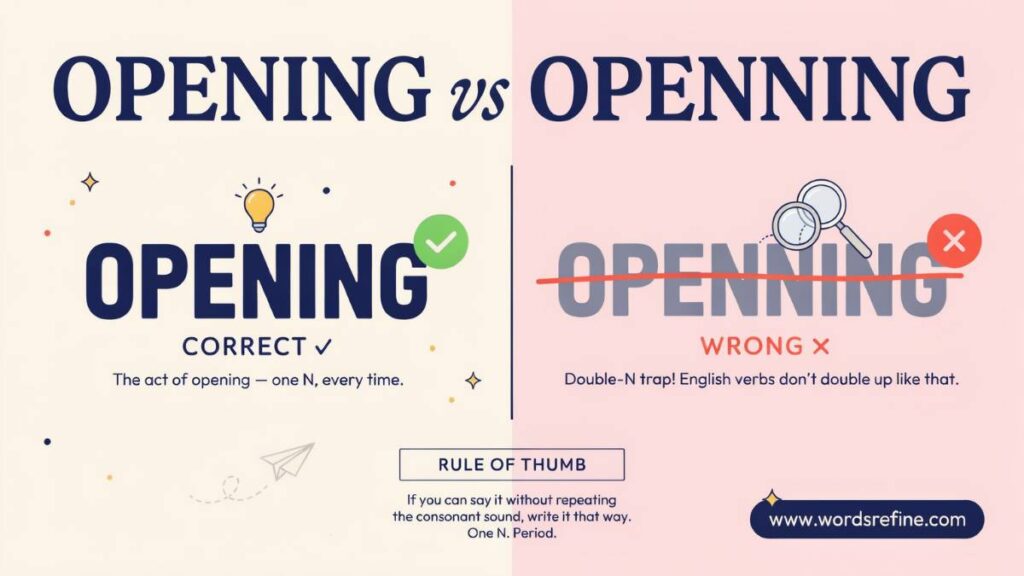
Have you ever hesitated over a simple word because an extra letter suddenly seemed to make sense? The confusion between opening vs openning can leave even confident writers second guessing themselves. Although both spellings may look convincing, only one is correct. Opening is the standard form, while openning is a common spelling mistake caused by confusion about English consonant doubling rules. Whether you are opening a door, launching a business, or announcing a new opportunity, using the correct spelling matters. Let’s explore the meaning, grammar, spelling rules, and common mistakes behind these forms so you can write confidently without giving an already correct word an unnecessary extra letter.
Quick Answer opening vs openning
The correct spelling is opening, with only one n. opening vs openning is a spelling mistake and has no accepted use in standard English.
The word opening comes from the verb open. You can use it to describe the act of making something accessible, the beginning of an event, or an available opportunity. For example, you might talk about opening a door, attending a store opening, or finding a job opening.
The confusion usually comes from English spelling rules. Some verbs double their final consonant before adding -ing. For example, run becomes running and sit becomes sitting. However, open doesn’t follow that pattern. Its correct form is opening.
So, whenever you write this word, remember to use one n. It’s a small spelling detail, but it makes a big difference.
Learn the difference between confusing more English words
Ambassador vs Embassador Which Spelling Is Correct?
What Does Opening Mean?
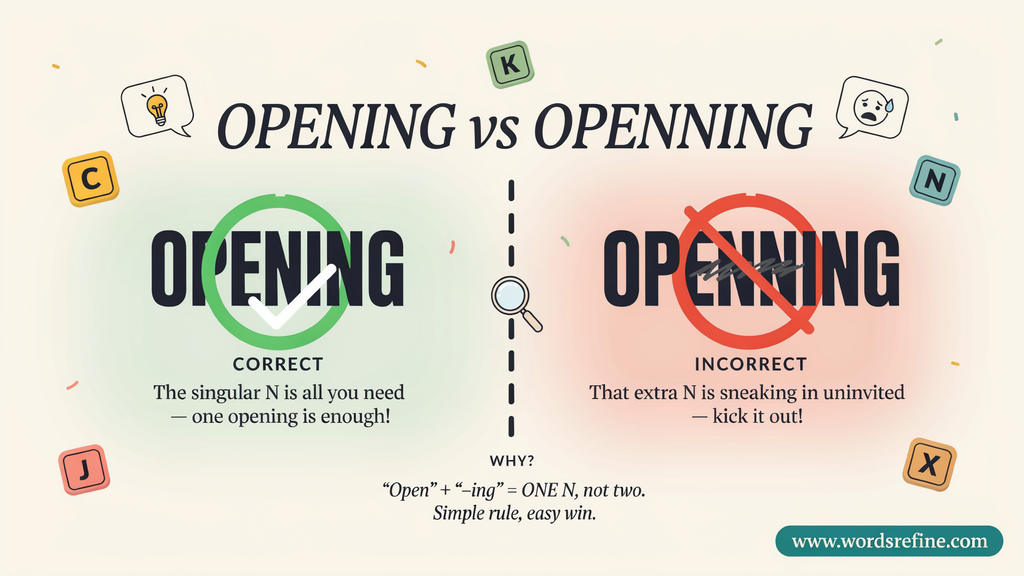
Opening is a form of the verb open. It can function as a noun, a present participle, a gerund, or a modifier in a sentence. Its meaning depends on how you use it.
Generally, opening vs openning refers to the beginning of something, the act of making something accessible, or an opportunity that becomes available.
For example, consider these sentences:
The store is opening a new branch downtown.
We attended the opening of the art gallery.
She is opening the window to let in some fresh air.
In each sentence, opening has a slightly different role. It can describe an action or refer to an event or opportunity.
Opening as a Noun
As a noun, opening refers to the beginning of something or an available space or opportunity. It can describe the first part of an event, a gap in a surface, or a vacant position.
For example:
The opening of the new restaurant attracted hundreds of visitors.
There is an opening in the fence near the garden.
The company announced a job opening for an experienced accountant.
In the first sentence, opening refers to the beginning of a business’s operations.1 In the second, it describes a gap in a physical structure. 2In the third, it means an available employment position.
You may also encounter the word in entertainment, sports, and formal events. An opening ceremony marks the beginning of an occasion, while an opening scene introduces a movie or television show.
Opening as a Verb Form
Opening is the present participle of the verb open. It usually appears with a form of the verb be to describe an action that is happening now or around the present time.
For example:
She is opening the front door.
The company is opening another office this summer.
They are opening their gifts after dinner.
In these sentences, opening describes an ongoing action. The form of be helps establish the tense, while opening tells you what action is taking place.
You can also use opening in participial phrases:
Opening the box carefully, he discovered an old photograph.
The woman opening the shop is the new manager.
Here, opening helps describe an action connected to the subject of the sentence.
Opening as a Gerund
A gerund is a verb form ending in -ing that functions as a noun. Opening can serve this purpose when it names an activity rather than describing an ongoing action.
For example:
Opening a small business requires careful planning.
She enjoys opening old letters and reading their stories.
Opening the windows makes the room feel cooler.
In the first sentence, opening refers to the activity of starting a business. 1.In the second, it names something the person enjoys doing. 2.In the third, it functions as the subject of the sentence.
The difference is easy to understand. When opening describes an action in progress, it works as a present participle. When it names an activity, it works as a gerund.
Opening as a Modifier
Opening can also appear before a noun to describe the first part of an event, activity, or experience.
For example:
The opening ceremony begins at noon.
She delivered the opening statement.
We watched the opening scene of the movie.
In these examples, opening modifies ceremony, statement, and scene. It tells readers that these are the first or introductory parts of something.
This use is common in everyday conversation, business writing, entertainment, and formal communication.
Is Openning a Correct Word?
No. Openning is not the correct spelling in standard English. The accepted form is opening, with one n.
People sometimes write openning because they assume the final consonant in open should double before the suffix -ing. However, English spelling doesn’t work that way for every verb.
For example, run becomes running, but open becomes opening. The difference comes from the spelling and stress patterns of the original verbs.
Consider these examples:
Incorrect: The manager is openning a new store.
Correct: The manager is opening a new store.
Incorrect: She is openning the package.
Correct: She is opening the package.
Incorrect: They are openning a new office downtown.
Correct: They are opening a new office downtown.
In each example, the correct spelling contains one n. Adding another n creates a spelling error rather than a new word.
Learn the difference between commonly mixed-up more words
Simular vs Similar Which One Is Correct?
Is Openning a Real Word With a Separate Definition?
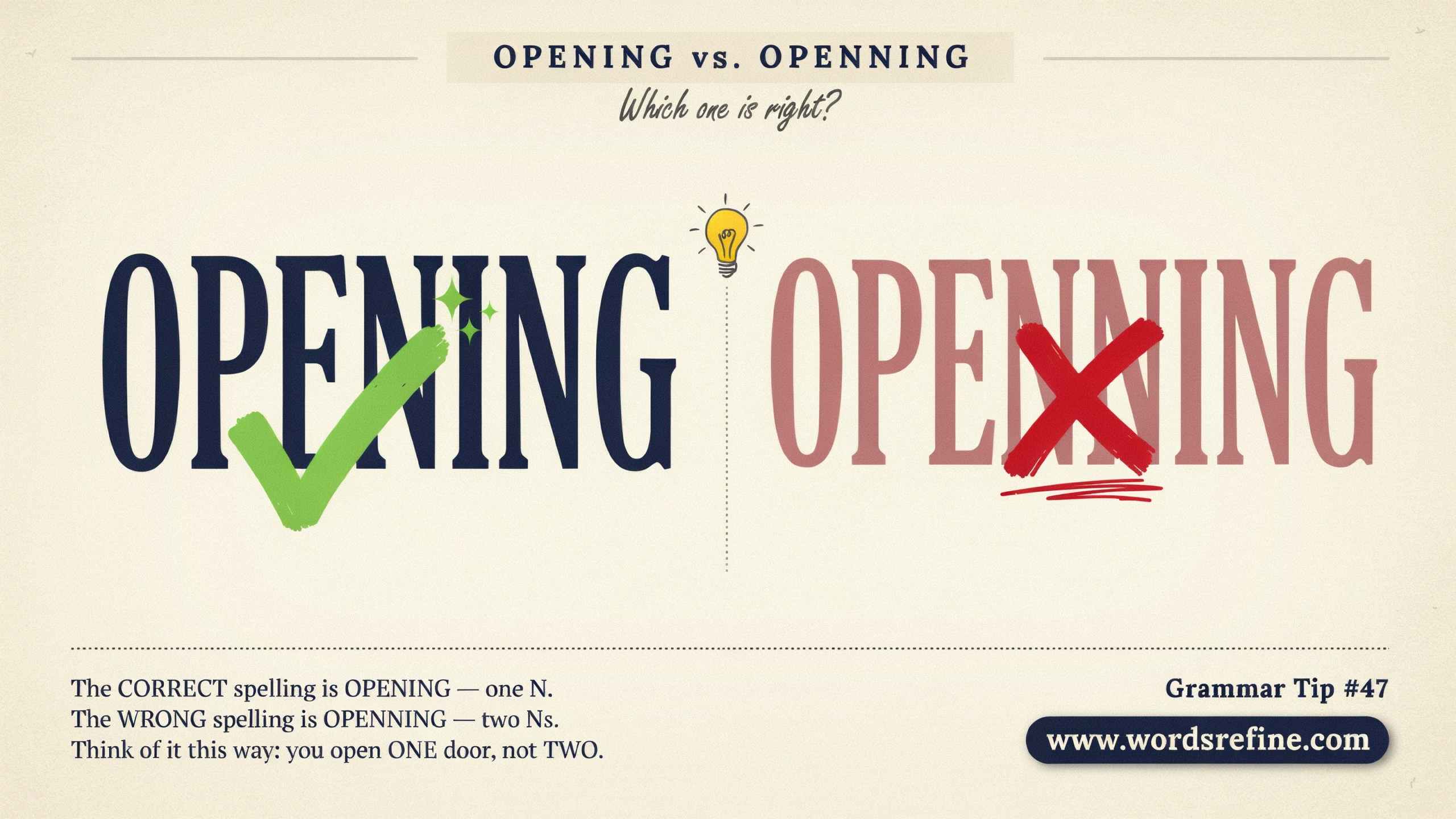
opening vs openning has no recognized separate definition in standard modern English dictionaries. It is generally treated as a misspelling of opening.
You might occasionally see it in informal messages, online comments, or poorly edited content. That doesn’t make it an accepted spelling.
For professional emails, school assignments, articles, and business documents, always use opening. Spell-checking tools can catch many mistakes, but understanding the correct spelling helps you avoid relying on software for every sentence.
Why Is Opening Spelled With One N?
The spelling of opening vs openning follows a common English pattern. When you add -ing to a verb, you don’t automatically double its final consonant.
Some verbs require doubling, while others keep their original spelling. The difference often depends on the number of syllables, the final letters, and the position of the stressed syllable.
The verb open ends with an n, but its final syllable isn’t stressed. Therefore, you add -ing without doubling the n.
The result is opening, not openning.
Understanding the English Consonant Doubling Rule
English sometimes doubles the final consonant of a verb before adding a suffix such as -ing or -ed. This usually happens when a short verb ends in a consonant-vowel-consonant pattern.
For example:
Run becomes running.
Sit becomes sitting.
Stop becomes stopping.
Plan becomes planning.
The final consonant doubles because these verbs follow the common short-vowel spelling pattern.
However, longer verbs require closer attention to syllable stress. When a multisyllabic verb ends in a consonant-vowel-consonant pattern and its final syllable carries the stress, the final consonant is often doubled before adding a suffix.
For example:
Begin becomes beginning.
Admit becomes admitting.
Prefer becomes preferring.
Open doesn’t follow this pattern because its stress falls on the first syllable rather than the last.
The Role of Syllable Stress in English Spelling
Syllable stress plays an important role in many English spelling rules. When you pronounce a word, one syllable often receives more emphasis than the others.
In open, the first syllable carries the stress: O-pen. The final syllable is unstressed.
Because the stress doesn’t fall on the final syllable, the final n doesn’t double when you add -ing.
Compare open with begin:
Open becomes opening.
Begin becomes beginning.
The difference becomes clearer when you say both words aloud. In open, the emphasis falls on the first syllable. In begin, the emphasis falls on the second syllable.
This is why beginning has two n’s while opening has only one.
Why the Final N Is Not Doubled in Opening
The verb open has two syllables, and its stress falls on the first one. When you add the suffix -ing, you keep the original spelling and simply attach the suffix.
The spelling process looks like this:
Open + ing = Opening
There is no need to remove or double the final consonant.
The same pattern appears in several other English verbs:
Listen becomes listening.
Happen becomes happening.
Visit becomes visiting.
Offer becomes offering.
These examples show that adding -ing doesn’t always require a doubled consonant. The spelling depends on the structure and stress of the original verb.
Other Examples of the Consonant-Doubling Rule
Comparing different verbs makes the rule easier to remember.
Some verbs double their final consonant before adding -ing:
Run becomes running.
Swim becomes swimming.
Sit becomes sitting.
Begin becomes beginning.
Other verbs keep their final consonant:
Open becomes opening.
Listen becomes listening.
Visit becomes visiting.
Happen becomes happening.
The important point is that you shouldn’t double a consonant simply because a verb ends with one. You need to consider the word’s spelling pattern and stress.
That’s why opening is correct. The word follows the spelling pattern of open, not the pattern of run or begin.
Learn the difference between confusing word pairs
Loosing vs Losing Which Is Correct? Meaning, Spelling, and Usage
What Is the Key Difference?
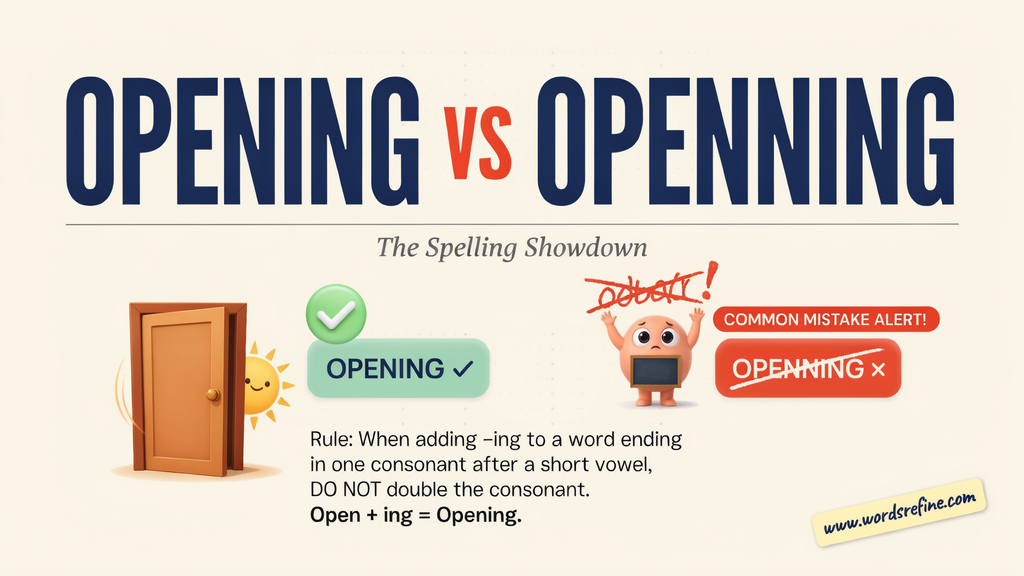
The difference between opening vs openning is straightforward: opening is correct, while openning is a spelling mistake. Although the two forms look similar, only opening follows standard English spelling rules.
Opening comes from the verb open. It can function as a noun, a present participle, or a gerund. Depending on the sentence, it may describe an action, the beginning of an event, or an available opportunity.
For example:
The company is opening a new branch downtown.
We attended the opening of the art gallery.
She is opening the package carefully.
In each sentence, opening has a different role. However, its spelling never changes. You don’t need to add another n, even when the word describes an action happening right now.
Openning, on the other hand, has no accepted meaning in standard English. It usually appears because someone mistakenly doubles the final consonant.
The easiest way to remember the difference is to start with the original verb. Open has one n, so opening keeps one n as well.
Is Opening Spelled Differently in American and British English?
No. Opening has the same spelling in American and British English. There is no regional difference between these two forms.
Whether you’re writing for readers in the United States, the United Kingdom, Canada, or Australia, the correct spelling remains opening.
For example:
American English: The store is opening a new location in Chicago.
British English: The store is opening a new location in London.
Both sentences use exactly the same spelling. Adding another n doesn’t make the word more British or give it a different regional meaning.
English does contain several spelling differences between countries. For example, American English uses color, while British English generally uses colour. Similarly, center is common in American English, while centre is standard in British English.
However, opening vs openning doesn’t belong to this group. Its spelling stays the same regardless of the English variety you’re using.
Common Uses of the Word Opening
Opening appears in everyday conversations, business communication, education, entertainment, and formal writing. Its meaning depends on the context, but it usually relates to a beginning, an action, or an opportunity.
Understanding these different uses will help you recognize the word and use it naturally.
Opening a Door or Window
One of the most familiar uses of opening describes moving a door, window, or another object to create access.
For example:
She is opening the front door for the guests.
Please stop opening the window during the meeting.
The children watched their father opening the garage door.
In these sentences, opening describes an action. It tells readers what someone is doing at that moment.
You might also use it when talking about packages, containers, or other objects.
For example:
He is opening a gift from his sister.
I’m opening the box to check its contents.
Opening a Business or Store
Businesses use opening to describe the start of their operations or the launch of a new location. It can refer to the event itself or the process of beginning business activities.
For example:
The restaurant is opening its doors next Monday.
We attended the opening of a new shopping center.
The company announced the opening of its second branch.
The phrase grand opening is especially common in business communication. It refers to a special event celebrating a new store, restaurant, office, or other establishment.
For example:
The bakery is hosting its grand opening this weekend.
A grand opening may include special offers, invitations, entertainment, and activities for customers. It’s the business equivalent of saying, “We’re here, and we’d love you to visit!”
Opening a Job Opportunity
Opening can also refer to an available position at a company or organization. In this context, it means that an employer has a vacancy and is looking for someone to fill it.
For example:
Our company has an opening for a marketing manager.
She applied for an opening at a local hospital.
The university announced several teaching openings.
The expression job opening is common in employment advertisements, recruitment emails, and career websites.
For example:
I found a job opening that matches my experience.
The company currently has three job openings in its finance department.
If you’re looking for work, you may come across this expression frequently. It simply means that a position is available.
Opening an Event or Ceremony
Opening often describes the first official part of an organized event, performance, or formal gathering.
For example:
The opening ceremony begins at 9 a.m.
The mayor delivered the opening remarks.
Everyone applauded during the opening performance.
These expressions refer to the beginning of an occasion. An opening ceremony introduces an event, while opening remarks provide the first formal comments from a speaker.
You might encounter these phrases at conferences, sporting competitions, award ceremonies, school functions, and public celebrations.
Opening a Conversation or Speech
Opening can also describe the first words or statements someone uses when starting a conversation, presentation, or speech.
For example:
His opening statement captured everyone’s attention.
She prepared a strong opening for her presentation.
The speaker began with a humorous opening remark.
A good opening helps establish the mood and encourages people to listen. It might include a question, a short story, an interesting fact, or a surprising observation.
However, a speaker doesn’t need to begin with a dramatic announcement. Sometimes a simple, clear introduction works best.
Learn the difference between often confused words
Inclusivity vs Inclusiveness Which One Is Correct?
Common Phrases That Use Opening
Opening appears in many familiar English expressions. These phrases have specific meanings, so understanding them can make your everyday and professional communication more natural.
Grand Opening
A grand opening is a special event celebrating the launch of a new business, store, restaurant, or establishment.
Example: The new clothing store is hosting its grand opening this Saturday.
Job Opening
A job opening refers to an available position that an employer wants to fill.
Example: I found a job opening that matches my qualifications.
Opening Ceremony
An opening ceremony is a formal event marking the beginning of a competition, festival, conference, or other occasion.
Example: The opening ceremony of the tournament attracted thousands of visitors.
Opening Statement
An opening statement is the first formal explanation or argument presented during a discussion, debate, or legal proceeding.
Example: The lawyer delivered a clear opening statement before presenting the evidence.
Opening Hours
Opening hours describe the times when a business or establishment is available to customers.
Example: Check the store’s opening hours before planning your visit.
Opening Night
Opening night refers to the first public performance of a play, film, or other entertainment production.
Example: The actors celebrated after a successful opening night.
Opening Act
An opening act is a performer or group that appears before the main attraction at a concert or entertainment event.
Example: A local band performed as the opening act.
Opening Balance
An opening balance is the amount of money in an account at the beginning of an accounting period.
Example: The accountant checked the opening balance before preparing the financial report.
Opening Move
An opening move is the first action in a game, negotiation, or strategic situation.
Example: Her opening move surprised everyone at the chess tournament.
Learn the difference between basic English word mistakes
Labelled vs Labeled Which one Is Correct?
Common Spelling Mistakes Related to Opening
Although opening looks simple, people sometimes confuse it with other forms of the verb open. These mistakes often happen when writers overlook the difference between present participles and past-tense forms.
Knowing how each form works can help you avoid spelling errors.
Opening vs Openning
Opening is the correct spelling, while opening vs openning is incorrect in standard English.
Incorrect: The company is openning a new office.
Correct: The company is opening a new office.
Incorrect: She is openning the package.
Correct: She is opening the package.
The mistake usually happens because writers assume that the final n must double before adding -ing. However, open doesn’t follow that pattern.
Opening vs Opened
The Opening vs opened both come from the verb open, but they serve different grammatical purposes.
Opening is the present participle or gerund. It can describe an ongoing action or name the activity itself.
Example: She is opening the window.
Opened is the simple past tense and past participle. It describes an action that has already happened or a completed state.
Example: She opened the window yesterday.
Compare these sentences:
The manager is opening the store now.
The manager opened the store early this morning.
The first sentence describes an action in progress. The second describes an action that happened in the past.
Choosing the correct form depends on what you want to say and when the action takes place.
Opened vs Openned
Opened is the correct past-tense form of open. opening vs openning is a misspelling.
Incorrect: He openned the shop early.
Correct: He opened the shop early.
Incorrect: They openned the package yesterday.
Correct: They opened the package yesterday.
Just as opening keeps one n, opened also keeps one n. The verb doesn’t need an extra consonant when you add either suffix.
Learn the difference between commonly misused words
Flyer vs Flier Which one Is Correct?
Practical Examples of Opening in Different Contexts
Seeing a word in different situations makes its meaning easier to understand. Opening appears in casual conversations, workplace communication, academic writing, and news reports.
Opening in Everyday Conversations
People commonly use opening vs openning when talking about doors, packages, events, and opportunities.
For example:
I’m opening the package now.
Who is opening the door?
The new café is opening tomorrow.
She found an opening in her busy schedule.
These sentences show how naturally the word fits into everyday communication.
Opening in Professional Communication
In the workplace, opening often appears in emails, announcements, reports, and business discussions.
For example:
We are opening a new department next month.
The company has an opening for an experienced accountant.
Please review the opening section of the report.
The manager delivered the opening remarks at the conference.
Using the word correctly helps keep professional communication clear and polished.
Opening in Academic Writing
Students, teachers, and researchers may use opening when discussing the beginning of a paper, presentation, chapter, or discussion.
For example:
The opening paragraph introduces the main argument.
The professor began the lecture with an opening question.
The opening chapter provides background information about the subject.
In academic writing, opening often describes the introductory section that prepares readers for the main discussion.
Opening in News and Media
News reports frequently use opening to describe the launch of a business, the beginning of an event, or the first stage of an important development.
For example:
The city’s new library is opening to the public next week.
The opening ceremony attracted several international guests.
The film received positive reviews after its opening night.
Across all these situations, the spelling remains opening. Whether you’re writing a casual message, a business announcement, or an academic paper, one n is all you need.
Synonyms for Opening
The word opening has several synonyms, but the best alternative depends on the meaning you want to express. Sometimes it refers to the beginning of an event. In other situations, it describes an available opportunity, an entrance, or the act of making something accessible.
Choosing the right synonym helps you avoid repetition and makes your writing sound more natural.
Synonyms for Opening as a Beginning
When opening refers to the beginning of an event, activity, or process, you can use words such as beginning, start, introduction, launch, or commencement.
For example:
The opening of the conference attracted many visitors.
The start of the conference attracted many visitors.
She delivered the opening remarks before the presentation.
She delivered the introductory remarks before the presentation.
Although these words are similar, they don’t always fit every situation. Commencement sounds more formal, while start and beginning work well in everyday conversation.
Synonyms for Opening as an Opportunity
When opening refers to an available position or opportunity, suitable alternatives include vacancy, opportunity, position, and available post.
For example:
The company has a job opening for a designer.
The company has a vacancy for a designer.
She applied for an opening at the university.
She applied for an available position at the university.
In employment-related writing, vacancy and position are often more precise than general alternatives.
Synonyms for Opening as an Entrance or Gap
When opening describes a physical space or passage, you can use words such as entrance, doorway, gap, passage, or aperture.
For example:
There is an opening in the fence.
There is a gap in the fence.
The opening led directly into the garden.
The passage led directly into the garden.
The right choice depends on the situation. A doorway describes an entrance, while a gap usually refers to an empty space between objects.
Synonyms for Opening as an Action
When opening describes the action of making something accessible, alternatives may include uncovering, unsealing, unlocking, revealing, or unwrapping.
For example:
She is opening the package.
She is unwrapping the package.
He opened the door.
He unlocked the door.
These words aren’t always interchangeable. Unwrapping usually refers to removing packaging, while unlocking means releasing a lock. Choose the word that describes the actual action rather than replacing opening with the first synonym you find.
Learn the difference between more words people mix up
Reoccurrence vs Recurrence Which One Is Correct ?
Easy Ways to Remember the Correct Spelling
Remembering opening is easier when you focus on its original form. The verb open has one n, and adding -ing doesn’t change that consonant.
Here are a few simple ways to keep the correct spelling in mind.
Remember the Original Verb
Start with the word open. Then add -ing without changing its spelling.
Open + ing = Opening
This simple method works because the original verb doesn’t require consonant doubling.
Compare It With Similar Words
Think about other verbs that keep their final consonant when you add -ing.
Listen becomes listening.
Happen becomes happening.
Visit becomes visiting.
Open follows the same general pattern:
Open becomes opening.
Comparing familiar words can help you recognize the correct form without memorizing a complicated rule.
Say the Word Aloud
Pronouncing opening can also help you remember its spelling. Break it into syllables: o-pen-ing.
The word doesn’t need an extra n to sound correct. Saying it slowly can help you avoid adding a letter that doesn’t belong.
Check the Original Word Before Adding a Suffix
Whenever you’re unsure about a verb ending in -ing, look at its original form first. Then consider whether the consonant-doubling rule applies.
For example:
Run becomes running.
Begin becomes beginning.
Open becomes opening.
This comparison shows why you shouldn’t automatically double the final consonant. English spelling has patterns, but applying one rule to every verb can lead to mistakes.
Learn the difference between everyday English mistakes
Rosin vs Resin Which One Is Correct and What’s the Difference?
Practice Session Opening vs Openning
1. The company is ______ a new branch in the city.
2. We attended the grand ______ of the shopping center.
3. She is ______ the front door for her guests.
4. The manager announced a job ______ for an experienced accountant.
5. The ______ ceremony will begin at 10 a.m.
6. He is ______ a package he received yesterday.
7. The restaurant is ______ its doors next Monday.
8. Please check the store’s ______ hours before visiting.
9. The speaker delivered the ______ remarks at the conference.
10. They are ______ a new office downtown.
11. The movie’s ______ scene immediately caught my attention.
12. She enjoys ______ old letters and reading their stories.
13. The school announced an ______ for a new science teacher.
14. My brother is ______ the windows to let in fresh air.
15. The lawyer prepared a strong ______ statement.
16. The actors celebrated after a successful ______ night.
17. The accountant checked the ______ balance.
18. The shop is ______ earlier than usual today.
19. The band performed as the ______ act at the concert.
20. The new library is ______ to the public next week.
21. He found an ______ in the fence near the garden.
22. The company celebrated the ______ of its second location.
23. She is ______ her birthday presents.
24. The first ______ move surprised everyone in the chess match.
25. The manager is ______ a new position for qualified applicants.
Answers
- Opening
- Opening
- Opening
- Opening
- Opening
- Opening
- Opening
- Opening
- Opening
- Opening
- Opening
- Opening
- Opening
- Opening
- Opening
- Opening
- Opening
- Opening
- Opening
- Opening
- Opening
- Opening
- Opening
- Opening
- Opening
Here’s a trusted source for clear more words Comparison:
FAQs
Is “opened” grammatically correct?
Yes, opened is grammatically correct. It is the simple past tense and past participle of the verb open. Use it when describing an action that happened in the past or something that has already been made accessible.
Example: She opened the window to let in some fresh air.
What does “opened” mean?
Opened describes something that someone has made accessible by moving, removing, or unlocking a barrier. It can also refer to a business or establishment that has started operating.
Example: The museum opened its doors to visitors at 9 a.m.
What is a better word for opening?
The best alternative depends on the meaning. Beginning, start, launch, introduction, and commencement can replace opening when referring to the start of an event or activity. For a physical opening, words such as gap, entrance, and passage may be more suitable.
Example: The opening of the new store attracted a large crowd.
Alternative: The launch of the new store attracted a large crowd.
Which is correct: “opens” vs “opening”?
Both forms are correct, but they serve different grammatical purposes. Opens is the present-tense form used with singular third-person subjects, while opening is the -ing form of open.
Example: The store opens at 8 a.m.
Example: The store is opening a new branch next month.
What does “opening” mean?
Opening can refer to the beginning of an event, an available opportunity, a physical gap, or the action of making something accessible. Its meaning depends on how it appears in a sentence.
Example: The company announced a job opening for a graphic designer.
How do you spell “opening”?
The correct spelling is opening, with one n. Openning is incorrect in standard English. Simply add -ing to the verb open without doubling its final consonant.
Example: She is opening the package carefully.
Which is correct “the door is open” or “the door is opened”?
Both expressions are grammatically correct, but they emphasize different things. The door is open describes its current condition, while the door is opened usually emphasizes the action of someone opening it.
Example: The door is open, so you can come inside.
Example: The door is opened automatically when someone approaches.
What is the -ing form of “open”?
The -ing form of open is opening. Add -ing directly to the original verb without doubling the final n.
Example: He is opening the store early today.
Which is correct: “just opened” vs “open”?
Both expressions are correct, but their meanings differ opening vs openning. Just opened describes something that became accessible or started operating recently. Open describes its current condition or availability.
Example: The new restaurant just opened last week.
Example: The restaurant is open until 10 p.m.
Which is correct: “begining” or “beginning”?
Beginning is the correct spelling. The verb begin doubles its final n before adding -ing because the stress falls on its final syllable. Begining is a misspelling.
Example: The beginning of the movie was exciting.
Can you provide an example sentence using “opening”?
Certainly. Here’s a simple example:
The company is opening a new office downtown next month.
In this sentence, opening describes a planned action. It is the present participle of open and appears with the helping verb is.
Learn the difference between everyday English mistakes
Waving vs Waiving Which One Is Correct ?
Conclusion
A single extra letter can turn a perfectly good word into a spelling mistake. That’s exactly what happens with opening and openning. The correct spelling is opening vs openning with just one n. Whether you’re talking about opening a shop, starting a conversation, or announcing a new opportunity, the spelling stays the same.
The trick is to remember the original verb, open. When you add ing, you don’t double the final n. It’s also worth distinguishing opening from opened because the two forms have different grammatical roles and meanings.
Now you know the difference, you can stop second guessing this word every time you use it. Give opening one n and let the extra letter stay where it belongs: out of your writing. After all, English has enough spelling surprises without adding new ones!

Diora AJS she is an experienced blogger and passionate English language enthusiast at Words Refine. With a keen eye for language and a love for clear communication, she writes practical content about grammar, word meanings, usage, and commonly confused terms. Her goal is to make English easier to understand through clear explanations and relatable examples, helping readers write accurately and communicate with confidence.