
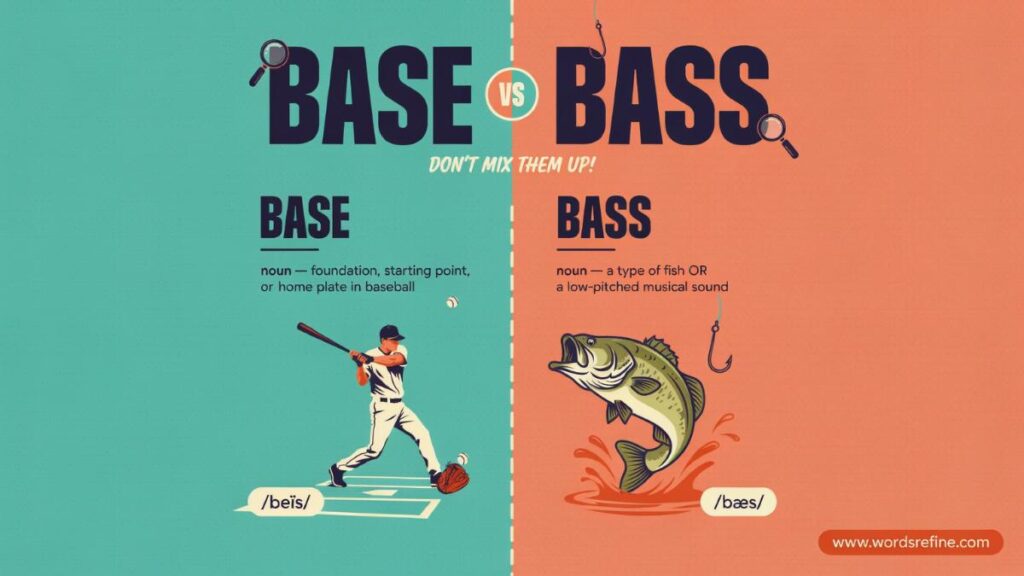
Have you ever hesitated between writing base vs bass because you are unsure which word fits your sentence? You are not alone These commonly confused words look similar but have entirely different meanings. Base refers to a foundation, starting point, or supporting structure, whereas bass describes low musical sounds, musical instruments, or a type of fish. Their pronunciation adds another twist musical bass rhymes with base, while fish bass has a short A sound. One spelling mistake can change the meaning of your sentence completely. Understanding the difference between base and bass will help you avoid common writing mistakes and express your ideas accurately. Let’s explore their meanings, pronunciations, and examples.
Quick Answer base vs bass
The main difference between base vs bass lies in their meanings and uses. Although they sound identical when referring to musical bass, they aren’t interchangeable.
Base (pronounced /beɪs/) means a foundation, bottom, starting point, or central location. It can function as a noun, verb, or adjective.
Bass (pronounced /beɪs/ in music) refers to a low-pitched musical sound, a musical instrument, or a deep singing voice.
Bass (pronounced /bæs/ when referring to fish) describes several types of freshwater and saltwater fish.
Consider these examples:
The statue rests on a solid stone base.
My brother plays the bass in a rock band.
We caught a large bass in the lake.
Notice how the spelling changes with the meaning. A statue needs a foundation, a band needs a bass player, and a fisherman hopes to catch a bass rather than a concrete support!
An easy way to remember the difference is to associate base with a bottom or beginning and bass with music or fish. This simple connection can help you choose the correct spelling.
Learn the difference between confusing more English words
Remediated vs Remedied Which One Is Correct ?
What Does Base Mean?
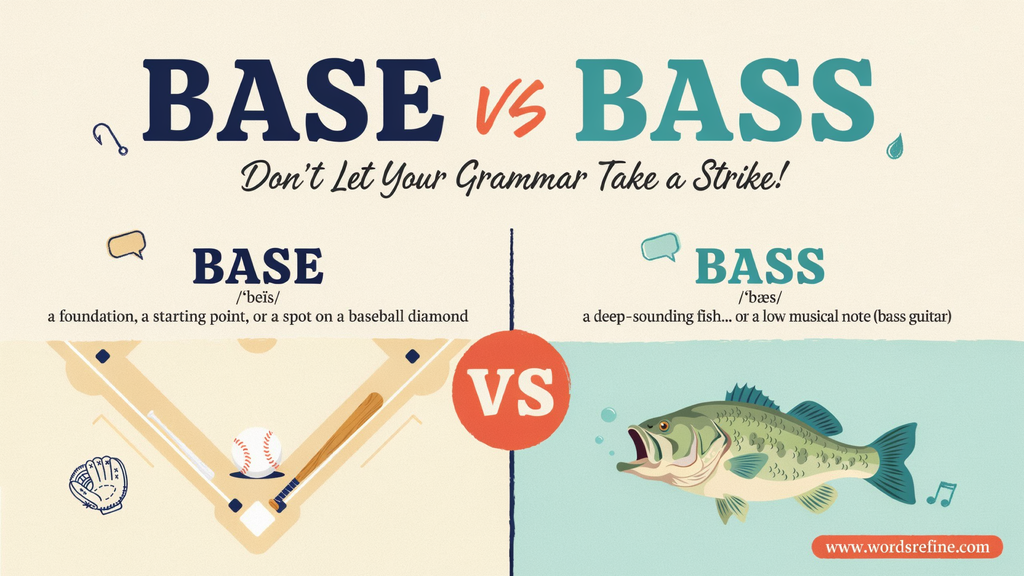
The word base describes the foundation, bottom, or starting point of something. It often refers to the part that supports an object, provides stability, or serves as the starting point for an activity, calculation, or idea.
For example, the base of a building supports its structure. Similarly, a military base provides a central location for personnel and operations. In mathematics, a base determines how a number system works.
However, base doesn’t always refer to a physical object. It can also describe an underlying principle, a central location, or the information supporting a decision.
Base as a Noun
As a noun, base has several meanings depending on the situation.
The bottom or supporting part of something
A base is often the lowest part of an object or structure. It provides support and helps keep the object stable.
The lamp has a heavy metal base.
Workers repaired the base of the damaged column.
The vase has a wide base that prevents it from falling.
A central location or headquarters
A base can also serve as a place where people organize activities, store equipment, or coordinate operations.
The soldiers returned to their military base.
The climbers established a base camp near the mountain.
The company operates from its main base in Chicago.
A military base may contain barracks, training facilities, offices, storage buildings, and other operational areas. Likewise, a base camp gives climbers and explorers a place to rest and prepare before continuing their journey.
A starting point or foundation
In business, education, mathematics, and everyday discussions, base can describe the information or principle on which something depends.
The company wants to expand its customer base.
The calculation uses a different numerical base.
Her argument has a strong factual base.
A particular point in sports
In baseball, a base is one of the four positions runners must reach to score.
The runner reached first base safely.
The player slid toward home base.
The batter hit the ball beyond second base.
Base as a Verb
As a verb, base means to establish, develop, or support something using a particular fact, principle, location, or set of conditions.
The expression “based on” is especially common in everyday English.
The movie is based on a true story.
The company based its decision on customer feedback.
The research team based its conclusions on scientific evidence.
They base their prices on production costs.
The word also appears in expressions such as “base something on facts” and “be based in a particular city.”
For example, “The organization is based in Boston” means Boston serves as its main location.
One important grammar point is that base is the present-tense verb, while based is its past-tense and past-participle form.
Base as an Adjective
Although less common than its noun and verb uses, base can also function as an adjective.
It can describe something low, inferior, dishonorable, or morally unacceptable. This use often appears in formal or literary English.
The dishonest official acted from base motives.
The novel describes the base behavior of a corrupt character.
He accused his opponent of using base tactics.
In chemistry, however, base is also used as a noun to identify a substance with particular chemical properties. That meaning has nothing to do with physical foundations.
Learn the difference between commonly mixed-up more words
Vaccum Vs Vacuum Which One Is Correct and Why It Matters ?
What Does Bass Mean?
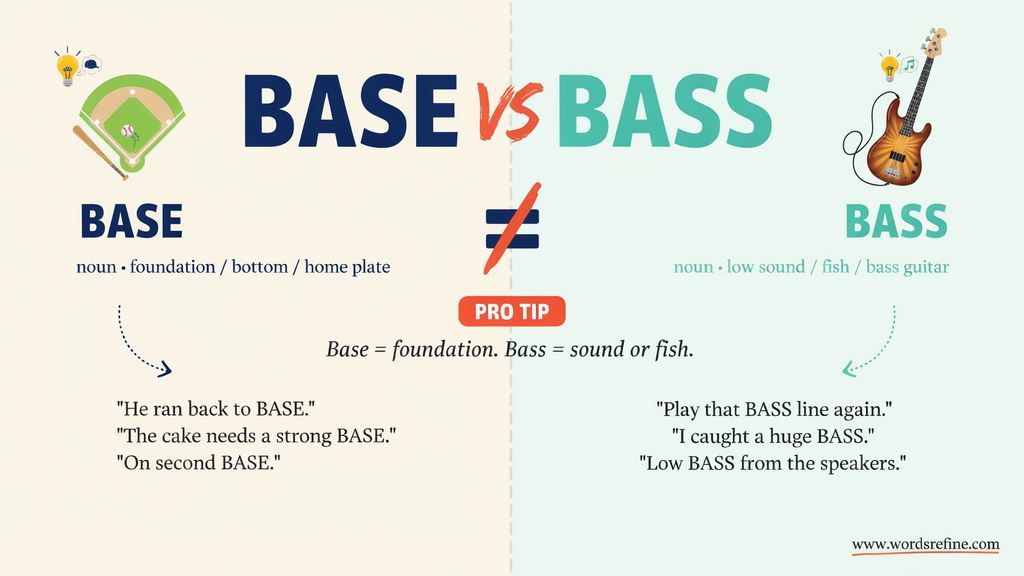
The word bass has several meanings, but they share an important connection: low pitch or particular types of fish.
In music, bass describes sounds in the lower frequency range. It also refers to instruments designed to produce those sounds and singers with especially low vocal ranges.
Outside music, bass identifies several fish species found in freshwater and saltwater environments.
Unlike base, which commonly appears in discussions about foundations and starting points, bass belongs mainly to musical, audio, vocal, and fishing vocabulary.
Bass in Music
In music, bass refers to the lower-pitched sounds that help create depth, rhythm, and harmony.
You can hear bass in almost every major musical genre, including rock, jazz, pop, hip-hop, classical music, and electronic dance music.
A bass line often works alongside drums to establish a song’s rhythmic foundation. Meanwhile, bass notes support the harmony and help connect different musical sections.
Consider a rock band with a singer, guitarist, drummer, and bass player. The guitarist may perform the main melody or chords, while the bass player provides lower notes that give the song its depth and rhythmic movement.
Common musical terms include:
1Bass line refers to a sequence of low notes that supports a musical composition.
2Bass notes are individual notes played or sung in a low register.
3Bass clef is a musical notation symbol used for lower-pitched instruments and voices.
4Bass instrument describes an instrument designed to produce low-frequency musical sounds.
5Bass player refers to a musician who plays a bass instrument.
Bass vs Treble
In music theory, bass and treble describe contrasting pitch ranges.
| Feature | Bass | Treble |
|---|---|---|
| Pitch | Low | High |
| Sound quality | Deep and full | Bright and sharp |
| Musical role | Supports harmony and rhythm | Often carries melodies |
| Common instruments | Bass guitar, double bass, bassoon | Flute, violin, piccolo |
| Audio equipment | Subwoofer | Tweeter |
A subwoofer reproduces low-frequency sounds, including deep bass notes. Tweeters handle higher frequencies. Together, these speakers help reproduce a wider range of sounds in an audio system.
Bass as a Musical Instrument
One of the most familiar uses of bass appears in the phrase bass guitar.
A bass guitar is a stringed musical instrument that produces low-pitched notes. It commonly has four strings, although five-string and six-string models are also available.
Several instruments fall into the bass family.
An electric bass uses magnetic pickups to convert string vibrations into electrical signals. Musicians usually connect it to an amplifier to produce a strong, controlled sound.
An acoustic bass uses a hollow body to amplify string vibrations naturally. It can produce a warm, rounded sound without relying entirely on electronic amplification.
A double bass, also called the upright bass, is a large string instrument that appears in orchestras, jazz ensembles, and other musical groups. Players usually stand or sit on a tall stool while playing it.
The bass guitar differs from a standard guitar in several ways. A typical bass guitar has four strings, while a standard guitar usually has six. Bass guitars generally produce lower notes. Bass players often support the rhythm and harmony, while standard guitars frequently handle chords, melodies, and solos.
So, if you’re wondering whether to write base or bass guitar, the correct spelling is always bass guitar.
Bass in Singing and Voice Types
In classical singing, bass describes the lowest standard male voice type. A bass singer can produce deep notes that add weight and richness to a musical performance.
The traditional male classical voice categories include tenor, baritone, and bass.
A tenor has a higher male vocal range. A baritone occupies a middle range, while a bass generally has the lowest range.
For general reference, the commonly cited bass vocal range is approximately E2 to E4, although individual singers may extend beyond these notes. Voice classification depends on more than the highest and lowest notes a singer can produce. Vocal weight, tone, comfort, and tessitura also matter.
A bass singer might perform a deep supporting part in a choir or take a prominent role in an opera.
Therefore, the correct expression is bass voice, not base voice.
Bass as a Type of Fish
Interestingly, bass isn’t exclusively a musical term. It also refers to several types of fish found in lakes, rivers, estuaries, and coastal waters.
ies include largemouth bass, smallmouth bass, striped bass, and sea bass.
Largemouth bass is a popular freshwater sport fish recognized by its large mouth and greenish body.
Smallmouth bass has a smaller mouth and a bronze or brownish appearance. It commonly inhabits rocky environments and clearer waters.
Striped bass is known for the dark horizontal stripes running along its body. It occurs in coastal and estuarine environments and can also live in freshwater.
Sea bass is a common name used for several marine fish species, including European sea bass.
Bass fishing is especially popular in North America. Anglers often use fishing rods, artificial lures, and live bait to catch freshwater bass.
Here is the pronunciation twist: musical bass rhymes with face, but fish-related bass rhymes with pass in American English.
This distinction matters because the spelling remains unchanged even though the pronunciation and meaning differ.
Learn the difference between tricky grammar more words
Effort vs Affort Which One Is Correct and How to Use It?
Base vs Bass Pronunciation Differences
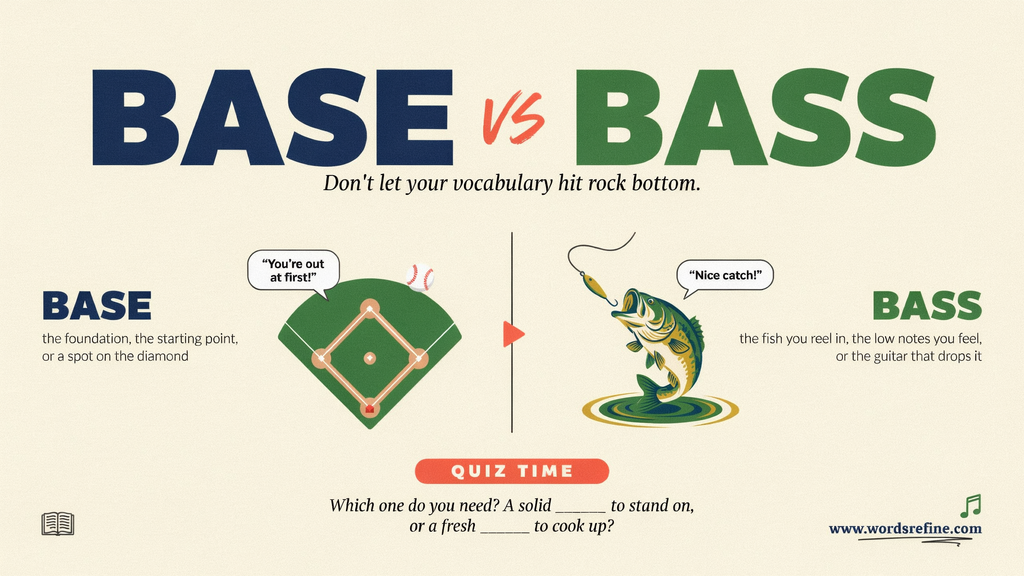
The base vs bass Pronunciation is one of the biggest reasons people confuse these words. The interesting part is that base and musical bass can sound exactly alike, but bass has another established pronunciation when it refers to a fish.
Understanding these differences makes it easier to recognize the intended meaning, especially in conversations where you cannot see the spelling.
How to Pronounce Base
The word base is pronounced /beɪs/ in both American and British English.
It contains one syllable and has a long A sound, similar to the words face, place, and case.
The building has a strong base.
Our company has a large customer base.
The team returned to its home base.
The pronunciation stays the same whether base functions as a noun or a verb.
How to Pronounce Bass
The word bass has two standard pronunciations depending on its meaning.
Musical bass is pronounced /beɪs/. When discussing music, musical instruments, or singing, bass rhymes with base, face, and case.
She plays the bass in a jazz band.
The song has a deep bass line.
He is a talented bass singer.
Fish bass is pronounced /bæs/. When referring to a fish, bass has a short A sound. In American English, it rhymes with pass and gas.
We caught a bass in the river.
The fisherman released the bass back into the lake.
My father enjoys bass fishing.
| Word | Pronunciation | Rhymes with | Meaning |
|---|---|---|---|
| Base | /beɪs/ | Face | Foundation or starting point |
| Bass (music) | /beɪs/ | Face | Low musical sound or instrument |
| Bass (fish) | /bæs/ | Pass | Type of fish |
Learn the difference between often confused words
Octopus vs Octopi Which Plural Is Correct and Why?
Why Does Bass Have Two Pronunciations?
English contains many words whose spellings don’t provide a complete guide to their pronunciation. In this case, the two meanings of bass have different historical backgrounds and developed different spoken forms.
The musical word comes through Italian basso, meaning low. The fish name has a separate history and is associated with an older English word for the fish.
Consequently, you cannot determine the pronunciation of bass by spelling alone. You need context.
Base vs Bass Origin and Etymology
Although base and bass sound alike in musical contexts, their histories reveal why they have different spellings and meanings.
Understanding their origins also helps explain why English sometimes gives similar sounds completely different written forms.
Origin of Base
The word base entered English through Old French base, which came from Latin basis. The Latin term traces back to Greek basis, meaning a step, foundation, or something on which another thing stands.
Over time, English developed several related meanings.
The word came to describe the bottom or supporting part of an object, the foundation of a building, a starting point for an activity or calculation, a central location for operations, and an underlying principle or fundamental idea.
For example, the expression base of operations reflects the idea of a central location from which activities are organized.
Similarly, based on evidence connects to the idea of using a foundation to support an argument or decision.
Origin of Bass
The musical word bass comes from Italian basso, meaning low. It ultimately traces to Latin bassus, meaning low or short.
The term entered musical vocabulary to describe lower-pitched sounds and musical parts. It eventually became associated with bass instruments, bass voices, and the low-frequency foundation of musical arrangements.
The fish-related word bass, however, has a separate English history. It comes from an older English fish name traditionally associated with Old English bærs.
This distinction explains why the same spelling represents two different meanings and pronunciations.
An important point is that musical bass and fish-related bass are homographs because they share a spelling but have different meanings and pronunciations. Meanwhile, base and musical bass are homophones because they sound alike but have different spellings and meanings.
Learn the difference between basic English word mistakes
Sublet vs Sublease Which One Is Correct ?
Base vs Bass in American and British English
Does British English prefer base while American English uses bass? Not at all.
Both varieties use the same spelling distinction. The correct word depends on meaning rather than geography.
For example, an American musician writes bass guitar, and a British musician does the same. Likewise, both use base camp when describing a central location for an expedition.
| Context | American English | British English |
|---|---|---|
| Foundation | Base | Base |
| Military location | Military base | Military base |
| Central location | Home base | Home base |
| Musical instrument | Bass guitar | Bass guitar |
| Percussion instrument | Bass drum | Bass drum |
| Low singing voice | Bass voice | Bass voice |
| Fish | Bass | Bass |
The pronunciations of musical bass and base are also the same in standard American and British English.
However, regional accents can affect individual vowel sounds. Fish-related bass may also have slight regional pronunciation differences, but the distinction between the musical and fish meanings remains.
Remember that base and bass are not American and British spelling alternatives. They are separate words with different meanings.
Learn the difference between confusing word pairs
Drily vs Dryly Which One Is Correct?
Base vs Bass in Different Contexts
Sometimes the easiest way to understand confusing words is to see how people actually use them.
Although base and bass may sound identical, their surrounding words usually make their meanings clear.
Base in Sports and Military Contexts
The word base appears frequently in sports, military discussions, and outdoor activities.
In baseball, players run between four bases: first base, second base, third base, and home plate. These positions form an essential part of the game’s structure.
In military contexts, a base is a facility used to house personnel, maintain equipment, conduct training, and coordinate operations.
The runner reached second base before the fielder caught the ball.
The soldiers returned to their military base.
The hikers established a base camp near the mountain.
Our team uses the training center as its main base of operations.
Notice that none of these examples involves musical sounds. Therefore, base is the correct spelling.
Bass in Music and Entertainment
In music and entertainment, bass appears in conversations about instruments, recording, audio quality, and musical performances.
For example, someone might ask a sound engineer to increase the bass because the song sounds too thin. Another person might compliment a musician’s bass playing.
The bass guitar gives the song a fuller sound.
Turn down the bass if the speakers produce too much vibration.
The drummer played the bass drum throughout the performance.
Our band needs an experienced bass player.
The bass drum deserves special attention because people sometimes write base drum by mistake.
A bass drum is a large percussion instrument that produces a deep, low-frequency sound. It plays an important role in orchestras, marching bands, rock groups, and drum kits.
Therefore, when choosing between base or bass drum, bass drum is correct.
Base in Science and Mathematics
The word base has important technical meanings in chemistry and mathematics.
In chemistry, a base is a substance that can accept hydrogen ions, also called protons, or donate an electron pair, depending on the acid-base theory being used.
For example, the Brønsted–Lowry definition describes a base as a proton acceptor.
Common examples include sodium hydroxide (NaOH), potassium hydroxide (KOH), ammonia (NH₃), and calcium hydroxide [Ca(OH)₂].
Bases often react with acids in neutralization reactions. For example, hydrochloric acid reacts with sodium hydroxide to produce sodium chloride and water.
\[ \mathrm{HCl + NaOH \rightarrow NaCl + H_2O} \]
In mathematics, base has another important meaning.
A number system uses a base to determine how many unique digits it employs before moving to the next place value.
| Number system | Base | Digits used |
|---|---|---|
| Binary | 2 | 0 and 1 |
| Octal | 8 | 0–7 |
| Decimal | 10 | 0–9 |
| Hexadecimal | 16 | 0–9 and A–F |
The decimal system uses base 10, which is the standard number system in everyday arithmetic. Computers commonly use binary, which has a base of 2.
In both subjects, base is the correct word. Bass has no place in these mathematical or chemical definitions.
Bass in Fishing and Wildlife
When someone discusses bass fishing, they’re referring to catching fish rather than playing musical instruments.
Freshwater bass species inhabit lakes, rivers, and reservoirs. Their habitats, feeding patterns, and physical characteristics vary by species.
For example, largemouth bass often prefer areas with aquatic vegetation, submerged structures, and other places where they can ambush prey.
Smallmouth bass commonly inhabit clearer waters and rocky environments, although their preferred habitats vary.
Striped bass are different from these freshwater species. They can live in coastal waters and migrate between freshwater and saltwater environments. Some populations are landlocked in freshwater reservoirs.
The fisherman caught a largemouth bass.
Smallmouth bass often inhabit rocky areas.
Striped bass can migrate between coastal and freshwater environments.
My uncle enjoys bass fishing during the summer.
Here, bass always refers to fish. Its pronunciation uses the short A sound.
Base in Business and Technology
In business and technology, base frequently describes the foundation of an operation, a group of customers, or a system that stores information.
Customer base refers to the group of people who purchase or regularly use a company’s products or services.
User base describes the people who use a particular application, website, or digital platform.
Database refers to an organized collection of information that can be stored, accessed, and managed electronically.
Base price means the initial price of a product or service before additional charges or options.
Knowledge base describes a collection of organized information designed to help people find answers or solve problems.
The software company expanded its international customer base.
Our website has a growing user base.
The employee searched the company’s database.
The advertised base price doesn’t include installation.
These expressions describe foundations, starting points, or underlying structures. Therefore, base is the appropriate spelling.
Learn the difference between commonly misused words
Weighed vs Weighted Which One Is Correct ?
Base vs Bass Comparison Table
Now that both words have been explored in detail, let’s put their differences base vs bass together.
| Feature | Base | Bass |
|---|---|---|
| Main meaning | Foundation, bottom, or starting point | Low musical sound, instrument, voice, or fish |
| Pronunciation | /beɪs/ | /beɪs/ in music; /bæs/ for fish |
| Parts of speech | Noun, verb, adjective | Noun, adjective |
| Music | Not the correct spelling for musical bass | Bass guitar, bass drum, bass line |
| Science | Chemical base and mathematical base | No equivalent meaning in these contexts |
| Sports | Baseball base, home base | Bass fishing |
| Business | Customer base, database | Not normally used in these expressions |
| Fishing | Not used for the fish | Largemouth bass, sea bass |
| Example | The lamp has a strong base. | He plays bass in a band. |
The simplest way to remember the difference is to connect each spelling with its main meaning.
Base means foundation, bottom, support, or starting point.
Bass means deep musical sound, low voice, musical instrument, or fish.
Learn the difference between everyday English mistakes
Annual vs Anual Which one Is Correct?
Common Mistakes with Base vs Bass
Even experienced English speakers sometimes confuse these words, especially when writing about music.
Because base vs bass and musical bass sound alike, people may choose the wrong spelling without noticing the mistake.
Here are some common errors and their corrections.
| Incorrect sentence | Correct sentence |
|---|---|
| He plays the base guitar. | He plays the bass guitar. |
| The drummer bought a new base drum. | The drummer bought a new bass drum. |
| She has a beautiful base voice. | She has a beautiful bass voice. |
| The company expanded its bass. | The company expanded its base. |
| The statue needs a stronger bass. | The statue needs a stronger base. |
| We caught a large base. | We caught a large bass. |
| The soldiers returned to their bass. | The soldiers returned to their base. |
Writing Base Guitar Instead of Bass Guitar
This is one of the most recognizable spelling mistakes.
A bass guitar produces low musical notes and helps support the rhythm and harmony of a song. A base guitar isn’t the standard name of a musical instrument.
Correct: My cousin bought an electric bass guitar.
Confusing Bass Drum with Base Drum
A bass drum is a percussion instrument that produces deep, powerful sounds. It appears in drum kits, orchestras, and marching bands.
Correct: The bass drum provides the strong rhythmic beat.
Using Base for a Low Singing Voice
A bass voice is a low vocal classification. It describes a singer’s vocal range and characteristics.
Correct: The opera featured a talented bass singer.
Using Bass When Referring to a Foundation
If you’re describing the bottom of a structure, the starting point of a project, or the foundation of an argument, use base.
Correct: The architect designed a stronger base for the building.
Confusing the Two Pronunciations of Bass
Not every use of bass sounds the same.
A musician’s bass rhymes with face, while a fish called a bass rhymes with pass in American English.
The spelling stays the same. The meaning and pronunciation change.
Base vs Bass Examples in Sentences
Sentence examples make confusing words much easier to understand. Instead of memorizing definitions alone, pay attention to how each word works in context.
Examples of Base in Sentences
The base of the monument was made from solid granite.
The soldiers returned to their military base after completing the mission.
The company wants to increase its international customer base.
The research team based its conclusions on reliable scientific evidence.
The hikers established a base camp near the mountain.
The lamp has a wide base that prevents it from tipping over.
The building requires a stronger base to support its weight.
The company’s database contains thousands of customer records.
The runner reached home base just before the opposing player caught the ball.
The argument has no factual base.
Examples of Bass in Sentences
My brother plays the bass guitar in a local band.
The song has a powerful bass line.
The drummer added a strong beat using the bass drum.
He has a naturally deep bass voice.
The orchestra included a double bass player.
The speakers produce a rich bass sound.
We caught a large bass while fishing at the lake.
The fisherman released the largemouth bass into the water.
She adjusted the audio settings to increase the bass.
The choir needed another bass singer for its performance.
These examples show that the correct spelling depends on what you’re describing. A building needs a base, while a musical instrument needs bass.
Learn the difference between more words people mix up
Instinctually vs Instinctively Which One Is Correct ?
How to Remember the Difference Between Base vs Bass
Remembering the difference doesn’t require memorizing complicated grammar rules. A simple connection between spelling and meaning can help you choose the right word whenever you write.
Think of base as bottom or beginning. It refers to the foundation or starting point of something.
For example, consider the base of a building, the base of a lamp, home base, a military base, or the base of an argument.
On the other hand, connect bass with beats, bands, and fish.
For example, remember bass guitar, bass drum, bass player, bass voice, and bass fishing.
The pronunciation can also help. Musical bass sounds exactly like base, while fish-related bass has a short A sound.
Whenever you’re unsure, ask yourself what you’re describing.
Am I talking about a foundation or starting point? Use base.
Am I discussing music, low sounds, or fish? Use bass.
For example, the speaker’s bass sounds powerful, but the speaker sits on a wooden base.
One small spelling change creates two completely different meanings.
Learn the difference between confusing word pairs
Ingenuine vs Ungenuine Which One Is Correct ?
Practice Session Base vs Bass
1. The soldiers returned to their military ______ after completing the mission.
2. My brother plays the ______ guitar in a rock band.
3. The fisherman caught a large ______ in the lake.
4. A strong foundation provides a stable ______ for a building.
5. The sound engineer adjusted the ______ to give the music a deeper sound.
6. The company hopes to expand its customer ______ this year.
7. The musician bought a new ______ drum for his performance.
8. The restaurant serves freshly grilled sea ______.
9. The research team established a temporary ______ near the mountain.
10. The singer has a deep ______ voice that stands out in the choir.
11. The scientist tested the chemical ______ before mixing the substances.
12. The band is looking for a talented ______ player.
13. The song features a catchy ______ line that drives its rhythm.
14. The hikers returned to their ______ camp before sunset.
15. He caught a smallmouth ______ while fishing with his friends.
16. The DJ increased the ______ to give the track more depth.
17. The football team uses the stadium as its home ______.
18. She practices the double ______ every evening.
19. The producer added more ______ to make the song sound fuller.
20. The soldiers received new instructions at the army ______.
21. Musicians use the ______ clef to read lower-pitched notes.
22. The chemist used a strong ______ to neutralize the acid.
23. My favorite part of the song is its powerful ______ riff.
24. The business has built a loyal customer ______ over the years.
25. The orchestra’s ______ player performed a beautiful solo.
Answers
- Base
- Bass
- Bass
- Base
- Bass
- Base
- Bass
- Bass
- Base
- Bass
- Base
- Bass
- Bass
- Base
- Bass
- Bass
- Base
- Bass
- Bass
- Base
- Bass
- Base
- Bass
- Base
- Bass
Here’s a trusted source for clear more words Comparison:
FAQs
What’s the hardest song to play on bass?
“YYZ” by Rush, “The Dance of Eternity” by Dream Theater, and “Teen Town” by Weather Report are among the most challenging songs for bass players. Their complex rhythms, fast passages, and demanding techniques require excellent timing and coordination. However, the difficulty depends on your experience and playing style.
Which rock song has the most bass?
“Another One Bites the Dust” by Queen is one of the most recognizable bass-heavy rock songs. Its catchy bass line drives the entire track. “Money” by Pink Floyd and “Come Together” by The Beatles also feature memorable bass parts that give their songs a distinctive sound.
What genre uses bass the most?
Funk, reggae, hip-hop, R&B, jazz, and electronic dance music often place bass at the center of their sound. These genres use deep bass lines and powerful low frequencies to establish rhythm, create grooves, and give music its characteristic depth. However, bass plays an important role in almost every modern music genre.
What is a slang word for bass?
Musicians and music fans often use terms such as “low end,” “the lows,” and “sub” when talking about bass sounds. In electronic music, “808” commonly refers to a deep bass sound associated with the iconic Roland TR-808 drum machine.
What are the three types of bass?
Three common types of bass instruments are the electric bass, acoustic bass guitar, and upright bass. An electric bass uses pickups to produce an amplified sound, while an acoustic bass guitar has a hollow body that produces sound naturally. An upright bass is a large, vertical string instrument commonly used in jazz, classical music, and other styles.
What is a bass instrument called?
The most familiar bass instrument is the bass guitar. Other examples include the double bass, upright bass, bass synthesizer, and bass drum. Although these instruments produce different sounds, they contribute low-frequency tones that support a song’s rhythm and harmony.
Why do bassists make that face?
The famous bass face usually comes from intense concentration, musical excitement, or simply feeling the groove. Bassists often focus on timing, finger placement, and rhythm while playing. Sometimes, a particularly satisfying bass line brings out an expression they can’t quite control. It’s part of the fun of playing music.
What is the hardest guitar to learn to play?
There isn’t one universally accepted answer because different guitars require different skills. However, classical guitar can be challenging because of its fingerstyle technique, while double-neck and extended-range guitars require additional coordination and familiarity. The difficulty also depends on the music you want to play and how much practice you put in.
Can bass be self taught?
Yes, you can learn to play bass guitar without a formal teacher. Start by learning how to tune your instrument, position your fingers, play basic notes, and maintain a steady rhythm. Then practice simple bass lines before moving on to more complicated songs. Online lessons, a metronome, and consistent practice can help you develop your skills.
What’s better, treble or bass?
Neither is better because bass and treble serve different purposes. Bass adds depth, warmth, and fullness, while treble brings brightness, clarity, and detail. A balanced combination usually produces the most enjoyable sound. Too much bass can make music muddy, whereas excessive treble can make it sound sharp or harsh.
What is the bass sound called?
The low-frequency sound produced by a bass instrument is called bass or low-end sound. Extremely low frequencies are often called sub-bass. These sounds add depth and weight to music while helping establish its rhythmic foundation.
Why is it pronounced base and not bass?
Musical bass is pronounced like “base” because the word comes through Italian basso, meaning “low.” English adopted this pronunciation for the low musical range, including bass guitars, bass drums, and bass voices. However, bass referring to the fish has a different pronunciation.
Is it bass or base guitar?
Bass guitar is the correct spelling when referring to the musical instrument. The word bass describes its low-pitched sound and musical role. Base refers to a foundation, starting point, or bottom layer, so writing “base guitar” is incorrect.
Why does bass have two pronunciations?
Bass has two pronunciations because the word has different meanings and historical origins. Musical bass is pronounced like “base,” while bass referring to a type of fish has the short A sound heard in “cat.” Although both words share the same spelling, their meanings and pronunciations are different.
What is the correct pronunciation of base?
Base is pronounced like “case,” “face,” and “place,” with a long A sound. It has one standard pronunciation in ordinary English. Don’t confuse it with bass, which has two pronunciations depending on whether you’re discussing music or fish.
Learn the difference between basic English word mistakes
Cadaver vs Corpse Which One Is Correct ?
Conclusion
Base vs bass may look like twins on the page, but they certainly do not share the same job! Base refers to a foundation, starting point, or supporting structure, while bass can describe a low musical sound, an instrument, or even a fish. Here’s where things get interesting: musical bass rhymes with base, but fish bass sounds completely different. One small spelling mix up can leave readers wondering whether you’re discussing a guitar or planning a fishing trip! The key is to understand the context before choosing your word. Remember the difference, practice with real examples, and you’ll build a strong base for using bass and base correctly. After all, good grammar should always hit the right note!

Diora AJS she is an experienced blogger and passionate English language enthusiast at Words Refine. With a keen eye for language and a love for clear communication, she writes practical content about grammar, word meanings, usage, and commonly confused terms. Her goal is to make English easier to understand through clear explanations and relatable examples, helping readers write accurately and communicate with confidence.