
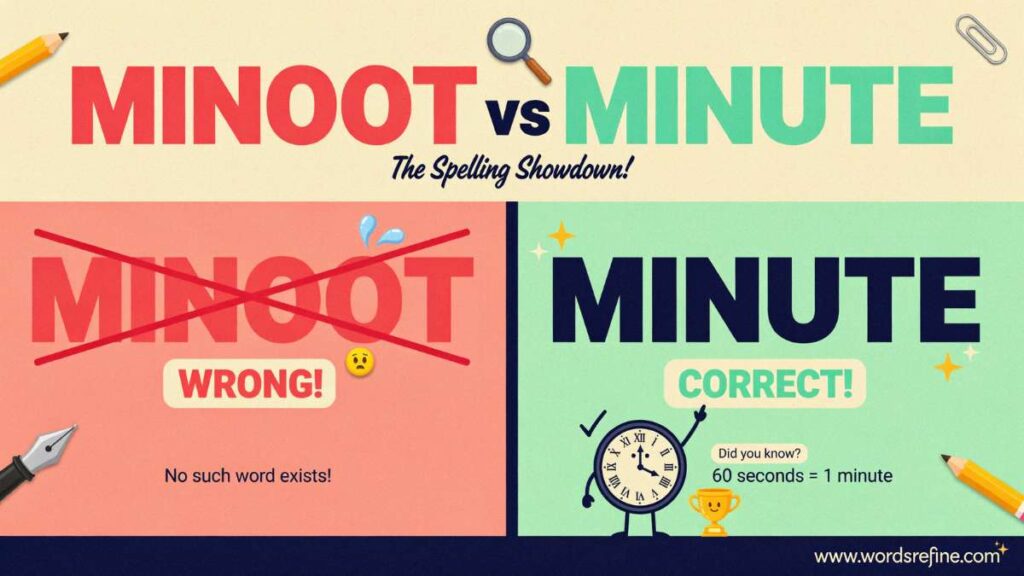
English spelling can be tricky, especially when one word has two pronunciations and completely different meanings. The confusion surrounding minoot vs minute is a perfect example. One pronunciation refers to a period of 60 seconds, while the other describes something extremely small slight or detailed. So, is minoot an alternative spelling, or is minute the only correct choice? Although minoot may seem logical when you write the word as it sounds, it isn’t accepted in standard English. Understanding the difference will help you avoid this common spelling mistake and use minute confidently in everyday writing.
Quick Answer minoot vs minute
minoot vs minute is the correct spelling. Minoot is not a standard English word when used to represent either the time-related noun or the adjective meaning extremely small.
The confusion comes from the adjective’s pronunciation. When minute describes something tiny, speakers pronounce it as my NOOT. Someone who hears this pronunciation without seeing the written word might naturally spell it as minoot.
However, English spelling doesn’t always follow pronunciation. The correct spelling remains minute in both cases.
Consider these examples:
The meeting will begin in one minute.
I’ll be there in one minute.
The scientist discovered a minute particle.
There was a minute difference between the two measurements.
The important distinction is that minute has two pronunciations but retains one standard spelling.
Learn the difference between confusing more English words
Sited vs Cited Meaning Differences Examples and Correct Usage
Minoot vs Minute Comparison Table
The following table explains the difference between minoot vs minute the two forms and shows why minute is the appropriate choice.
| Feature | Minute | Minoot |
|---|---|---|
| Spelling | Correct | Incorrect in standard English |
| Word status | Standard English word | Nonstandard phonetic spelling |
| Part of speech | Noun and adjective | Not a standard form |
| Time-related meaning | 60 seconds | No standard meaning |
| Smallness-related meaning | Extremely small | No standard meaning |
| Pronunciation | MIN-it or my-NOOT | Intended as a phonetic approximation |
| Formal writing | Acceptable | Incorrect as a substitute for minute |
| Dictionary recognition | Established word | Not an accepted spelling for these meanings |
The distinction is simple: use minute regardless of whether you’re discussing time or something extremely small.
What Does Minute Mean?
The word minoot vs minute has several related uses in English. Most importantly, it functions as a noun and an adjective.
As a noun, it commonly describes a unit of time consisting of 60 seconds. It can also refer to an official written record of a meeting.
As an adjective, it describes something extremely small, slight, or detailed. This meaning appears frequently in scientific writing, technical descriptions, and everyday conversations.
Although these meanings share the same spelling, their pronunciation and grammatical functions differ.
Minute as a Noun Meaning 60 Seconds
The most familiar meaning of minute refers to a unit of time equal to 60 seconds or one-sixtieth of an hour.
People use it to describe how long an activity takes, how much time remains, or how long someone needs to wait.
For example:
The presentation will begin in five minutes.
Give me a minute to finish this email.
The elevator took less than a minute to reach the top floor.
She arrived two minutes before the appointment.
The recipe requires you to boil the vegetables for ten minutes.
In each sentence, minute measures time.
A minute can also describe a short or unspecified period rather than an exact 60-second interval.
For example, when someone says, “I’ll be back in a minute,” they might return after 30 seconds or several minutes. The expression communicates that the wait should be brief rather than providing a precise measurement.
Here are a few useful time-related facts:
One minute contains 60 seconds.
One hour contains 60 minutes.
One day contains 1,440 minutes.
One week contains 10,080 minutes.
The plural form is minutes, which follows the regular English pluralization pattern.
Learn the difference between commonly mixed-up more words
Cloth vs Clothe Differences Examples and Correct Usage ?
Minute as an Adjective Meaning Extremely Small
The Minute has a completely different minoot vs minute meaning when it functions as an adjective. It describes something exceptionally small, tiny, or difficult to notice.
For example:
The researcher discovered a minute crack in the glass.
The microscope revealed minute particles in the sample.
There was a minute difference between the two measurements.
The artist included minute details in the painting.
The doctor noticed a minute change in the patient’s condition.
Here, minute describes size, degree, or detail rather than time.
The adjective often appears in situations where precision matters. Scientists use it to describe tiny measurements and particles. Artists may use it to discuss fine details in their work. Engineers might use it when examining small variations in a machine’s performance.
Minute can describe extremely small physical objects, slight changes in measurements, subtle differences between two things, fine details in artwork, and tiny quantities of a substance.
However, minute doesn’t always mean physically microscopic. It can also describe something so slight that it has little practical importance.
For instance, a minute difference between two examination scores might be only one point. The difference is measurable, but it may not significantly affect the overall result.
Minute as a Noun Meaning an Official Meeting Record
Another important use appears in professional and organizational settings.
The plural noun minutes refers to the official written records of a meeting. These documents summarize important discussions, decisions, agreements, and assigned responsibilities.
For example:
The secretary prepared the minutes after the meeting.
Please review the meeting minutes before Friday.
The board approved the minutes from its previous session.
The manager added the budget decision to the meeting minutes.
Meeting minutes help organizations maintain accurate records of what happened during a discussion.
They generally include the meeting date, time, and location, names of attendees and absentees, main discussion points, decisions and resolutions, assigned tasks, and deadlines for follow-up actions.
One important distinction is that minutes in this context is pronounced MIN-its, just like the time-related noun. It doesn’t use the adjective’s my-NOOT pronunciation.
Learn the difference between tricky grammar more words
Teams vs Teams Meaning Differences Accounts and Features ?
Why Is Minute Pronounced Differently?
English pronunciation can be unpredictable, but the word minoot vs minute has a clear explanation for its two readings. The noun and adjective have different pronunciations because they developed through different historical paths, even though they share a Latin connection.
This makes minute an example of a heteronym: a word with the same spelling as another word but a different pronunciation and meaning.
The Two Pronunciations of Minute
The two pronunciations are easy to distinguish once you know which meaning you’re discussing.
| Meaning | Pronunciation | IPA | Part of Speech |
|---|---|---|---|
| A period of 60 seconds | MIN-it | /ˈmɪnɪt/ | Noun |
| An extremely small amount or object | my-NOOT | /maɪˈnuːt/ | Adjective |
| An official meeting record | MIN-it | /ˈmɪnɪt/ | Noun |
Notice that the stress changes depending on the meaning.
When minute refers to time, the first syllable receives the stress. When it describes something tiny, the second syllable receives the stress.
How to Pronounce Minute When It Means Time
The time-related noun has two syllables. Its first syllable sounds like the beginning of minimum, while its second syllable has a short vowel sound.
Its American English pronunciation is /ˈmɪnɪt/.
For practice, read these sentences aloud:
I’ll call you in a minute.
The train arrives in ten minutes.
We have only one minute left.
The presentation lasted 45 minutes.
The important thing is to stress the first syllable. Don’t stretch the vowel or add an extra syllable.
The same pronunciation applies when minute refers to official meeting records or the verb meaning to record what someone says during a meeting.
How to Pronounce Minute When It Means Extremely Small
The adjective has a noticeably different sound. Its American English pronunciation is /maɪˈnuːt/.
The first syllable contains the long i sound found in my. The second syllable sounds like newt, with a long oo vowel.
Try these examples:
The scientist found a minute particle.
The painting contains minute details.
We noticed a minute difference in the results.
The machine requires minute adjustments.
The key is to stress the second syllable. Give the vowel in the final syllable a longer sound than you would in the time-related noun.
This is the pronunciation responsible for the spelling confusion. Because my-NOOT sounds different from the way the word looks, people sometimes write minoot instead.
Learn the difference between confusing word pairs
Peak vs Pique Differences Examples and Correct Usage ?
Why the Same Spelling Has Two Pronunciations
The explanation goes back to the word’s history.
The adjective minute comes from the Latin word minutus, meaning small or diminished. The time-related noun also traces back to the same Latin root through medieval terminology for a small division of an hour.
Over time, English developed different pronunciations for these meanings while retaining the same spelling.
Therefore, the two pronunciations aren’t random mistakes or regional alternatives. They represent established meanings of the word.
How to Use Minute Correctly in a Sentence
Knowing the definition is helpful, but understanding how the word functions in a sentence makes the difference easier to remember.
The noun minute generally identifies a period of time or a unit of measurement. The adjective minute describes a characteristic of something, such as its size, degree, or level of detail.
Using Minute as a Noun
When minute functions as a noun, it can refer to 60 seconds, a short period, or an official record.
Consider these examples:
| Sentence | Meaning |
|---|---|
| Give me a minute. | A short period of time |
| The examination lasted 30 minutes. | A measurable period |
| She arrived five minutes early. | A specific amount of time |
| The secretary recorded the meeting minutes. | Written meeting records |
| One minute equals 60 seconds. | A unit of time |
The noun also appears in several grammatical expressions.
For example, a minute is singular, while two minutes is plural. When referring to meeting records, writers generally use the minutes because the document records multiple points discussed during a meeting.
Using Minute as an Adjective
The adjective describes something very small, slight, or exceptionally detailed.
It usually appears before a noun.
Examples include:
A minute crack appeared along the edge of the window.
The technician identified a minute error in the software.
The researcher measured a minute quantity of liquid.
The artist painted every minute detail of the landscape.
The inspection revealed minute differences between the two products.
The adjective can also describe something that receives extremely careful attention.
For example, the detective conducted a minute examination of the evidence.
Here, minute suggests a thorough and detailed examination. It doesn’t mean that the detective spent exactly 60 seconds investigating.
This distinction matters because the adjective has developed a sense of precision beyond physical size.
How Context Changes the Meaning of Minute
Sometimes, the surrounding words make the intended meaning obvious. Other times, pronunciation provides the strongest clue.
Compare these sentences:
| Sentence | Meaning |
|---|---|
| I’ll finish in a minute. | 60 seconds or a short period |
| The insect is minute. | Extremely small |
| Please read the meeting minutes. | Official written records |
| She noticed a minute variation. | A very slight difference |
| We waited for another minute. | An additional 60 seconds |
Context determines which meaning makes sense.
For example, minute examination refers to a detailed inspection, while one-minute examination describes an examination lasting 60 seconds. A hyphen helps show that the first expression describes the duration of an examination.
Minoot vs Minute Examples in Everyday Writing
Examples make spelling rules easier to remember because they show how a word works in real situations.
The following sections cover both meanings and different minoot vs minute writing contexts.
Examples of Minute Meaning 60 Seconds
Use minute when discussing time, waiting periods, appointments, or short activities.
The customer service representative asked me to hold for a minute.
Our flight was delayed by 20 minutes because of bad weather.
The microwave stopped automatically after three minutes.
She completed the final question with one minute remaining.
Give the paint another five minutes to dry.
The athlete improved her running time by 15 seconds and six minutes overall.
I’ll meet you outside the building in a few minutes.
The teacher gave students ten minutes to complete the exercise.
These examples all use the noun pronounced /ˈmɪnɪt/.
Examples of Minute Meaning Extremely Small
When describing something tiny, use the adjective minute.
The jeweler examined a minute scratch on the diamond.
Scientists discovered minute particles in the water sample.
The engineer identified a minute defect in the metal component.
The painting contains minute details that become visible under magnification.
A minute amount of dust covered the surface.
The laboratory detected minute changes in temperature.
The researcher observed minute differences between the samples.
The machine can measure minute quantities with remarkable precision.
These sentences use the adjective pronounced /maɪˈnuːt/.
Examples of Minute in Formal and Academic Writing
The adjective frequently appears in technical and academic contexts because it communicates precision.
Scientific research: The laboratory identified minute particles that were difficult to observe without specialized equipment.
Engineering: The technician detected minute variations in the machine’s operating temperature.
Medicine: The examination revealed a minute change in the tissue sample.
Art and design: The restoration team preserved the minute details of the original painting.
Business: The financial analyst identified minute discrepancies between the two reports.
It can also appear in formal records.
The committee approved the minutes of its previous meeting after reviewing the recorded decisions.
This sentence uses the noun rather than the adjective.
Learn the difference between often confused words
Labor Day vs Labour Day Meaning and Usage ?
Common Expressions That Use Minute
The word minute appears in several everyday expressions. Depending on the context, it can refer to a short period of time or something extremely small.
For example, “Wait a minute” asks someone to pause briefly. “Just a minute” communicates that something will take a little time. Meanwhile, “at the last minute” describes something that happens just before a deadline or an important event.
The adjective minute also appears in expressions that describe small details or differences. A minute change is a very slight adjustment, while a minute detail is a tiny piece of information that might escape notice.
Here are a few examples:
“Please wait a minute while I check your reservation.”
“She finished the assignment at the last minute.”
“The scientist noticed a minute difference between the two samples.”
“Even a minute adjustment can improve the machine’s performance.”
These expressions show how one spelling can communicate different ideas depending on pronunciation and context.
Common Mistakes When Using minoot vs minute
Although minute looks simple, its two pronunciations can create confusion. Writers sometimes choose the wrong meaning because they focus on how the word sounds rather than how it works in a sentence.
One common mistake is confusing the adjective minute with the time unit. When someone describes an object as minute, they mean it is extremely small, not that it lasts for 60 seconds.
For example, “The researcher discovered a minute particle” describes something tiny. It does not suggest that the particle lasts for one minute.
Another mistake involves writing minoot vs minute instead of minute. The spelling minoot may reflect how some people pronounce the adjective, but it is not the standard spelling. The correct written form remains minute.
Writers also sometimes confuse minute with minuet. Although the words look and sound somewhat similar, they have completely different meanings. A minute can describe a small object or a period of time, while a minuet is a type of dance or musical composition.
Finally, remember that minutes can refer to the written record of a meeting. For example, “The secretary prepared the meeting minutes” means that the secretary documented the discussion and decisions. It has nothing to do with measuring time in this context.
Minute vs Minuet
The Minute and minuet may look similar, but they serve different purposes.
Minute can function as a noun, adjective, or verb. 1.As a noun, it refers to a unit of time equal to 60 seconds. 2.As an adjective, it describes something extremely small or detailed. 3.As a verb, it means to record the details of a meeting or proceedings.
A minuet, on the other hand, is a traditional formal dance that became popular in Europe. The word can also refer to a piece of music composed for that dance.
For example:
“We only have one minute before the presentation begins.”
“The artist included minute details in the painting.”
“The orchestra performed a beautiful minuet.”
The context makes the distinction clear. If you’re discussing time, size, or detailed records, use minute. If you’re talking about a traditional dance or its music, use minuet.
Minute vs Minimum
The Minute and minimum are also easy to confuse, especially when discussing small amounts or quantities.
Minute, when pronounced my-noot, means extremely small. It describes something tiny, slight, or difficult to notice.
Minimum refers to the smallest amount, number, level, or requirement allowed or needed.
For example, “The machine requires a minute adjustment” means the adjustment is very small.
However, “The machine requires a minimum of five adjustments” means five is the lowest required number.
The difference is straightforward. Minute describes smallness, while minimum identifies the lowest acceptable or possible amount.
The Origin of the Word Minute
The word minute has an interesting history that helps explain why it has more than one meaning.
The adjective minute comes from the Latin word minutus, meaning “small” or “lessened.” It developed from minuere, a Latin verb meaning “to lessen” or “make smaller.” Over time, English adopted minute to describe things that were extremely small, slight, or finely detailed.
The time-related noun has a different historical development. It traces back to the Medieval Latin expression minuta, associated with a small division of time. The phrase pars minuta prima referred to the first small division of an hour. Eventually, minute became the familiar name for the 60-second unit we use today.
Although both meanings developed through related historical language, they took on different pronunciations in English. That’s why minute can sound like min-it when referring to time and my-noot when describing something extremely small.
Learn the difference between basic English word mistakes
Traveled vs Travelled Which one Is Correct in English?
How to Remember the Correct Spelling
The easiest way to remember minute is to connect its spelling with its meaning rather than relying only on pronunciation.
When you mean a period of 60 seconds, pronounce minute as min-it. Think of a clock, a timer, or a short wait.
When you mean something extremely small, pronounce minute as my-noot. Picture a tiny object, a slight difference, or a detail that requires close attention.
In both cases, the spelling stays exactly the same.
Remember that minoot is not the standard spelling, even when it seems to match the pronunciation. English spelling doesn’t always follow sound, and minute is a good example of that quirk.
Learn the difference between commonly misused words
Absence vs Absense Correct Spelling Meaning and Usage ?
Practice Session Minute vs Minoot
- Please wait one ______ while I finish this task.
- The scientist discovered a ______ particle under the microscope.
- We have only five ______ before the meeting begins.
- The artist paid attention to every ______ detail in the painting.
- She arrived at the airport at the last ______.
- Even a ______ change in temperature can affect the results.
- The secretary prepared the ______ of the meeting.
- Give me a ______ to check your application.
- The detective noticed a ______ difference between the two fingerprints.
- The soup needs to cook for another ten ______.
- The researcher examined every ______ detail of the experiment.
- He completed his assignment at the last ______.
- The machine requires a ______ adjustment to work properly.
- We spent several ______ discussing the new project.
- A ______ amount of dust covered the table.
- Please give me a ______ before you leave.
- The committee reviewed the ______ from its previous meeting.
- The doctor noticed a ______ change in the patient’s condition.
- The train will arrive in three ______.
- The designer made a ______ change to the original pattern.
- I will call you in a few ______.
- The painting contains ______ details that are easy to overlook.
- The manager asked everyone to read the meeting ______.
- She paused for a ______ before answering the question.
- The inspector carried out a ______ examination of the building.
Answers
- Minute
- Minute
- Minutes
- Minute
- Minute
- Minute
- Minutes
- Minute
- Minute
- Minutes
- Minute
- Minute
- Minute
- Minutes
- Minute
- Minute
- Minutes
- Minute
- Minutes
- Minute
- Minutes
- Minute
- Minutes
- Minute
- Minute
Here’s a trusted source for clear more words Comparison:
FAQs
How is minute used in a sentence?
Minute can refer to a period of 60 seconds or describe something extremely small. For example, “Please wait a minute” refers to time, while “The scientist discovered a minute particle” describes something tiny.
What are the two meanings of minute?
Minute has two main meanings. Pronounced min-it, it refers to 60 seconds. Its plural form, minutes, can also describe the written record of a meeting. Pronounced my-noot, it means extremely small, slight, or detailed.
Is minut a valid Scrabble word?
No. Minut is not a standard English spelling and isn’t accepted in standard Scrabble word lists. If you mean a period of time or something extremely small, the correct spelling is minute.
Why do people say “been a minute”?
“Been a minute” is an informal expression meaning that quite some time has passed since something happened. For example, “It’s been a minute since we last talked” means the speakers haven’t spoken in a while.
What’s another word for a minute?
The best alternative depends on the meaning. When minute refers to time, you can use moment, instant, or short while. When it describes something extremely small, suitable alternatives include tiny, minuscule, microscopic, and slight.
Why do people say “give me a minute”?
People use “give me a minute” when they need a little time to finish a task, think, or get ready. It doesn’t necessarily mean exactly 60 seconds. It’s simply a polite way to ask someone to wait briefly.
How do you spell minoot?
The correct spelling is minute. Minoot is an informal, pronunciation-based misspelling that sometimes appears when people try to write the adjective’s pronunciation.
How do you spell minut?
The standard English spelling is minute, with an e at the end. Minut is incorrect when referring to a 60-second period or something extremely small.
Is it minute vs minuit?
Minute is the correct English spelling. Minuit is not the standard spelling of this English word. However, minuit is a French word meaning midnight, so the two forms belong to different languages.
Does minute always refer to time?
No. Minute can also function as an adjective meaning extremely small, slight, or very detailed. For example, “The jeweler examined the minute details of the ring” describes tiny features rather than a period of time.
How can you tell which pronunciation of minute to use?
The meaning of the sentence usually tells you which pronunciation fits. Say min-it when referring to time or meeting records. Say my-noot when describing something extremely small or detailed. Although the pronunciation changes, the spelling remains the same.
Learn the difference between everyday English mistakes
Want vs Wont Meaning Differences and Usage ?
Conclusion
Who knew one little word could cause so much confusion? Minute keeps English interesting with two pronunciations and two different meanings. When pronounced min-it, it refers to 60 seconds or the written record of a meeting. When pronounced my-noot, it describes something extremely small, slight, or detailed. The spelling, however, never changes.
Although minoot vs minut might seem reasonable when written according to their sounds, neither is the correct standard spelling. The secret is to pay attention to context rather than let pronunciation trick you. Whether you’re talking about a brief wait or examining the tiniest detail, minute is the word you need.
Now that you know the difference, you can use minute with confidence. Just remember: the meaning may change, the pronunciation may change, but the spelling stays put. That’s one less English spelling mystery to worry about!

Diora AJS she is an experienced blogger and passionate English language enthusiast at Words Refine. With a keen eye for language and a love for clear communication, she writes practical content about grammar, word meanings, usage, and commonly confused terms. Her goal is to make English easier to understand through clear explanations and relatable examples, helping readers write accurately and communicate with confidence.